

Dynamic pricing tools help vacation rental owners maximize revenue in real time.
A real time pricing vacation rental website automatically updates your property’s displayed rates the moment they change in your property management system, so a guest visiting your direct booking site sees the exact same price as a guest browsing Airbnb or VRBO. Consider what that gap costs in practice: a host charging $250 per night who loses just two direct bookings per month to OTA commission pays roughly $900 in avoidable fees annually on a single property: fees that exist only because their real time pricing vacation rental website was showing a stale figure that sent the guest back to the OTA to confirm the “real” price. This sounds like a technical detail. It is actually one of the highest-leverage factors in whether a direct booking channel converts or quietly bleeds potential revenue every single day.
At Boostly Connect, we work with more than 2,000 hosts across 25 countries who have collectively generated over one billion dollars in direct bookings. The pattern we see consistently: hosts who set up a direct booking website but skip the live pricing connection are the ones who complain that their site gets traffic but never converts. The guests are arriving. But a stale rate, a broken calendar, or a price mismatch with their Airbnb listing sends those guests straight back to the OTA to complete the booking. You pay the commission anyway, and you never know it happened.
This guide covers exactly how real time pricing on a vacation rental website works, what breaks when it is not set up correctly, and how to audit your own site for the most common rate-display failures that quietly drain your direct booking revenue in 2026.
a laptop screen showing a vacation rental booking website with live availability calendar and real time pricing
What Is Real-Time Pricing for a Vacation Rental Website?
Real time pricing for a vacation rental website refers to a live data connection between your property management system and your website’s booking engine, so any rate change made in your PMS instantly appears on your public-facing site. The alternative is a static or manually updated rate display, where the price guests see was set days or weeks ago and may no longer reflect your actual availability or current market positioning.
The mechanism works through an API integration. Your PMS holds the authoritative record of your pricing rules, minimum stays, seasonal adjustments, and availability blocks. A properly connected direct booking website reads that data continuously and renders the current rate at the moment a guest loads the page. No caching lag, no stale calendar, no manual intervention required.
This matters because the short-term rental market in 2026 moves fast. Rates shift based on local events, last-minute demand, nearby property changes, and dynamic rules you have configured in your PMS. If your website cannot display those shifts in near real time, you are either showing guests a price that is too high (and losing the booking) or showing a price that is too low (and leaving money on the table or creating a frustrating rebooking situation).
For direct booking channels specifically, accurate live pricing is the foundational trust signal. Guests who find your property through a Google search or a social media post arrive on your website with one question: what does this cost? If that answer is wrong, you have already lost the booking before they have read a single line of your property description.
Why Stale Rates on Your Website Are Silently Killing Direct Bookings
Stale rates on a vacation rental website create a specific, invisible problem. The guest arrives, sees a price, and starts to feel interested. Then they open another tab and check your Airbnb listing. The prices do not match. At that moment, something shifts in their psychology: they do not know which price is correct, which site is current, or whether booking directly is safe. Most do not email to ask. They simply close your tab and book through the OTA instead.
The research intelligence on this topic from our content team is stark: none of the major competitors in the vacation rental pricing space directly describe the mechanism by which a stale rate causes abandonment. They discuss dynamic pricing tools at length. But they skip the step that explains why the price on your real time pricing vacation rental website needs to match your OTA rates within minutes, not hours, and certainly not days.
From what we observe across the direct booking websites we support, rate mismatches are most damaging in three specific situations. First, when a dynamic pricing tool has just updated your nightly rate for an upcoming high-demand weekend. Second, when you have applied a last-minute discount in your PMS that has not yet propagated to your website. Third, when you have manually blocked dates or changed minimum stay requirements and the website still shows those nights as available at the old price.
Every one of these scenarios represents a live guest session where trust breaks. And broken trust does not produce a support ticket you can see and fix. It produces a silent exit and a commission paid to Airbnb for a booking that should have been yours.
How Does Rate Parity Violation Destroy Guest Trust?
Rate parity violation happens when your direct booking website displays a price that differs from what the same guest sees on OTAs like Airbnb or VRBO. Even a small discrepancy , say your website shows $225 per night while Airbnb shows $210 after their service fee , signals to the guest that your direct channel is either outdated or untrustworthy. Neither conclusion leads to a booking.
The psychological effect is asymmetric. A guest who sees your direct site is slightly cheaper than Airbnb may book, but they will wonder why the difference exists. A guest who sees your direct site is more expensive will almost never book direct, and they will feel vaguely suspicious about why. Both outcomes are avoidable if your pricing syncs accurately and your website transparently communicates what is included in the direct rate.
Maintaining rate parity across channels, while offering a legitimate direct-only incentive such as a discount code or an added amenity, is the approach that converts best. But that strategy only works if the base rate on your real time pricing vacation rental website is accurate to begin with. A live pricing connection through your PMS is what makes parity enforcement automatic rather than a daily manual chore.
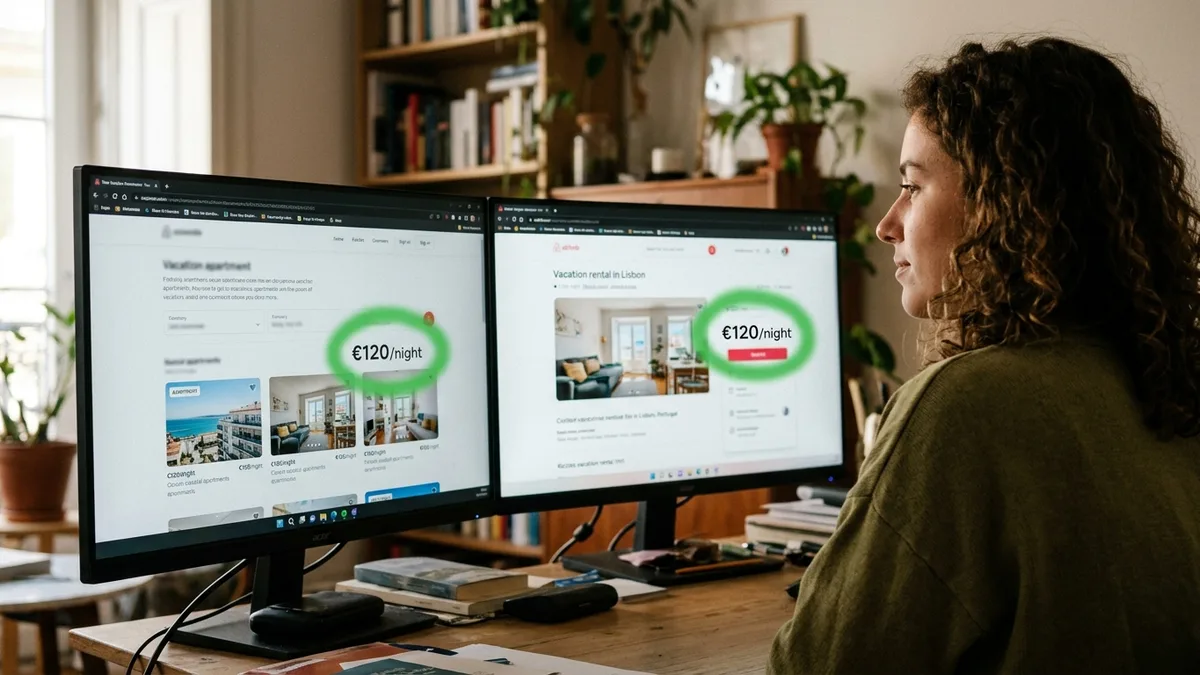
a split-screen graphic showing a vacation rental website on one side and an Airbnb listing on the other, illustrating rate parity
How Does Real-Time Pricing Actually Work Technically?
Real time pricing on a vacation rental website works through a direct API connection between your property management system and your booking engine. The PMS stores all your pricing rules: base rates, minimum stays, seasonal multipliers, dynamic pricing adjustments, and availability blocks. When a guest loads your website, the booking widget calls the PMS API and retrieves the current rate for the requested dates. The displayed price reflects that live pull, not a cached or static value.
The quality of this connection determines how “real-time” your pricing actually is. A well-built integration pulls fresh data on each page load or calendar query, so the guest always sees current availability. A poorly built connection may cache rates for hours, meaning a rate change you made in your PMS at 10am does not appear on your website until late afternoon. That gap is invisible to you but very visible to guests who cross-reference your pricing against OTAs.
PMS-to-website sync latency is a topic almost no one in the direct booking space addresses directly. Most platforms advertise “live” or “real-time” sync without clarifying what that means in practice. When evaluating any direct booking setup, the specific questions to ask are: how frequently does the booking widget refresh rate data from the PMS, what is the maximum acceptable delay between a PMS rate change and the updated display on the website, and does the platform provide a sync log or audit trail you can check?
PMS Sync vs. Manual Rate Updates: Why One Breaks at Scale
Manual rate updates require you to log into your website, navigate to the pricing section, enter the new rate, and save. Every time. Across every property. Every time your dynamic pricing tool, your market demand assessment, or a local event prompts a rate change. For one property with stable seasonal pricing, this is inconvenient. For three or more properties with actively managed dynamic pricing, it is a system that breaks constantly and exposes you to the exact rate mismatch problem described above.
PMS sync removes that manual step entirely. A rate change made in your PMS , whether triggered by you manually or by a connected dynamic pricing tool , propagates automatically to your website. You set the pricing rules once in the PMS and let the system handle distribution. That is the model that scales without adding operational load for every additional property you manage.
Boostly Connect was built specifically for this workflow. Our platform connects your existing PMS to your direct booking website using one of 8 supported integrations, including Hospitable, Guesty, Lodgify, and OwnerRez. The connection itself takes under five minutes. Once it is live, pricing and availability sync automatically without any manual intervention on your part.
What Pricing Signals Should Your Rates Respond To?
Effective real time pricing on a vacation rental website requires your PMS rates to account for several distinct demand signals. The website displays whatever your PMS holds, so the quality of your live rate depends on the quality of the pricing inputs feeding your PMS. Understanding what your rates should respond to is as important as understanding how they are delivered to the guest.
Seasonal Demand and Local Events
Seasonal demand is the most obvious pricing input. Peak periods in mountain cabin markets like the Smoky Mountains or Park City see substantially higher demand than shoulder months, and your rates should reflect that gap. According to ATLAS by AvantStay, shoulder seasons and off-peak months can drop 15 to 20 percent or more compared to peak rates. That spread represents real revenue that hosts with static pricing leave uncaptured.
Local events are a sharper, more time-bounded signal. A major music festival, a college graduation weekend, or a sold-out sporting event in your market can drive demand spikes that justify significantly higher rates for a narrow window. Dynamic pricing tools connected to your PMS can detect these signals and adjust your rates proactively, but only your real time pricing vacation rental website can display those adjustments to direct bookers if the PMS integration is live.
Hosts who manage their seasonal calendar manually in their PMS but rely on a static rate display on their website are capturing only a fraction of the available direct booking revenue. The demand signal is being detected. The pricing adjustment is being made. But it is only benefiting the OTA channels where rate sync is handled automatically.
Competitor Rate Benchmarking
Competitor rate monitoring involves tracking what comparable properties in your market are charging for the same dates and adjusting your own rates to remain competitive or to capitalize on scarcity when nearby properties are fully booked. This is a standard capability in most dynamic pricing platforms.
The insight your real time pricing vacation rental website needs to deliver is that your price is accurate and competitive at the moment a guest checks. If your PMS has just pushed a rate reduction because three comparable two-bedroom condos in your Nashville ZIP code dropped out of inventory for a convention weekend , driving your optimal rate up by $40 per night , your website should show that increase immediately, not twelve hours later when the highest-intent guests have already booked elsewhere. Speed of propagation matters most in competitive urban markets like Nashville, Austin, or Scottsdale, but the principle holds everywhere: a competitor pricing move that your PMS catches in real time only benefits your direct channel if your website reflects it just as fast.
How Do You Embed Live Rates Into a Vacation Rental Website?
Embedding live rates into a vacation rental website requires one of three approaches, each with different trade-offs in terms of technical complexity, sync reliability, and maintenance burden.
The first approach is a direct PMS API integration, where your website’s booking engine communicates directly with your PMS to retrieve rates and availability on demand. This is the most reliable method and the one we use in the Boostly Connect platform. It requires no manual export or import of pricing data, no iFrame embed with third-party caching issues, and no breakable plugin that needs updating every time your PMS releases a new version.
The second approach is an iFrame embed, where your PMS or a third-party booking widget hosts the calendar and rate display, and you embed it on your website using an iFrame tag. This works but introduces dependency on the third party’s server uptime and cache refresh cycle. If their server caches rates for four hours, guests on your website see rates that are up to four hours old. That is usually acceptable for availability, but it can cause visible pricing discrepancies on high-demand dates where rates shift rapidly.
The third approach is manual synchronization, where you export rates from your PMS and update them on your website by hand. This should not be used by any host managing more than one property or using any form of dynamic pricing. It is certain to result in stale rates within days of setup.
For hosts who are currently running a WordPress or Wix website with a booking widget that is not connected to their PMS, this is the first gap to close. Boostly Connect’s setup process connects your PMS to a conversion-ready booking engine in under 20 minutes, and the live rate sync starts immediately after that initial configuration.
Which Pricing Mistakes Do Hosts Make Most Often?
The most common pricing mistake we see hosts make is treating the direct booking website as a secondary channel that does not need the same pricing infrastructure as Airbnb. This is backwards. Your direct booking channel is the one where you keep 100 percent of the revenue. It deserves at least the same quality of pricing accuracy as the channel where you surrender 15 to 20 percent of every reservation to the platform.
The second most common mistake is setting rates once for the season and leaving them. Static pricing is consistently outperformed by market-responsive pricing across all property types and geographies. Demand is not static, and your rates should not be either.
Third is failing to audit the website rate display after making pricing changes. Most hosts who set up a direct booking website test it once at launch and never check whether the displayed rates still match the PMS a month later. Plugin updates, PMS version changes, and API credential expirations can all silently break a pricing sync without triggering any visible error on the website. The guest just sees a wrong price and leaves.
Here is a practical three-point audit you can run on your own site today:
-
Open your direct booking website and check the displayed nightly rate for a peak weekend next month.
-
Open the same dates on your Airbnb listing and note the rate before Airbnb’s guest service fee is added (that base rate should be close to your website rate).
-
Open your PMS and confirm what you have priced those dates at in the system.
If all three numbers align within a few dollars, your sync is working. If they diverge meaningfully, you have a rate display problem that is actively costing you direct bookings. Boostly Connect also gives you a fourth check: the connection health dashboard surfaces sync status across all 8 supported PMS integrations in real time, so you can spot a broken credential or a failed pull before a guest session ever surfaces the wrong price: without running the three-step manual audit at all.

a short-term rental host sitting at a kitchen table reviewing pricing data on a tablet, with a cozy rental property visible in the background
How Often Should Your Website Rates Sync, and How Do You Audit Accuracy?
Your vacation rental website rates should sync from your PMS continuously, or at minimum on every guest-initiated calendar query. Anything less frequent than an on-demand pull introduces the risk of displaying outdated information to an active guest session.
In practice, most well-built direct booking integrations update rates either on each page load or on a short polling interval, typically every few minutes. This is sufficient for most hosting situations, including properties using dynamic pricing tools that update rates daily. Where it becomes insufficient is in high-demand markets during peak booking windows, where rates may shift multiple times in a single day in response to occupancy signals.
To audit your sync frequency, the cleanest method is to make a deliberate rate change in your PMS, note the exact time, and then refresh your real time pricing vacation rental website’s booking engine calendar to see when the new rate appears. If the update takes more than 15 to 30 minutes to surface on the website, your integration is caching rates longer than is optimal for an active direct booking channel.
A sync delay is not always a fatal problem. For properties with stable seasonal pricing and minimal day-to-day rate variation, a 60-minute sync interval causes no material harm. But for hosts using a dynamic pricing tool that adjusts rates based on real-time demand data, a slow sync means the pricing intelligence you are paying for only reaches guests on Airbnb, not on your own website.
The Boostly Connect dashboard gives you visibility into your integration status, including connection health indicators for all 8 supported PMS partners. If a sync breaks due to an API credential change or a PMS update, the platform surfaces that as an alert rather than silently displaying stale data to guests.
Does Real-Time Pricing Work Differently Across Property Types?
Pricing behavior and sync requirements do differ meaningfully across property types and locations, and a direct booking website strategy that ignores those differences will leave revenue on the table.
Beachfront condos on the Florida Gulf Coast or the Outer Banks experience sharply compressed peak seasons. Demand spikes hard in summer, drops in autumn, and partially recovers around holiday weeks. For these properties, the ability to display accurately priced peak availability to direct bookers before those dates sell out on OTAs is especially critical. A stale rate that fails to reflect peak-season pricing in a high-demand window costs more in absolute dollar terms than the same lag would cost for an off-peak mountain cabin.
Mountain cabin markets like the Smoky Mountains or Joshua Tree have more distributed demand driven by fall foliage, ski season, and shoulder-season “uncrowd” travelers. Dynamic pricing adjustments happen continuously throughout the year, making a live PMS sync more consistently important rather than just critical during a narrow peak window.
Urban short-term rentals in markets like Nashville, Austin, or Charleston respond most sharply to local events. A sold-out concert or major conference can change the optimal rate by a large margin within a 72-hour window. For these properties, sync speed matters most: a rate adjustment made after a large event is announced needs to propagate to your real time pricing vacation rental website in minutes, not hours, to capture the guests who search your direct channel first.
Multi-property portfolio operators face a compounded version of all these dynamics. Each property type in their portfolio has its own demand curve, and managing rate accuracy manually across all of them simultaneously is not a realistic operational model. A centralized PMS integration that pushes rates to all property pages from a single source of truth is the only approach that works at that scale.
How Do You Measure Whether Live Pricing Is Actually Working?
Measuring the performance of real time pricing on your vacation rental website requires tracking a specific set of metrics that connect pricing accuracy to booking outcomes. The most important is your direct booking conversion rate: of the guests who load your property calendar and check availability, what percentage complete a booking?
A healthy direct booking conversion rate on a well-configured website with live pricing suggests that your rates are competitive, accurate, and presented clearly. A low conversion rate with high calendar traffic suggests one of three problems: your prices are set too high relative to OTAs, your pricing is accurate but not displayed clearly enough, or your pricing sync has a gap that is causing guests to see wrong rates and abandon the process.
The Boostly Connect reporting dashboard tracks direct booking revenue, conversion performance, and channel-by-channel comparison across your portfolio. That data makes it straightforward to see whether a pricing change in your PMS produced the expected direct booking response, or whether the website failed to propagate the change and lost the opportunity.
Secondary metrics worth tracking include average daily rate on direct bookings versus OTA bookings, occupancy percentage from direct versus OTA channels, and the lead time on direct bookings relative to OTA bookings. Direct bookings that come in earlier in the booking window at higher rates are the clearest signal that your live pricing and direct channel positioning are working together effectively.
Pricing Setup Type Rate Accuracy Sync Approach Scale Viability Guest Trust Impact Manual rate updates on website Often outdated within days Host-driven, error-prone Breaks above 2 properties High risk of rate mismatch iFrame embed from third-party widget Depends on cache interval Periodic pull from external server Moderate, with monitoring Moderate, latency risk on peak dates Direct PMS API integration Accurate on every page load On-demand pull from PMS Scales to full portfolio Highest trust, consistent parity
Frequently Asked Questions
What is the difference between dynamic pricing and real-time pricing for vacation rentals?
Dynamic pricing refers to the strategy of adjusting your nightly rates based on demand signals such as seasonality, local events, and competitor availability. Real time pricing refers to the technical mechanism that ensures those rate adjustments appear instantly on your vacation rental website. The two work together: dynamic pricing tools set the optimal rate in your PMS, and a real time sync connection pushes that rate to your direct booking website so guests always see the current figure. You can have dynamic pricing in your PMS without real time pricing on your website, but the benefit to your direct channel is limited if the two are not connected.
How do I know if my vacation rental website is displaying stale rates?
The quickest audit is to make a deliberate rate change in your PMS, note the exact time, and refresh your booking calendar on your website to see when the new rate appears. If the update takes longer than 30 minutes to surface, your integration is caching data longer than is optimal. You should also periodically compare your website’s displayed rate for a specific date against what your PMS shows and what your Airbnb listing shows. A three-way match confirms the sync is working. A discrepancy identifies exactly where the data pipeline is breaking.
Does real-time pricing sync work with all property management systems?
Not all website platforms or booking engines support every PMS through a live API connection. The quality of the integration depends on both the PMS and the website platform. Boostly Connect supports 8 PMS integrations, including Hospitable, Guesty, Lodgify, and OwnerRez, and the connection for each is a direct API sync rather than an export-import process. If your current PMS is not on a supported list, it is worth checking whether the PMS exposes an open API before assuming a live sync is impossible.
Can I offer a lower rate on my direct booking website than on Airbnb?
Yes, and this is one of the strongest incentives for guests to book direct. You can configure your PMS to push a base rate that matches your OTA rates, then apply a direct-only discount code or added-value offer on your website. Airbnb’s terms restrict you from using their platform to actively direct guests to book elsewhere, but offering a competitive or slightly lower direct rate on your own real time pricing vacation rental website is a legitimate channel strategy. The key is to ensure the base rate displayed on your website is accurate before any discount is applied, which requires a working PMS sync.
How long does it take to connect my PMS to a direct booking website with live pricing?
With a platform that uses a direct API integration rather than a manual setup process, the PMS connection itself takes under five minutes for supported integrations. The full website setup, including property pages, booking engine, and payment configuration, takes under 20 minutes with Boostly Connect. There is no developer required and no coding involved. Once the connection is live, pricing and availability sync automatically without any ongoing manual maintenance.
What happens if the sync between my PMS and website breaks?
A broken sync means your website continues to display whatever rate was last pulled from the PMS before the connection failed. This can be a rate that is hours, days, or weeks out of date depending on when the break occurred. The practical risk is that guests see a stale rate, cross-reference with your Airbnb listing, find a discrepancy, and abandon the direct booking. A good direct booking platform surfaces sync failures as alerts in the dashboard rather than letting them persist silently. Boostly Connect includes connection health indicators for this reason, so you catch and fix sync issues before they affect guest-facing rate display on your real time pricing vacation rental website.
Does having live pricing on my website help with Google Vacation Rentals listings?
Yes, directly. Google Vacation Rentals pulls pricing and availability data to display your property in search results with current rate information. A website connected to your PMS through a live pricing sync is what enables Google to retrieve accurate, up-to-date data for your listing. A static website with manually updated rates is unlikely to meet Google’s data freshness requirements for Vacation Rentals integration. Boostly Connect includes Google Vacation Rentals integration as part of the platform, meaning live pricing data flows through to metasearch from the same PMS connection that powers your direct booking site.
The Bottom Line on Real-Time Pricing for Your Direct Booking Site
A real time pricing vacation rental website is not a premium feature. It is a baseline requirement for a direct booking channel that actually converts. A website that displays a price to a guest is making a promise. If that price is wrong, the promise is broken before the booking begins.
The solution is not complicated. It is a direct API connection between your PMS and your booking engine, configured once and maintained automatically. Every rate change you make in your PMS , whether driven by seasonality, dynamic pricing, last-minute demand, or competitor activity , should reach your website in minutes and reach every guest session from that point forward without any manual action on your part.
In 2026, hosts who treat their direct booking website as infrastructure rather than a marketing experiment are the ones building sustainable revenue channels that are genuinely independent of Airbnb’s commission structure. The operational foundation of that independence is a live pricing connection. Everything else , the SEO, the email marketing, the guest CRM , builds on that foundation.
If your repeat guests are rebooking through Airbnb because your direct channel does not give them confidence in the pricing they see, Boostly Connect’s built-in PMS integration captures live rates and availability from your existing property management system and displays them accurately on your real time pricing vacation rental website from day one. Get started with Boostly Connect and see exactly how the pricing sync works for your specific PMS setup.