

Airbnb’s host-only service fee typically runs 15.5 percent of your booking subtotal, which means a host generating $50,000 a year in gross bookings hands over roughly $7,750 annually, and one at $100,000 loses about $15,500. Multiply that across every year you operate and the number gets hard to ignore.
Key Takeaways
- Airbnb’s current host-only service fee is typically 15.5 percent of the booking subtotal (nightly rate plus cleaning fees and other host-set charges), though it can run higher in specific countries.
- At $50,000 in annual gross bookings, that fee works out to roughly $7,750 a year; at $200,000 in bookings, it climbs to around $31,000 a year.
- Hosts in Brazil and Mexico are often charged 16 percent rather than 15.5 percent, and EU-based hosts frequently pay 15.5 percent plus VAT, pushing the effective rate toward 18 to 19 percent.
- The booking subtotal, not your total payout, is the number Airbnb applies its percentage to, so cleaning fees and pet fees factor into what you’re actually taxed on.
- Repeat guests still get routed through the OTA and charged commission again unless a host has a way to bring them back directly.
- Boostly Connect syncs your existing property management system to your own booking website, so returning guests and new direct traffic can book without that recurring commission hit.
If you’ve never sat down and calculated exactly what Airbnb’s commission costs you across a full calendar year, you’re not alone. Most hosts see the per-booking deduction on their payout summary and move on, without ever adding up the annual total. In 2026, with occupancy and nightly rates both trending upward across most U.S. markets, that annual total is bigger than it was two years ago.
This guide walks through how Airbnb’s fee structure works, what counts toward the fee base, and how the math changes by country. It also covers what the real annual cost looks like at different revenue levels. We cover the parts most fee breakdowns skip: how cancellation policies and mandatory taxes interact with the commission base, and what it takes to claw some of that money back through a direct booking channel.
At Boostly Connect, we work with hosts and property managers who are running this exact calculation for the first time, usually after a slow month makes the fee line item impossible to ignore. The pattern is consistent: once someone sees the annual number in writing, the conversation shifts from “is this normal” to “how do I reduce it.”
How Much Does Airbnb Commission Actually Cost?
Airbnb’s host-only service fee typically runs 15.5 percent of your booking subtotal for most hosts as of 2026, applied to the nightly rate plus any cleaning fees, pet fees, or extra-guest charges you set. This replaced the older split-fee model for most accounts, where hosts paid around 3 percent and guests paid an additional 12 to 16 percent on top.
The shift to a host-only fee model matters because it changes how you should think about pricing. Under the older split structure, guests absorbed most of the visible fee, which softened the psychological impact on your listed rate. Under the current host-only model, the full percentage comes out of your payout, meaning your headline nightly rate has to work harder to net the same income.
The exact percentage you pay can vary based on account history, cancellation policy strictness, and location. Hosts running a Super Strict cancellation policy have historically paid a higher rate under older fee structures, sometimes 14 percent or more, so check your specific account settings rather than assuming a flat number applies.
This is exactly the gap that makes annual commission costs so easy to underestimate. A host looking at a single $200 booking sees roughly $31 disappear and shrugs it off. That same host running 150 bookings a year at similar rates loses close to $4,650, and most never do that multiplication until they’re forced to.
What Is the 80/20 Rule in Airbnb?
The 80/20 rule as it’s commonly discussed among hosts refers to the general business observation that roughly 80 percent of your booking revenue tends to come from a smaller share of your total guests or listings, often your best-performing property or your most loyal repeat visitors. It is not an official Airbnb policy or fee structure.
This distinction matters because hosts sometimes confuse informal industry heuristics with actual platform rules. Airbnb does not publish an “80/20” commission split anywhere in its official fee documentation. The fee you pay is a flat percentage (typically 15.5 percent) applied uniformly to the booking subtotal, not a tiered or split ratio based on revenue concentration.
Where the 80/20 concept becomes useful is in guest retention strategy. If a small number of guests generate a disproportionate share of your repeat business, those are the guests you most want booking directly instead of through the OTA a second time. Every repeat stay processed through Airbnb triggers the same commission again, even though you already did the work of earning that guest’s loyalty once.
That’s the exact problem Boostly Connect was built to solve. Every guest who books through your own site gets automatically captured into your CRM, so the next time a repeat guest wants to rebook, you have their contact details and booking history ready, without relying on Airbnb to remind them you exist.
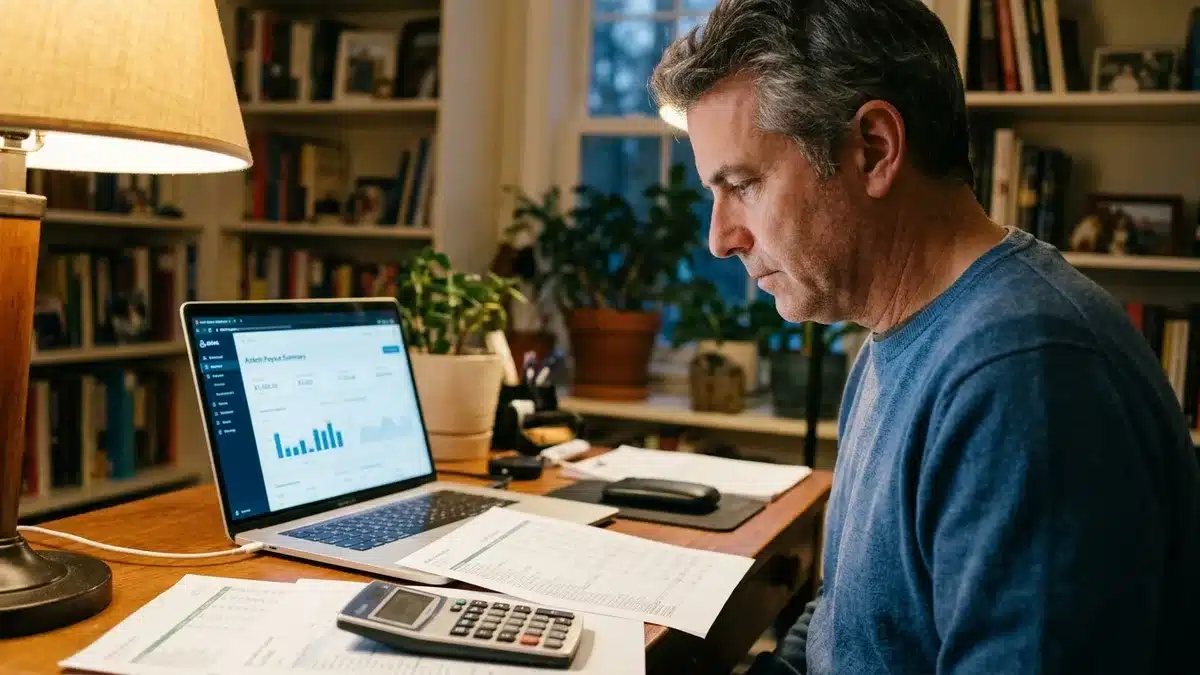
How to Avoid Paying the Airbnb Service Fee?
You cannot avoid Airbnb’s service fee on any booking processed through the platform, since it is deducted automatically from every payout as a condition of using Airbnb’s marketplace. The only way to avoid the fee entirely is to move a portion of your bookings to a channel Airbnb doesn’t touch, such as your own direct booking website.
Some hosts try workaround tactics like asking guests to cancel and rebook off-platform, which violates Airbnb’s terms of service and puts your account at risk of suspension. We don’t recommend this. The fee is a cost of doing business on Airbnb, full stop.
What you can control is how much of your total booking volume depends on Airbnb in the first place. If 100 percent of your bookings run through Airbnb, 100 percent of your revenue is subject to that fee. If you build a direct channel that captures even a meaningful slice of your repeat and referral traffic, you reduce your commission exposure proportionally without violating a platform policy.
This is where a lot of hosts get stuck. Building a standalone booking website sounds simple until you realize it needs live availability synced from your property management system and real-time pricing that matches what’s on Airbnb, plus a way to actually get traffic to it. Boostly Connect handles the sync piece directly, connecting to your existing PMS in under 20 minutes with no developer needed, so your direct site shows accurate availability the moment a guest lands on it. You can read more about what a solid direct booking website for short-term rentals should include if you’re evaluating this path for the first time.
How Do You Calculate Your Actual Annual Airbnb Commission?
Calculating your annual Airbnb commission means multiplying your total gross booking subtotal for the year by your applicable fee percentage, typically 15.5 percent for U.S.-based hosts in 2026. The formula is straightforward: annual gross bookings times 0.155 equals your estimated annual fee.
The tricky part isn’t the math, it’s getting an accurate gross booking figure. Your “booking subtotal” includes the nightly rate plus any cleaning fees, pet fees, or extra-guest fees you charge, but it typically excludes taxes collected and remitted on your behalf. If you’re pulling this number from your bank deposits instead of your Airbnb dashboard, you’ll likely undercount, since the deposit already has the fee subtracted.
The table below shows what this looks like at different revenue levels, using the 15.5 percent host-only rate that applies to most U.S. hosts as of 2026.
| Annual Gross Booking Revenue | Estimated Airbnb Commission (15.5%) | Net Revenue After Commission |
|---|---|---|
| $30,000 | $4,650 | $25,350 |
| $50,000 | $7,750 | $42,250 |
| $100,000 | $15,500 | $84,500 |
| $200,000 | $31,000 | $169,000 |
Take an $810 booking subtotal: Airbnb collects $125.55 at the 15.5 percent rate, leaving the host with $684.45 net. Run that math across a full season of bookings and you start to see why so many hosts treat their annual fee total as background noise instead of a line item worth actively managing.
The number that gets missed even more often is the compounding effect on repeat guests. Repeat guests often make up a modest but meaningful share of total bookings, and most of that repeat revenue still flows back through OTAs carrying the same commission rate as a first-time stay. That’s guests you already earned once, paying full commission again on their second and third stay.
Do Airbnb Fees Vary by Country?
Airbnb’s service fee percentage is not uniform worldwide, and several countries carry meaningfully different rates than the standard 15.5 percent applied to most U.S. hosts. This matters for any host or property manager operating across multiple markets or considering an international expansion.
Hosts in Brazil and Mexico are commonly charged a 16 percent host-only fee rather than 15.5 percent, based on current fee breakdowns. Hosts based in the European Union typically pay the standard 15.5 percent plus applicable VAT on top of that fee, which pushes the effective total commission rate to somewhere between 18 and 19 percent once VAT is factored in.
This VAT layer is easy to miss if you’re only looking at the percentage in your payout breakdown. The VAT is charged on the service fee itself, not on your booking subtotal, but it still comes out of your pocket as an EU-based host. If you operate in multiple countries, check the fee rate for your specific market rather than assuming the U.S. rate applies everywhere.
For multi-property operators managing listings across several countries, this variability adds real complexity to revenue forecasting. A portfolio split between the U.S. and EU markets won’t have a single blended commission rate; it’ll have two distinct rates that need separate tracking. This is one of the areas where operators managing several properties tell us manual spreadsheet tracking breaks down fastest, since a single averaged percentage stops being accurate the moment your portfolio spans borders.
What’s Included in Airbnb’s Booking Subtotal, and Why Does It Matter?
Airbnb’s booking subtotal is defined as the nightly rate plus any additional host-set charges, including cleaning fees, pet fees, and extra-guest fees, and this combined figure is what the service fee percentage is applied against. Taxes collected on your behalf are typically excluded from this base.
Here’s why this distinction matters for your annual math: if you charge a $150 cleaning fee on top of a $200 nightly rate, Airbnb applies its 15.5 percent fee to the full $350 subtotal for that night, not just the $200 room charge. Hosts who bundle more costs into cleaning or extra fees, rather than folding them into the nightly rate, sometimes end up paying commission on charges that feel like pass-through costs rather than revenue.
This is one of the content gaps most fee breakdowns skip. A host charging a $100 cleaning fee across 80 bookings a year is paying roughly $1,240 in commission on cleaning fees alone at the 15.5 percent rate, money that’s arguably just covering your cleaner’s invoice, not profit.
This also affects how you should think about your effective commission rate versus your nominal one. If your nightly rate is low but your fees are high, your effective commission burden as a percentage of your actual room revenue can end up higher than 15.5 percent once you back out the pass-through cleaning cost. Reviewing your fee structure with this in mind is a useful annual exercise, not just a one-time calculation.
How Does Property Management Software Change Your Fee Exposure?
Property management software and channel managers don’t reduce Airbnb’s service fee percentage directly, but they change how much of your total booking volume is exposed to that fee by making it operationally realistic to run a direct booking channel alongside your OTA listings. Without that infrastructure, most hosts stay 100 percent OTA-dependent by default.
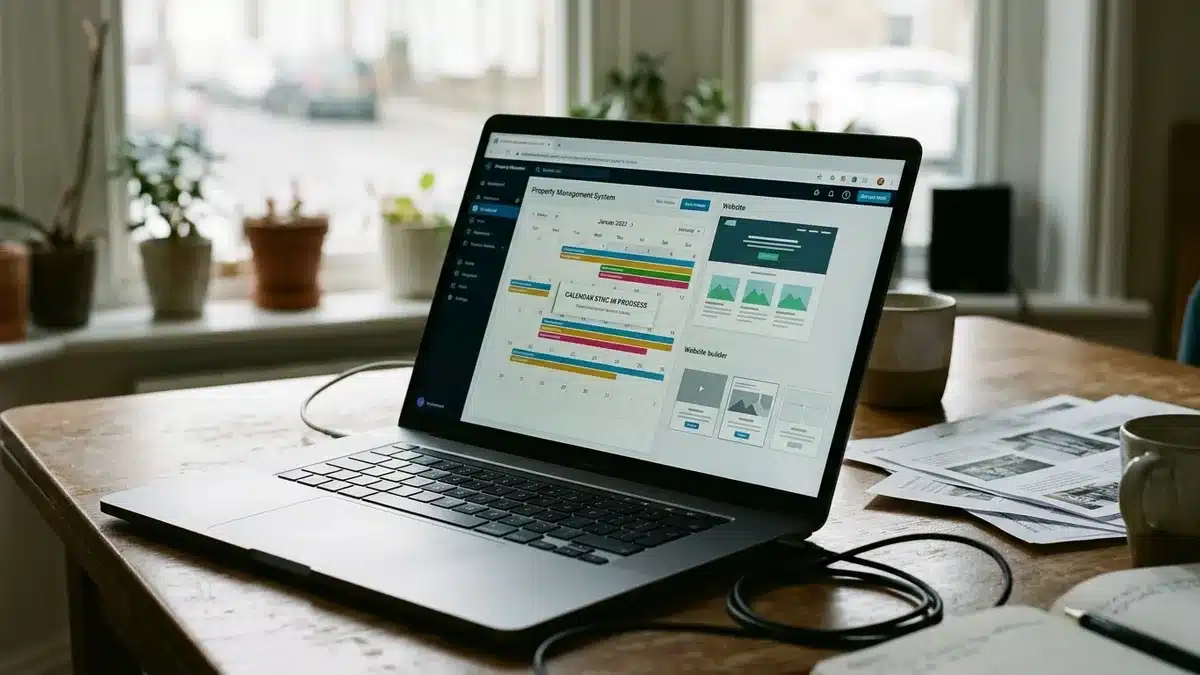
The core issue is technical, not strategic. Running a direct booking site that shows accurate availability requires your PMS calendar to sync with your website in real time. Do that manually, and you’re one missed update away from a double booking. Most solo hosts and small property managers don’t have the bandwidth to maintain that sync by hand across even two or three listings, let alone a growing portfolio.
Boostly Connect solves this by connecting directly to 27 different PMS platforms, so your existing system, whether that’s Hospitable, Hostfully, Lodgify, or Guesty, feeds live availability and real-time pricing straight to your own WordPress website. No developer is required and no ongoing manual syncing once it’s set up, which typically takes under 20 minutes for accounts with up to 10 listings.
The operational payoff compounds as your portfolio grows. If you’re managing multiple properties, the challenge of keeping pricing and availability consistent across every listing gets harder with each new unit added, which is exactly why we built a system for managing multiple vacation rentals without chaos as a foundational piece of the platform rather than a bolt-on feature.
What Does Direct Booking Actually Save You Compared to Airbnb Commission?
Direct booking eliminates Airbnb’s host-only service fee entirely on any reservation processed through your own site, meaning the full booking subtotal goes to you instead of roughly 15.5 percent going to the platform. The savings scale directly with how much of your total volume shifts away from OTA dependency.
Flat-fee direct booking alternatives can cost around $199 per year per property, a fraction of what a single mid-sized OTA fee bill costs across a full season of bookings. The exact savings for your business depend on your booking volume and average nightly rate, so run your own numbers using the formula from earlier in this guide before assuming a specific percentage.
What’s harder to quantify, but just as real, is the guest data ownership piece. When a guest books through Airbnb, their contact information stays inside Airbnb’s ecosystem, and Airbnb can surface that guest to competing listings later. When a guest books direct, their information goes straight into your CRM. You own that relationship going forward, which is the whole premise behind owning your guest data instead of renting it from Airbnb.
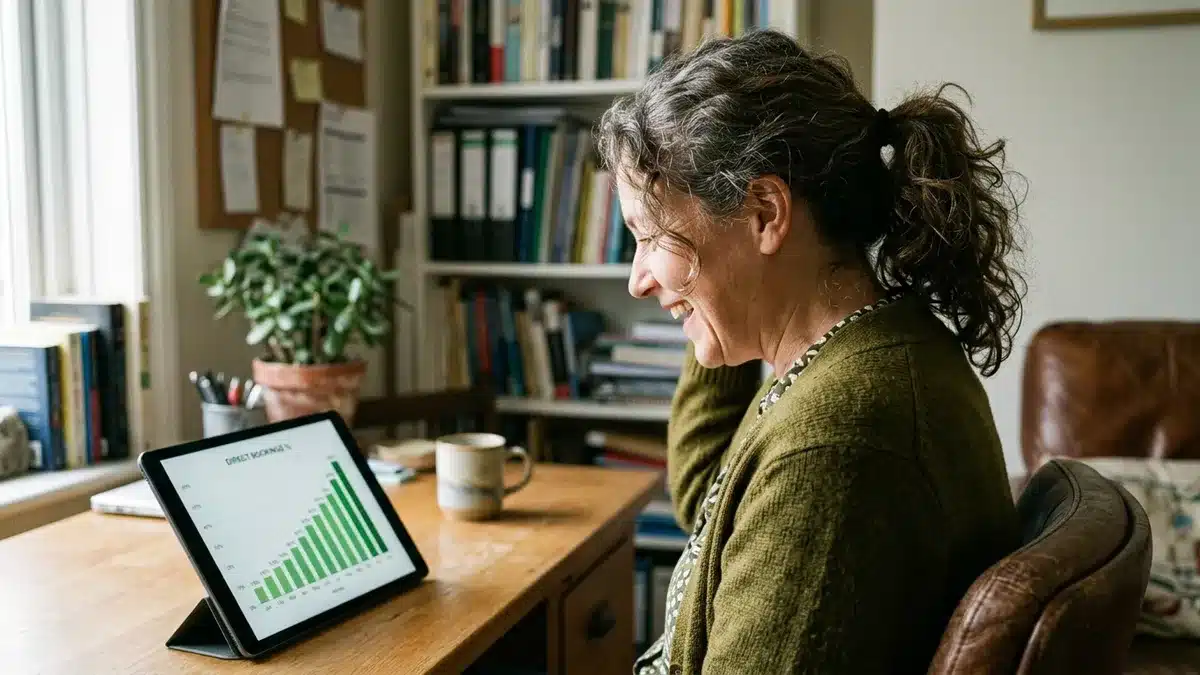
We’ve seen this play out clearly with hosts who prioritize their direct channel early. One bed and breakfast operator we’ve worked with grew direct bookings to 90 percent of total reservations, which also drove repeat guest rates to 60 percent, giving the owners financial stability without needing to constantly chase new OTA traffic. That shift comes from consistently having a direct channel guests can actually use, backed by a CRM built for short-term rental hosts that keeps past guests engaged rather than letting them drift back to browsing OTAs.
How Do You Reduce Your Airbnb Commission Exposure Without Losing Bookings?
Reducing your Airbnb commission exposure without losing booking volume means running Airbnb and a direct booking channel simultaneously, rather than abandoning the platform outright. Most hosts who successfully lower their annual commission bill keep their Airbnb listing active while redirecting specific guest segments, especially repeat guests, to book direct instead.
This is the practical middle path, and it addresses the fear most hosts have when they first consider direct bookings: losing Airbnb search ranking. Your Airbnb listing’s ranking is driven by response rate, review quality, and booking activity on the platform itself, not by whether you also have a website. Keeping your listing active and well-maintained protects your ranking regardless of how much direct traffic you build elsewhere.
A practical sequence for reducing commission exposure without disruption:
- Keep your Airbnb listing fully active and continue accepting new-guest bookings through the platform as normal.
- Identify guests who’ve stayed with you before, since they’re your lowest-risk candidates for direct rebooking.
- Build a direct booking site connected to your live PMS calendar, so availability never conflicts between channels.
- Capture every direct booking guest into a CRM automatically, rather than relying on manual spreadsheet entry.
- Send returning guests a direct link to book their next stay before they default to searching Airbnb again.
Boostly Connect is built around exactly this sequence. The website syncs to your PMS so availability stays accurate across both channels, and the built-in CRM automatically captures and segments direct bookers so you can follow up with past guests without manual list-building. If you’re figuring out how to balance OTA and direct bookings in 2026, this is the operational backbone that makes the balance sustainable rather than a constant juggling act.
Common Mistakes Hosts Make When Estimating Their Annual Commission Cost
The most common mistake hosts make when estimating annual Airbnb commission is calculating from bank deposit totals instead of gross booking subtotals, which understates the actual fee paid since the deposit already has the commission removed. This single error skews every downstream projection.
A second frequent mistake is ignoring country-specific rate differences. A host managing listings in both the U.S. and the EU who applies a flat 15.5 percent to their entire portfolio will underestimate their EU-side costs once VAT is factored in, sometimes by a meaningful margin depending on booking volume in that market.
A third mistake, and one of the more expensive ones, is failing to separate pass-through fees like cleaning charges from actual room revenue when evaluating fee burden. Treating a $100 cleaning fee as “free” simply because it’s reimbursed by the guest ignores that Airbnb still takes its cut on that amount, which adds up meaningfully across a full year of bookings.
Many hosts also calculate their annual commission once and never revisit it. Your fee exposure changes as your average daily rate, occupancy, and cancellation policy settings shift. A recalculation once or twice a year, ideally using your actual Airbnb dashboard export rather than estimates, keeps this number honest and useful for planning.
Frequently Asked Questions
How much commission does Airbnb take?
Airbnb typically charges hosts a host-only service fee of around 15.5 percent of the booking subtotal as of 2026, though the exact rate can vary based on your account’s cancellation policy, location, and history. Brazil and Mexico see a slightly higher 16 percent rate.
How much of a cut does Airbnb take from each booking?
Airbnb’s cut is generally 15.5 percent of your nightly rate plus any host-set fees like cleaning or pet charges, deducted automatically before your payout is issued. On an $810 booking subtotal, for example, Airbnb collects around $125.55, leaving the host with roughly $684.45.
What percentage does Airbnb take from hosts?
Most hosts under the current host-only fee model pay 15.5 percent of their booking subtotal. EU-based hosts typically pay that same 15.5 percent plus VAT on the fee itself, pushing their effective rate closer to 18 to 19 percent.
How much does Airbnb take in total?
On an annual basis, a host generating $50,000 in gross bookings loses roughly $7,750 to Airbnb’s service fee at the 15.5 percent rate, while a host generating $200,000 loses closer to $31,000 per year. The exact figure depends on your specific booking volume, average rate, and country.
What is Airbnb commission, exactly?
Airbnb commission, more precisely called the host service fee, is the percentage Airbnb deducts from every completed booking’s subtotal for listing your property, processing payments, and providing guest support. It’s automatically withheld before your payout arrives, so you never have to remit it separately.
Can you negotiate or lower your Airbnb commission rate?
Airbnb does not offer individual negotiation on its standard service fee for typical hosts, since the rate is set by policy rather than by account. The only way to lower your effective annual commission cost is to reduce how much of your total booking volume runs through the platform by building out a direct booking channel.
Does using property management software lower my Airbnb fees?
Property management software and channel managers don’t change Airbnb’s fee percentage directly, but they make it operationally feasible to run a direct booking website alongside your Airbnb listing, which reduces your total commission exposure by shifting bookings to a fee-free channel. Tools like Boostly Connect handle the live sync piece that makes this practical without manual double-entry.
Do repeat guests still cost me Airbnb commission?
Yes. If a returning guest rebooks through Airbnb rather than a direct channel, you pay the same service fee again, even though you already earned that guest’s loyalty on their first stay. This is one of the least discussed costs of not owning your guest relationship, and it’s a key reason many hosts prioritize building a direct booking CRM.
Conclusion: What the Real Annual Number Tells You
The math is consistent across every revenue level we’ve walked through: a 15.5 percent host-only service fee turns into thousands of dollars a year the moment you apply it to real booking volume, and that number only grows as your occupancy and rates climb through 2026. Whether you’re at $30,000 or $200,000 in annual gross bookings, the fee is the same percentage, and the dollar impact scales with you.
Fixing this doesn’t require abandoning Airbnb or gambling your booking volume on an unproven website. It requires connecting the systems you already run, your PMS, your calendar, your guest list, to a booking site built to convert visitors and capture repeat guests. That’s the exact infrastructure gap Boostly Connect was built to close, syncing your existing PMS to a direct booking website in under 20 minutes with no developer and no upfront cost for your first 10 listings.
If you’ve run the numbers from this guide and don’t like what you saw, book a demo to see exactly how Boostly Connect connects to your existing property management system and gets your own booking site live, so the next guest who wants to come back can book you directly instead of paying Airbnb’s cut a second time.