
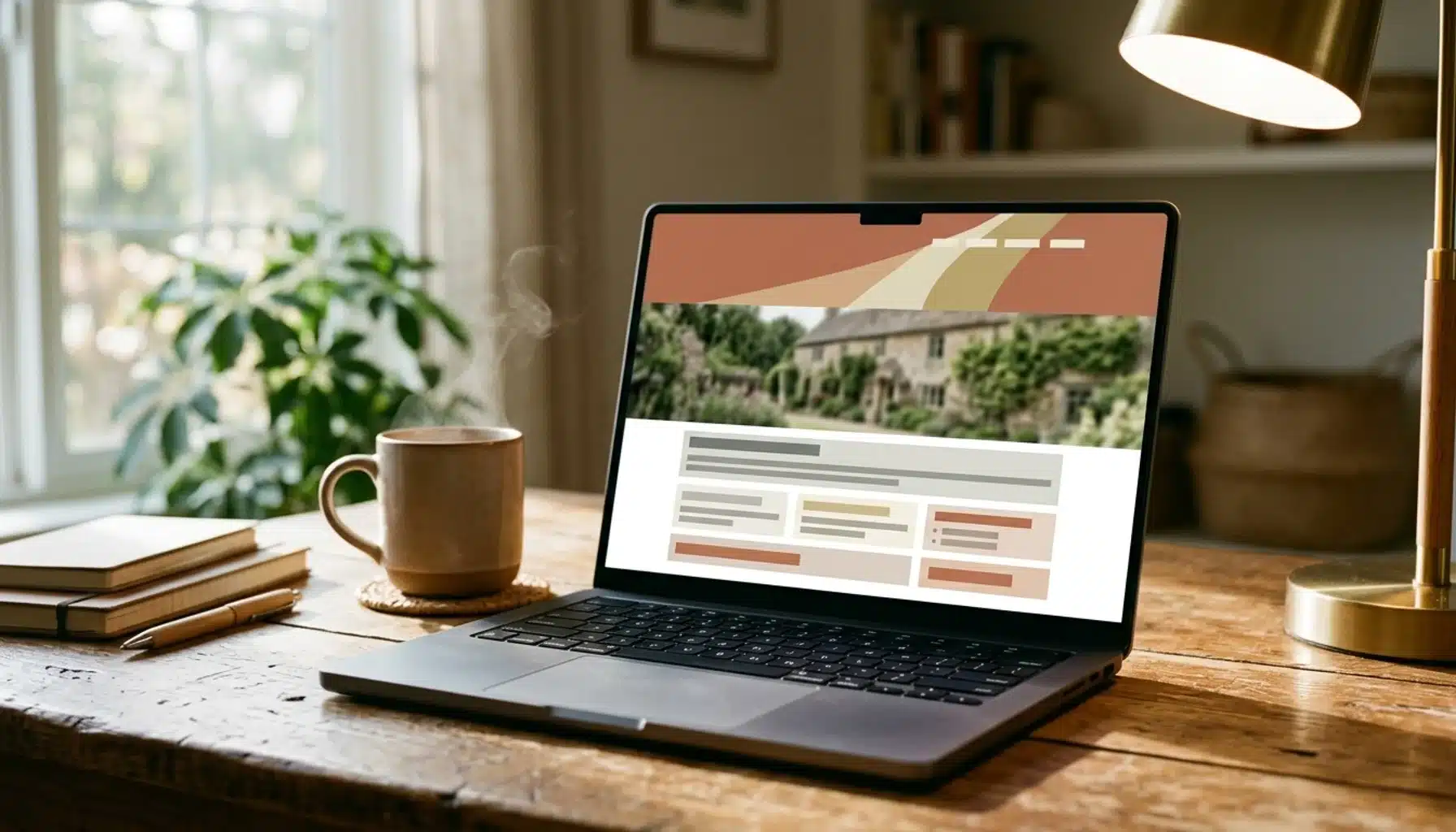
A direct booking website, built to turn browsers into guests.
A direct booking website for short-term rentals is a host-owned platform where guests can check live availability, review pricing, and pay securely without going through Airbnb, Vrbo, or Booking.com. It eliminates the 15 to 20 percent commission those platforms charge on every reservation and, more importantly, it gives you permanent ownership of your guest relationships instead of surrendering that data to a third party who will use it to remarket your past guests to competing properties.
-
A direct booking website for short-term rentals is a property owner’s own platform for accepting reservations commission-free, without paying 15 to 20 percent to Airbnb, Vrbo, or Booking.com.
-
The non-negotiable features are live availability sync with your property management system, secure payment processing, mobile-first design, and a built-in CRM that captures guest contact data permanently.
-
Without a PMS integration, any direct booking you take creates a double-booking risk because dates are not automatically blocked on your OTA listings.
-
Post-launch traffic is the most common failure point: a site with no visibility strategy generates zero bookings regardless of how well it converts.
-
Hosts who reach 65 percent direct bookings typically use three channels together: their own website, Google Vacation Rentals, and an automated email sequence targeting past guests.
-
Boostly Connect syncs your existing PMS to a conversion-optimized WordPress website in under 20 minutes, captures every direct booker into a CRM you own permanently, and backs the whole system with a 65 percent direct bookings guarantee within 12 months.
OTA platforms are excellent discovery engines. Nobody disputes that. The problem is not that Airbnb sends you guests; the problem is that Airbnb owns those guests after checkout. Every returning traveler who loved your property and searches for it again is routed back through a platform that collects another commission, retains the contact data, and recommends six competing listings alongside yours. Your direct booking website breaks that cycle.
In 2026, with available short-term rental listings in the United States projected to reach 1.77 million according to AirDNA’s 2026 Outlook Report, competition for OTA visibility is tighter than it has ever been. Building a direct channel is no longer an optional upgrade for ambitious operators. It is the infrastructure layer that separates hosts building a real business from those perpetually dependent on a platform they do not control. This guide covers exactly what that infrastructure needs to include, what to look for when evaluating your options, and what the most common mistakes look like so you can skip the expensive trial and error.

a short-term rental host at a bright home office desk reviewing a vacation rental direct booking
What Is a Direct Booking Website for Short-Term Rentals?
A direct booking website for short-term rentals is a host-owned web property that accepts reservations directly from guests, with no intermediary platform taking a percentage of the revenue. Functionally, it includes a property listing, a live availability calendar, real-time pricing, and a secure checkout, all under the host’s own domain and brand rather than on a third-party marketplace.
The distinction matters beyond commission savings. When a guest books directly, their contact information, payment details, and stay history are stored in a database you own. When a guest books through Airbnb, that data belongs to Airbnb. The platform uses it to send promotional emails, suggest alternatives, and power its own remarketing campaigns, none of which benefit you.
Why Hosts Need More Than Just a Pretty Website
A common mistake is confusing a marketing website with a direct booking website. A marketing website shows photos and describes the property. A direct booking website closes the transaction. The difference comes down to infrastructure: live calendar sync, payment processing, and CRM capture.
Without those three components working together, a beautifully designed vacation rental site is just a brochure that sends guests back to Airbnb to actually complete their reservation. We have seen this pattern repeatedly at Boostly Connect, hosts who invest in a professional website, then wonder why direct bookings never materialize. The design was fine. The infrastructure was missing.
What Features Does a Direct Booking Website Actually Need?
A direct booking website for short-term rentals needs four foundational features to function as a genuine booking channel rather than a marketing asset with no conversion capability. Hosts who overlook any one of these four elements consistently report the same result: traffic that bounces back to OTA platforms to complete the transaction.
Live Availability and Real-Time Pricing Sync
Live calendar sync with your property management system is the single most critical technical requirement. Without it, a direct booking does not automatically block dates on your Airbnb or Vrbo listing, which creates real double-booking risk. That risk alone stops most cautious hosts from promoting their direct channel, which is exactly the problem a proper PMS integration solves.
Real-time pricing sync matters just as much. If your nightly rate on your direct website differs from your OTA rate by even a few dollars, guests will notice and book wherever the price is lower, which is usually the OTA. Rate parity, maintained automatically through your PMS connection, removes that friction entirely.
Boostly Connect supports 8 PMS integrations, including Hospitable, Guesty, Hostfully, Lodgify, and OwnerRez. The sync takes under five minutes to configure, and live availability appears on the booking calendar immediately after. You can also explore how real-time pricing works on a vacation rental website to understand the technical mechanics before you commit to a platform.
Secure Payment Processing
Guests booking directly expect the same security signals they see on established booking platforms. That means SSL encryption, recognizable payment infrastructure, and a checkout flow that does not look like it was built in 2015. Stripe is the payment processor Boostly Connect uses, a PCI-compliant infrastructure trusted by millions of businesses worldwide. Payments go directly to the host’s account with no additional per-booking fee from the platform on top of standard processing rates.
Trust signals around payment are not optional. A guest who hesitates at checkout and closes the tab is a lost booking, and that hesitation almost always comes from a checkout experience that feels unfamiliar or insecure.
Mobile-First Design That Converts
Most vacation rental searches happen on mobile devices. A direct booking website that does not load cleanly and convert on a phone is leaving a substantial share of its potential revenue on the table. Mobile-first design means fast load times, thumb-friendly buttons, a booking flow that works in three taps, and photo galleries that display properly without horizontal scrolling.
Conversion rate optimization for vacation rental websites goes further than mobile design: it includes visible social proof (reviews, guest testimonials), clear unique selling propositions above the fold, and a booking widget that stays accessible as guests scroll. These details are the difference between a 1 percent conversion rate and a 4 percent one on the same volume of traffic.
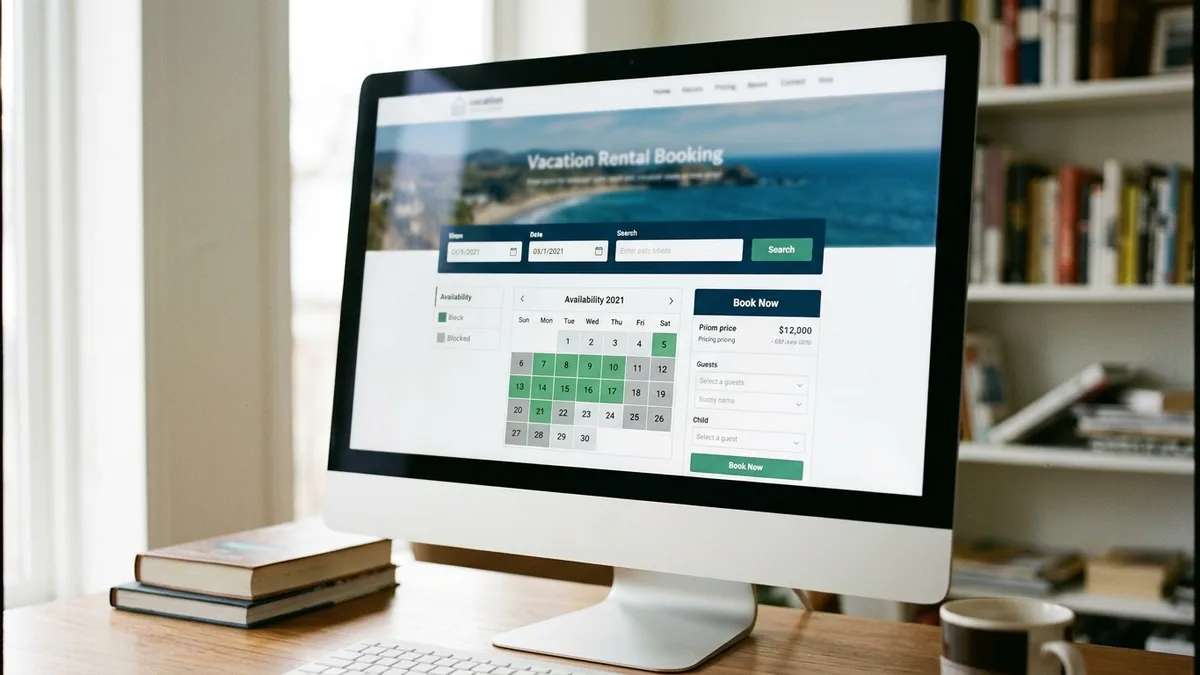
a clean vacation rental direct booking website displayed on a desktop monitor with a live
How to Get Direct Bookings for Short-Term Rentals
Getting direct bookings for short-term rentals requires a traffic strategy that works independently of OTA platforms. A conversion-optimized website without traffic generates zero bookings. The hosts who reach meaningful direct booking percentages within their first 12 months consistently use the same three-channel approach: Google Vacation Rentals for organic search visibility, email marketing to past guests, and social media for brand-building and remarketing.
Google Vacation Rentals and Organic Search
Google Vacation Rentals places your property directly in Google search results alongside OTA listings, which means travelers searching for accommodation in your destination can find your direct booking page before they ever visit Airbnb. This is organic traffic, not paid, and it levels the playing field between independent hosts and large OTA inventory.
WordPress is the platform best positioned to take advantage of organic search because it allows full control over structured data, meta content, and page speed, all of which influence how Google ranks vacation rental pages. Building your direct booking site on WordPress means your property pages are indexed, optimized, and eligible for Google Vacation Rentals in a way that locked-down website builders often are not. At Boostly Connect, every website we build uses WordPress specifically for this reason: the SEO foundation is already in place from day one.
A practical complement to this is using market data tools to benchmark your rates against local competition. The RentCast Rental Market Search Tool lets you explore rental data by location across thousands of US zip codes, which is useful for confirming that your direct pricing is competitive before you start driving traffic to the site.
Email Marketing to Past Guests
Past guests are your highest-converting audience. They already know your property, they liked it enough to check out positively, and they are statistically more likely to book again than a first-time visitor. The problem most hosts face is that Airbnb owns those guest contact details. After checkout, you have no way to reach that person directly.
Every guest who books through your direct website is captured automatically into your own CRM. That database grows with every reservation, and it becomes the foundation for email campaigns that bring repeat guests back without paying another OTA commission. A straightforward post-stay sequence, a follow-up at the 60-day mark with a direct-only rate offer, and a seasonal campaign before peak periods can recover a significant share of returning revenue. You can read more about building this infrastructure in our guide to the best CRM for short-term rental hosts who want to own their guest list.
One case study from our community illustrates this clearly. A serviced accommodation host in the UK who launched a Boostly Connect website increased their direct bookings to 40 percent within the first year and generated a single booking worth £6,000 through their direct channel, a reservation they would have paid 15 to 20 percent commission on through an OTA.
Which Website Platform Works Best for STR Direct Bookings?
WordPress is the strongest platform for a direct booking website for short-term rentals when SEO and long-term scalability are priorities. It offers full control over structured data, page speed optimization, meta content, and content marketing through built-in blogging, all of which compound over time to drive organic traffic that OTA-dependent hosts never access. Unlike closed website builders that constrain your technical configuration, WordPress lets you build destination-level content pages that attract travelers before they ever open an OTA app.
The trade-off is that WordPress requires more initial configuration than drag-and-drop builders. Without a PMS integration already in place, live availability does not work automatically. Connecting your property management system through a platform like Boostly Connect resolves this: the PMS sync handles live calendar data and real-time pricing without any ongoing manual management from the host.
The right answer also depends on your portfolio size. A single-property host with minimal tech experience needs a different setup than a boutique property manager running 20 listings. But in both cases, the platform that wins is the one that connects cleanly to your existing PMS, captures guest data into a CRM you own, and does not require a developer every time you need to make a change.

a split-screen showing a property management system dashboard on the left syncing live availability
How to Evaluate a Direct Booking Website Builder: A Scoring Framework
Evaluating a direct booking website builder requires a structured framework rather than a side-by-side feature list. Most hosts compare surface-level design options and miss the infrastructure questions that actually determine whether the site generates revenue. Use the criteria below to score any platform you are considering.
Evaluation Criterion What to Look For Why It Matters PMS Integration Depth Live two-way sync with your existing PMS, under 5 minutes to configure No sync means manual calendar updates and double-booking risk CRM and Guest Data Ownership Every direct booker auto-captured into a database you own permanently Without this, you cannot run repeat-guest campaigns or reduce OTA reliance over time SEO Foundation WordPress or equivalent platform with full structured data control and blog capability Organic traffic from Google Vacation Rentals requires a proper technical SEO base Payment Processing PCI-compliant processor (Stripe), direct-to-host payouts, no per-booking platform fee Trust at checkout determines whether guests complete the booking or abandon Multi-Property Support One PMS connection syncs all listings simultaneously, no per-property setup required Single-property setups do not scale; rebuilding the workflow per listing is unsustainable Email Marketing Integration Pre-built post-stay sequences, repeat-stay nurture, seasonal campaigns in the same platform Traffic to a booking site without a retention strategy loses the majority of its long-term value Coaching and Support Access to group coaching, documented training, and a host community A tool you do not know how to use is a tool that does not generate bookings Performance Guarantee A stated direct bookings target within a defined timeframe, with consequences if unmet Guarantees signal confidence in the system’s actual effectiveness, not just its feature list
Boostly Connect scores well on every row above because the platform was built specifically to solve each of these problems rather than to replicate OTA functionality under a different brand. The 65 percent direct bookings guarantee within 12 months, which applies to clients who implement the full system including the website, CRM automation, and email marketing sequences, is a criterion no other platform in this space currently matches.
What Happens to Your Guest Data Without a Direct Booking Site?
Without a direct booking website, every guest relationship you build belongs to the OTA, not to you. Airbnb’s data policy means that after checkout, you have no access to your guest’s email address, phone number, or payment information. You cannot contact them for future stays, you cannot send a seasonal offer, and you cannot build a loyalty campaign around the guests who loved your property enough to leave a five-star review.
That data gap compounds annually. A property generating 50 bookings per year, with even a 20 percent repeat guest rate, represents 10 potential commission-free reservations each year that instead cycle back through Airbnb because the host never owned the relationship in the first place. Multiply that across five years and the cumulative revenue loss is significant, not from new guests discovering the OTA, but from returning guests who would happily book direct if there were a direct channel to find.
Every guest who books through a Boostly Connect-powered website is automatically captured into the host’s own CRM. Contact details, booking history, and stay preferences stay in a database the host owns permanently, with no platform intermediary retaining or monetizing that data. That database is the foundation for every repeat-guest campaign, upsell sequence, and loyalty offer that makes a direct booking channel worth more than the sum of its individual reservations.
How Much Can You Actually Save by Cutting OTA Commissions?
OTAs typically charge 15 to 20 percent commission on every reservation. For a property generating $100,000 in annual gross revenue, that is $15,000 to $20,000 per year in platform fees. Not a one-time cost. Every year. For as long as OTAs remain the primary booking channel.
The math shifts quickly once you calculate it at the repeat-guest level. A guest who books a $1,500 stay costs you $225 to $300 in OTA commission. If that same guest returns twice more over the next two years and books both times through Airbnb because you have no direct channel, you pay that commission three times for the same person who already knows and trusts your property.
Boostly Connect clients who reach the platform’s 65 percent direct bookings target within 12 months recover a proportional share of those annual fees. The average Boostly Connect client earns around $59,000 per year from their direct channel. Mark Simpson, who founded Boostly Connect after building the system for his own properties, personally recovered over $30,000 annually in platform fees using the same infrastructure the platform now deploys for more than 2,000 hosts across 25 countries.
For a more precise look at what you would recover at your specific revenue level, tools like the Beyond Pricing free listing analysis tool can give you a baseline understanding of your current performance before you model out the direct booking scenario.
What Are the Most Common Mistakes When Launching a Direct Booking Site?
Most direct booking websites fail not because of bad design but because of predictable, avoidable mistakes in the launch and post-launch phase. Here are the five we see most consistently.
-
Launching without a PMS integration. A direct booking site that does not sync with your property management system is a manual liability. Dates blocked on Airbnb are not reflected on your site, and vice versa. The first double-booking is usually the last time the host promotes the direct channel. Configure the PMS connection before you send a single guest to the site.
-
Treating the website launch as the traffic strategy. A new direct booking website has zero organic search authority on day one. Expecting Google traffic immediately is unrealistic. The launch is the beginning of a traffic strategy, not the completion of one. Google Vacation Rentals integration, a past-guest email campaign, and social media promotion are all required from week one.
-
No email capture before launch. If you have been on Airbnb for years without a direct channel, you cannot legally email past Airbnb guests directly. But you can send a message through Airbnb’s messaging system directing guests to your new site before their next booking. Many hosts skip this step and launch to an audience of zero instead of their existing guest history.
-
Pricing higher on the direct site than on OTAs. Guests who compare your direct rate to your Airbnb listing and find the direct rate higher will always book through Airbnb. Rate parity, or ideally a small direct-only discount communicated clearly on the website, removes this friction. Automatic PMS sync handles rate parity; a visible discount code handles the incentive.
-
Skipping the CRM setup. A direct booking website that takes payments but does not capture guest data into a CRM is solving the commission problem without solving the retention problem. Every direct booker who checks out without being added to a marketing database is a one-time transaction rather than the beginning of a long-term guest relationship.
FAQ: Direct Booking Websites for Short-Term Rental Hosts
What is a direct booking website for short-term rentals?
A direct booking website for short-term rentals is a host-owned platform where guests can check live availability, view pricing, and complete a reservation without going through Airbnb, Vrbo, or another OTA. The host keeps 100 percent of the reservation value instead of paying 15 to 20 percent commission, and all guest contact data is stored in the host’s own CRM rather than being retained by a third-party platform.
How do I get direct bookings for short-term rentals?
Getting direct bookings consistently requires three things working together: a conversion-optimized website with live availability and secure payment processing, a traffic strategy that includes Google Vacation Rentals and organic search, and an email marketing system that targets past guests with direct-only offers. A website alone is not enough; traffic and retention are what turn a booking site into a reliable revenue channel.
Which website platform is best for short-term rental direct bookings?
WordPress is the strongest foundation for a direct booking website because it supports full SEO control, structured data, Google Vacation Rentals integration, and scalable content marketing through built-in blogging. Boostly Connect builds all direct booking websites on WordPress and syncs them to 8 different property management systems, including Hospitable, Guesty, Hostfully, Lodgify, and OwnerRez, in under five minutes.
Does building a direct booking website hurt my Airbnb ranking?
No. Your direct booking website and your Airbnb listing operate as completely separate channels. Airbnb’s search algorithm ranks listings based on factors within its own platform, including reviews, response rate, and pricing competitiveness. Running a direct booking website in parallel does not affect those signals. Many hosts maintain their full OTA presence while growing their direct channel simultaneously during the transition period.
What happens to my guest data when someone books through my direct website?
Every guest who completes a direct booking is automatically captured into the host’s CRM, and that data stays there permanently under the host’s ownership. Unlike Airbnb, which retains guest contact information after checkout and uses it for its own remarketing, a direct booking through a Boostly Connect-powered website means that contact data, booking history, and preferences belong entirely to you.
How long does it take to set up a direct booking website with Boostly Connect?
The PMS integration takes under five minutes for any of the 8 supported systems. The full website, including live availability, payment setup, and property pages, goes live in under 20 minutes. No developer or coding knowledge is required, and there is a free plan for up to 3 listings on the Discover map.
What is the 65 percent direct bookings guarantee from Boostly Connect?
Boostly Connect guarantees that clients who implement the full system, including the website, CRM automation, and email marketing sequences, will reach 65 percent direct bookings within 12 months. If that threshold is not reached, the Boostly Connect team continues working with the host at no additional cost until it is. No other platform in this space currently offers a comparable performance guarantee.
The Takeaway: What Your Direct Booking Website Actually Needs to Do
A direct booking website for short-term rentals is not a vanity project or a backup channel. It is the infrastructure that determines whether you own your guest relationships and your revenue long-term, or whether you permanently subsidize the platforms that do. The hosts who build it correctly, with a PMS sync that works automatically, a CRM that captures every booker, and a traffic strategy that does not depend on OTA visibility, are the ones who reach meaningful direct booking percentages within 12 months and sustain them without ongoing manual effort.
The hosts who struggle are almost always missing one of the same three things: live availability sync that prevents double-bookings, an email system that re-engages past guests, or a traffic channel that brings new visitors to the site in the first place. Get all three in place before you promote the site, and the conversion follows naturally.
In 2026, with OTA inventory growing and commission structures unchanged, the cost of staying OTA-dependent compounds every year. The infrastructure to change that is available today, takes less than 20 minutes to configure, and pays for itself within the first few direct bookings.
If you are ready to build a direct channel that works while you are not watching it, get started with Boostly Connect. More than 2,000 hosts across 25 countries have collectively generated over $1 billion in direct bookings using this system. The next step is a 20-minute demo at connectyourpms.com to see exactly how it maps to your property count and revenue level.
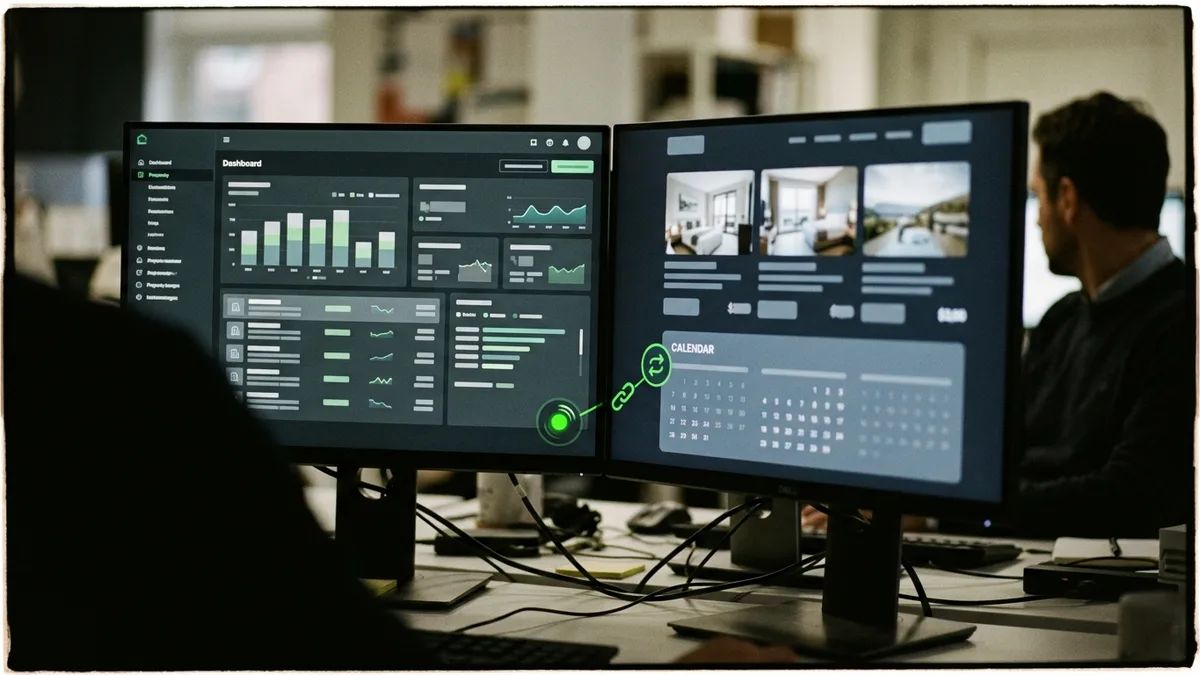
a clean split-screen graphic showing a property management system dashboard on the left syncing