

Weighing commission costs against direct booking revenue.
Airbnb charges most hosts a 15.5% host-only service fee on every booking subtotal as of late 2026, a figure that applies to the nightly rate plus any host-charged extras like cleaning fees. On a property generating $60,000 in annual gross revenue, that single line item costs you $9,300 every year. Before you calculate your own number, you need to understand exactly how the fee is structured, where regional exceptions apply, and what your realistic alternatives are.
-
Airbnb’s standard host-only fee is 15.5%, applied to the booking subtotal (nightly rate plus host fees), excluding taxes and security deposits. This rate took effect for most hosts starting October 27, 2026.
-
Regional exceptions exist: Brazil hosts pay 16%, and Mexico and UK hosts moved to host-only pricing in June 2026. Italy hosts have historically paid above the standard split-fee rate.
-
On $50,000 annual revenue, you pay $7,750 to Airbnb. On $100,000 annual revenue, that figure reaches $15,500 per year, every year, compounding as your revenue grows.
-
The fee applies to cleaning fees and pet fees you charge guests, not just nightly rates, which means your effective annual cost is often higher than a simple percentage of nightly revenue suggests.
-
Direct bookings eliminate this cost entirely. Hosts who build a direct booking channel capture 100% of guest payments instead of surrendering a recurring annual loss to the platform.
-
Boostly Connect was built specifically for this problem, syncing your existing property management system to a live direct booking website in under 20 minutes, with no developer and a free plan for up to 3 listings on the Discover map.
What Percentage Does Airbnb Actually Take From Hosts?
Airbnb’s standard host-only fee is 15.5% of the booking subtotal, deducted directly from the host’s payout before the money reaches your account. This rate replaced the older split-fee model for most hosts starting October 27, 2026. Under the previous split-fee structure, hosts paid roughly 3% while guests absorbed a separate 14% to 16% charge on top of the listed price. The new host-only model shifts the entire fee burden to you, the host.
This distinction matters more than most hosts initially realize. Under the split-fee system, your $200 nightly rate appeared on Airbnb at roughly $200, and guests paid their fee on top separately. Under the host-only model, you absorb the full 15.5% cut while guests see a cleaner, all-inclusive price. Your net payout on that same $200 night drops to approximately $169 before any cleaning fee adjustments.
Regional variations do exist. Brazil hosts pay a 16% host-only fee. Mexico and UK hosts transitioned to the host-only structure in June 2026. Italy hosts operating under the split-fee model historically paid above the standard 3% rate. If you manage properties across multiple markets, your blended effective rate may differ from the headline 15.5%.
One detail that catches many operators off guard: the 15.5% applies to the full booking subtotal, meaning your cleaning fee and any pet fee you charge are included in the calculation. If your cleaning fee is $150 and your nightly rate across a 3-night stay is $600, Airbnb calculates its fee on $750, not $600. That adds up significantly across a full calendar year.
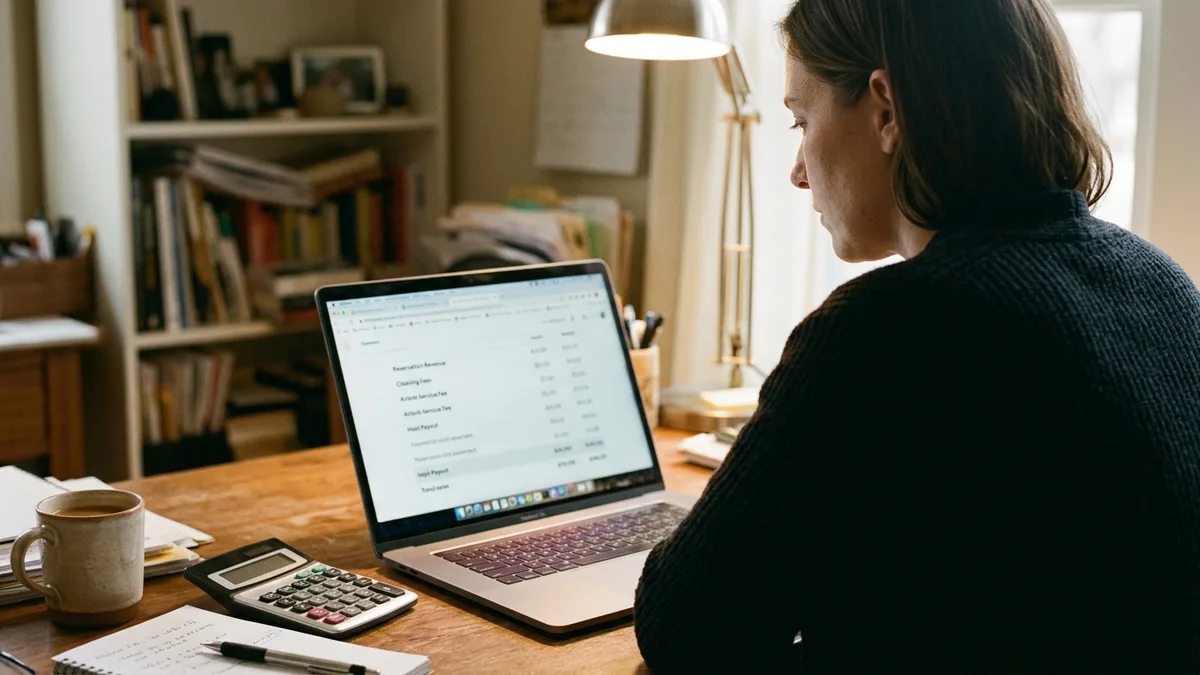
a focused host reviewing Airbnb payout statements on a laptop with a calculator nearby, showing the
How Much Does Airbnb Commission Cost You Annually at Different Revenue Levels?
Your annual Airbnb commission cost is a direct function of your gross booking revenue multiplied by 15.5%. The table below shows exactly what that costs at common revenue levels, using verified figures.
Annual Gross Revenue Airbnb Fee (15.5%) What You Keep (Before Other Costs) $30,000 $4,650 $25,350 $50,000 $7,750 $42,250 $60,000 $9,300 $50,700 $100,000 $15,500 $84,500 $150,000 $23,250 $126,750 $200,000 $31,000 $169,000
These figures reflect the booking subtotal fee only. They do not account for transient occupancy taxes, local licensing fees, or the additional bite taken when your cleaning fee is included in the subtotal. A property generating $5,000 per month in gross bookings pays $775 per month to Airbnb before a single maintenance bill or property cost is counted.
Notice that the cost scales linearly with your revenue. Every effort you make to improve occupancy, raise your average daily rate, or add a higher-value property directly increases what you send to Airbnb. A host who grows revenue from $60,000 to $100,000 adds $6,200 in annual platform fees on top of the $9,300 they were already paying. Growth on Airbnb enriches the platform proportionally to how hard you work.
In our experience working with more than 2,000 hosts across 25 countries, most operators dramatically underestimate this number until they run the actual math. The commission feels invisible on a per-booking basis. It becomes viscerally real when you see the annual total in one line.
What Is the 75-55 Rule for Airbnb?
The 75-55 rule is an informal Airbnb pricing framework used by some hosts to set nightly rates that absorb the platform’s service fees without appearing uncompetitive. The concept suggests that a host aiming to net a specific amount per night should price at a level where roughly 75% of the listed rate covers the desired net payout after Airbnb’s deductions, leaving the remaining margin to cover the fee. A variation of this applies the 55% figure to cleaning-heavy bookings where additional host fees are also subject to Airbnb’s percentage cut.
The practical application is straightforward: if you want to net $170 per night after Airbnb’s 15.5% fee, you need to list at approximately $201 (because $201 multiplied by 0.845 equals $169.85). The formula Airbnb itself has acknowledged for hosts converting from the old split-fee model to the host-only model is: new rate = old rate multiplied by 1.1479. This approximation accounts for the shift in fee burden from a guest-facing charge to a host-side deduction.
The problem with this approach is the ceiling it creates. Raising your listed rate to compensate for Airbnb’s fee may keep your net payout whole, but it also affects your competitiveness on the platform. Guests searching within a price bracket may see your listing at $201 when a comparable property sits at $185. You end up paying the platform to make you less competitive, which is not a neutral outcome.
This is precisely the dynamic that makes direct bookings so valuable. When a guest books directly through your own website, there is no platform fee to absorb. Your $185 rate is your $185 revenue. No formula required.
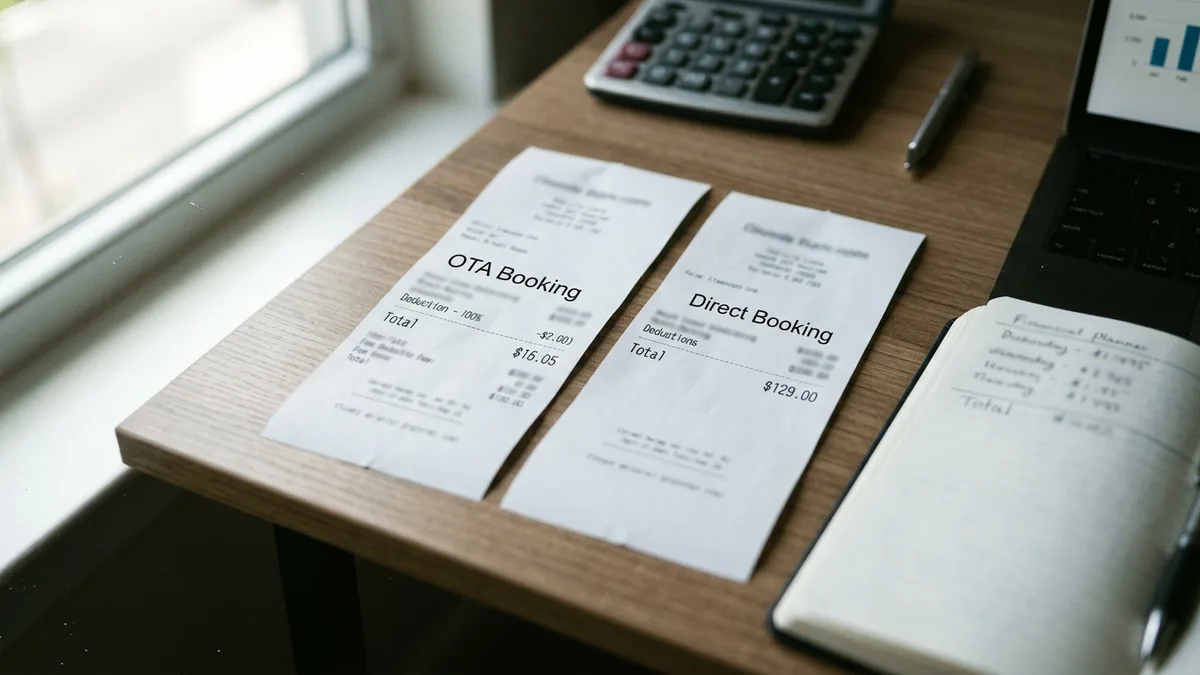
a clean infographic-style scene showing two side-by-side receipts on a desk, one labeled OTA
Is Airbnb Going to Charge Hosts 15%?
Airbnb has already moved most hosts to a fee above 15%, not below it. The standard host-only fee that took effect on October 27, 2026 is 15.5%, not 15%. The question of whether Airbnb would charge hosts 15% was an earlier concern that the platform resolved by landing at a slightly higher figure. Brazil hosts pay 16%. Hosts in Mexico and the UK joined the host-only model at their respective rates in June 2026. If you were hoping the fee would settle at or below 15%, the current structure says otherwise.
The shift from the split-fee model to host-only was significant. Previously, the platform’s total revenue came from two sources: a roughly 3% fee charged to hosts and a separate 14% to 16% service fee charged to guests. The guest-facing fee appeared during checkout, which made it visible to the person making the booking. The new host-only model eliminates the guest-facing service fee and instead takes 15.5% directly from your payout. Guests see a cleaner listed price; you see a smaller deposit.
Professional property managers connected to property management systems now pay the flat 15.5% host-only rate on all bookings they process through Airbnb. There is no volume discount, no negotiated rate for multi-property operators, and no mechanism to reduce the fee by demonstrating booking quality or guest satisfaction scores.
If you are managing multiple properties and wondering whether scale earns you a better rate on Airbnb, the answer, as of 2026, is no. The fee is fixed regardless of portfolio size. That reality makes building your own direct booking channel more financially meaningful, not less, as your portfolio grows.
How Does the Airbnb Fee Affect Your Net Income After Real Expenses?
The 15.5% Airbnb fee is the first deduction, not the only one. Understanding your true net income requires stacking all costs on top of each other to see what actually reaches your pocket. Most hosts who calculate only the Airbnb fee are significantly overestimating their actual margin.
Consider a property generating $80,000 annually in gross booking revenue. The Airbnb fee at 15.5% removes $12,400 immediately, leaving $67,600. From there, local transient occupancy taxes, which commonly range from 5% to 15% of gross revenue depending on your jurisdiction, take another $4,000 to $12,000. Cleaning costs, maintenance, insurance, and property management fees stack on top. By the time a host counts everything, the Airbnb fee alone represents a much larger share of actual profit than it does of gross revenue.
The tax deductibility angle is worth understanding. Airbnb’s service fee is generally deductible as a business expense on your tax return, which softens its after-tax impact. If you are in a 25% effective tax bracket, a $12,400 Airbnb fee produces a $3,100 tax benefit, reducing the real after-tax cost to approximately $9,300. This does not make the fee disappear, but it changes the net math. Work with a tax professional familiar with short-term rental tax treatment to confirm how this applies to your specific situation.
What the tax deduction cannot fix is the opportunity cost. Every dollar sent to Airbnb as a commission is a dollar that never enters your guest CRM, never funds your next property acquisition, and never builds your direct brand. The fee is not just a cost; it is a structural constraint on how fast your business can grow. At Boostly Connect, we see this ceiling play out consistently across operators who come to us after years of strong Airbnb performance but weak direct channel development.
For a practical snapshot of how this stacks up, the table below models a mid-tier property at different occupancy levels, using a $200 average nightly rate and a $150 cleaning fee applied to every stay, assuming an average stay length of 3 nights.
Annual Occupancy Gross Revenue (Est.) Airbnb Fee (15.5%) Cleaning Fee Included in Subtotal Total Airbnb Cost 50% (61 stays) ~$45,800 ~$7,099 $150 per stay included ~$7,099 70% (85 stays) ~$63,750 ~$9,881 $150 per stay included ~$9,881 90% (110 stays) ~$82,500 ~$12,788 $150 per stay included ~$12,788
Note: These are illustrative projections using the 15.5% rate applied to combined nightly and cleaning fee revenue. Your actual figures will vary based on your specific nightly rate, cleaning fee, stay length, and seasonality.
Is $100 a Night Expensive for Airbnb, and How Does Pricing Affect Your Commission?
Whether $100 per night is expensive on Airbnb depends entirely on the market, property type, and amenities, but the commission question behind this search is more specific: at a $100 nightly rate, how much does the Airbnb fee actually cost you per stay? The answer is $15.50 per night deducted from your payout, before the cleaning fee is factored in.
On a 3-night stay at $100 per night with a $100 cleaning fee, your booking subtotal is $400. Airbnb’s 15.5% fee on that $400 is $62, leaving you a payout of $338 before taxes. That $62 per stay, across a full calendar year of 80 bookings, becomes $4,960 in annual Airbnb commission on what looks like a modestly priced listing.
The pricing psychology around the host-only model is worth addressing directly. Because guests no longer see a separate Airbnb service fee during checkout, your listed nightly rate is effectively the price they compare against every alternative, including direct booking sites, hotels, and other platforms. This is actually a structural advantage for hosts who build a direct booking website: you can price your direct bookings at your listed Airbnb rate or slightly below, make more money per booking because no fee is deducted, and give guests a clear financial reason to book with you directly instead of through the platform.
Some hosts try to price their Airbnb listing higher to recover the 15.5% fee while keeping their direct rate more competitive. This works up to a point, but crossing psychological price thresholds, like moving from $99 to $116 to recover the fee on a mid-tier listing, can reduce search visibility and booking conversion on the platform itself. The math rarely fully recovers the fee through price adjustment alone.
For hosts exploring their own real-time pricing on a direct booking website, the ability to display your actual rate without any platform surcharge baked in is a genuine competitive differentiator. Guests who find you directly see the real price and book at the real price. You keep the full amount.
How Does the Split-Fee Model Compare to the Host-Only Fee?
The split-fee model and the host-only model are two distinct structures Airbnb has used to collect its platform revenue, and understanding the difference explains exactly why the 2026 fee change matters to your bottom line.
Under the old split-fee model, hosts paid approximately 3% of the booking subtotal, and guests paid a separate 14% to 16% service fee on top of the host’s listed price. A host listing at $200 per night paid $6 to Airbnb per night; the guest paid an additional $28 to $32 on top of the $200. Total platform revenue on that booking: roughly $34 to $38, split between both parties.
Under the host-only model, the guest no longer sees a separate service fee. The listed price is what they pay. But Airbnb still collects its revenue from your payout: 15.5% of the booking subtotal, deducted before you receive anything. That same $200 listing now costs you $31 per night in platform fees, up from $6 under the old model.
This table captures the structural difference clearly.
Fee Model Host Pays Guest Pays Total Platform Revenue Host Net on $200/night Split-fee (old) ~3% ~14-16% ~17-19% of subtotal ~$194 Host-only (current) 15.5% 0% (fee included in price) 15.5% of subtotal ~$169
The host-only model actually reduces the total take rate Airbnb collects on a per-booking basis, but it concentrates the entire fee on you rather than sharing it with the guest. From a host’s perspective, the effective cost increased substantially compared to the 3% split-fee era.
For property managers connected to a PMS, the host-only model applies universally as of late 2026. There is no opt-in or opt-out mechanism. If you want to stay on Airbnb, you pay 15.5% on every reservation.
What Can You Do to Reduce Your Annual Airbnb Commission Cost?
Reducing your annual Airbnb commission cost requires shifting bookings away from the platform, not negotiating a lower rate. Airbnb does not offer volume discounts, performance-based fee reductions, or negotiated terms for individual hosts or property managers. The 15.5% rate is fixed. The only lever you control is what percentage of your total bookings go through Airbnb versus your own direct channel.
Here are the most effective approaches, ordered by financial impact.
-
Build a direct booking website with live availability. A direct booking site connected to your property management system allows guests to check real-time availability and pay securely without going through any OTA. Every booking completed on your own site costs you zero platform commission. This is the single highest-impact lever available to any host at any portfolio size. The challenge historically has been the technical complexity of building and maintaining this infrastructure, which is exactly the problem we designed Boostly Connect to eliminate. The platform syncs your existing PMS to a live WordPress booking site in under 20 minutes, with no developer and no coding knowledge required.
-
Capture every direct booker’s contact information. When a guest books through Airbnb, their contact details belong to Airbnb, not to you. When the same guest wants to rebook, they search Airbnb again, and you pay 15.5% on a guest you already earned once. A short-term rental CRM that captures guest data directly gives you the ability to reach past guests with a direct offer before they return to the platform. Our clients who implement post-stay email sequences see repeat guests return through their direct channel instead of through Airbnb, recovering that 15.5% on every repeat stay.
-
Offer a direct-only rate or incentive. A modestly lower price on your direct booking site, even 5% to 8% below your Airbnb listed rate, gives guests a clear financial reason to book with you. You net more on that booking even after offering the discount, because 0% platform fee plus an 8% discount is still meaningfully better than 15.5% platform fee at full price. Discount codes and direct-only offers built into your booking page make this incentive visible and easy to act on.
-
Use social media and email marketing to drive direct traffic. Every follower on your property’s social accounts and every past guest in your email list is a potential direct booker. Social content that drives traffic to your booking site, combined with a post-stay email sequence that includes a direct booking link, creates an ongoing pipeline of commission-free reservations. This is the channel-building work that Airbnb’s platform structure actively discourages, which is precisely why most hosts who prioritize it gain a durable competitive advantage over those who do not.
-
List on multiple channels simultaneously. Maintaining your Airbnb listing while growing your direct channel is the practical approach for most operators. OTAs remain excellent discovery engines for first-time guests who have never heard of your property. The goal is not to abandon Airbnb overnight but to convert first-time Airbnb guests into direct repeat bookers over time, reducing your platform dependency gradually without sacrificing income during the transition.
One case study from our community illustrates how this plays out in practice. A bed and breakfast operator using Boostly’s system grew direct bookings to 90% of all reservations, with 60% of those guests returning directly on repeat stays. At that ratio, the 15.5% Airbnb fee becomes a cost on a small fraction of total revenue rather than a tax on every booking the property generates.
a confident short-term rental host sitting at a kitchen table with a laptop showing a direct
How to Calculate Your Projected Annual Airbnb Commission
Calculating your projected annual Airbnb commission is a straightforward three-step process. You need your average nightly rate, your average cleaning fee per stay, your average stay length, and your expected annual occupancy level. Here is the exact template to run the math for your property.
Step 1: Calculate your annual booking subtotal.
Annual booking subtotal = (Average nightly rate x Average stay length x Number of stays per year) + (Cleaning fee per stay x Number of stays per year)
Example: ($200 nightly x 3 nights x 80 stays) + ($150 cleaning x 80 stays) = $48,000 + $12,000 = $60,000 annual booking subtotal.
Step 2: Apply the 15.5% host-only fee.
Annual Airbnb fee = Annual booking subtotal x 0.155
Example: $60,000 x 0.155 = $9,300 per year paid to Airbnb.
Step 3: Calculate your net payout before other costs.
Net payout = Annual booking subtotal minus annual Airbnb fee
Example: $60,000 minus $9,300 = $50,700 net before cleaning costs, maintenance, taxes, and insurance.
Run this calculation at three occupancy scenarios: your current level, a conservative lower scenario, and an optimistic higher scenario. The difference in Airbnb fees between 50% and 90% occupancy on the same property is often several thousand dollars per year. Understanding that range helps you make an informed decision about whether the cost of building a direct booking channel is justified by the potential recovery.
For multi-property operators, multiply this calculation across your portfolio and add the results. A 10-property manager where each property generates $60,000 annually is collectively sending $93,000 per year to Airbnb before any other expense is counted. That number tends to clarify the ROI case for direct booking infrastructure very quickly.
If you want to see this math applied to your specific portfolio and revenue levels, Boostly Connect’s team runs this calculation as part of every demo, using your actual numbers to show exactly how much direct booking recovery is possible at your current portfolio size.
Frequently Asked Questions About Airbnb Commission Costs
How much does Airbnb commission cost per booking?
Airbnb deducts a 15.5% host-only service fee from your payout on every booking. This fee applies to the full booking subtotal, which includes your nightly rate and any additional fees you charge guests, like cleaning or pet fees. On a booking subtotal of $500, your Airbnb fee is $77.50, leaving you a payout of $422.50 before taxes and other expenses. Brazil hosts pay 16%, and regional variations apply in select markets.
What is the difference between Airbnb’s split-fee and host-only fee?
Under the old split-fee model, hosts paid roughly 3% of the booking subtotal and guests paid a separate 14% to 16% service fee on top. Under the current host-only model, which took effect October 27, 2026 for most hosts, the guest-facing service fee is eliminated and the host pays the full 15.5% from their payout. Guests see a cleaner all-inclusive price; hosts see a larger deduction before their payment arrives.
Does the 15.5% Airbnb fee apply to cleaning fees?
Yes. Airbnb’s 15.5% host-only fee applies to the entire booking subtotal, which includes your nightly rate plus any cleaning fees and pet fees you charge. It does not apply to taxes or security deposits. This means a high cleaning fee significantly increases the total commission you pay per stay, particularly on shorter bookings where the cleaning fee represents a larger share of the subtotal.
Can you reduce your Airbnb commission by negotiating with the platform?
No. Airbnb does not offer negotiated rates, volume discounts, or performance-based fee reductions to individual hosts or property managers. The 15.5% host-only fee is fixed across the platform for all qualifying hosts. The only effective way to reduce your annual Airbnb commission cost is to shift a portion of your bookings to a direct booking channel where no platform fee applies.
How does building a direct booking website reduce my annual Airbnb commission?
A direct booking website allows guests to check availability and pay you directly without going through Airbnb or any other OTA. Every reservation completed on your own site carries zero platform commission, meaning you keep 100% of the guest’s payment. If you currently generate $80,000 annually through Airbnb and shift 50% to direct bookings, you recover approximately $6,200 in annual fees. Boostly Connect syncs your existing PMS to a live direct booking website in under 20 minutes, with no developer required.
Does running a direct booking website hurt my Airbnb ranking?
No. Your Airbnb listing’s visibility on the platform is determined by factors Airbnb controls internally, including your review score, response rate, pricing competitiveness, and listing quality. Operating a separate direct booking website does not affect these signals in any way. Many hosts maintain strong Airbnb performance while simultaneously growing their direct channel, treating the platform as a discovery engine for first-time guests and their own website as the retention tool for repeat bookings.
What happens to my guest contact data after an Airbnb booking?
When a guest books through Airbnb, their full contact details remain with Airbnb, not with you. Airbnb’s platform retains this data and can use it to remarket to that guest on behalf of other properties. If that guest wants to rebook, they return to Airbnb and you pay another 15.5% commission on a relationship you already built. Direct bookings capture the guest’s contact information into a CRM you own permanently, enabling you to send direct booking offers before they return to the platform.
Is Airbnb’s 15.5% fee tax-deductible for hosts?
In most jurisdictions, the Airbnb service fee qualifies as a deductible business expense for hosts who operate their short-term rental as a business. This deduction reduces the after-tax cost of the fee but does not eliminate it. If you are in a 25% effective tax bracket, a $9,300 annual Airbnb fee produces roughly a $2,325 tax benefit, bringing your after-tax cost to approximately $6,975. Consult a tax professional familiar with short-term rental regulations in your jurisdiction to confirm the treatment for your specific situation.
Is Building a Direct Booking Channel Worth the Effort?
Building a direct booking channel is worth it for any host whose annual Airbnb commission exceeds the cost of setting up and maintaining the channel, which describes the overwhelming majority of hosts generating more than $30,000 per year in gross revenue. The financial case is straightforward. The setup challenge is where most operators get stuck.
The traditional barrier was technical complexity: building a booking engine, syncing it to your calendar, processing payments securely, and keeping availability accurate across channels required either developer skills or a significant budget. That barrier no longer exists at the level it once did. Boostly Connect’s platform connects your existing PMS, be it Hospitable, Guesty, Hostfully, Lodgify, OwnerRez, or any of 8 supported systems, directly to a WordPress direct booking website in under 20 minutes. Every guest who books direct is automatically captured into a CRM you own, not Airbnb’s database.
The hosts in our community who move earliest to a direct booking channel consistently outperform those who delay. Liam, one of our operators, grew from zero direct bookings to 55% direct across a portfolio of 30-plus properties by applying Boostly’s direct booking strategy consistently. A serviced accommodation host in the UK generated a single £6,000 direct booking through her Boostly website within months of launching and is targeting 60% direct bookings as her next milestone.
For a direct booking website built specifically for short-term rentals, the infrastructure is not the bottleneck it used to be. The variable is whether you choose to build it now or continue paying 15.5% on every reservation indefinitely.
In 2026, with the host-only fee now standard across most markets and regional expansions confirmed for Mexico and the UK, the cost of staying entirely OTA-dependent is higher than it has ever been. The math favors action.
A direct booking front door — no middleman, no commission.
If you have run the numbers above and realized that Airbnb is collecting a five-figure annual fee from your property, the next logical question is how quickly you can recover it. Boostly Connect’s clients collectively generate over $1 billion in direct bookings, with the average client earning around $59,000 per year from their direct channel. Our team offers a 65% direct bookings guarantee within 12 months for clients who implement the full system, including the website, CRM automation, and email marketing sequences, or we continue working with you at no additional cost until you reach that threshold.
The next step is a 20-minute demo at Boostly Connect where we show you exactly what the commission recovery looks like for your specific portfolio size and revenue level. No generalities. Your numbers, your properties, your path forward.