

Airbnb works by connecting travelers directly with property hosts through an online marketplace: guests search listings, book and pay through the platform, and hosts accept the reservation, host the stay, and receive a payout after Airbnb deducts its service fee. Both sides pay a percentage-based fee, and the entire transaction happens inside Airbnb’s system.
Key Takeaways
- Airbnb operates as a two-sided marketplace connecting guests and hosts, with more than 5 million hosts and over 2 billion guest arrivals recorded across almost every country worldwide, according to Airbnb’s official platform overview.
- Most hosts pay a 3% service fee under the standard split-fee structure (4% in Brazil and Mexico), while guests typically pay a service fee ranging from 14.1% to 16.5% of the booking subtotal, per Airbnb’s published fee page.
- Instant Book confirms a reservation automatically; without it, hosts generally have 24 hours to accept or decline a booking request.
- Payouts typically take 1 to 7 business days to reach a host’s bank account, depending on country and payout method.
- Cancellation penalties for hosts scale with timing: policies commonly cited include a 50% fee for cancellations within 48 hours of check-in, 25% between 48 hours and 30 days out, and 10% if canceled more than 30 days in advance.
- Because every guest who books through Airbnb belongs to Airbnb’s database and not the host’s own CRM, tools like Boostly Connect let hosts sync their existing property system to their own website, so repeat guests can book direct and stay inside the host’s own guest database instead.
If you’re a host trying to understand your own numbers, or a guest curious how the money moves, the mechanics of Airbnb are simpler than most people expect once you break it into its pieces: listing, search, booking, payment, stay, and payout. In 2026, with U.S. short-term rental listings projected to reach 1.77 million, understanding how the platform takes its cut matters for anyone running a rental as a business.
We work with hosts every day at Boostly Connect who came up entirely inside the Airbnb ecosystem and never questioned how the fee structure worked until they started comparing what they kept versus what they could keep with a direct booking channel running alongside it. This guide walks through the guest side, the host side, the money, and what happens when a listing goes wrong or a host has to cancel.
How Does Airbnb Actually Work?
Airbnb works as a marketplace platform: hosts list a property with photos, a description, and pricing, and guests search, filter, and book that listing directly through Airbnb’s app or website. Airbnb processes the payment, holds it briefly, and releases funds to the host after check-in, taking a service fee from both sides in the process.
The listing itself is the foundation. A host builds a page that includes photographs, a written description, a full amenities list, house rules, exact location, a live availability calendar, nightly pricing, a cleaning fee, and often separate weekend rates or minimum-stay requirements. Guests filter search results by dates, location, price range, and amenities, then compare listings much like shopping any marketplace.
Once a guest finds a match, they submit a request or, if the host has Instant Book enabled, the reservation confirms immediately without host approval. Airbnb charges the guest at booking and holds the host’s portion until shortly after check-in, a standard practice across most OTA marketplaces as a fraud and dispute safeguard.
Where hosts start losing money without realizing it is the fee stack. Every booking that runs through Airbnb includes a host-side service fee and a guest-side service fee, both baked into the total price the guest sees at checkout. As of 2026, that fee structure is a major reason more hosts are building a parallel direct booking channel rather than relying on Airbnb exclusively.
What Happens When a Guest Books a Stay?
A guest books a stay by searching listings, selecting dates, and either sending a reservation request or confirming instantly through Instant Book, then paying the full price at checkout, including service fees and taxes. Airbnb’s official booking guidance allows reservations to be made up to 2 years in advance, subject to what the host has opened on their calendar.
For example, a guest browsing a 3-night stay sees a nightly rate, a cleaning fee, and an added Airbnb service fee, all rolled into one checkout total before taxes. That’s different from walking into a hotel and seeing a flat room rate; the fee structure is more transparent at checkout than in the search results themselves, a common source of guest confusion and one-star review complaints about “hidden fees.”
Instant Book listings skip the waiting period entirely. Without it, a host typically has 24 hours to accept or decline the request, and an unanswered request can auto-expire, costing the host a booking they never saw in time.
Once confirmed, Airbnb sends both guest and host a summary with check-in instructions, the exact refund policy attached to that booking, and a messaging thread for pre-arrival coordination. Guests can also communicate through the Airbnb app to ask questions, request early check-in, or clarify house rules before their stay begins.
For hosts managing this manually across dozens of message threads a month, the back-and-forth adds up fast. That repetitive messaging load is exactly the kind of manual work that the re-engagement strategies we’ve written about for past guests are designed to reduce, by automating the parts of the guest relationship that don’t need a human typing the same answer for the fortieth time.
How Does Airbnb Work for Hosts?
Airbnb works for hosts by giving them a listing page, a shared calendar, a messaging inbox, and a payout system, in exchange for a service fee taken from every completed booking. Hosts control pricing, availability, and cancellation policy, but Airbnb controls search visibility, payment processing, and dispute resolution.
Setting up a listing means uploading photos, writing a description, setting nightly and weekend rates, defining a cleaning fee, and choosing a cancellation policy from Airbnb’s standard tiers. Hosts also decide whether to enable Instant Book, which tends to improve search ranking but removes the ability to screen every guest before confirming.
Once bookings start coming in, the operational side kicks in: coordinating cleaning turnovers, answering guest messages, and updating the calendar to avoid double-bookings, all while monitoring reviews that directly affect future search placement. Multi-property operators often find this is where things break down first, since Airbnb’s native tools weren’t built to manage 10, 20, or 50 units from one dashboard.
This is also the exact point where most hosts we talk to realize the guest relationship itself never actually belongs to them. Every message, every email address, every returning guest lives inside Airbnb’s system, not the host’s own CRM for short-term rental hosts. Boostly Connect was built to solve that specific problem: syncing a host’s existing property management system to their own website so guest data captured on a direct booking flows into a database the host actually owns, not one Airbnb controls and can use to remarket that same guest to a competing listing next year.
What Is the Downside of Airbnb?
The biggest downside of Airbnb is the combined guest and host service fee, which reduces the effective payout on every booking. Airbnb, not the host, also owns the guest’s contact information and booking history, and hosts have limited control over search ranking, meaning a bad month of reviews can quietly tank future visibility.
Take the math on a $100 nightly listing. Under Airbnb’s official host-fee example, a 3% host service fee means the host earns $97 on that $100 night, while the guest pays roughly $115 once the roughly 15% guest service fee is added on top. Multiply that host-side fee across a full year of bookings and it becomes a meaningful chunk of revenue that never reaches the host’s account.
Beyond the fee, hosts lose the ability to build a direct relationship with returning guests. A guest who loved their stay and wants to rebook has no reason to come back to the host’s own site if the host never built one, so they rebook through Airbnb again, and Airbnb collects the fee a second time on a guest the host already earned.
Cancellation policy is another underappreciated downside. If a host has to cancel within 48 hours of check-in or after check-in, the cited host-cancellation policy applies a fee of 50% of the reservation amount for the nights not stayed, subject to a minimum fee. Cancel between 48 hours and 30 days out, and the fee drops to 25%; more than 30 days ahead, it’s typically 10%. That reservation amount includes the base rate, cleaning fee, and pet fees, but excludes taxes and guest fees, which surprises hosts who assume the whole booking total is at stake.
At Boostly Connect, we built our platform around fixing the repeat booking trap, where past guests default back to Airbnb because the host never captured their email or phone number in the first place. A direct booking website synced to a host’s existing PMS keeps that guest relationship inside the host’s own business going forward.

What Is the 80/20 Rule for Airbnb?
Hosts and property managers sometimes use “80/20” as informal shorthand, not an official Airbnb policy, for prioritizing the small share of tasks, listings, or guest segments that drive the majority of revenue and reviews. It’s an operating habit some hosts apply to focus limited time on the highest-impact parts of running a rental business.
In practice, this often means a host notices that a small number of returning guests or referral bookings generate a disproportionate share of annual revenue, while one-off OTA bookings require far more marketing and messaging effort for a smaller payoff. Applying that lens, a host might spend more time nurturing the guests most likely to rebook directly rather than treating every guest interaction as equally valuable.
For hosts managing multiple listings, this usually means automating the repetitive share of the work, like standard check-in instructions and review requests, so time goes toward guest relationships, pricing strategy, and direct booking growth. That’s the operational split we see across the multi-property operators we work with.
This is where a connected CRM makes a measurable difference. Instead of manually tracking which guests are worth a personal follow-up, Boostly Connect’s guest CRM automatically segments returning visitors so hosts can focus attention on the smaller group of guests most likely to book direct next time, rather than treating every Airbnb guest as a one-time transaction.
How Do I Use Airbnb for the First Time?
Using Airbnb for the first time as a guest means creating an account, verifying identity, searching listings by location and dates, and completing checkout with a saved payment method. As a host, first-time use means creating a listing, setting availability and pricing, and choosing whether to accept bookings manually or through Instant Book.
For a first-time guest, the process typically starts with reading the listing carefully: check the exact cancellation policy attached to that specific reservation, review recent guest feedback, and confirm amenities like parking or pet policies match what’s needed for the trip. Messaging the host directly through the app before booking is a reasonable step for anything ambiguous in the listing description.
For a first-time host, the setup work is front-loaded: photographing the space well, writing an accurate description, and setting a cancellation policy that balances flexibility for guests against protection for the host’s calendar. Most new hosts start with a moderate cancellation policy and adjust based on how bookings and cancellations play out over the first few months.
New hosts also tend to underestimate how much manual work is involved once bookings start: syncing calendars, answering the same five questions repeatedly, and tracking who’s rebooked before. If that sounds familiar, our guide on how to get more direct bookings for your vacation rental covers the practical first steps toward building a channel that doesn’t depend entirely on OTA search visibility from day one.
What Does Airbnb Actually Charge in Fees?
Airbnb charges hosts a service fee, most commonly 3% of the booking subtotal under the standard split-fee model, while guests pay a separate service fee that typically ranges from 14.1% to 16.5% of the subtotal, according to Airbnb’s official fee page. Hosts in Brazil and Mexico pay a 4% fee under the same cited structure.
| Fee Component | Who Pays | Typical Rate (per Airbnb’s official fee page) |
|---|---|---|
| Host service fee | Host | 3% of booking subtotal (4% in Brazil and Mexico) |
| Guest service fee | Guest | 14.1% to 16.5% of booking subtotal |
| Payout processing time | Host receives | 1 to 7 business days depending on country and method |
| Booking window | Guest can book | Up to 2 years in advance, subject to host availability |
That fee spread between what the guest pays and what the host receives funds Airbnb’s marketing, payment processing, and customer support, as described in Airbnb’s resource center guidance.
Fee structures have shifted before and can shift again; always check the exact breakdown shown at checkout for the specific reservation in question rather than relying on a general percentage, since the split can vary by market and by the specific host fee option selected.
Over a full year, the 3% host fee compounds against total booking volume, separate from the guest-side fee that pushes total trip cost higher without adding a cent to the host’s payout. Multi-property operators running a dozen units through Airbnb exclusively often find this is the largest recurring line item they’ve never calculated in dollar terms. Our breakdown on how much Airbnb commission actually costs per year walks through that math in more detail.
How Do Cancellation Policies Work on Airbnb?
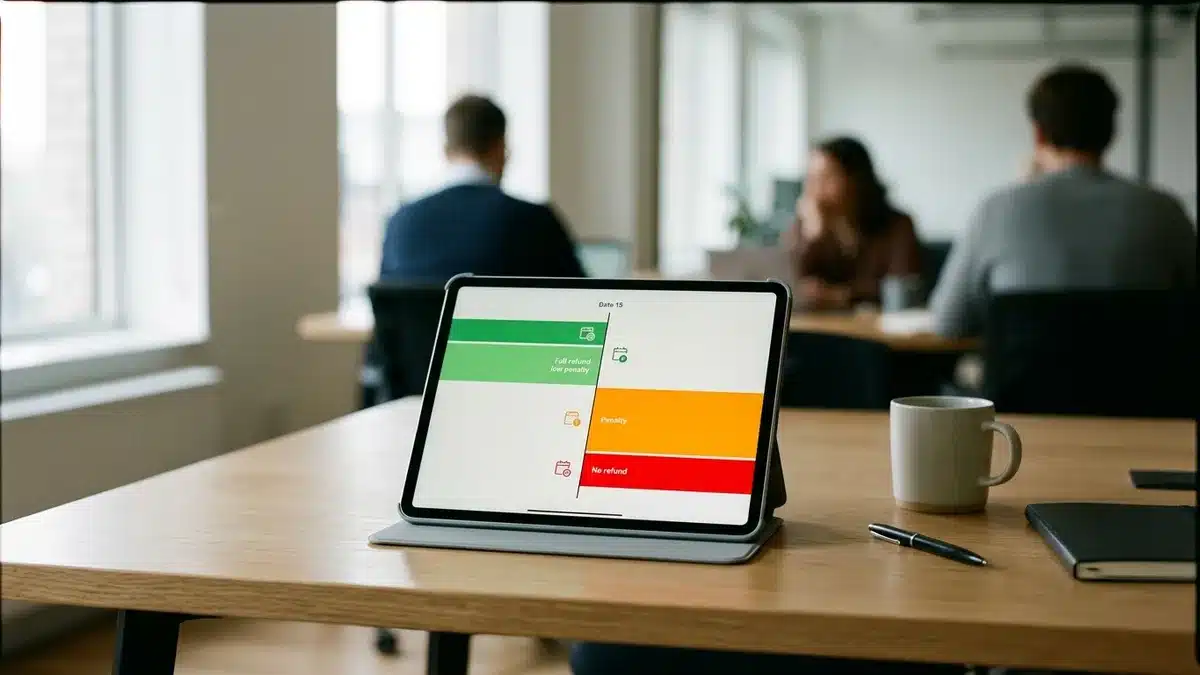
Airbnb cancellation policies define how much of a booking gets refunded to a guest, and how much penalty a host pays for canceling a confirmed reservation. Guests booking a standard stay under 28 nights typically get a 24-hour cancellation window with a full refund, including taxes, if the reservation was made at least 7 days before check-in.
For hosts, canceling has real financial consequences. Cancel within 48 hours of check-in or after check-in begins, and the cited policy applies a 50% fee on the reservation amount for remaining nights, with a minimum fee floor. Cancel between 48 hours and 30 days out and the fee drops to 25%; beyond 30 days, it’s typically 10%, again with that same minimum floor applying if the percentage works out lower.
The “reservation amount” used for this calculation includes the base nightly rate, cleaning fee, and any pet fees, but excludes taxes and the separate guest service fee. That distinction matters because it means the penalty is smaller than a host might assume if they’re mentally calculating against the full checkout total the guest saw.
These policies protect guests from last-minute cancellations that can ruin a trip, and give hosts a real incentive to keep confirmed bookings rather than holding out for a better one. Understanding exactly where these lines sit matters before assuming what a cancellation will actually cost.
What Happens If a Listing Goes Wrong or a Host Cancels?
When a listing is inaccurate or a host cancels unexpectedly, Airbnb’s dispute and protection systems, along with customer support, step in to arrange refunds, rebooking assistance, or compensation depending on the situation. Guests should document the issue with photos and messages through the app immediately, since that record supports any claim filed afterward.
If a host cancels a confirmed reservation, the guest is generally entitled to a full refund and, in many cases, assistance finding comparable alternative accommodation. The host faces the cancellation penalties described above plus potential calendar restrictions if cancellations become frequent. This is one of the most common gaps in beginner-level explainers: the process assumes bookings always go smoothly, and doesn’t answer what happens when they don’t.
For amenities or conditions that don’t match the listing description, such as a broken air conditioner in summer or a missing amenity that was advertised, guests can raise the issue through the messaging thread first, then escalate to Airbnb support if the host doesn’t resolve it. Documentation timestamps matter here more than almost anything else in the dispute process.
For hosts, protecting against these situations starts well before a guest checks in: keeping listing photos and descriptions current, testing amenities before each season, and setting a cancellation policy that reflects actual operational reality rather than the most guest-friendly option by default. A host who has to cancel repeatedly due to overbooking calendar errors is also signaling a deeper operational problem, often stemming from running multiple calendars manually across different channels without a synced system.
Instant Book vs. Request to Book: What’s the Real Difference?
Instant Book confirms a reservation the moment a guest completes checkout, with no host approval step, while Request to Book requires the host to manually accept or decline within a set window, typically 24 hours. The choice affects search visibility, guest screening, and how much control a host retains over who stays in their property.
| Factor | Instant Book | Request to Book |
|---|---|---|
| Confirmation speed | Immediate | Up to 24 hours for host response |
| Host screening control | Limited, pre-set requirements only | Full review of each request before accepting |
| Search ranking impact | Generally favored by Airbnb’s algorithm | No boost from enabling it |
| Risk of missed bookings | Low, no response window to miss | Higher if host doesn’t respond in time |
Stays of 28 nights or longer also operate under different terms than short stays, often with monthly payment structures rather than the full amount collected upfront, and typically with different cancellation terms attached. Hosts renting to longer-stay guests should confirm exactly which policy set applies before assuming standard short-stay rules carry over.
For hosts juggling both Instant Book and manual requests across multiple listings, the operational overhead of tracking response windows is real. Multi-property operators managing that volume manually often miss the 24-hour window at least occasionally, losing bookings they never saw in time to answer.
Practical Guidance: What Guests and Hosts Should Check Before Booking
Before completing any booking, both guests and hosts benefit from a short checklist that catches the most common sources of disputes and lost revenue. Guests should verify listing accuracy and policy terms; hosts should verify their own calendar accuracy and fee exposure before assuming a booking is pure profit.
For Guests
- Read recent reviews, not just the overall rating, to spot recurring complaints about cleanliness or accuracy.
- Confirm the exact cancellation policy attached to the specific dates being booked, since it can vary by listing and season.
- Message the host directly through Airbnb before booking if anything in the description is unclear, particularly parking, pet policy, or check-in logistics.
- Screenshot or save the listing description and photos at time of booking in case a dispute arises later.
For Hosts
- Calculate the true payout after the host service fee before setting a nightly rate, not just the sticker price shown to guests.
- Decide deliberately between Instant Book and manual requests based on how much screening control matters for the property type.
- Track which guests have stayed before and consider building a direct channel so repeat guests don’t automatically funnel back through Airbnb.
- Review the cancellation policy tier in place and confirm it matches actual business risk tolerance, not just the default setting.
That third point for hosts is where we spend most of our time at Boostly Connect. Once a host understands what Airbnb’s fee structure costs annually, the natural next question is how to capture more of those repeat guests directly. Our platform connects to 27 different property management systems, so pricing and availability sync to a host’s own website automatically, without a developer or manual data entry every time a booking comes in.
How Does the Global Vacation Rental Market Compare in 2026?
U.S. short-term rental listings are projected to reach 1.77 million in 2026, with occupancy averaging 57.4% and demand growth moderating to roughly 4.1% year over year as supply keeps expanding alongside it.
What this means practically for hosts: more competition for the same guest pool, and a growing incentive to differentiate through direct relationships rather than competing purely on OTA search ranking. As more spend shifts toward property management tools built to connect existing systems rather than replace them entirely, that’s exactly the category Boostly Connect operates in.
Frequently Asked Questions
What percentage does Airbnb take?
Airbnb typically takes a 3% host service fee under the standard split-fee structure (4% in Brazil and Mexico), while guests pay a separate service fee that generally ranges from 14.1% to 16.5% of the booking subtotal, according to Airbnb’s official fee page. These figures can vary by market, so check the exact breakdown at checkout for any specific reservation.
How much of a cut does Airbnb take overall?
Combining both sides of the fee, a typical $100 nightly booking results in the host receiving about $97 after the 3% host fee, while the guest pays around $115 once the guest service fee is added, per Airbnb’s own host-fee example. That spread funds payment processing, marketing, and support, which is why many hosts look for ways to reduce reliance on OTA bookings over time.
How much commission does Airbnb take compared to other OTAs?
Airbnb’s combined host and guest fees generally land in a similar range to other major OTA commission structures across the short-term rental industry, though the exact split between host-side and guest-side fees varies by platform. Confirm the current fee structure directly on the platform rather than assuming rates from a prior year still apply.
What CRM does Airbnb use for hosts?
Airbnb doesn’t offer hosts an external CRM; guest data and messaging live entirely inside Airbnb’s own platform and aren’t exportable into a host’s independent contact database. This is a main reason hosts adopt a separate guest CRM, like the one built into Boostly Connect’s CRM for short-term rental hosts, so that guest contact information captured through a direct booking website stays with the host permanently.
Will switching some bookings to direct hurt my Airbnb search ranking?
Running a direct booking website alongside an active Airbnb listing does not directly penalize Airbnb search ranking, since ranking is driven primarily by response rate, reviews, and booking activity on the platform itself. Most hosts run both channels simultaneously, using a direct site specifically to capture returning guests who already know and trust the property.
How long does it take to see results from reducing OTA dependency?
Results vary by property type, guest volume, and how actively a host promotes their direct channel, but many hosts start seeing repeat guests book direct within the first few months of launching a dedicated website. Consistency in guest communication and CRM follow-up tends to matter more than the platform switch itself.
Can a direct booking site handle multiple Airbnb listings at once?
Yes. Systems built for multi-property operators, including Boostly Connect, sync pricing and availability across an entire portfolio from a single connected PMS, rather than requiring separate manual setup for each individual listing. This is particularly relevant for boutique property managers running 5 to 20 units who need consistent pricing across every channel.
Where This Leaves Hosts Heading Into 2026
Airbnb’s fee structure, roughly 3% from hosts and 14.1% to 16.5% from guests under the current split model, funds a real service: search visibility, payment processing, and customer support at global scale. But that fee compounds every year a host relies on it exclusively, and it never returns the guest relationship back to the host once the stay ends.
Run the math and the pattern is clear: every returning guest who rebooks through Airbnb instead of a host’s own site is a fee paid twice on a relationship the host already earned. Fixing that doesn’t require leaving Airbnb behind. It requires connecting the property management system a host already uses to a website built to capture that guest directly, which is what Boostly Connect does, typically without a developer and in a fraction of the time most hosts expect.

If you’re ready to see what a direct booking website connected to your own PMS looks like in practice, book a demo with Boostly Connect and see your listings synced and a direct booking site live in under 20 minutes, no developer required.