
If you want to know how to re-engage past vacation rental guests, the short answer is this: you own their contact data, then reach out through a timed sequence of personalized emails and offers that invite them to book directly instead of returning to Airbnb. The window to do this closes fast: once a guest checks out, Airbnb owns that relationship unless you’ve already captured their details yourself.
- Guest data ownership is the real bottleneck. If a guest booked through Airbnb, you likely never got their email or phone number, meaning you have no way to reach them once the platform’s own remarketing kicks in.
- Timing matters more than most hosts realize. A structured sequence, typically running from 24 hours post-checkout out to 11 months later, consistently outperforms a single generic “come back soon” message.
- Small incentives outperform deep discounts. Vacasa’s own guidance suggests a modest 5 percent discount can be enough to inspire a returning stay, often paired with a low-cost local gift rather than a steep price cut.
- Segmentation changes the message. A guest who booked last-minute at full price behaves differently than one who chased a shoulder-season deal, and your re-engagement copy should reflect that.
- Airbnb’s own tools (Special Offers, the Re-book button, Wishlists) help, but they keep the relationship on Airbnb’s terms. Pairing them with an owned channel is how you actually shift bookings direct.
- Boostly Connect solves the root problem by capturing every direct booker automatically into a host-owned CRM and running the review request and repeat-stay nurture sequences without manual follow-up.
Most vacation rental hosts treat “guest retention” as an afterthought, something to think about once occupancy softens. That’s backwards. In our experience working with short-term rental operators, the guests who already stayed with you are the cheapest booking channel you have, and 2026 is the year that gap between OTA-dependent hosts and direct-booking hosts is widening fastest.
This guide covers what most articles on this topic skip: the actual timing cadence for outreach, how to segment guests by price sensitivity and booking channel, the psychological triggers that move a past guest to rebook, and how to measure whether your re-engagement effort is even working. We’ll also walk through where Boostly Connect fits into this, because a re-engagement strategy without an owned data layer underneath it is just wishful thinking.
Why Is Re-Engaging Past Guests Your Highest-ROI Marketing Channel?
Re-engaging past guests beats acquiring new guests because you already have proof they liked your property, you already have their contact information (if you captured it), and you don’t need to spend on ads to reach them. Acquiring a first-time guest typically costs more in time, ad spend, and OTA visibility competition than reactivating someone who already stayed.
Here’s the part hosts underestimate: a returning guest who books direct costs you nothing in commission. Compare that to a new Airbnb booking, where Airbnb typically charges guests around 14 percent in service fees on top of whatever host-side commission applies, according to ATLAS by AvantStay’s 2026 guest pricing data. Every returning guest you keep off Airbnb and onto your own site is margin you don’t have to fight for.
We’ve seen this play out concretely. One bed and breakfast using the Boostly framework pushed direct bookings to 90 percent of total reservations, and repeat guests climbed to 60 percent of that mix. That’s not a fluke: it’s what happens when you stop treating guest data as disposable and start treating it as an asset.
The math only works, though, if you actually have a channel to reach these guests through. That’s the part most hosts never solve, and it’s exactly why owning your guest data instead of leaving it inside Airbnb has to come before any re-engagement tactic you try.
How to Reengage Past Clients: What’s the Actual Timing Sequence?
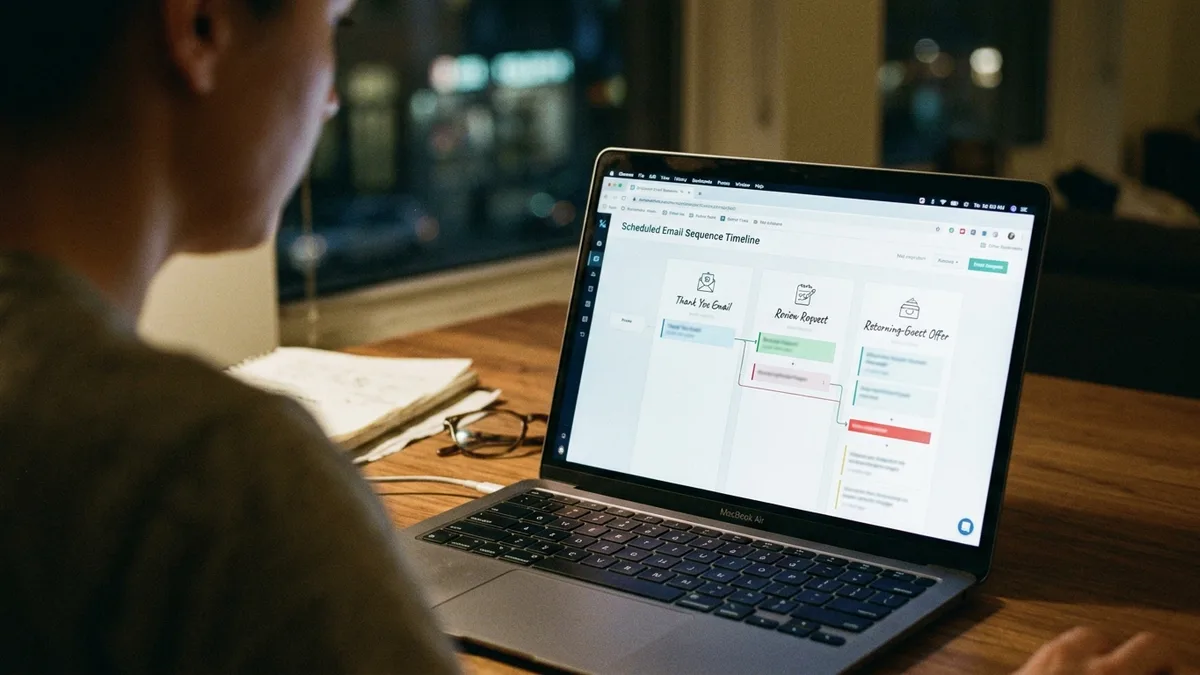
The optimal re-engagement sequence for vacation rental guests runs across five touchpoints: a thank-you within 24 to 48 hours of checkout, a review request follow-up around day 3, a returning-guest offer at day 30, a seasonal highlight email 60 to 90 days before their likely next travel window, and an anniversary message around 11 months post-stay with a modest returning-guest discount.
This staggered structure, drawn from patterns across multiple vacation rental retention frameworks, works because it mirrors how people actually plan trips. Nobody rebooks a vacation home the day after they get home. But they do open a “thank you for staying” email, and that first touch sets up everything after it.
The Five-Touch Sequence in Practice
- Day 1: Thank-you message. Simple, warm, no sales pitch. Just gratitude and an easy way to reach you again.
- Day 3: Review request, ideally paired with a soft nudge that you’d love to host them again.
- Day 30: A specific returning-guest offer. StayStrat’s framework, for example, uses language like “It’s been a month since your stay. If you’re ever planning another trip to [area], we’d love to welcome you back. As a returning guest, book directly with us and save 10 percent.”
- 60 to 90 days pre-season: A seasonal highlight, tying your property to an upcoming local event or travel window.
- Month 11: An anniversary email, often with a modest discount code, timed to land right as the guest starts thinking about next year’s trip.
Manually building and scheduling five separate emails per guest, across every guest you’ve ever hosted, is the kind of task that quietly eats an entire afternoon every week. That’s precisely the workload Boostly Connect’s guest CRM was built to remove: automated review requests and repeat-stay nurture sequences run on their own once a guest is captured, so you’re not rebuilding this timeline from scratch for every checkout.
How Should You Segment Past Guests Before Reaching Out?
Guest segmentation means grouping past guests by shared characteristics, such as booking channel, price sensitivity, travel season, or stay length, so each group receives a message relevant to their actual behavior instead of one generic blast. Segmentation is the single most overlooked step in vacation rental re-engagement.
Most hosts send the same “come back soon” email to every past guest. That’s a mistake. A guest who booked a last-minute weekend at full rate has a different relationship to your property than someone who booked six weeks out chasing a shoulder-season discount. Treat them identically and you waste the opportunity to personalize.
Practical Segments to Build
- By booking channel: Guests who came through Airbnb versus guests who already booked direct. The Airbnb-sourced group needs a stronger case for switching channels next time; your direct bookers just need a reason to return.
- By price sensitivity: Guests who booked during off-peak months (shoulder seasons and off-peak periods can run 15 to 20 percent or more below peak-season rates, per ATLAS by AvantStay) respond better to value-driven messaging, while peak-season bookers respond better to exclusivity and availability urgency.
- By stay length and party size: A family that booked a full week during summer break is a different re-engagement target than a couple who booked a weekend getaway.
- By review sentiment: Guests who left glowing reviews deserve a warmer, more personal outreach. Guests with a mixed or quiet experience need a different, more careful approach (more on that below).
Building these segments manually inside a spreadsheet, and updating them every time a new guest checks out, becomes unmanageable past a handful of properties. This is one of the clearer cases where Boostly Connect’s built-in guest CRM earns its keep: every direct booker is captured automatically with their booking data intact, so you can segment by season, channel, or spend without a separate export-and-sort process.
What Psychological Triggers Actually Drive Repeat Bookings?
The psychological triggers that reliably drive repeat vacation rental bookings are scarcity (limited-time offers), social proof (reviews and repeat-guest counts), and exclusivity (returning-guest-only perks). Vacation rental guests respond to these signals the same way shoppers respond to them in retail, because a rental booking is still a purchase decision made under uncertainty.
Scarcity Without Sounding Desperate
Scarcity works when it’s specific and true, not vague and pushy. “Your dates might still be available, check here” (a phrasing GuestIntro’s guidance recommends) works because it’s a genuine prompt, not a countdown timer trying to manufacture panic. Avoid fake urgency; past guests can smell it, and it damages the trust you built during their stay.
Social Proof From Guests Who Already Trust You
A guest who already stayed with you doesn’t need convincing that your property is nice, they experienced it firsthand. What they need is a reminder that other people also loved it. Reference your repeat-guest percentage, or simply ask “if you know anyone who’d love this place, I’d appreciate you sharing our website” (a tactic GuestIntro also recommends), and you lean on the trust you’ve already earned rather than trying to build it from zero.
Exclusivity That Feels Earned
Returning-guest-only offers work because they reward loyalty rather than just discounting broadly. A 5 percent returning-guest rate, per Vacasa’s guidance, or a small local gift like a coffee shop gift card, can be enough to tip a hesitant past guest toward booking again, without training your entire guest base to wait for a sale.
None of these triggers matter if the message never reaches the guest, or reaches them with generic, unpersonalized copy. That’s where a dedicated CRM built for short-term rental hosts changes the equation: it’s the infrastructure that makes personalization at scale actually possible instead of theoretical.
What Discount or Incentive Level Actually Works Without Killing Margin?
The discount level that maximizes repeat vacation rental bookings without eroding margin typically sits in the 5 to 15 percent range, with smaller discounts (around 5 percent) paired with a low-cost added perk outperforming steep blanket discounts that train guests to expect a deal every time.
Vacasa’s guidance is instructive here: a 5 percent discount to returning guests can be enough to inspire another stay, and a small add-on like a local coffee shop gift card can work just as well as, or alongside, a price cut. StayStrat’s framework goes further, suggesting free upgrades (early check-in, late checkout, a welcome basket) as an alternative to discounting at all, preserving your rate integrity while still delivering perceived value.
When to Offer a Deeper Discount
Deeper discounts (in the 10 to 15 percent range) make sense at specific moments: the 11-month anniversary touchpoint, a guest who left an exceptional review, or a booking window during a historically slow month where filling the calendar matters more than protecting rate. Outside those moments, a smaller incentive plus a personal touch usually converts just as well and protects your average daily rate.
The mistake we see most often: hosts default to discounting because it’s the easiest lever to pull, then wonder why margins shrink even as occupancy improves. A returning-guest offer should feel like a reward, not a permanent price reduction. Build this logic into an automated sequence, rather than deciding case by case, and you get exactly the kind of workflow a direct booking strategy is supposed to formalize.
How Do You Handle Guests Who Left a Bad Review or Had a Rough Stay?
Handling a past guest who had a negative experience means you acknowledge the issue directly, show what changed since their stay, and invite them back with a specific, concrete improvement rather than a generic apology. Ignoring these guests in your re-engagement sequence, or treating them identically to your happiest past guests, is a common and costly mistake.
Homevy’s guidance notes that communicating property updates based directly on guest feedback strengthens loyalty because it makes the guest feel heard, not just placated. Say a guest complained about slow Wi-Fi during a stay in your two-bedroom cabin unit and you upgraded the router afterward: name that fix directly in your outreach. “We upgraded the Wi-Fi after your visit” reads as genuine. “We’ve made some improvements” reads as damage control.
What Not to Do
- Don’t send this guest the same discount-heavy offer as your five-star reviewers. It can read as tone-deaf if the issue wasn’t addressed.
- Don’t ignore them entirely and hope they forget. Silence after a poor stay often reads as indifference.
- Don’t over-apologize in a way that reopens the complaint without offering resolution.
Segment your CRM by review sentiment so these guests get a distinct, careful outreach track rather than your standard sequence. Most re-engagement guides skip this entirely. It’s also exactly the kind of segmentation that becomes practical once your guest data lives in one connected system instead of scattered across OTA messaging threads and spreadsheets.
What Is the 75 55 Rule in Airbnb, and Does It Affect Repeat Guests?
There isn’t a documented, official Airbnb policy called the “75/55 rule.” The phrase circulates among hosts as shorthand for Airbnb’s Superhost and ranking-adjacent expectations around response rate and acceptance behavior, but Airbnb hasn’t published a rule under that specific name, and it has no direct bearing on whether a past guest rebooks with you off-platform. If you’re worried that focusing energy on direct re-engagement will hurt your standing inside Airbnb’s own metrics, you can stop worrying: retention efforts that happen outside the platform don’t touch your on-platform performance data at all.
What actually affects repeat bookings from an Airbnb-sourced guest is whether you captured any way to reach them after checkout. If a guest booked entirely through Airbnb messaging and never gave you an email or phone number through a separate channel, your options are limited to Airbnb’s own retention tools: Special Offers, the Re-book button, and Wishlists.
Airbnb’s Native Tools Versus an Owned Channel
Airbnb’s Re-book button simplifies the process for a guest who wants to return, and Homevy’s guidance suggests you mention it explicitly in your post-stay message to make rebooking easier. Special Offers let you extend a personalized discount directly through Airbnb’s messaging system. Wishlists let guests save your property for future reference.
These tools work, but they keep the entire relationship, and the commission, inside Airbnb’s ecosystem. The guest still pays Airbnb’s service fee, and you still pay host-side commission on every rebooking. Pair these native tools with an owned email and SMS channel, and you can actually shift a repeat guest from an Airbnb rebooking to a direct one over time, which is precisely the transition a balanced OTA and direct booking strategy is designed to manage. Boostly Connect maps directly onto this transition: it’s the owned-channel layer that sits alongside Airbnb’s tools rather than replacing your listing there.
What Is the 80 20 Rule for Airbnb, and How Does It Apply to Guest Retention?
There’s no official Airbnb policy called the “80/20 rule” either. It’s a borrowed version of the Pareto principle that hosts apply informally to guest retention: a small share of your past guests, often your repeat bookers and referral sources, generate a disproportionate share of your future revenue, meaning your re-engagement effort should weight most heavily toward guests who have already shown a pattern of returning or referring others.
In practice, this means your highest-value re-engagement target isn’t every guest who ever stayed with you. It’s the guest who’s already stayed twice, the guest who referred a friend, or the guest who consistently books your highest-margin dates. Spend equal effort on a one-time weekend booker and a three-time repeat guest, and you misallocate your limited outreach capacity.
Applying This to Segmentation
Once you’ve segmented guests by booking channel and price sensitivity (covered earlier), layer in a loyalty tier: first-time guests, repeat guests, and referral sources. Give repeat guests and referral sources your best incentives and most personal outreach, because based on what we see across operator portfolios, this smaller group consistently converts at a far higher rate than a cold or one-time guest list.
This kind of tiered prioritization is nearly impossible to maintain manually once you’re managing more than a handful of properties. It’s one of the clearer reasons multi-property operators lean on a connected system for managing multiple vacation rentals rather than tracking guest history property by property. Boostly Connect’s tiering lives inside the same CRM that runs your sequences, so a guest’s loyalty tier and their next scheduled touchpoint sit in one place instead of two.
What Multi-Channel Tactics Work Beyond Email?
Multi-channel re-engagement for vacation rentals means combining email with SMS, in-property signage, and social media touchpoints, since past guests don’t check every channel with the same frequency, and reaching them where they’re already paying attention increases the odds of a response.
Email remains the backbone of most re-engagement sequences because it’s low-cost and easy to automate. But it’s not the only channel worth using, and in 2026, relying on email alone leaves reach on the table.
Practical Multi-Channel Additions
- SMS: Shorter, more immediate, and better suited to time-sensitive offers like a last-minute availability opening.
- QR codes in the welcome book: A simple prompt like “Join our list for local tips and future offers” (a tactic used in several published guest retention frameworks) captures contact data during the stay itself, before the guest even checks out.
- Social media: Platforms like Instagram and Facebook work well for seasonal content and property updates that keep your property visible between stays, even for guests who haven’t opted into email.
- Google Ads or Meta Ads retargeting: For hosts with a larger past-guest list, paid retargeting campaigns aimed specifically at people who’ve already stayed can supplement organic outreach.
The challenge with multi-channel outreach is coordination: keeping SMS, email, and social messaging consistent without duplicating effort or contradicting your timing sequence. Boostly Connect’s CRM includes email and SMS automation in one connected system, so you don’t have to build a returning-guest offer twice across two disconnected tools.

How Do You Measure Whether Your Re-Engagement Effort Is Actually Working?
Measuring re-engagement ROI for vacation rentals means tracking the percentage of total bookings that come from returning guests, the conversion rate of your re-engagement email sequence, and the average booking value of a repeat direct guest compared to a new OTA-sourced guest. Without these numbers, you’re guessing whether the effort is paying off.
The clearest benchmark we can point to: a bed and breakfast running the Boostly framework reached 60 percent repeat guests as part of a 90 percent direct booking mix. Track that kind of number against your own portfolio, not as a universal target, but as a sign of what’s achievable when you treat re-engagement as core infrastructure rather than an occasional email blast.
Core Metrics to Track
| Metric | What It Tells You |
|---|---|
| Repeat guest percentage | Share of total bookings from guests who’ve stayed before |
| Sequence open and click rate | Whether your re-engagement emails are actually being read |
| Direct booking conversion rate | How many re-engaged guests book direct versus return to Airbnb |
| Average booking value, repeat vs. new | Whether returning guests book longer stays or higher-value dates |
| Referral-sourced bookings | Bookings generated indirectly through past-guest word of mouth |
Most hosts have no reliable way to see these numbers because the data lives split across their PMS, their email tool, and Airbnb’s own dashboard. Boostly Connect’s reporting dashboard tracks direct booking revenue and ROI in one place, so you’re not guessing whether re-engagement works, you’re looking at the number.
What Legal and Privacy Considerations Apply When Marketing to Past Guests?
Marketing to past vacation rental guests requires consent-based data collection and compliance with applicable privacy regulations, meaning you need a clear opt-in for email and SMS communication rather than assuming a past booking automatically grants you permission to market to that guest indefinitely.
This matters more in 2026 than it did a few years ago. Data privacy expectations have tightened under frameworks like GDPR in the EU and the growing patchwork of US state privacy laws (California’s CCPA among them), and guests are more aware of how their information gets used. If you’re collecting contact details through a welcome book, a Wi-Fi login page, or a direct booking form, make the opt-in explicit rather than implied. A guest who booked through Airbnb and never separately opted into your mailing list should not receive unsolicited marketing emails from you directly.
Practically, this means you build your guest list through consent-based capture: a checkbox at checkout on your direct booking site, a QR code sign-up in the welcome book, or an explicit ask during the stay. We built Boostly Connect’s guest CRM around exactly this principle, consent-based capture at the point of direct booking, rather than pulling contact details from other channels, so the compliance question is handled at the point of collection instead of left for you to sort out later.
What Are Red Flags for Airbnb Guests, and Should That Affect Your Re-Engagement Strategy?
Red flags for Airbnb guests typically include a history of property damage, repeated cancellations, negative reviews from previous hosts, or communication that raises concern before check-in, and these signals matter for re-engagement because they help you decide which past guests are actually worth inviting back.
Not every past guest deserves a spot in your win-back sequence. If a guest left your property in poor condition, violated house rules, or generated a dispute during their stay, adding them to your automated returning-guest nurture sequence isn’t just wasted effort, it’s a risk. Filter these guests out of your CRM segments before running any re-engagement campaign, and you protect both your property and your time.
This is another place where manual guest tracking falls apart at scale. Remembering which of two hundred past guests had an issue, without a system flagging it, is unrealistic past a handful of bookings. This is exactly why we built incident notes directly into Boostly Connect’s guest profiles: booking history, review sentiment, and any flagged issue sit on the same record, so a guest who damaged a property or triggered a dispute doesn’t accidentally land in your automated win-back sequence six months later.
Practical Guidance: How Do You Prioritize Your First Re-Engagement Push?
Prioritizing your first vacation rental re-engagement campaign means starting with your highest-value segment, typically repeat guests and five-star reviewers from the last 12 to 18 months, rather than attempting a full-scale campaign across your entire guest history on day one.
A Step-by-Step Starting Framework
- Audit what guest data you actually have. Pull contact details from your PMS, any direct bookings, and any consent-based sign-ups. Note how many guests you can legally and practically reach.
- Segment by loyalty tier first. Separate repeat guests and referral sources from one-time bookers before anything else.
- Build the five-touch sequence for your top segment only. Don’t try to launch a full multi-channel campaign across every guest simultaneously.
- Set your incentive level before you write the copy. Decide on a 5 to 15 percent range (or a non-discount perk) so your messaging stays consistent.
- Track your baseline metrics before you launch. You can’t measure improvement without knowing your current repeat guest percentage.
- Expand to broader segments once the first sequence proves out. Scale to lower-tier guests and past bad-experience guests only after your top segment shows results.
Common Mistakes to Avoid
- Sending one generic email to your entire guest history instead of segmenting first.
- Discounting too deeply, training guests to wait for a sale instead of booking at your standard rate.
- Forgetting to include one clear call to action per message, a principle Hostrexa’s guidance specifically emphasizes.
- Relying entirely on Airbnb’s Special Offers and Re-book tools without ever building an owned channel.
- Never measuring conversion, so you can’t tell if the effort is actually paying off.
If you’re starting from zero, with no CRM and no consent-based guest list yet, that’s the actual first problem to solve, not the email copy. That’s the gap building a direct booking channel from zero is meant to close, and it’s the foundation everything in this guide depends on.
Frequently Asked Questions
How often should I email past vacation rental guests?
A five-touch sequence spread across roughly 11 months, thank-you, review request, 30-day offer, seasonal highlight, and an anniversary message, tends to outperform sporadic one-off emails. Beyond that structured sequence, occasional seasonal updates (two to four times a year) keep you visible without overwhelming the guest’s inbox.
Do I need a direct booking website to re-engage past guests effectively?
Yes, in practice you do. A social media page alone doesn’t let a guest check live availability, see current pricing, or pay securely, which are the three things a past guest needs to actually rebook without going back through Airbnb.
What’s the best discount to offer returning guests without hurting my margins?
Most hosts find a 5 to 15 percent range works well, with smaller discounts around 5 percent often paired with a low-cost perk like a local gift card. Reserve deeper discounts for specific moments, like an anniversary touchpoint or a historically slow booking month.
How do I get guest email addresses if most of my bookings come through Airbnb?
Capture contact details through consent-based methods during the stay itself: a QR code in the welcome book, a Wi-Fi login page, or an explicit sign-up prompt on your own direct booking site. You cannot assume an Airbnb booking alone grants you permission to email a guest directly.
Should I still use Airbnb’s Special Offers and Re-book button?
Yes, they’re useful for guests you can only reach through Airbnb’s own messaging system. But pair them with an owned email and SMS channel, and you can eventually shift that same guest to a direct, commission-free booking over time.
How do I re-engage a guest who left a negative review?
Acknowledge the specific issue, mention any concrete change you’ve made since their stay, and avoid sending them the same offer as your happiest guests. A vague apology reads as damage control; naming the exact fix reads as genuine.
What’s the difference between guest retention and guest re-engagement?
Guest retention generally refers to the ongoing relationship-building that keeps a guest loyal to your property over time. Re-engagement is the specific, timed outreach effort aimed at converting a past guest into a new booking. Re-engagement is one tactic within a broader retention strategy.
Can I automate my guest re-engagement sequence without a developer?
Yes. Modern guest CRM platforms, including Boostly Connect, are built for no-code setup, meaning you can configure a timed email and SMS sequence without writing code or hiring a developer to build it for you.
Conclusion: Turning Past Guests Into Your Most Predictable Revenue Stream
Re-engaging past vacation rental guests comes down to three things working together: owning the contact data in the first place, running a timed sequence rather than a one-off email, and segmenting your outreach so the message actually fits the guest. Skip any one of those three, and the effort underperforms.
The hosts who get this right aren’t doing anything exotic. They’re treating their guest list as real infrastructure, the same way they treat their pricing strategy or their cleaning schedule, not as a side project they’ll get to eventually. As we head further into 2026, with online travel sales continuing to grow as a share of total travel revenue, you have a meaningful edge over hosts still starting from scratch if you’ve already built an owned channel to your past guests.
That’s exactly the infrastructure Get started with Boostly Connect was built to provide: your existing PMS synced to your own website in under 20 minutes, every direct booker automatically captured into your own CRM, and the review request and repeat-stay nurture sequences running on their own once it’s set up. If you’re tired of watching past guests rebook through Airbnb instead of you, the next step is seeing exactly how this would work for your property.

If keeping past guests in your own hands (not Airbnb’s) sounds like the missing piece in your booking strategy, book a demo and we’ll walk through connecting your existing PMS and setting up your first automated guest sequence live.