

Ranking a vacation rental website on Google starts with picking one specific location keyword, publishing at least 800 words of unique content per property page, and getting the site properly indexed through Google Search Console before you touch anything else. There is no shortcut around those three steps, and most new hosts skip all of them.
- Start with one keyword, not ten. A brand-new site should target a single [property type] plus [location] combination rather than trying to rank for “vacation rentals” broadly.
- Technical SEO comes before content. If Google can’t index your site through a submitted sitemap and robots.txt file, no amount of writing will help you rank.
- Photos and alt text matter more than most hosts realize. Industry guidance recommends at least eight high-quality photos per listing with descriptive alt text, not generic filenames like IMG_1234.jpg.
- Google Business Profile and NAP consistency drive local visibility. Your name, address, and phone number need to match exactly across your website, directories, and your Google profile.
- Direct booking sites and OTA listings can coexist. Ranking your own site on Google doesn’t require pulling your listing from Airbnb or Vrbo, it builds a second channel alongside them.
- Boostly Connect ships SEO-ready property pages and blog infrastructure from day one, so you’re not starting from a blank, unranked page with zero technical foundation.
If you’re reading this, you probably just launched a website for your rental, or you’re about to, and you have no idea where Google will actually put it. That’s normal. In 2026, the vacation rental market is worth well over $100 billion globally by most industry estimates, and a growing share of that demand starts with a Google search, not an OTA app.
We work with hosts every day who assume a website alone generates traffic. It doesn’t. A site with no indexed pages, no location keyword focus, and no photo optimization sits invisible on page nine of Google forever. This guide walks through the exact sequence: what to do in week one, what mistakes tank new sites, and how to structure a single-property page correctly even if you have no marketing budget and no SEO agency.
We’re going to treat this as a real 30-day plan for someone starting completely from scratch, because that’s the gap most vacation rental SEO content leaves unaddressed. Most guides assume you already have a portfolio, a booking engine, and a marketing budget. This one doesn’t.
What Does It Actually Take to Rank a Vacation Rental Website on Google?
Ranking a vacation rental website on Google requires three layers working together: technical accessibility (Google can crawl and index your pages), on-page relevance (your content matches what a specific searcher is typing), and trust signals (reviews, backlinks, and consistent business information). Miss any one layer and the other two won’t compensate.
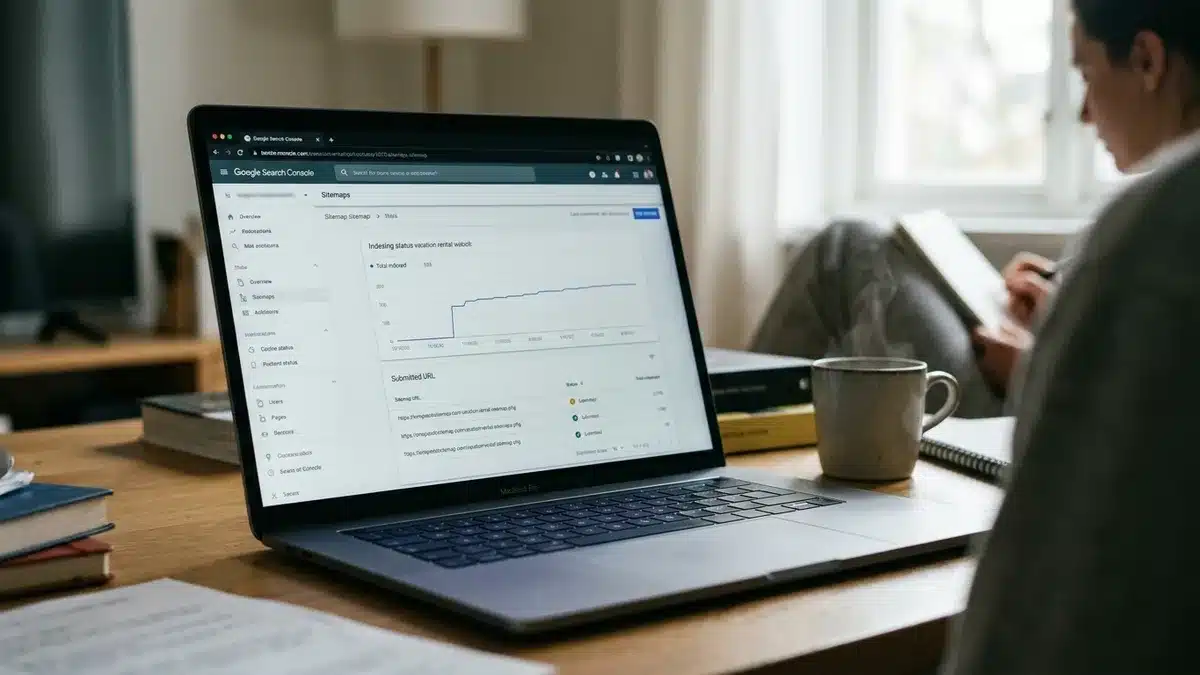
Most new hosts jump straight to writing blog posts about their destination, skipping the technical layer entirely. That’s backwards. If your sitemap was never submitted to Google Search Console, your beautifully written property description sits unindexed and invisible, no matter how good it is.
We’ve seen this exact pattern with hosts who came to us after building a site themselves. They wrote a nice homepage, added some photos, and waited. Nothing happened for months, because nobody told Google the pages existed. That’s precisely why a direct booking website built for short-term rentals should include indexing setup as a default step, not an optional add-on you have to know to ask for.
The order matters: fix indexing first, then optimize on-page content, then build trust signals through reviews and citations. Skipping ahead to content or backlinks before your site is even crawlable wastes effort you can’t get back.
How Do You Target the Right Location Keyword When You Have Zero Visibility?
A new vacation rental site should target one narrow location keyword using the formula: property type plus unique feature plus location, rather than competing for broad, high-volume terms like “cabin rental” that established sites already dominate. Specificity is your only advantage when you’re starting at zero.
For example, “pet-friendly lake cabin Broken Bow” beats “Broken Bow cabin rental” because fewer sites compete for it, and it matches exactly what a specific traveler is searching. This is the single biggest content gap we see in vacation rental SEO advice: nobody tells brand-new owners to go narrow first and expand later.
Once that page ranks and starts pulling traffic, you can add a second page targeting a related term, then a third. Trying to rank for five keywords at once with one page dilutes relevance and confuses Google about what the page is actually about.
If you manage more than one property, this same logic scales. Each property gets its own page targeting its own specific keyword combination rather than one generic “our properties” page trying to rank for everything. That’s a structural decision that gets harder to fix later, so get it right from the start. If you’re juggling more than a couple of listings already, our guide on managing multiple vacation rentals without chaos covers how page structure needs to change as your portfolio grows.
How Do You Structure a Single-Property Page That Google Actually Understands?
A Google-friendly single-property page needs a clear title tag with your location keyword near the front, a meta description under 155 characters, at least 800 words of unique descriptive content, and a URL structure that’s short and readable. Thin pages under 300 words rarely rank against competitors with fuller content.
Here’s what that page needs, specifically:
- A title tag that reads naturally, such as “Cozy 2-Bedroom Cabin Near Broken Bow Lake, Oklahoma” rather than a generic “Home” or “Welcome.”
- A meta description that states the property type, location, and one standout feature in under 155 characters.
- Descriptive body content covering the neighborhood, nearby attractions, what makes the property distinct, and practical guest information, targeting roughly 800 or more words per PriceLabs’ published SEO checklist guidance.
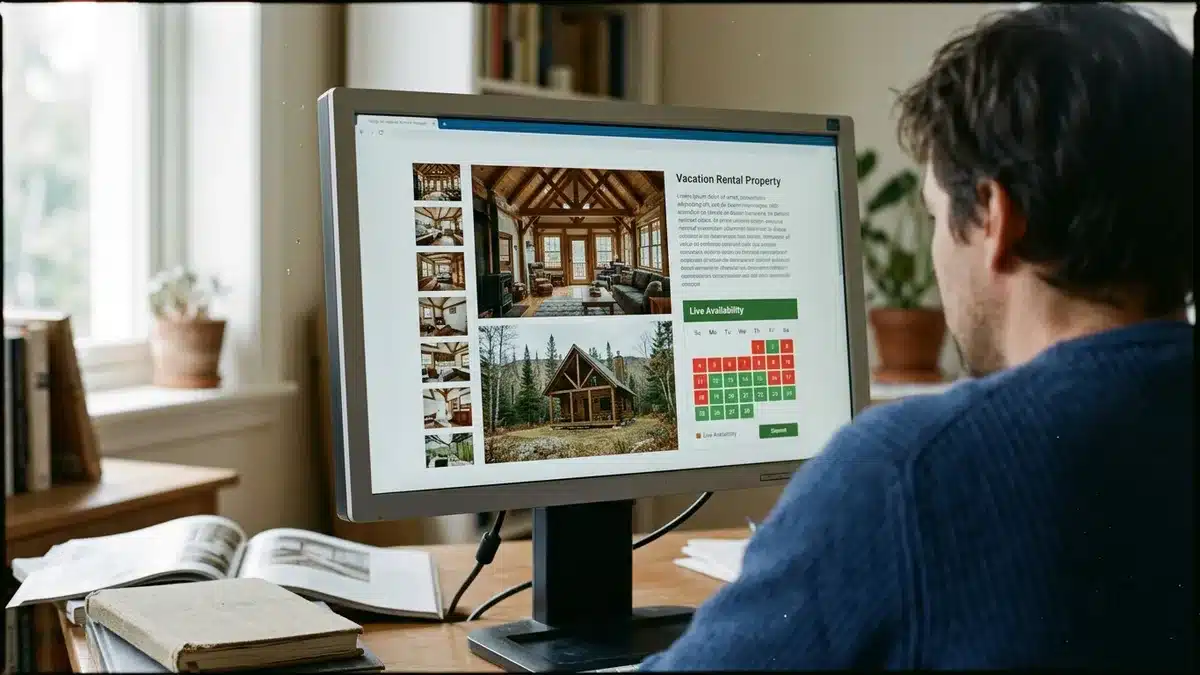
- At least eight high-quality photos with descriptive alt text like “lakefront-deck-view-broken-bow-cabin.jpg” instead of a default camera filename.
- Schema markup, including review schema, so star ratings and rich snippets can display directly in search results.
A single property with no booking engine and no portfolio can absolutely rank on this structure alone. You don’t need ten listings to justify doing SEO correctly. This is exactly the setup we built into Boostly Connect’s property page templates: mobile-first layouts with the schema, alt text fields, and word-count structure already in place, so you’re not researching every field from scratch on your own.
What Technical SEO Steps Do New Sites Skip That Cost Them Rankings?
Technical SEO refers to the behind-the-scenes setup that lets Google crawl, index, and understand your website, and new vacation rental sites consistently skip it in favor of visible content like photos and copy. An XML sitemap submitted through Google Search Console and a properly configured robots.txt file are the two most commonly missed steps.
Site speed is the next casualty. A vacation rental homepage loaded with unoptimized, full-resolution photos can take several seconds to load on mobile, and Google’s ranking systems weigh page speed as part of the overall experience signal. Compress your images before upload, always.
Mobile-friendliness matters just as much, since most travel searches now happen on a phone. Google’s free Mobile-Friendly Test tool will flag layout issues instantly, and it costs nothing to check. HTTPS (the padlock icon in your browser bar) is now table stakes; a site without it gets flagged as insecure and loses trust immediately.
Here’s the honest tradeoff: fixing technical SEO yourself means learning Search Console, sitemap generation, and speed optimization from scratch, which can eat a full weekend for someone with no development background. That’s precisely the gap a done-for-you platform closes. Boostly Connect’s property pages and blog structure are built on WordPress with the sitemap, mobile optimization, and HTTPS handled as part of setup, not as a separate project you have to tackle later.
What Local SEO Steps Actually Move the Needle for a Vacation Rental?
Local SEO for a vacation rental means claiming and optimizing a Google Business Profile, maintaining consistent name, address, and phone (NAP) information across every directory and citation, and encouraging guest reviews that reinforce local relevance. This is separate from on-page SEO and often gets neglected by hosts focused only on their website.
NAP consistency sounds minor until you realize how many places your business information can drift: your website footer, your Google Business Profile, any directory listing, even your email signature. If your phone number differs by one digit across two of these, Google’s local algorithm treats it as a trust signal problem, not just a typo.
Reviews compound this. A property with a steady stream of recent, genuine reviews signals activity and trustworthiness, both to Google’s local ranking system and to a traveler scanning search results. This is also where a repeat guest strategy pays off twice: guests who book direct and have a great stay are the easiest reviews to collect, because you already have a direct line to them through email, not through an OTA’s messaging system that disappears after checkout.
That’s a big part of why we built the CRM layer inside Boostly Connect the way we did. Every guest who books direct gets automatically captured into your own contact list, so following up for a review after checkout isn’t a manual task you remember to do sometimes, it’s an automated sequence that runs whether you’re at your desk or not. If you want the deeper mechanics of why owning that guest data matters beyond just reviews, we cover it in how to own guest data from Airbnb and why it matters.
How Do You Get Listed on Google Vacation Rentals?
Google Vacation Rentals is a free listing program inside Google Travel and Google Hotel Search that displays your property alongside hotels and other rentals for relevant location searches. Getting listed requires either working with an approved connectivity partner or integrating through Google’s Hotel Center, and eligibility generally depends on having live pricing and availability data that can sync automatically.
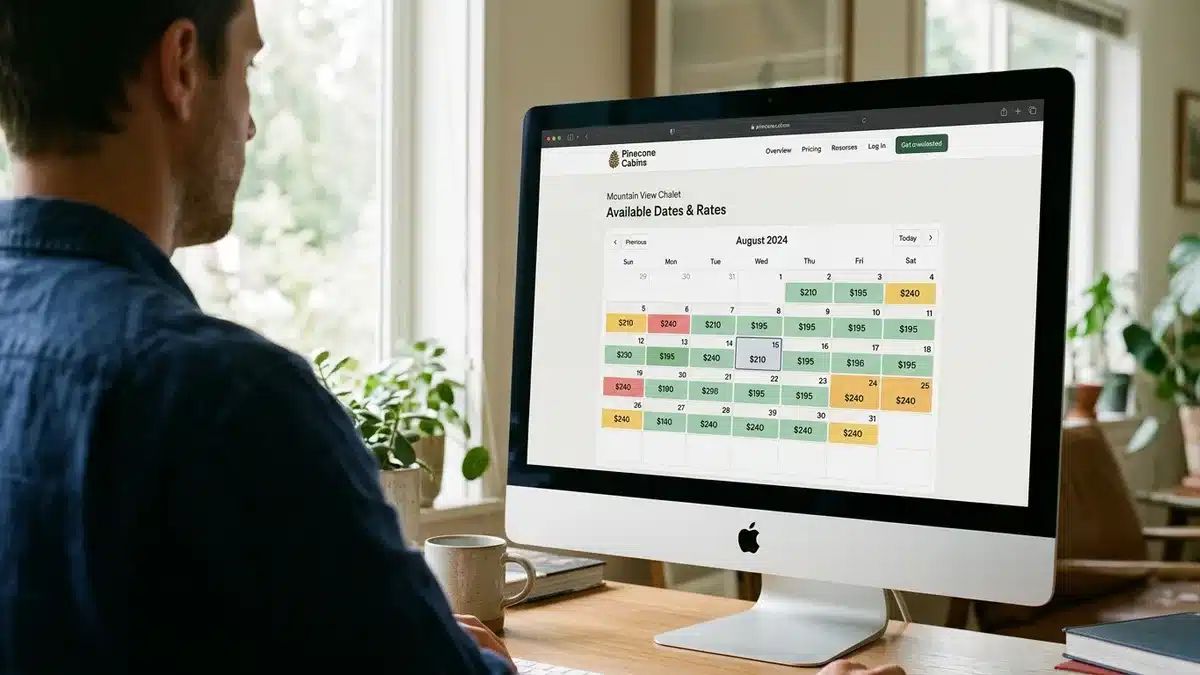
This program is worth understanding even if you never use it, because it illustrates a broader point: Google increasingly rewards sites with real-time, structured data over static pages. A property page with a live availability calendar and current pricing carries more weight than one showing a “contact us for rates” form from three years ago.
That’s precisely the technical requirement a manual WordPress site struggles to meet without a live PMS connection. Boostly Connect’s direct integration pulls real-time availability and pricing straight from your existing property management system, which is the same kind of structured, current data that supports both Google Vacation Rentals eligibility and general on-page freshness signals. If real-time pricing on your own site is a topic you want to go deeper on, our piece on real-time pricing for your vacation rental website walks through the mechanics.
Is Google Vacation Rentals Worth It for a Single-Property Host?
Google Vacation Rentals can be worth pursuing for a single-property host, but it works best as a complement to a strong direct booking site rather than a replacement for one. The program increases visibility in Google Travel search results, but it still routes bookings back through your existing connectivity setup rather than functioning as an independent marketing channel on its own.
For a brand-new host with one property and no existing PMS integration, the setup overhead may not be worth prioritizing in month one. Get your on-page SEO and Google Business Profile solid first. Once your site is indexed and pulling organic traffic, layering in Google Vacation Rentals becomes a lower-effort addition rather than a standalone project.
Some Reddit discussions among short-term rental operators raise concerns about guest quality through this channel compared to a direct site where the traveler already chose you specifically. That’s a fair point worth weighing: a guest who found you through a Google Travel aggregator hasn’t necessarily read your reviews or your house rules the way someone who landed on your dedicated site has.
Should You List Your Vacation Rental on Multiple Sites?
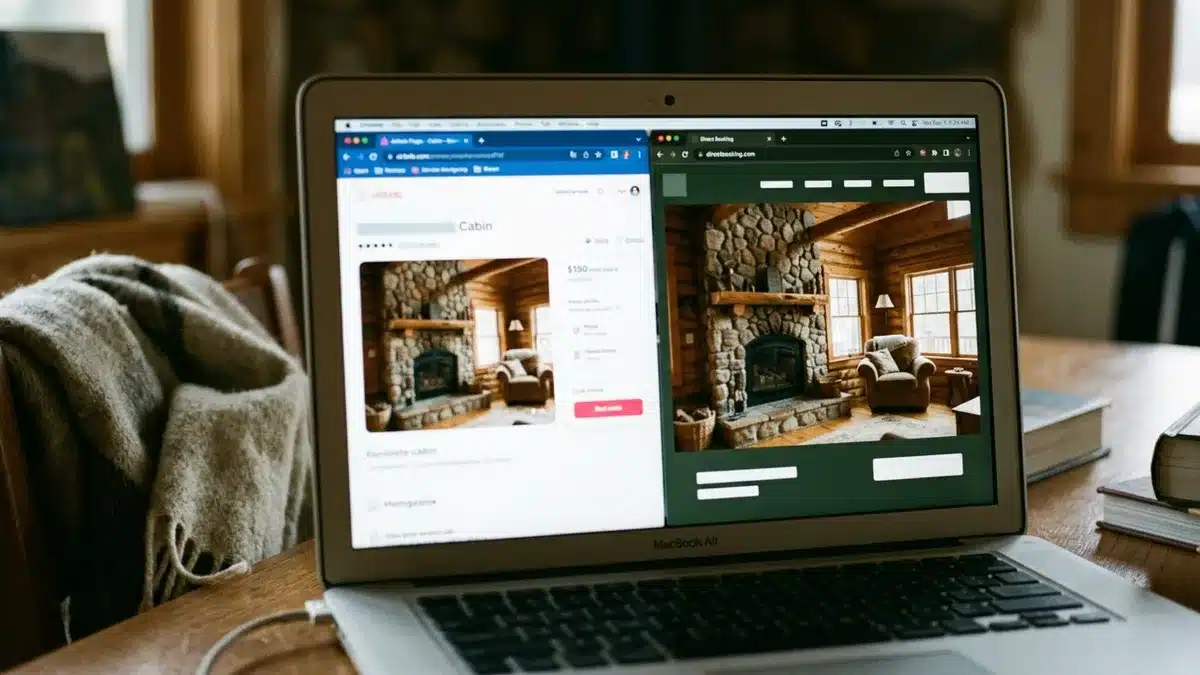
Listing your vacation rental across multiple platforms, including Airbnb, Vrbo, and your own direct booking website, is standard practice and does not conflict with ranking your website on Google. Industry guidance consistently recommends multi-platform visibility alongside professional photography and social media promotion as complementary strategies, not either-or choices.
The confusion we hear most often from hosts: “won’t building my own site hurt my Airbnb ranking?” No. Airbnb’s search algorithm ranks your listing based on your performance within Airbnb, response rate, review score, booking activity, not based on whether you also have a website. These are separate ecosystems.
What actually happens when you do this well is a shift in booking mix over time, not a loss on either side. We’ve seen this play out directly: one B&B we worked with grew from a website generating inconsistent results to 90% direct bookings and 60% repeat guests, while still maintaining their presence elsewhere. Another host built a portfolio from a handful of self-managed properties to over 30 units, reaching 55% direct bookings after consistently applying a direct booking strategy alongside his existing channels.
The strategic question isn’t “OTA or direct,” it’s how you balance the two so neither cannibalizes the other. That’s exactly the framing in our guide on how to balance OTA and direct bookings in 2026, if you want the fuller channel strategy beyond just the SEO angle.
What Content Strategy Actually Builds Long-Term Google Authority?
A content strategy that builds long-term authority for a vacation rental website combines individual property pages, destination guides for the surrounding area, and a regularly updated blog targeting traveler intent, not just booking-focused keywords. This mix signals to Google that your site is a genuine resource, not a thin sales page.
Destination content matters more than most hosts expect. A blog post about “best hiking trails near [your property’s location]” captures searchers who haven’t decided where to stay yet, but who will land on your site during the research phase and remember your property when it’s time to book. This is top-of-funnel content that a pure listing page can never capture.
Consistency beats volume here. Publishing one well-researched, 800-plus word post per month for a year builds more authority than a burst of ten thin posts published in a single week and then abandoned. Google’s systems reward sites that show sustained, genuine effort over time, not sites gaming for a quick spike.
This is also where a lot of self-managed hosts stall out, not because they lack ideas, but because writing and publishing consistently competes with actually running the property. Boostly Connect’s built-in blog structure removes the technical setup barrier (formatting, SEO fields, indexing) so the only remaining task is writing, which is a much smaller lift than building a publishing system from scratch.
Vacation Rental SEO Data and Benchmarks You Should Know for 2026
| SEO Factor | Benchmark or Guidance | Why It Matters |
|---|---|---|
| Property page word count | 800+ words per page | Thin pages under 300 words rarely outrank fuller competitor content |
| Photos per listing | At least 8 high-quality images | Meets Google’s visual content guidelines and improves engagement signals |
| Alt text format | Descriptive file names (e.g. lakefront-deck-broken-bow.jpg) | Helps Google’s image search understand and index visual content |
| NAP consistency | Identical name, address, phone across all listings | A cited local ranking factor across multiple SEO guides |
| Technical setup | Sitemap and robots.txt submitted via Search Console | Without this, pages may never get indexed at all |
| Schema markup | Review schema for star ratings in search results | Improves click-through rate from search results pages |
These aren’t arbitrary numbers we invented, they reflect what’s consistently referenced across current SEO guidance for vacation rental sites. As of 2026, the vacation rental market itself continues expanding, with global market size estimates from multiple research firms placing it well past the $100 billion mark this year. More competition for search visibility is coming, not less, which makes getting these fundamentals right now more urgent, not less.
What Are the Most Common Mistakes New Vacation Rental Sites Make?
The most common mistake new vacation rental websites make is publishing a site before submitting it to Google Search Console, leaving pages uncrawled and effectively invisible regardless of content quality. Beyond that, hosts frequently target broad, competitive keywords instead of specific location-plus-feature combinations they could realistically rank for.
Here’s a quick list of what we see repeatedly:
- Skipping the sitemap submission entirely, assuming Google finds new sites automatically and quickly. It doesn’t, not reliably.
- Using stock photography or generic filenames instead of real property photos with descriptive alt text.
- Inconsistent business information across the website, Google Business Profile, and any directory listings.
- Writing thin, generic property descriptions that could describe any rental anywhere, rather than specific neighborhood and property details.
- Treating the site as “done” after launch, with no ongoing content, no review requests, and no repeat guest follow-up.
- Building manually with disconnected plugins that break sync with pricing and availability over time, creating stale, inaccurate pages.
That last one is worth dwelling on. We’ve talked to more than a few hosts who built a WordPress site with a separate booking plugin, only to find prices out of sync with their actual PMS months later. Manual reconciliation isn’t sustainable, especially once you’re managing more than one property. Boostly Connect exists specifically to remove that failure point: your PMS connects directly, availability and pricing stay live without anyone manually updating a calendar field.
How Long Does It Realistically Take to Rank a New Vacation Rental Website?
New websites in competitive niches typically take several months to start showing meaningful organic movement, and vacation rentals in popular destinations are no exception. A realistic first milestone is getting your core pages indexed within the first 30 days, with early keyword visibility building over the following months as content, reviews, and backlinks accumulate.
Don’t expect page-one rankings in week two. What you can expect in month one, if you follow the steps above correctly, is full indexing of your homepage and property pages, a working Google Business Profile, and your first destination blog post published. That’s the foundation everything else builds on.
The hosts who get discouraged and quit are usually the ones who expected a website launch to behave like flipping a light switch. It doesn’t. It behaves more like planting something that needs consistent, unspectacular attention for months before it visibly pays off.
Practical 30-Day Action Plan for Ranking a New Vacation Rental Website
Here is a step-by-step sequence for a host starting completely from zero, condensed into what to actually do in the first month:
- Week 1: Choose one location-plus-feature keyword. Set up Google Search Console and submit your sitemap. Confirm your site passes Google’s Mobile-Friendly Test.
- Week 1-2: Write your primary property page at 800-plus words, upload at least eight photos with descriptive alt text, and set your title tag and meta description around your chosen keyword.
- Week 2: Claim and fully complete your Google Business Profile, matching your NAP information exactly to your website footer.
- Week 3: Publish your first destination-focused blog post targeting a related, non-branded search query travelers actually type.
- Week 3-4: Set up review schema markup if your platform supports it, and start a simple email or text follow-up asking recent direct guests for reviews.
- Week 4: Check your Search Console indexing status, confirm pages are crawled, and plan your second blog post and second keyword target for month two.
Doing this manually, from scratch, with no prior SEO experience, is a genuinely significant time investment. That’s exactly the gap Boostly Connect closes. Your PMS syncs to a WordPress site built with the sitemap, mobile optimization, and page structure already handled, in under 20 minutes, no developer required. The remaining work, writing your first blog post and claiming your Google Business Profile, is still yours to do, but you’re not also debugging plugins or researching schema markup from zero.
Frequently Asked Questions
How do I get listed on Google Vacation Rentals?
You get listed on Google Vacation Rentals through an approved connectivity partner or by integrating through Google’s Hotel Center, generally requiring live, structured pricing and availability data. A property management system connected directly to your website, rather than manually updated spreadsheets, makes this integration far more straightforward.
What is the best search engine for vacation rentals?
Google remains the dominant starting point for most vacation rental searches, particularly through Google Travel and Google Vacation Rentals, which display listings alongside hotel results. Optimizing for Google’s ranking factors, indexing, on-page relevance, and local trust signals, covers the large majority of search-driven traffic most hosts will realistically capture.
Is Google Vacation Rentals worth it?
Google Vacation Rentals is generally worth pursuing once your direct booking site and Google Business Profile are already established, since it adds visibility in Google Travel search rather than replacing your core SEO work. For a single-property host just starting out, prioritize on-page SEO and local listings first, then layer this program in afterward.
Should I list my vacation rental on multiple sites?
Yes, listing on multiple platforms including Airbnb, Vrbo, and your own direct booking website is standard practice and doesn’t conflict with your website’s Google rankings. These are separate ranking systems: your own site’s Google visibility depends on your website’s SEO, while your Airbnb visibility depends on your performance inside Airbnb’s marketplace.
Will building a direct booking website hurt my Airbnb search ranking?
No, building and ranking a direct booking website has no direct impact on your Airbnb search ranking, which is determined by factors inside Airbnb’s own platform like response rate and review score. Many hosts run both channels simultaneously without any negative effect on either.
How much content do I need on a single vacation rental property page to rank?
Industry SEO guidance points to roughly 800 words or more of unique, descriptive content per property page as a practical benchmark, covering the property itself, the neighborhood, and nearby attractions. Pages significantly shorter than this tend to struggle against fuller competitor content covering the same search terms.
Do I need coding or developer experience to launch an SEO-friendly vacation rental site?
No, modern direct booking platforms are built for no-code setup, meaning you don’t need developer experience to launch a technically sound, SEO-ready site. Boostly Connect, for example, connects to your existing property management system and builds your WordPress site without requiring any coding knowledge, typically in under 20 minutes.
What’s the difference between ranking on Google and getting listed on Airbnb?
Ranking on Google means your own website appears in organic search results for relevant travel queries, which you control through SEO. Getting listed on Airbnb means your listing appears within Airbnb’s internal marketplace search, governed entirely by Airbnb’s own ranking algorithm and policies. The two are independent systems requiring different strategies.
Conclusion: Your Path to Ranking a Vacation Rental Website on Google in 2026
Ranking a vacation rental website on Google in 2026 comes down to fundamentals executed in the right order: technical indexing first, a single sharp location keyword, at least 800 words of real content per property page, and consistent local trust signals through your Google Business Profile and reviews. None of this requires a marketing agency or a massive budget, but it does require doing the unglamorous setup work before writing a single blog post.
We built Boostly Connect because we watched too many hosts do the content work well and still get zero traffic because nobody handled the technical foundation underneath it. If you want your PMS connected, your pages structured to rank, and your guest data flowing into a CRM that supports the reviews and repeat bookings that reinforce your local SEO, book a demo and see your property synced and ready in under 20 minutes.
If you’ve been putting off building a direct channel because the SEO side felt overwhelming, that’s the exact problem this platform was designed to remove. See how a live-synced, SEO-ready site could work for your property, and start building the search visibility your business deserves in 2026.