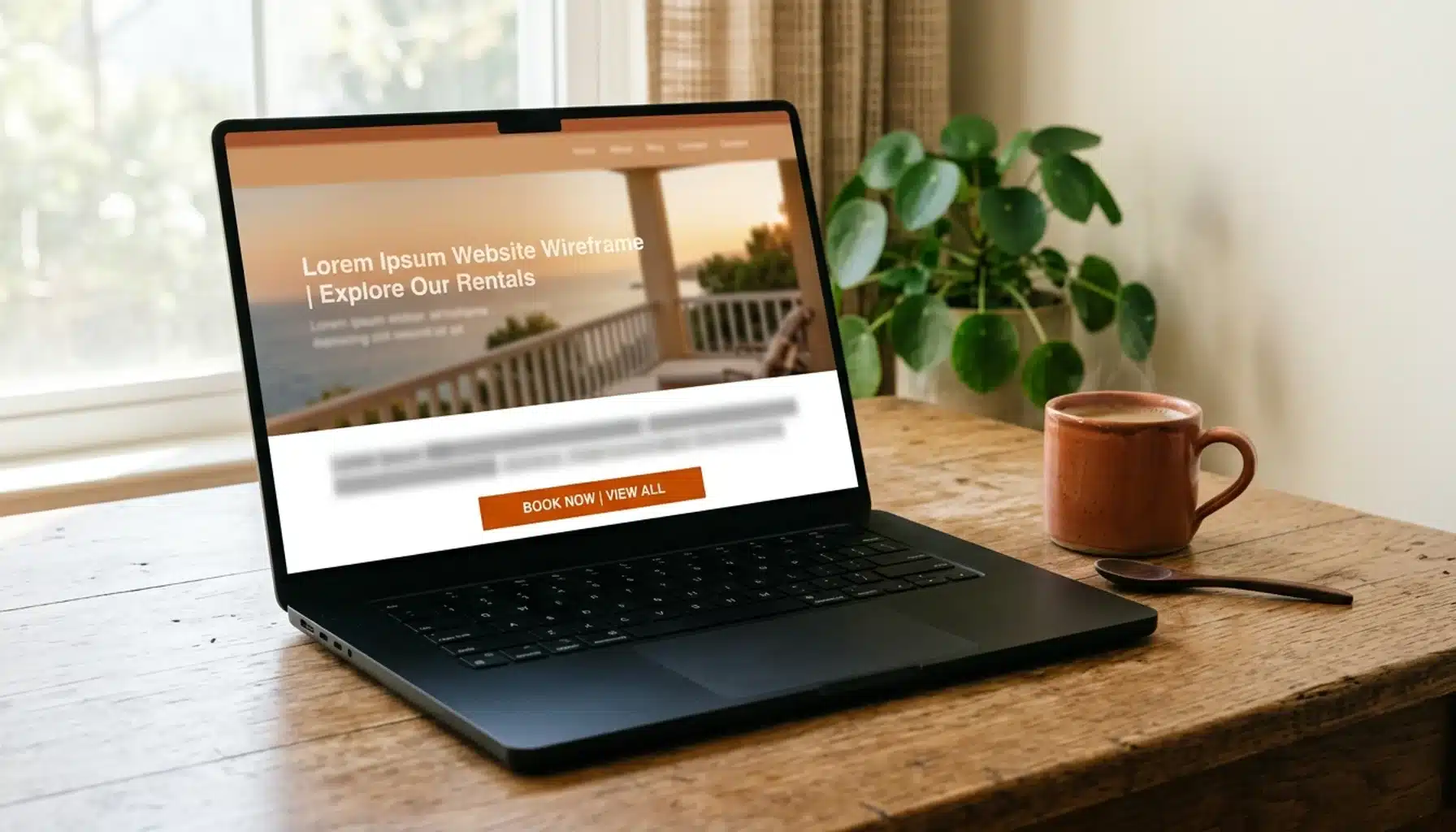
You convert website visitors to bookings by removing every point of friction between the click and the confirmed reservation: a visible booking button above the fold, a short form with live availability, instant confirmation, and automated follow-up for anyone who doesn’t finish. Most vacation rental sites lose guests at exactly these four points.
- Industry-standard direct booking conversion rates for vacation rental websites typically run 1-3% of visitors, with optimized funnels reaching 4-6%.
- Online bookings are projected to hold 66.2% market share in 2026, according to StayFi, meaning your website’s booking flow matters more than ever.
- A visible “Book Now” button above the fold and a sticky header with scheduling access are widely recognized as baseline conversion requirements.
- One Boostly-supported B&B reached 90% direct bookings and 60% repeat guests by prioritizing their own site’s conversion path over third-party listings.
- Every extra form field in a booking request is a potential abandonment point, and vacation rentals add unique friction: multi-night minimums, cleaning fees, and pet policies that hotels don’t deal with.
- Boostly Connect syncs live PMS availability and Stripe payments directly to your website in under 20 minutes, so visitors book in real time instead of waiting on an email reply.
If you’re reading this, you already have traffic. Somebody is landing on your vacation rental website, whether from Google, a social post, or a returning guest who bookmarked your page. The problem is that traffic alone doesn’t pay the mortgage. Bookings do.
At Boostly Connect, we’ve watched hundreds of hosts drive decent traffic to a beautiful-looking site, only to convert almost none of it into confirmed stays. The site loads fine. The photos look great. But the visitor lands, scrolls, gets confused about how to actually book, and leaves. That’s not a marketing problem. It’s a conversion problem, and it’s fixable in 2026 with the right structure, not more ad spend.
This guide walks through exactly what changes when a vacation rental site starts converting: what to fix first, what mistakes cost you the most bookings, and where automation replaces the manual chasing that eats your evenings. We’ll also cover the vacation rental specific friction points, like multi-night minimums and pet policies, that generic booking advice usually skips entirely.
How Do You Convert Website Visitors Into Bookings?
You convert website visitors into bookings by making the booking action visible immediately, cutting the form down to essential fields only, confirming instantly, and following up automatically with anyone who doesn’t finish. Each of these reduces a specific drop-off point in the guest’s decision path.
Start with visibility. A “Check Availability” or “Book Direct and Save” button needs to sit above the fold on your homepage, your property pages, and ideally in a sticky header that follows the visitor as they scroll. If someone has to hunt for how to book, they’ll assume it’s easier to go back to Airbnb or Vrbo, even if your rates are better.
Next comes the form itself. Every additional field, an extra phone number confirmation, a mandatory account creation, a “how did you hear about us” dropdown, is a chance for the visitor to bail. Limit the form to dates, guest count, and contact info. Save everything else for after the booking is confirmed.
Then there’s confirmation speed. A visitor who submits an inquiry and hears nothing for six hours has already moved on mentally, even if they don’t formally cancel. That’s precisely why we built Boostly Connect to pull live availability and secure Stripe payment straight from your existing PMS, so the guest sees real dates and completes the booking in one sitting instead of waiting on a manual reply.

How Do You Make a Booking System on a Website?
A booking system on a vacation rental website is a live calendar connected to your property management system that shows real availability, calculates pricing automatically, and accepts payment without the guest leaving your page. Building this from scratch with plugins is where most hosts get stuck.
The manual route looks like this: a WordPress calendar plugin, a separate payment plugin, and a PMS you’re updating by hand to keep the two in sync. The moment your PMS calendar changes, say a guest cancels or you block a date for maintenance, someone has to remember to update the website plugin too. Miss that step once and you’ve got a double booking, which is one of the fastest ways to lose a guest’s trust permanently.
Independent owners we’ve worked with often try this DIY stack first because it looks cheaper upfront. But the ongoing reconciliation work, checking that the plugin calendar still matches the PMS calendar, catching sync errors before a guest books an unavailable date, adds up to a recurring chore nobody budgeted for.
Boostly Connect solves this by connecting directly to your existing PMS. We support 8 integrations, including Hospitable, Hostfully, Lodgify, and Guesty, so your website’s calendar and pricing update automatically the moment anything changes in your PMS. No plugin to babysit, no manual sync, and the setup itself takes under 20 minutes with no developer required. If your portfolio has grown past a couple of units, our guide on managing multiple vacation rentals without chaos covers how this scales across a full property lineup.
What Vacation Rental Specific Friction Costs You Bookings?
Vacation rental bookings carry friction points that generic hotel or service booking advice never addresses: multi-night minimums, cleaning fees disclosed late in the process, and unclear pet policies. Each of these causes hesitation or abandonment at a different stage of the booking journey.
Multi-night minimums are the most common one. If your property requires a three-night minimum stay but your calendar widget lets a visitor select two nights before rejecting the request, you’ve just wasted their time and possibly lost them. The fix is showing minimum-stay requirements directly on the calendar before the guest picks dates, not after they submit a request.
Cleaning fees are the second big drop-off point. Nothing kills trust faster than a guest reaching a final payment screen and seeing a cleaning fee that wasn’t visible during browsing. Show total pricing, including cleaning fees and any resort or pet fees, as early in the funnel as possible. Surprise costs at checkout are a well-documented cause of cart abandonment across every booking-based industry, and vacation rentals are no exception.
Pet policies deserve their own clear callout, not a buried paragraph in your house rules. Guests traveling with pets often filter properties specifically by pet-friendliness before they even look at photos. If your policy is ambiguous, “pets considered on request”, you’ll lose pet-traveling guests to a competitor with a clear yes or no.
These are exactly the gaps generic conversion advice skips, and they’re where a done-for-you direct booking site earns its keep. Boostly Connect’s property pages let you display real-time pricing, minimum stays, and pet policy details directly on the booking widget, so guests see the full picture before they commit, not after.
How Should You Structure Landing Pages for a Single Property vs a Portfolio?
A single-property landing page should function as one long, persuasive story culminating in a single booking action, while a portfolio site needs a filterable directory that routes each visitor to the specific property matching their trip. Mixing these two structures is a common and costly mistake.
If you manage one property, every element on your homepage, photos, testimonials, local attractions, should point toward one goal: booking that specific unit. There’s no need for a search bar or filter system. In fact, adding one for a single listing just adds a decision-making step that isn’t necessary. Keep the booking widget visible throughout the page and repeat it after every major section.
Portfolio operators face the opposite challenge. A visitor landing on a 15-property site needs to filter fast, by location, guest count, or amenities like a pool or pet-friendliness, before they’ll commit to browsing individual listings. Without a filter, visitors bounce because scrolling through unrelated properties feels like wasted effort.
Boostly Connect’s multi-listing support gives every property its own customizable, synced page under one connected system, so portfolio operators can offer both: a filterable directory for browsing and a dedicated, conversion-focused page once a guest lands on the right unit. If you’re scaling past a handful of properties, our piece on growing your vacation rental business without more OTA listings goes deeper into structuring a portfolio site that still converts.
How Do You Convert a Browsing Visitor Into a Buyer?
You convert a browsing visitor into a buyer by matching your call to action and trust signals to where they are in the decision process: cold visitors need reassurance and social proof, warm visitors need pricing clarity, and hot visitors need a frictionless final step to complete the booking.
Cold visitors, people landing on your site for the first time with no prior familiarity, respond to trust signals more than urgency. Guest reviews, secure payment badges, and a clearly stated cancellation policy do the heavy lifting here. Don’t push a hard “book now” CTA immediately; give them a reason to trust the property first.
Warm visitors, those who’ve scrolled through photos and amenities already, are evaluating price against alternatives. This is where transparent, real-time pricing matters most. If your rates require a form submission just to see a number, you’ll lose warm visitors to a competitor who shows pricing upfront.
Hot visitors, guests who’ve selected dates and are ready to pay, need the shortest possible path to confirmation. Every additional click, page reload, or required field at this stage risks losing a booking that was essentially already won. This is the exact segment where instant Stripe payment processing inside Boostly Connect, with no added booking fees, matters most: the guest never leaves your site to complete the transaction.
For a deeper look at balancing this funnel against OTA traffic that still lands on your listings, our guide on balancing OTA and direct bookings in 2026 covers how to route each visitor type without cannibalizing your Airbnb ranking.
What Is a Good Conversion Rate for Website Visitors?
A good conversion rate for a vacation rental website visitor falls between 1% and 3% for most properties, with high-performing, optimized funnels reaching 4% to 6%. Anything below 1% usually signals a structural problem in the booking flow rather than a traffic quality issue.
If your site is getting reasonable traffic but converting under 1%, the issue is rarely the marketing that brought people there. It’s typically one of the friction points already covered: a hidden booking button, a form with too many fields, or a lack of visible, real-time pricing. Fix the funnel before you spend more on driving traffic to it.
Conversion also varies by guest type. Family bookers researching a group trip take longer and visit more pages before committing, so their session-to-booking rate looks lower even when they eventually convert well through email follow-up. Couples and solo travelers often convert faster on a single visit because the decision involves fewer stakeholders.
This is one reason a reporting dashboard matters. Boostly Connect’s built-in reporting tracks direct booking revenue and conversion rate in one place, so you can actually see where visitors are dropping off instead of guessing. Multi-property operators who’ve applied consistent direct booking strategy across a portfolio have reported reaching 55% direct bookings over time, a result documented in our own case study work with operators who started at zero.
Data and Benchmarks for Vacation Rental Website Conversion
Conversion benchmarks for vacation rental websites in 2026 sit meaningfully below general ecommerce standards because of the higher price point and longer decision cycle involved in booking a stay. Understanding where you fall against these ranges tells you whether to focus on traffic quality or funnel repair.
| Metric | Typical Range | What It Signals |
|---|---|---|
| Overall visitor-to-booking conversion | 1% to 3% | Baseline for most vacation rental sites |
| Optimized funnel conversion | 4% to 6% | Achieved with visible CTAs, short forms, instant confirmation |
| Online booking market share | 66.2% projected in 2026 | Per StayFi; guests increasingly expect self-serve booking |
| Direct bookings achieved with consistent strategy | Up to 90% (documented case) | Achievable over time with dedicated direct booking focus |
| Repeat guest rate with strong CRM follow-up | Up to 60% (documented case) | Shows the value of owning guest data instead of losing it to an OTA |
Those last two rows come directly from a Boostly-supported bed and breakfast that shifted its focus to direct bookings and built a returning guest base through consistent marketing rather than one-off OTA traffic. It’s proof that conversion improvements compound over a full year, not a single site redesign.
For pricing intelligence specifically, tools like the AirDNA real-time demand pricing framework can help you understand what rate visitors are comparing you against before they even land on your site. Real-time pricing transparency on your own page, powered by a live PMS sync, removes the guesswork guests would otherwise do by tab-switching to Airbnb to check comparable rates.
What Mistakes Should You Avoid When Optimizing Your Booking Funnel?
The most damaging mistakes in a vacation rental booking funnel are hiding the booking action below the fold, requiring account creation before booking, disclosing fees only at checkout, and failing to follow up with visitors who didn’t complete their booking. Each mistake compounds the others.
- Burying the CTA. If “Book Now” isn’t visible without scrolling on every key page, you’re relying on visitors to hunt for it. Most won’t.
- Forcing account creation. Requiring a guest to create a password and username before they can even see pricing adds a step most visitors won’t tolerate on a first visit.
- Hiding fees until the final step. Cleaning fees, pet fees, and taxes shown only at checkout feel like a bait and switch, even when unintentional.
- No follow-up for abandoned bookings. A visitor who selects dates but doesn’t finish is not a lost cause. An automated email or SMS within an hour, followed by a reminder within 24 hours, recovers a meaningful share of that intent.
- Ignoring mobile speed. Slow-loading calendars and small, hard-to-tap date pickers frustrate mobile visitors, who now make up the majority of vacation rental traffic.
- One booking pathway only. Some guests want to book instantly online, others want to message first. Offering only a contact form when a guest expects instant booking pushes them back to Airbnb, where instant booking is standard.
We built the CRM inside Boostly Connect specifically to catch mistake number four. Every guest who starts a booking gets captured automatically, so an automated nurture sequence can follow up without you lifting a finger. Compare that to manually tracking abandoned inquiries in a spreadsheet, which is realistically never going to happen consistently across a busy season.
How Long Does It Take to See Results From Conversion Improvements?
Most vacation rental hosts see measurable conversion improvements within one to three months of fixing core funnel issues, though building a mature direct booking channel that consistently outperforms OTA traffic typically takes closer to a full year of sustained effort. The B&B case referenced earlier reached 90% direct bookings over an extended period of consistent focus, not overnight.
Quick wins, adding a sticky booking button, cutting form fields, showing pricing upfront, tend to show up in your analytics within weeks. These are structural fixes, and structural fixes respond fast because you’re removing an existing barrier rather than building new demand.
Slower wins, like growing a repeat guest base through email marketing and improving your organic search visibility, compound over months. One operator who launched a professional direct booking site saw direct bookings grow from zero to 8% within twelve months, then continue climbing to 55% as the strategy matured and word of mouth built on top of it.
This is why we’re honest with hosts who ask us: a direct booking website is not a “build it and they will come” solution. It requires consistent marketing on top of a converting funnel. That’s the exact gap our twice-weekly group coaching calls exist to close, helping hosts apply the strategy consistently instead of setting up a site once and walking away.
What Should You Prioritize First When Fixing Conversion Problems?
Prioritize visible, functioning booking access first, then form simplification, then automated follow-up, in that order. Fixing follow-up automation before your booking button is even visible wastes effort on guests who never made it far enough into the funnel to abandon anything.
Here’s a practical sequence to work through:
- Audit visibility. Load your site on both desktop and mobile. Can you find the booking action in under three seconds without scrolling? If not, fix this first.
- Simplify the form. Strip your booking or inquiry form down to dates, guest count, and contact details. Move everything else to post-booking.
- Show pricing and availability live. Static “contact us for rates” pages lose visitors who expect instant answers. Real-time pricing synced from your PMS solves this directly.
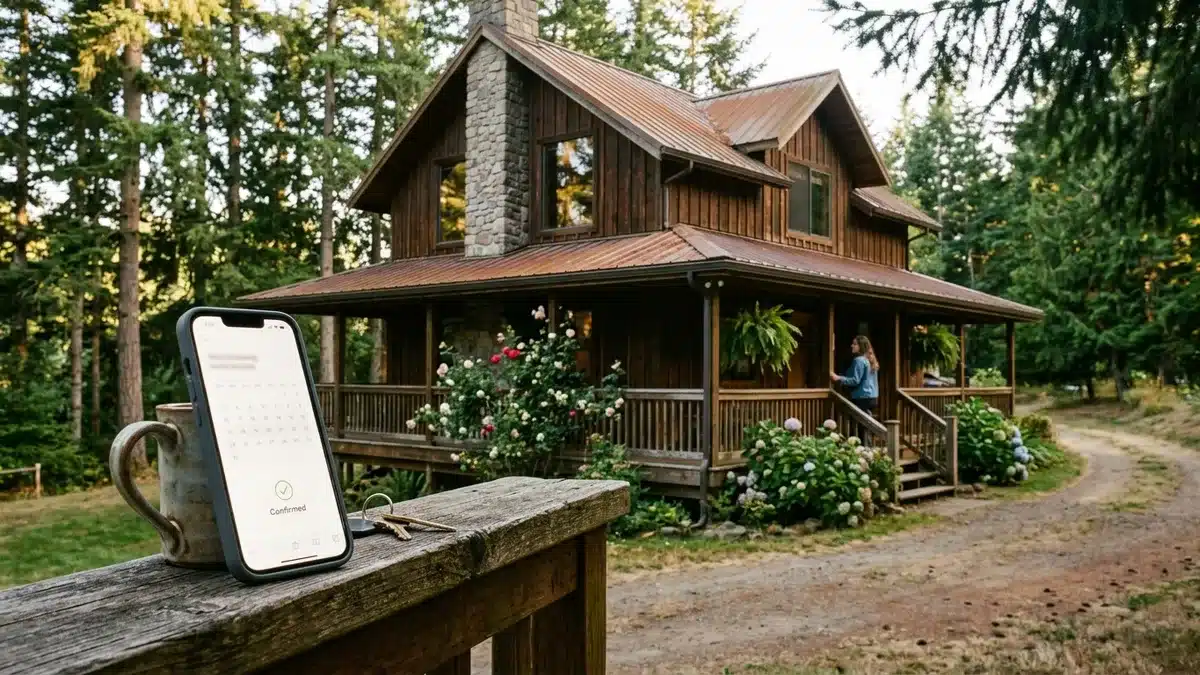
- Build in confirmation. Instant email or SMS confirmation after a booking reduces the anxiety that leads to cancellations.
- Add automated follow-up. Set up sequences for visitors who started but didn’t finish, and separately for guests after their stay to encourage rebooking.
- Track and iterate. Use a dashboard to see where visitors drop off, then test one change at a time.
Trade-offs matter here too. A fully automated, instant-booking flow works well for straightforward stays but can feel impersonal for boutique properties where guests expect a warm, hosted-feeling exchange. If that’s your brand, keep instant booking as the default path but make a “message the host” option equally visible, not buried.
If you’d rather see the whole system built rather than stitched together from plugins, our overview of a direct booking website for short-term rentals walks through what to look for before you commit to a build.
Frequently Asked Questions
How do I convert website visitors into customers for my vacation rental?
Convert visitors by making your booking button visible above the fold, keeping the booking form to essential fields only, showing live pricing and availability, and following up automatically with anyone who doesn’t complete their booking. These four fixes address the majority of drop-off points on a typical vacation rental site.
How do you make a booking system on a website without a developer?
You can build a booking system by connecting your property management system directly to your website through a no-code integration platform. Boostly Connect syncs 8 supported PMS platforms, including Hospitable, Hostfully, Lodgify, and Guesty, to a WordPress site in under 20 minutes with no coding required.
What is a good conversion rate for a vacation rental website?
Most vacation rental websites convert between 1% and 3% of visitors into bookings. High-performing, optimized funnels with visible CTAs, short forms, and instant confirmation can reach 4% to 6%. Anything below 1% typically signals a structural problem in the booking flow rather than weak traffic.
Will requiring a cleaning fee disclosure hurt my conversion rate?
No, disclosing cleaning fees early actually protects your conversion rate. Guests who reach checkout and discover an undisclosed fee tend to abandon the booking entirely. Showing total pricing, including cleaning and pet fees, earlier in the funnel builds trust and reduces last-step drop-off.
Should vacation rental hosts offer instant booking or inquiry-only booking?
Instant booking generally converts better because it matches guest expectations set by platforms like Airbnb, where instant booking is the default. Inquiry-only booking works for boutique or highly personalized properties, but it should still be paired with a fast, automated response so guests aren’t left waiting.
How do I recover visitors who start a booking but don’t finish?
Set up an automated follow-up sequence: an email or text within an hour of abandonment, followed by a reminder within 24 hours that includes the booking link and any added value, like a small discount or answer to a common objection. This recovers a meaningful share of visitors who had genuine intent but got distracted.
Does a direct booking website hurt my Airbnb search ranking?
There’s no verified evidence that maintaining a direct booking website reduces your Airbnb search ranking. Airbnb ranks listings based on factors like response rate, reviews, and booking activity on their platform, not on whether you also operate a separate direct channel.
What’s the fastest way to improve booking conversion on an existing website?
The fastest improvement usually comes from adding a sticky, visible booking button and cutting your booking form down to essential fields. These structural changes typically show measurable improvement in analytics within weeks, since they remove an existing barrier rather than requiring new traffic or content.
Conclusion: Turning Visitors Into Confirmed Guests
Converting website visitors to bookings comes down to removing friction at four points: visibility, form length, confirmation speed, and follow-up. Most vacation rental sites lose guests not because of weak traffic, but because the booking path itself asks too much before delivering an answer. Fix the funnel, and the same traffic you already have starts converting at a meaningfully higher rate, whether that’s moving from under 1% toward the 4% to 6% range optimized funnels reach.
The hosts who solve this fastest treat their direct booking channel as real infrastructure, not a side project bolted onto an Airbnb listing. That means live PMS-synced availability, instant payment, and automated guest follow-up working together, not a static contact form hoping someone calls back. In 2026, with online bookings projected to hold the majority of market share, guests simply expect that level of instant, self-serve booking on any site they land on.
Boostly Connect was built to be that infrastructure: a direct booking website synced live to your existing PMS, a CRM that captures every guest automatically, and reporting that shows you exactly where your funnel is working and where it isn’t. If you’re ready to see what your own conversion funnel could look like with this fully connected, book a demo with Boostly Connect and we’ll walk through connecting your property live.

If you’re still deciding whether a rebuilt booking funnel is worth the investment, our breakdown of how to get more direct bookings for your vacation rental lays out the case in more detail, and our guide on the best CRM for short-term rental hosts covers exactly how guest data capture ties back into repeat booking rates like the 60% figure referenced earlier in this article.