You grow a direct booking channel from zero by building an owned website connected to your live availability, capturing every guest’s contact details into a CRM, and turning past guests into repeat bookers through email and offline nudges, all before spending a dollar on ads. It takes consistent effort over months, not a single tactic.
- A direct booking channel starts with infrastructure, not marketing: you need a website synced to real-time availability before any promotion makes sense.
- Guest data ownership is the real asset: Airbnb keeps contact details on its own platform, so hosts who never build a CRM have nothing to market to.
- Repeat guests are the fastest path to zero-cost growth: one host we worked with reached 60% repeat guests after shifting focus to direct bookings.
- Offline triggers work as well as digital ones: checkout conversations, in-property guides, and post-stay follow-ups seed a direct pipeline without any media spend.
- Incremental growth compounds: one property manager grew from 0% to 8% direct bookings in the first 12 months, then to 55% direct bookings over the following years by staying consistent.
- Boostly Connect removes the technical barrier by syncing your existing PMS to a conversion-ready website in under 20 minutes, so the infrastructure step stops being the reason hosts never start.
Most direct booking advice online is written for hotels with marketing departments, ad budgets, and loyalty programs already in place. If you’re a solo host or a boutique property manager starting from literally zero, that content is close to useless. You don’t have an email list. You don’t have reviews on your own site. You don’t have a CRM. You have a handful of past guests scattered across Airbnb’s messaging inbox and a listing you don’t control.
This guide is different. We built it specifically for operators who want to know how to grow direct booking channel traffic and revenue starting with nothing, no paid budget, no existing website traffic, and no technical team. Every tactic below assumes you’re starting cold.
At Boostly Connect, we’ve worked with hosts who went from zero direct bookings to a majority of their revenue coming through their own site, and the pattern is remarkably consistent. It’s never one trick. It’s ten disciplined moves, applied in order, over roughly 12 months.
1. Build a Website Connected to Live Availability
A direct booking website with live, synced availability is the non-negotiable first step in growing a direct booking channel from zero. Without it, every marketing effort you run afterward has nowhere to send traffic that actually converts into a paid stay.
Most first-time hosts skip this step or half-build it. They throw up a static WordPress page listing their property with no real calendar, no instant booking, and no payment processor. A guest lands on the page, sees no way to check dates, and bounces back to Airbnb. That’s a wasted click, and it happens constantly on DIY sites.
This is exactly the gap Boostly Connect closes. It syncs directly to your existing property management system in under 20 minutes with no developer and no code, pulling live availability and real-time pricing straight onto your own WordPress site. Guests see accurate dates immediately and can pay securely through Stripe with no added booking fees.
Before you touch marketing, get this piece live. A direct booking website for short-term rentals only works as a growth engine once the booking flow itself is frictionless.

How Do You Increase Direct Bookings Without an Existing Audience?
You increase direct bookings without an audience by targeting the guests you already have first, meaning past bookers, referral contacts, and anyone who has ever stayed with you, before trying to attract strangers. Existing guests convert at a far higher rate than cold traffic because they already trust you.
This is where most zero-budget growth plans go wrong. Hosts assume they need SEO traffic or social followers before direct bookings can happen. In reality, your first ten direct bookings almost always come from people who already know your property.
Pull every past guest’s name and email from your Airbnb inbox, your Vrbo threads, and your own memory. Send a short, personal message: “We now book directly through our own site, here’s the link, and returning guests get a discount.” That single email can generate your first bookings before any traffic exists.
The problem is that Airbnb doesn’t hand you a clean guest list, it retains that data on its own platform. Boostly Connect’s built-in CRM automatically captures every guest who books direct into a host-owned database going forward, so this manual scramble only has to happen once.
What Is the 80/20 Rule in Direct Bookings?
The 80/20 rule in short-term rental revenue generally describes the pattern where a small share of your guests, typically repeat bookers and referrals, generate a disproportionate share of your direct revenue. In practice, this means your existing guest relationships matter more than acquiring new visitors from scratch.
Applied to direct bookings specifically, this means your energy should go first toward retention, not acquisition. A guest who already stayed with you and had a good experience needs far less convincing to book direct next time than a stranger who has never heard of your property.
One host we worked with, a bed and breakfast operator, reached 90% direct bookings and 60% repeat guests by focusing almost entirely on the guests already in their orbit rather than chasing new traffic. That repeat rate is the practical result of the 80/20 pattern in action.
This is why Boostly Connect’s CRM includes automated review requests and repeat-stay nurture sequences. Once a guest books direct, the system keeps nudging them back without you writing a single follow-up email by hand.
What Are the 3 C’s of Hospitality That Drive Direct Bookings?
The 3 C’s commonly referenced in hospitality are Communication, Consistency, and Convenience, the three factors guests weigh when deciding whether to book directly with a property versus through an OTA. Get any one of these wrong and guests default back to the platform they already trust.
Communication means guests can reach you easily and get a fast, clear answer, whether that’s a pricing question or a special request. Consistency means your direct site shows the same accurate rates and availability every time, with no stale calendars or mismatched pricing versus your Airbnb listing.
Convenience is the one operators underestimate most. If booking direct takes five extra steps compared to one tap on Airbnb, guests won’t bother, even if they’d rather support you directly.
Boostly Connect addresses all three at once: live PMS-synced pricing keeps consistency intact, the CRM’s messaging tools support communication, and the streamlined booking flow keeps convenience on par with, or better than, the OTA experience guests already know.
What Percent of Bookings Should Come From Direct Channels?
There’s no single universal target, but independent operators commonly aim for a channel mix where direct bookings make up a meaningful plurality of total revenue rather than a token slice, with OTAs and partnerships filling the remainder. The right mix depends on your property type, market, and how long you’ve been building your own channel.
Some operators we’ve supported have reached far higher direct shares over time. One property manager grew a portfolio to 55% direct bookings across 30-plus properties after applying consistent strategy for several years, up from a starting point of zero. Another host reached 90% direct bookings by prioritizing lifestyle and control over rapid scaling.
These outcomes didn’t happen in month one. The property manager mentioned above grew from 0% to 8% direct in the first 12 months, then continued climbing over subsequent years as the CRM, website, and referral network matured together.
Boostly Connect’s own coaching framework centers on getting hosts to a majority direct-booking mix within their first year of consistent use, which is why the platform pairs its technology with twice-weekly group coaching rather than shipping a website and walking away.
| Growth Stage | Typical Focus | Approximate Timeline |
|---|---|---|
| Starting from zero | Website, PMS sync, past-guest outreach | Month 1 to 2 |
| Early traction | Email capture, checkout nudges, review requests | Month 2 to 6 |
| Scaling | SEO content, referral network, repeat-stay automation | Month 6 to 12 |
| Mature channel | Majority direct share, landlord/owner referrals | 12+ months |
How Do You Capture Guest Emails Without a CRM in Place?
You capture guest emails without an existing CRM by collecting contact details manually at every touchpoint, check-in messages, checkout conversations, and post-stay review requests, until you have a system that does it automatically. This manual phase is temporary but essential for hosts starting with nothing.
Ask for an email address the same way you’d ask for a phone number: naturally, as part of the check-in process. “I’ll send you the WiFi password and a local guide, what’s the best email for you?” works far better than a cold signup form nobody fills out.
Store these in a simple spreadsheet if you must, but recognize the ceiling on that approach. Spreadsheets don’t send automated emails, don’t segment guests by trip type, and don’t remind you when a past guest’s return-trip window is approaching.
That’s precisely the gap in the best CRM for short term rental hosts is designed to close. Boostly Connect’s CRM captures every direct booker automatically going forward, so the manual spreadsheet phase only needs to last until your first PMS sync is live, typically under 20 minutes once you connect your existing system.
How Do Offline Triggers Seed a Direct Booking Pipeline?
Offline triggers refer to in-person or in-property moments, such as checkout conversations, printed guides, and exit surveys, that plant the seed for a guest to book directly next time without any digital ad spend involved. These moments are consistently underused by hosts who only think about direct bookings as a website problem.
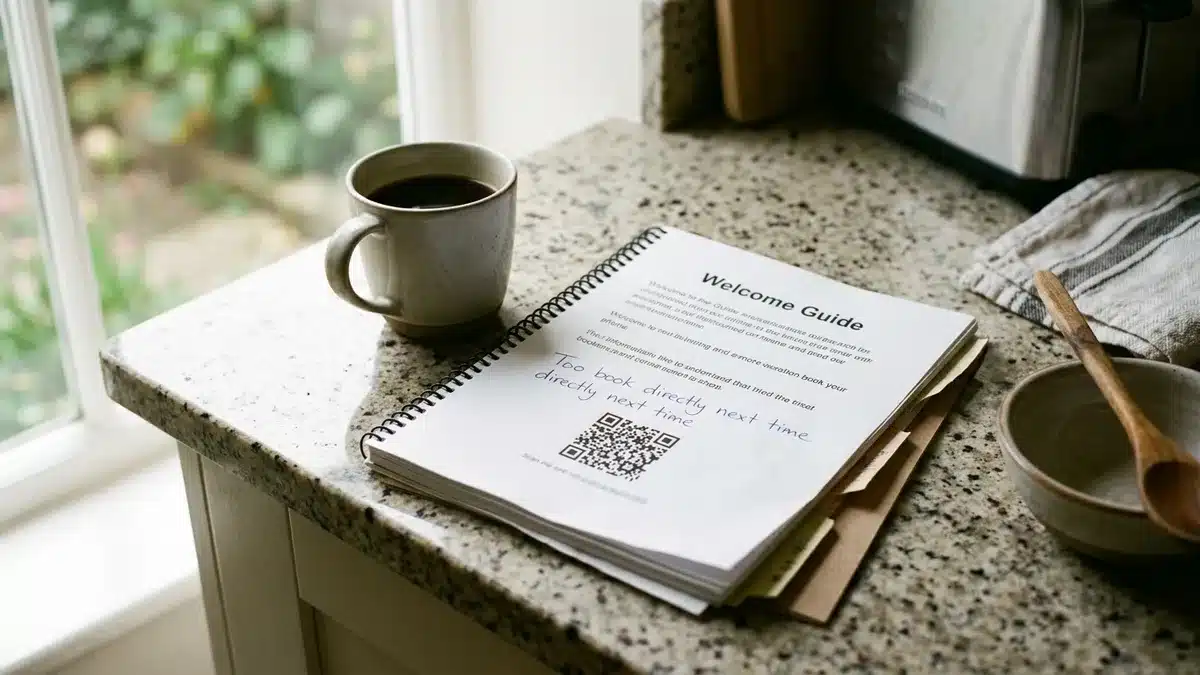
A well-placed in-room guide with a QR code linking to your direct site, paired with a note like “book direct next time for a returning-guest rate,” costs nothing and reaches every single guest who stays. Unlike a social post that maybe 2% of followers see, an in-property card reaches 100% of your guests.
Exit conversations matter too. Ask departing guests directly: “Would you consider booking with us again next time? We have a direct site now that’s often better priced than the platforms.” Most guests have never been asked this question, and a surprising share say yes on the spot.
Liam, an operator we worked with, made his first direct booking worth £800 using one simple tactic taught during a free challenge, not a paid ad campaign. That single booking is what convinced him the strategy worked before he scaled it across his portfolio.
How Long Does It Take to See Results From Direct Booking Marketing?
Building a direct booking channel from zero typically takes 12 months or longer to reach a meaningfully high direct share, based on the pattern we see across operators who start with no existing audience or CRM. Early wins, like a first direct booking, can happen within weeks, but compounding growth takes sustained effort.
The timeline isn’t linear either. Growth is usually slow for the first few months while you build the foundational pieces, then accelerates once your CRM, review flow, and referral network start reinforcing each other.
Consider the property manager case referenced earlier: 0% to 8% direct in year one, then a jump to 55% direct over the following years as consistent application of the same strategies compounded. That’s not an overnight result. It’s a multi-year trajectory that started with a single website launch.
Boostly Connect’s own client guarantee reflects this reality: the platform aims to get operators to 65% direct bookings within 12 months, and continues working with them at no additional cost until that threshold is hit. That structure exists because the timeline genuinely varies by starting point and consistency of execution.
What Mistakes Should You Avoid When Growing a Direct Channel?
The most common mistake operators make when growing a direct booking channel is treating the website launch as the finish line rather than the starting point. A live site with no ongoing marketing, email flow, or guest follow-up simply sits idle.
- Building a static site with no live availability. Guests bounce the moment they can’t see real dates or pay instantly.
- Never capturing guest contact data. Every guest who books without landing in a CRM is a guest you can’t remarket to later.
- Ignoring past guests entirely. Your fastest direct bookings come from people who already trust you, not cold traffic.
- Competing on price alone. Discounting against OTA rates race-to-the-bottoms your margin; instead, offer perks OTAs can’t, like flexible check-in or a returning-guest rate.
- Assuming direct bookings hurt OTA ranking. Running both channels simultaneously, with synced calendars, doesn’t damage your Airbnb visibility as long as availability stays accurate everywhere.
- Stitching together disconnected tools. A separate website builder, a separate CRM, and a separate PMS that don’t talk to each other create sync errors and double bookings.
That last mistake is the one we built Boostly Connect specifically to eliminate. Rather than managing three disconnected tools, the platform connects your PMS, website, and CRM as one system so nothing needs manual reconciliation. If you’re also juggling several listings, our guide on how to manage multiple vacation rentals without chaos covers the operational side of this same problem.
How Does Rate Parity Affect Your Direct Booking Growth?
Rate parity refers to keeping your pricing consistent (or better) on your own site compared to Airbnb, Vrbo, and Booking.com, so guests have a genuine incentive to book direct rather than being penalized for it. Getting this wrong is one of the fastest ways to undermine an otherwise solid direct booking strategy.
Many OTA contracts technically restrict undercutting their listed rate, but nothing stops you from offering value that isn’t price-based: a returning-guest discount code, a free late checkout, or a small welcome gift that only direct bookers receive. This sidesteps parity restrictions while still giving guests a reason to choose you.
Displaying accurate, live rates on your own site also matters more than most hosts realize. If your direct site shows outdated pricing while your Airbnb calendar has already adjusted for demand, guests notice the mismatch and lose trust in the direct channel entirely. For more on this specific mechanic, our piece on real-time pricing for your vacation rental website walks through how synced pricing protects both channels simultaneously.
Because Boostly Connect pulls pricing directly from your existing PMS in real time, your direct site never falls out of step with what guests see on Airbnb, removing the parity confusion before it starts.
What Role Does SEO and Content Play in Zero-Budget Growth?
Search engine optimization and content marketing are the primary organic traffic sources available to hosts growing a direct booking channel without paid ads, since search visibility costs time rather than money. A well-optimized property page and blog can bring in guests who were never going to find you through Airbnb search at all.
Local landing pages targeting phrases like “cabin rentals near [landmark]” or “[city] vacation rental direct booking” capture searchers with strong local intent who are actively comparing options before they ever open Airbnb. This is genuinely free traffic, if the underlying site is built to rank.
Most host-built websites never rank because they’re thin: a single page with no blog, no schema markup, and slow load times. That’s the difference between a website that exists and a website that generates.
Boostly Connect ships every site with SEO-optimized property pages and a built-in WordPress blog structure, so you’re not starting from a blank, unranked page the way most DIY builds do. Combined with listing visibility through Google Vacation Rentals, this gives your content a fighting chance at organic discovery well before you’d otherwise see traffic.
Practical Guidance: Prioritizing Your First 90 Days
Prioritizing correctly in your first 90 days means sequencing infrastructure before marketing, and past-guest outreach before cold acquisition. Attempting everything simultaneously with no budget spreads your limited time too thin to see any single tactic work.
- Weeks 1-2: Get your PMS-synced website live with real availability and a working payment flow.
- Weeks 3-4: Email or message every past guest with your new direct booking link and a returning-guest incentive.
- Month 2: Add a checkout script for staff or yourself to ask departing guests about future direct stays; place a printed guide with a QR code in every unit.
- Month 3: Start one piece of SEO content per week targeting local search terms, and set up automated review requests for every completed stay.
This sequencing mirrors what we’ve seen work across the operators in our own community, including hosts who started with a single property and no prior marketing experience. If your growth plan doesn’t include a repeat-guest email flow by month three, you’re leaving the highest-converting segment of your audience unaddressed.
Frequently Asked Questions
How much commission does Airbnb actually charge hosts?
Airbnb typically charges hosts a service fee plus guests a separate service fee, with combined platform commission commonly falling in a range that erodes a meaningful share of gross booking revenue over a year. Exact percentages vary by listing type and location, so check your current host dashboard for your specific rate.
Will building a direct booking website hurt my Airbnb search ranking?
No, running a synced direct booking website alongside your Airbnb listing does not damage your OTA search ranking, as long as your calendar availability stays accurate across both channels. Airbnb ranks listings based on guest experience signals like response rate and reviews, not on whether you also sell direct.
Which property management systems integrate with direct booking platforms like Boostly Connect?
Boostly Connect supports 8 PMS integrations, including widely used platforms like Hospitable, Guesty, Lodgify, OwnerRez, and Hostfully. If your current system is on that list, syncing live availability to your own website typically takes under five minutes.
How long does it take to set up a direct booking website?
With Boostly Connect, connecting your existing PMS to a live, conversion-ready website takes under 20 minutes once your property system is linked, with no developer or coding required. The heavier work comes afterward: building your guest email list and consistently marketing the channel over the following months.
Do I need coding or developer experience to launch a direct booking site?
No. Boostly Connect was specifically built as a no-code setup so hosts without any technical background can launch a fully synced website themselves. You connect your PMS, and the platform handles the live availability and pricing sync automatically.
What percentage of bookings should come direct versus through OTAs?
There’s no fixed rule, but independent operators generally aim for direct bookings to represent a substantial share of total revenue rather than a minor fraction. Some operators we’ve worked with reached 55% to 90% direct over time, though results depend heavily on consistency and how long the channel has been active.
How do I get guests to rebook directly instead of going back to Airbnb?
Capture their contact details at every stay, follow up with automated review requests and repeat-stay offers, and make booking direct at least as convenient as booking through Airbnb. A CRM that automatically nurtures past guests, rather than relying on your memory, is what makes this repeatable at scale.
Is a direct booking website worth it for a single-property host?
Yes, even single-property hosts benefit, since the biggest wins come from repeat guests and referrals rather than volume. One bed and breakfast operator we worked with reached 90% direct bookings and 60% repeat guests operating a single property, proving scale isn’t a prerequisite for a strong direct channel.
Conclusion: Your Direct Booking Channel Is Built in Stages, Not Overnight
Growing a direct booking channel from zero without paid ads comes down to sequencing: infrastructure first, past-guest outreach second, then offline triggers and SEO content compounding over months. The operators who reach a majority direct-booking mix, whether that’s the 55% one property manager achieved across 30-plus properties or the 90% a bed and breakfast reached, all started with the same first step: a live, synced website.
As of 2026, the technical barrier to that first step has essentially disappeared. There’s no longer a reason to delay launch because you’re worried about developers, code, or breaking your existing PMS workflow.
If commission costs and disconnected tools have kept you from starting, Get started with Boostly Connect and see your property synced to a live, conversion-ready website in under 20 minutes. Book a demo, connect your existing PMS, and get the exact CRM and coaching framework that’s helped operators build their direct channel from nothing.

If you’re ready to stop losing repeat guests back to Airbnb, this is the same dashboard hosts use to track direct booking revenue from day one. Book a free demo and see your PMS connected live.