PMS helps keep managing multiple vacation rentals, manageable
To manage multiple vacation rentals without your workflow falling apart, you need three things working together: a property management system (PMS) that centralizes operations, standardized processes that run the same way every time, and a direct booking channel that keeps guest data inside your business instead of inside Airbnb’s database. Without all three, growth past five properties almost always creates more problems than it solves.
TL;DR
-
Managing multiple vacation rentals at scale requires a centralized PMS, automated guest communications, and standardized turnover checklists across every property.
-
The most common breakdown point for portfolio operators occurs between five and ten properties, when manual calendar management and per-booking admin become unsustainable.
-
A direct booking channel protects your guest relationships: every returning guest who re-books through Airbnb costs you another 15 to 20 percent commission on revenue you already earned once.
-
According to Key Data (June 2026), 73 percent of property managers say staffing and revenue pressures are the biggest barriers to achieving their 2026 business goals.
-
Operators who reach 55 percent or more direct bookings report materially lower OTA dependency and stronger repeat guest rates, based on real results from hosts in our community.
-
Boostly Connect syncs your existing PMS to a live direct booking website across your entire portfolio in under 20 minutes, with no developer and a free plan for up to 3 listings on the Discover map.
In 2026, the U.S. short-term rental market is projected to reach $76.46 billion, according to StayFI’s vacation rental statistics overview. More hosts are building portfolios, and more of them are hitting the same wall: the systems that worked at one or two properties start generating errors, double bookings, and missed messages the moment you cross five listings. The problem is not the properties. It is the absence of infrastructure.
At Boostly Connect, we work with operators managing everything from two cabins in the Smokies to 30-plus urban apartments. The pattern we consistently see is this: hosts who scale successfully are not the ones who work harder. They are the ones who build operational systems first and add properties second. This guide covers exactly how to do that, starting with the most critical decisions and ending with the direct booking layer that most multi-property guides ignore entirely.

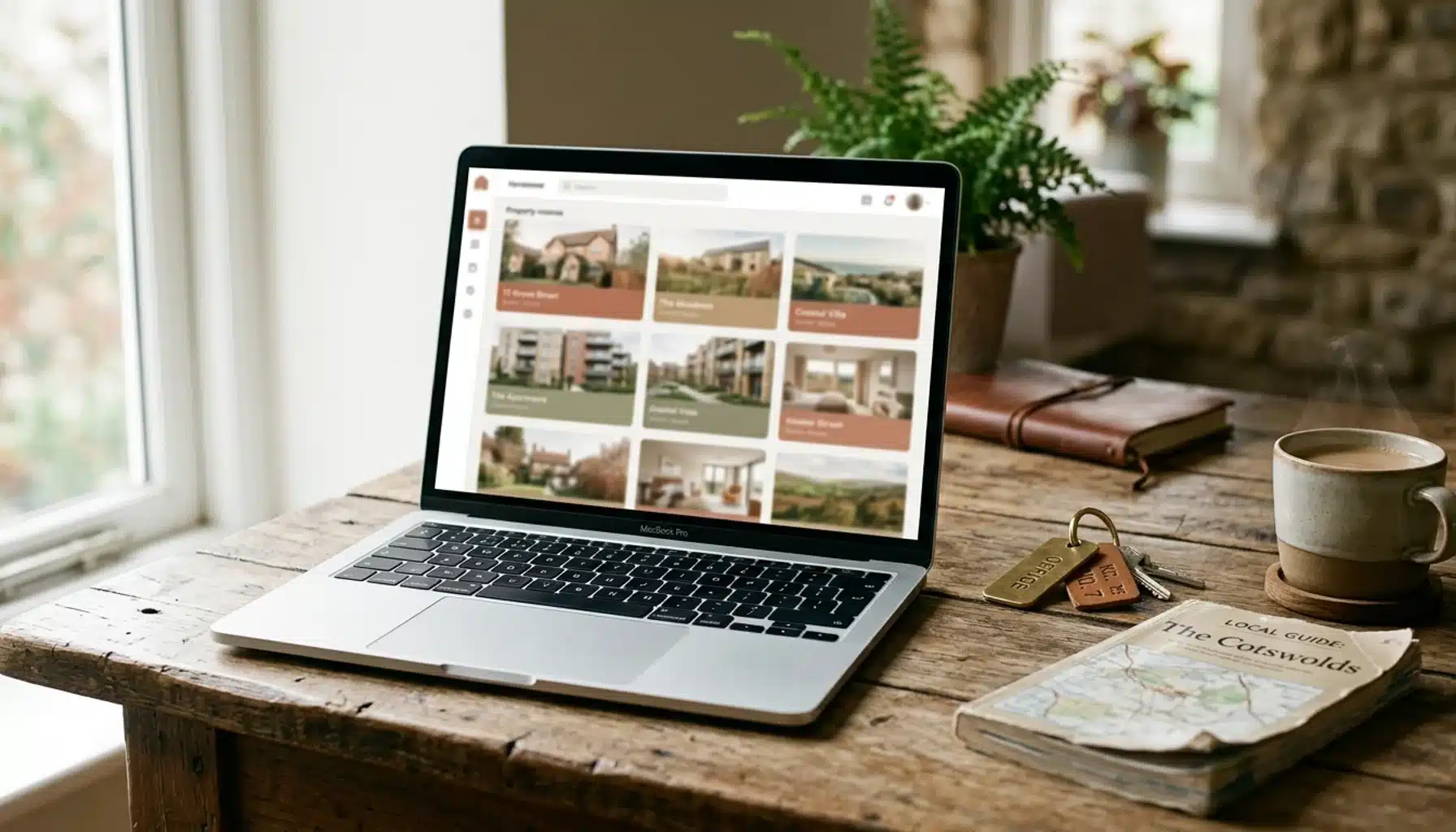
a short-term rental operator reviewing a multi-property management dashboard on a laptop at a clean
What Does a Property Management System Actually Do for Multiple Rentals?
A property management system, or PMS, is the operational backbone for managing multiple vacation rentals. It centralizes your booking calendar, guest communications, pricing updates, and cleaning schedules into a single interface so you are not logging into five separate Airbnb accounts and a spreadsheet every morning. For operators with more than two or three properties, a PMS is not optional. It is the point at which manual management stops scaling.
Specifically, a PMS handles calendar synchronization across every channel you list on, which eliminates the double-booking risk that plagues operators who manage OTA listings manually. Most systems also automate guest messaging, sending check-in instructions, mid-stay check-ins, and checkout reminders without you touching a keyboard. When you add a new property, the system extends the same workflows to that listing automatically.
The practical difference is significant. An operator managing ten properties through a PMS can handle the same communication volume as one managing three properties manually, because the repetitive tasks are running in the background. Platforms like Hospitable, Guesty, and Lodgify each cover the core functions, and the right choice depends on your portfolio size, your channel mix, and whether you need owner reporting built in.
Where most guides stop is at the PMS itself. But a PMS manages operations inside your existing OTA ecosystem. It does not build you a direct booking channel, and it does not capture your guest data into a CRM you own. That requires a separate layer, which is exactly what Boostly Connect was built to provide: a direct connection from your PMS to a live booking website, so the same availability that syncs to Airbnb also powers a commission-free booking page on your own domain.
Should You List Your Vacation Rental on Multiple Sites?
Yes, you should list your vacation rental on multiple booking platforms, but with a clear strategy rather than a spray-and-pray approach. Listing on Airbnb, Vrbo, and Booking.com simultaneously increases your property’s visibility and reduces the risk of revenue gaps if one platform’s algorithm deprioritizes your listing. But multi-channel distribution without a centralized calendar creates the exact double-booking problem that destroys guest trust.
The practical rule is this: only list on as many channels as your PMS can sync reliably. If you are managing calendars manually, every additional OTA you add is another surface where a sync error can occur. With a channel manager in place, adding a new distribution channel takes minutes and carries no additional calendar risk.
The more important question multi-property operators miss is this: what is your direct booking strategy alongside your OTA presence? OTAs are discovery engines. They are excellent at putting your property in front of first-time guests who do not know your brand yet. But every time a returning guest books through Airbnb instead of coming back to you directly, you pay another 15 to 20 percent commission on revenue you already earned and a guest relationship you already built.
Our recommendation for operators managing multiple rentals: maintain your OTA presence for top-of-funnel discovery, and run a direct booking website in parallel to capture repeat business. The two channels are not in conflict. They serve different stages of the guest journey. For a deeper look at building that direct channel alongside your OTA listings, our guide on how to get more direct bookings for your vacation rental walks through the specific tactics that work at portfolio scale.
What Is the Right System for Standardizing Processes Across Properties?
Standardizing processes across multiple vacation rentals means creating a documented, repeatable procedure for every operational task, from turnover cleaning to guest check-in to maintenance requests, so that the outcome is consistent regardless of which property is involved or who is executing the task. Without standardization, each property runs as its own operation, and your time scales linearly with your portfolio size instead of staying flat.
The starting point is a turnover checklist. Every cleaning team working across your properties should follow the same checklist, in the same order, with the same quality standard. This is not about micromanaging your cleaners. It is about eliminating the ambiguity that causes missed tasks, inconsistent guest experiences, and five-star reviews turning into four-star reviews for reasons you cannot easily diagnose.
Building Standard Operating Procedures for Each Property Type
Each property type in your portfolio, whether a beach house, an urban apartment, or a mountain cabin, will have different turnover requirements. But the structure of the SOP should be identical: a pre-arrival checklist, a during-stay protocol, and a post-checkout process. Once you have built the template for one property type, replicating it for a new listing takes a fraction of the time.
The onboarding process for a new property is where most multi-property operators lose days. In our experience working with portfolio operators, the hosts who scale fastest are the ones who have a documented new-property onboarding sequence: a checklist covering photography, listing setup, pricing configuration, cleaning team briefing, and PMS integration. Without this, every new listing is a fire drill.
Supplier Relationships and Bulk Purchasing
One practical efficiency that compounds as your portfolio grows: buy consumables in bulk across all properties. Soap, paper towels, toiletries, and cleaning supplies should be ordered on a consistent schedule from the same supplier, with each property receiving the same par stock. This reduces per-unit cost, eliminates the variability of each property’s supply chain, and means your cleaners never arrive to find a missing essential.

a professional vacation rental turnover team preparing a bright modern bedroom with fresh white
How Do You Automate Guest Communications Across Multiple Rentals?
Automating guest communications across multiple vacation rentals means setting up triggered message sequences in your PMS or CRM so that every guest receives timely, consistent contact at each stage of their booking: confirmation, pre-arrival instructions, a mid-stay check-in, and a post-checkout follow-up with a review request. Once configured, this workflow runs without manual input regardless of how many properties you manage.
The specific messages that matter most, based on what we see drive review quality and repeat bookings, are: the pre-arrival message sent 48 to 72 hours before check-in (covering parking, access codes, and your top local recommendations), and the post-checkout message sent within 24 hours (thanking the guest and requesting a review). Both are high-impact touchpoints that most operators handle inconsistently when managing multiple listings manually.
The review request is particularly important. Hosts who send a personal, timely post-stay message consistently outperform those who rely on the platform’s automated review prompt. The guest experience is freshest in the first 24 hours after checkout. That is the window.
For repeat guest communications, the automation gap is even larger. Most multi-property operators have no system for reaching past guests with direct booking offers. Their guests return to Airbnb because that is the only path they know. Boostly Connect’s built-in CRM captures every direct booker’s contact information automatically, storing it in a database you own permanently. Pre-built email sequences then reach past guests with repeat-stay incentives at the timing that drives conversions, with no manual list management required.
What Is the 80/20 Rule for Airbnb and How Does It Apply to Multiple Properties?
The 80/20 rule for Airbnb, as applied to short-term rental management, refers to the principle that roughly 80 percent of your revenue problems, guest complaints, and operational friction will come from 20 percent of your properties or your processes. For operators managing multiple vacation rentals, this means identifying your lowest-performing listing and your most time-consuming manual task, and fixing those two things before adding another property to the portfolio.
In practice, this looks like a monthly financial review across your entire portfolio. Which property has the lowest occupancy? Which one generates the most maintenance requests? Which listing produces the most guest complaints? The answers tell you where your operational energy is being consumed, and where a systems fix will produce the greatest return.
Applying the 80/20 lens to your direct booking channel is equally revealing. Most operators find that a small share of their past guests accounts for a disproportionate share of their repeat booking revenue. Those are the guests worth investing in. A targeted email campaign to your top 20 percent of past guests, offering a direct booking discount for their next stay, consistently outperforms broad marketing efforts aimed at acquiring new guests.
According to Key Data’s June 2026 report, 32 percent of property managers now review market data weekly to guide pricing and strategy decisions. If you are reviewing your portfolio’s financial performance monthly, you are ahead of most operators. If you are reviewing it less often, you are likely missing underperformance signals in individual properties before they compound into real revenue loss.
What Is the 2% Rule for Rentals and Should Multi-Property Operators Use It?
The 2 percent rule for rentals is a property investment screening benchmark: a rental property is considered potentially viable if its monthly gross rent equals or exceeds 2 percent of its purchase price. For example, a property purchased for $300,000 should generate at least $6,000 per month in gross rental income to meet the threshold. The rule is used primarily for acquisition screening, not ongoing management decisions.
For multi-property short-term rental operators, the 2 percent rule provides a useful initial filter when evaluating whether a new property is worth adding to the portfolio. But it has real limitations in the STR context. Vacation rentals generate revenue unevenly across the year, seasonal markets can produce 60 percent of annual revenue in 90 days, and nightly rates fluctuate with demand in ways that monthly rent figures do not capture.
A more useful ongoing metric for multi-property operators is the property’s contribution margin: gross revenue minus cleaning fees, OTA commissions, supplies, utilities, and maintenance costs, divided by gross revenue. This figure tells you how much of each dollar booked actually stays in your business. A high gross revenue property with a low contribution margin, often caused by high OTA commissions and frequent maintenance costs, can underperform a lower-revenue property with a leaner cost structure.
If OTA commissions are compressing your contribution margin across multiple properties, the true annual cost of Airbnb commissions across your portfolio is worth calculating before you add your next listing. The number is often larger than operators expect when they see it aggregated across five or ten properties.
What Is the 75/55 Rule for Airbnb and How Does It Affect Portfolio Management?
The 75/55 rule for Airbnb is an informal framework some STR operators use to guide their channel strategy: target 75 percent occupancy as your performance ceiling and aim for at least 55 percent of that revenue to come from direct bookings. The 75 percent occupancy ceiling exists because pushing for maximum occupancy often requires dropping nightly rates to fill gap nights, which compresses revenue per available night. The 55 percent direct booking target exists because that is roughly the threshold at which OTA commission costs stop being the dominant expense in a portfolio’s cost structure.
In our experience working with multi-property operators, the 55 percent direct booking target is achievable within 12 to 18 months for operators who build their direct channel systematically. Liam, a property manager in our community, grew his direct booking rate from zero to 55 percent across a portfolio of 30-plus properties by applying a consistent direct booking strategy over several years. His professional website attracted local landlords who wanted him to manage their properties, growing his portfolio from a handful of his own rentals to 50 to 60 properties under management.
The 75 percent occupancy ceiling is a pricing discipline question as much as a management question. Operators who use dynamic pricing tools to maintain rate integrity in shoulder seasons, rather than dropping to fill every available night, consistently generate higher revenue per available night than those who chase occupancy at any price. For multi-property portfolios, this means configuring your pricing tool once per property type and letting it run, rather than manually adjusting rates per property per week.
For operators ready to build that direct booking channel systematically, our guide on how to grow your vacation rental business without more OTA listings covers the specific steps that drive direct revenue at each portfolio size.
How Do You Build a Direct Booking Strategy Across Multiple Properties?
Building a direct booking strategy across multiple vacation rentals means creating a single branded website that displays live availability and real-time pricing for every property in your portfolio, capturing each guest’s contact information into a CRM you own, and running automated marketing sequences that convert first-time OTA guests into repeat direct bookers. This is the layer that transforms a collection of properties into a business with a guest database and a recurring revenue channel.
Most multi-property guides stop at the PMS and the OTA channel manager. They do not address the fundamental problem: every guest who books through Airbnb is a guest Airbnb owns. Their contact information stays with the platform. Airbnb uses it to remarket your past guests to competing properties. You have no path to reach that guest directly for their next trip unless they find you again through the platform.
Setting Up a Portfolio Direct Booking Website
A portfolio direct booking website is a single domain that hosts individual property pages for every listing you manage, each with live availability pulled directly from your PMS. Guests can browse your properties, compare availability, and book without leaving your site or going through an OTA. Every completed booking captures the guest’s contact data into your CRM automatically.
The technical setup is simpler than most operators expect. Boostly Connect supports 8 PMS integrations, including Hospitable, Guesty, Hostfully, Lodgify, and OwnerRez. Connecting your existing PMS to a live booking website takes under five minutes for supported systems. The full portfolio site, with live availability, real-time pricing, and payment processing across every listing, goes live in under 20 minutes. No developer, no coding knowledge, no upfront cost.
Using QR Codes and In-Property Marketing
One of the most effective and underused direct booking tactics for multi-property operators is in-property QR code placement. A QR code in each property’s welcome book, printed on a small card near the checkout instructions, linking directly to your booking website gives every guest a frictionless path to book their next stay directly. It is a one-time setup that works passively across every property in your portfolio.
Pair this with a post-checkout email that includes a direct booking link and a returning-guest discount code, and you have a repeatable system for converting OTA guests into direct bookers at zero ongoing cost. For a practical look at what an effective direct booking website should include, our guide on what to look for in a direct booking website for short-term rentals covers the specific elements that drive conversions at portfolio scale.

a vacation rental host reviewing a multi-property direct booking website on a laptop, showing live
How Do You Handle Finances and Compliance Across Multiple Vacation Rentals?
Handling finances across multiple vacation rentals requires each property to have its own bank account or sub-account so income and expenses can be tracked per property rather than pooled. This is not an accounting preference. It is the operational foundation that makes it possible to identify which properties are underperforming, which are generating the most maintenance costs, and where your overall portfolio margin is being compressed.
Monthly consolidated financial reviews, covering occupancy rates, gross revenue, contribution margin, and maintenance costs across all properties, are the minimum standard for operators managing five or more listings. Without this review, you are making pricing and investment decisions based on total portfolio numbers that mask individual property performance.
STR Permit Compliance at Scale
Regulatory compliance becomes more complex as your portfolio grows across multiple markets. In many U.S. cities and states, short-term rentals require a local STR permit or registration number, with annual fees commonly ranging from $100 to $600 per property. Non-compliance can trigger fines up to $1,000 per day in municipalities that enforce it. Managing permit renewal dates across 10 or 20 properties requires a dedicated tracking system, not a mental note.
According to Key Data’s June 2026 report, 47 percent of property managers report operating under strict permitting or licensing requirements. If you are in that group, a shared permit calendar with automated renewal reminders is one of the first administrative systems worth building as your portfolio grows.
For operators whose properties span multiple states, federal IRS Form 1099-K reporting applies to hosts earning at least $20,000 in gross payments over 200 transactions on platforms such as Airbnb and Vrbo. Tracking this threshold per platform across a multi-property portfolio requires clear per-platform revenue reporting, which most PMS platforms generate automatically if configured correctly.
How Do You Scale Your Team Without Over-Hiring?
Scaling your team for a growing vacation rental portfolio means building a contractor network rather than a staff-heavy payroll. The most efficient portfolio operators structure around three roles: a cleaning lead who manages turnover quality across your properties, a maintenance contractor who handles routine repairs and seasonal inspections, and a virtual assistant or co-host who handles guest communication during hours you are not available. Beyond these three, most operators do not need additional staff until they exceed 15 to 20 properties.
The key is that automation handles what humans used to handle manually. Automated check-in instructions eliminate the pre-arrival call. Automated review requests replace the post-stay follow-up email. AI live chat on your direct booking website handles guest inquiries around the clock. Each automated touchpoint reduces the hours your team spends on repetitive tasks, which is the operational budget that funds your next property acquisition rather than your next hire.
According to Key Data’s June 2026 report, 73 percent of property managers say staffing and revenue pressures are the biggest barriers to their 2026 business goals. The operators who break through that barrier are not the ones who hire faster. They are the ones who automate first and hire only for tasks that genuinely require a human.
For a practical breakdown of which STR tools deliver genuine time savings versus which ones create maintenance overhead, the gap between “automation that runs itself” and “automation that needs weekly configuration” is significant. Boostly Connect’s AI live chat agent and CRM automation were designed specifically to eliminate the configuration burden: once the sequences are set up, they run across every property in your portfolio without further input.
What Does a Multi-Property Onboarding System Look Like?
A multi-property onboarding system is a documented sequence of steps that every new property goes through before its first guest checks in. It covers listing setup, photography standards, pricing configuration, cleaning team briefing, PMS integration, and direct booking page creation. Without this system, each new property is an unstructured project that consumes disproportionate time and produces inconsistent results.
The most effective onboarding systems are built as checklists with assigned owners and completion dates. Photography happens in week one. PMS integration happens in week one. The listing goes live in week two. The direct booking page is live before the first OTA booking is accepted, so that any guest who finds the property through Airbnb can also be reached for future direct bookings.
This sequencing matters. Most operators build their direct booking website after they have been running an OTA portfolio for months or years, which means they have already accumulated a guest database they do not own. Building the direct booking infrastructure into the onboarding sequence for every new property means your guest CRM grows from day one, rather than being retrofitted after the fact.
For the CRM layer specifically, the choice of platform determines whether you actually own your guest data or just have temporary access to it. Our guide to the best CRM for short-term rental hosts who want to own their guest list covers the specific criteria that matter for multi-property operators, including how to choose between platform-native CRM tools and standalone systems that remain portable if you change your PMS.
Frequently Asked Questions About Managing Multiple Vacation Rentals
How many vacation rentals can one person realistically manage alone?
Most solo operators manage between three and six properties without significant strain if they have a reliable cleaning team and automated guest messaging in place. Beyond six properties, the volume of inquiries, maintenance coordination, and pricing management typically requires either a part-time assistant or additional automation tools. The ceiling rises significantly with each automation layer added, specifically automated communications, a centralized PMS, and a direct booking website that handles inquiries through AI live chat.
What software do I need to manage multiple vacation rentals?
The core software stack for managing multiple vacation rentals includes a property management system (PMS) for centralized calendar and booking management, a channel manager to sync availability across OTA platforms without double bookings, and a direct booking website with an integrated CRM to capture and retain guest data. Platforms like Hospitable, Guesty, and Lodgify handle the PMS and channel management layer. Boostly Connect adds the direct booking website and CRM layer on top of your existing PMS, syncing live availability from your PMS to a branded booking page in under 20 minutes.
How do I prevent double bookings across multiple platforms?
Preventing double bookings across multiple vacation rental platforms requires a channel manager or PMS that maintains a single master calendar and pushes real-time availability updates to every connected channel simultaneously. Manual calendar management across more than two OTA accounts creates double-booking risk every time a reservation is confirmed. A properly configured PMS eliminates this risk by treating all channels as read-only feeds from a single source of truth.
Should I manage multiple vacation rentals myself or hire a property manager?
Managing your properties yourself makes financial sense if you have the right automation tools in place and your portfolio is concentrated in one geographic area. Professional property managers typically charge 15 to 25 percent of gross collected revenue for full-service management in North American markets. At five or more properties spread across multiple markets, the management overhead and travel time often justify a hybrid approach: self-manage properties in your primary market and hire locally for properties in secondary markets.
How do I build a direct booking channel for multiple vacation rental properties?
Building a direct booking channel for multiple vacation rentals starts with a portfolio website that displays live availability for every property, connected to your existing PMS so calendars stay accurate without manual updates. Each guest who books directly should be automatically captured into a CRM you own permanently, not a platform-controlled database. Boostly Connect handles both layers: the PMS-to-website sync and the guest CRM, with support for 8 integrations including Hospitable, Guesty, Hostfully, Lodgify, and OwnerRez.
What is the biggest mistake operators make when scaling past 5 properties?
The most common mistake is adding properties before systemizing the operations that already exist. Operators who grow from three to eight properties without documented turnover checklists, automated guest messaging, and centralized financial tracking find that each new property adds more management hours than the previous one. The right sequence is to build the operational infrastructure first, confirm it runs smoothly across your existing portfolio, and then use it as the template for every new property you add.
How do I keep pricing accurate across multiple vacation rental listings?
Keeping pricing accurate across multiple vacation rental listings requires a dynamic pricing tool that adjusts rates automatically based on demand signals, competitor availability, and seasonal patterns, then syncs those rates to every channel and your direct booking website simultaneously. Manual rate management across five or more properties is not sustainable. Most modern PMS platforms include basic pricing rules, and dedicated dynamic pricing tools can be integrated as an additional layer for operators who want more sophisticated demand-based optimization.
How does a direct booking website affect my Airbnb ranking?
Running a direct booking website does not affect your Airbnb listing’s visibility or search ranking. Airbnb ranks listings based on factors within its own platform, including review score, response rate, and acceptance rate. Your direct booking website operates as an entirely separate channel. Many operators in the Boostly Connect community maintain their full Airbnb presence while simultaneously growing their direct channel, using OTAs for new-guest discovery and their own website for repeat-guest retention.
The Bottom Line on Managing Multiple Vacation Rentals in 2026
Managing multiple vacation rentals without your workflow falling apart comes down to one principle: build systems that scale before the properties do. A centralized PMS eliminates the calendar chaos. Standardized checklists eliminate the quality variability. Automated guest communications eliminate the manual follow-up grind. And a direct booking channel eliminates the compounding cost of paying OTA commissions on guests you have already earned.
The operators who scale successfully in 2026 are not the ones managing the most properties. They are the ones whose systems run the same way at 15 properties as they did at three. That operational consistency is what creates the margin, the guest loyalty, and the capacity to add the next property without disrupting the ones already running.
If you are ready to build the direct booking layer that most multi-property guides leave out, the infrastructure exists and the setup is faster than most operators expect. More than 2,000 hosts across 25 countries have collectively generated over one billion dollars in direct bookings using this system. The next step is a 20-minute demo.

Get started with Boostly Connect and see how multi-property operators sync their entire portfolio to a live direct booking website, capture every guest into a CRM they own, and start recovering OTA commissions they have been paying for years. Book a demo at connectyourpms.com to see the full workflow applied to your specific portfolio size.