
A direct booking site, open on a phone, steps ahead of another OTA listing.
The fastest way to grow your vacation rental business in 2026 is not to add more listings to Airbnb or Booking.com. It is to stop surrendering 15 to 20 percent of every reservation to platforms that own your guest relationships, and to build a direct booking channel that keeps that revenue inside your own business permanently.
-
Growing your vacation rental business does not require adding more OTA listings. The most durable growth comes from owning your direct booking channel.
-
Airbnb charges hosts 15 to 20 percent commission on every reservation. A property generating $100,000 annually surrenders up to $20,000 per year in fees that never return.
-
Boostly Connect clients collectively generate over $1 billion in direct bookings across 2,000-plus hosts in 25 countries, averaging around $59,000 per year from their direct channel.
-
Building a direct booking website on WordPress, connected to your existing PMS, takes under 20 minutes with no developer and a free plan for up to 3 listings on the Discover map.
-
Owning your guest CRM means past guests receive direct-booking offers automatically, breaking the repeat booking trap where returning guests rebook through Airbnb instead of you.
-
The 65 percent direct bookings guarantee within 12 months removes the risk from making the switch.
The vacation rental market is not slowing down. The global market is projected to reach $109.4 billion in 2026, according to Mordor Intelligence. More travelers are actively choosing vacation rentals over hotels. The opportunity is real and expanding.
But here is what most growth advice gets wrong: it tells you to optimize your Airbnb listing, add more photos, or list on another OTA. That grows Airbnb’s business. It does not grow yours. Every booking processed through a third-party platform is a booking where the platform captures the guest relationship, the contact data, and a significant slice of your revenue.
At Boostly Connect, we work with more than 2,000 hosts across 25 countries who have made the decision to build their own direct booking channel alongside their OTA presence. What we see consistently is that the hosts who grow most sustainably are not the ones who add the most listings to Airbnb. They are the ones who systematically redirect returning guests and new inquiries into a booking channel they own. This guide shows you exactly how to do that, step by step.

a confident vacation rental host at a kitchen desk reviewing a direct booking website dashboard on
How Do You Actually Grow a Vacation Rental Business Without More OTA Listings?
Growing a vacation rental business without adding more OTA listings means building a direct booking channel that captures guests before, during, and after the OTA relationship. Specifically, it involves three interconnected assets: a conversion-ready direct booking website, a guest CRM you own permanently, and an automated marketing system that brings past guests back without relying on Airbnb’s algorithm.
Most operators think of growth as a volume game. More listings, more platforms, more exposure. But volume on OTAs compounds your costs at the same rate it compounds your revenue. Every new listing on Airbnb means another 15 to 20 percent commission on every booking from that property, forever.
The alternative is a channel-first growth model. You keep your OTA presence for discovery, but you redirect the guest relationship into your own infrastructure the moment a booking completes. Over time, a growing share of your revenue comes from guests who book directly with you, paying no commission to a third party.
Key Data’s June 2026 industry survey found that 73 percent of property managers say staffing and revenue pressures are the biggest barriers to achieving their business goals this year. That is not a staffing problem. That is a margin problem created by OTA dependency. Recovering commission from even a portion of your bookings directly addresses both pressures without requiring a single new hire.
Step 1: Build Your Direct Booking Website as the Foundation
A direct booking website is the single most important infrastructure investment you can make to grow your vacation rental business sustainably. Without it, every growth tactic you deploy, whether social media, email marketing, or word-of-mouth, sends guests back to Airbnb to complete the transaction.
Your website is not just a brochure. It is a booking engine. It needs to show live availability, accept secure payments, and convert visitors into confirmed reservations without the host’s involvement. A static website with a “contact us to book” form is not a direct booking website. It is a brochure that leaks revenue.
The most common objection we hear is that building a website requires a developer, months of setup, and a technology budget most independent hosts do not have. That used to be true. It is not true in 2026. The Boostly Connect platform syncs your existing property management system directly to a WordPress website in under 20 minutes, with no coding knowledge and no upfront cost.
Why Does Your Direct Booking Website Need to Sync With Your PMS?
A direct booking website that does not sync live with your property management system creates a dangerous gap between what your website shows and what is actually available. That gap produces double bookings, guest frustration, and manual calendar management that scales into a full-time job.
When your PMS and your direct booking website share a live data connection, availability updates made in one system appear everywhere simultaneously. A guest books through Airbnb on Tuesday morning and your direct booking calendar closes that window within minutes, without you touching anything. That is the set-it-and-forget-it infrastructure that makes scaling past five properties operationally sustainable.
Boostly Connect supports 8 PMS integrations, including Hospitable, Guesty, Hostfully, Lodgify, and OwnerRez. You plug in your existing system in under five minutes and immediately gain live availability and real-time pricing on your direct booking site. No sync errors, no manual overrides, no double-booking risk. If you want to understand more about what to look for in a direct booking website for your short-term rental, the criteria matter more than most hosts realize at the outset.
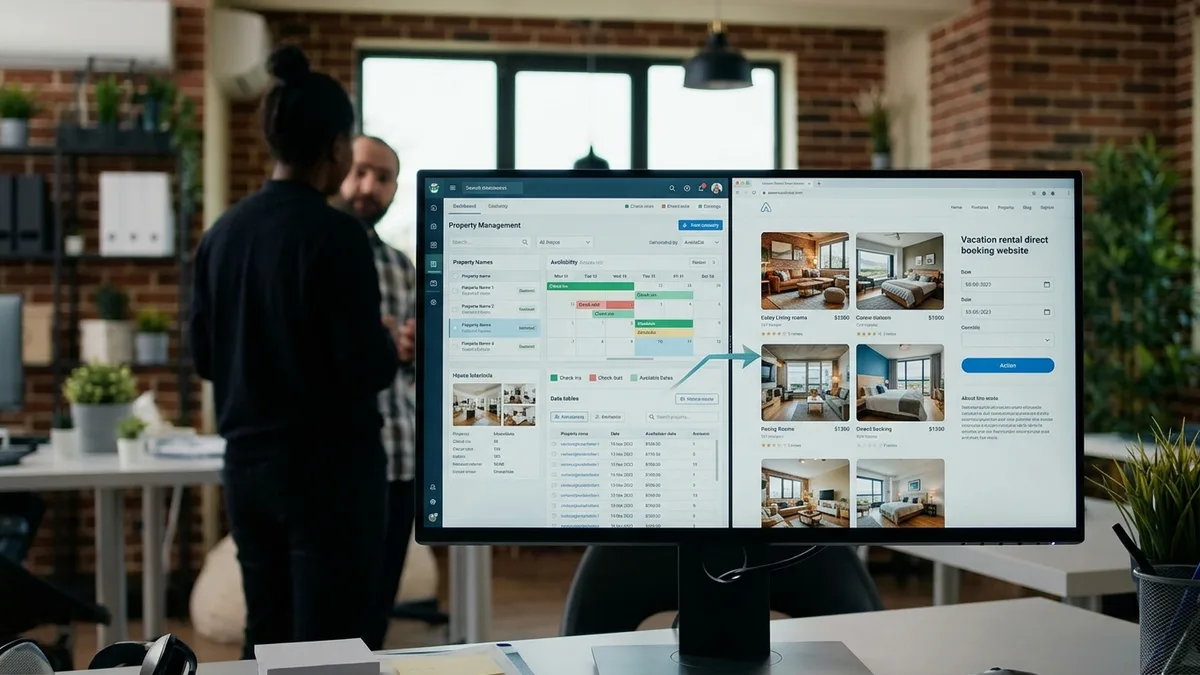
a split-screen graphic showing a property management system dashboard on the left syncing live
Step 2: Own Your Guest Data Before You Lose It Forever
Owning your guest data means storing every booker’s contact information, stay history, and preferences in a CRM database that belongs to you permanently, not to the platform that processed the reservation. This is the foundational difference between building a vacation rental business and building revenue for Airbnb.
Most hosts do not realize what they are surrendering every time a guest books through an OTA. The platform captures the guest’s contact details, payment method, and stay history. After checkout, that data stays with Airbnb. The host receives a name and a review. Airbnb receives a customer it can remarket to your competitors on every future search.
What Happens to Your Guest Data After Every Airbnb Checkout?
After an Airbnb checkout, the guest’s email address, phone number, and booking history remain in Airbnb’s database. Airbnb uses this data to send the guest future platform emails, suggest competing properties, and serve targeted ads on their next search. The host gets nothing usable for long-term marketing.
This is not a flaw in the system. It is the business model. Airbnb’s value as a public company depends on owning the largest guest database in the world. Every booking a host takes through Airbnb is a data contribution to that database, paid for by the host through their commission.
Every guest who books directly through your Boostly Connect website is automatically captured into a CRM database you own permanently. Contact details, stay dates, and property preferences are stored in your own system, not Airbnb’s. That data is yours to use for follow-up campaigns, loyalty offers, and repeat booking incentives whenever you choose. For a detailed look at what the best CRM for short-term rental hosts actually needs to do, the guest data ownership angle is the part most comparison guides skip.
Step 3: Turn Past Guests Into Repeat Direct Bookers
Converting past guests into repeat direct bookers is the highest-ROI growth tactic available to a vacation rental business. A guest who has already stayed with you and had a positive experience needs no further discovery, no Airbnb algorithm to surface your listing, and no platform commission to complete the transaction.
The problem most hosts face is structural. They never owned the guest relationship in the first place, so there is no channel through which to reach that guest directly. The guest remembers your property but searches Airbnb for their next stay because that is where they completed the first booking. Airbnb serves them your listing alongside three competitors. You pay another commission to win back a guest who was already yours.
We call this the repeat booking trap. It is the single most expensive pattern we see across host portfolios, and it is entirely preventable. Boostly Connect’s built-in email automation captures every direct booker into a post-stay sequence automatically. After checkout, the system sends a timed follow-up with a direct booking offer, a repeat-stay discount code, and a link to their dedicated booking page, without the host lifting a finger after the initial setup.
One B&B operator in our community used this exact approach to build a 60 percent repeat guest rate and 90 percent direct bookings overall. The shift did not come from adding more OTA listings. It came from owning the guest relationship after the first stay and giving returning guests a concrete financial reason to come back directly. For a practical breakdown of how to execute this, our guide on how to get more direct bookings for your vacation rental covers the full sequence.
Is Owning a Vacation Rental Profitable When You Cut OTA Commissions?
Yes. Owning a vacation rental is significantly more profitable when you reduce OTA commissions, because commission recovery compounds across every booking from every returning guest. A property generating $100,000 annually in gross revenue on Airbnb pays $15,000 to $20,000 in platform fees at the standard 15 to 20 percent rate. Redirecting even half of those bookings to a direct channel recovers $7,500 to $10,000 per year, per property, without changing a single nightly rate.
Profitability in vacation rentals depends on three variables: occupancy rate, average nightly rate, and cost structure. Most advice focuses on the first two. But the cost structure, specifically the OTA commission layer, is the variable hosts control most directly and address least often.
The math changes meaningfully at scale. An operator managing 10 properties, each generating $80,000 annually, pays $120,000 to $160,000 in aggregate OTA commissions per year at standard rates. A portfolio-wide direct booking strategy that achieves 55 percent direct bookings, as one operator in our community did after applying Boostly strategies consistently, recovers a proportional share of those fees without requiring a single additional listing.
The Boostly Connect clients who reach 65 percent direct bookings within 12 months, which is our guarantee for clients who implement the full system, are not doing so by abandoning Airbnb. They keep their OTA presence for discovery and new guest acquisition. They simply stop paying commission on guests who already know them.

a vacation rental host reviewing a direct booking revenue dashboard on a laptop at a clean modern
Step 4: Use Channel Management to Scale Without Chaos
Channel management for a growing vacation rental business means synchronizing live availability and pricing across every distribution channel simultaneously from a single PMS connection. Without a unified channel management layer, adding properties or platforms creates an exponentially expanding manual workload that breaks down around the five-to-ten-property threshold.
The failure point is predictable. You add a second OTA channel to increase exposure. Now you manage two calendars. You add a third property. Now you manage six calendars across two platforms. A sync error at 11 PM on a Friday leads to a double booking, a refund conversation, and a negative review. The operational drag from calendar management alone consumes hours per week that could go toward marketing, guest experience, or portfolio growth.
Boostly Connect’s channel management layer handles this by connecting your PMS to your direct booking website and all live channels through a single integration. Rate changes you make in your PMS appear on your direct booking calendar within minutes. Bookings from any channel immediately block the corresponding dates everywhere else. The system runs without your daily involvement after setup, which is the only model that actually scales.
For hosts evaluating whether their current pricing is generating the best possible return across channels, the real-time pricing tools available for vacation rental websites in 2026 have closed much of the gap between what OTAs offer and what a direct site can display. Live dynamic rates on your own site are no longer a luxury feature.
What Is the 80/20 Rule for Airbnb and How Does It Apply to Direct Bookings?
The 80/20 rule as applied to Airbnb and direct bookings means that roughly 20 percent of your guests, specifically your repeat visitors and highest-spending guests, are responsible for a disproportionate share of your total revenue. Those are the guests worth owning directly. They are also the guests Airbnb is most aggressively remarketing to your competitors after every stay.
In practice, this means your energy should not be distributed equally across all guests. New guests arriving through Airbnb for the first time serve a discovery function. That is legitimate value the platform provides, and maintaining OTA presence for that purpose is sensible in 2026. But every guest who has already stayed with you and had a positive experience is a candidate for the direct booking channel. That is the 20 percent who should never pay you another OTA commission.
The practical application is straightforward. Use OTAs as a discovery and acquisition channel. Use your direct booking website, email sequences, and guest CRM as a retention channel. The two systems run in parallel. Over time, the retention channel grows as a share of total revenue while OTA dependency shrinks as a share of margin cost.
One operator in our community, Liam, started at zero direct bookings and built to 55 percent across a portfolio of 30-plus properties using this exact model. He did not abandon OTAs. He built a parallel channel that captured returning guests and redirected them into his own booking infrastructure. The financial impact, including an additional £10,000 per year from a single landlord relationship he developed through his growing local reputation, came directly from owning the guest relationship rather than renting it from a platform.
Step 5: Automate Guest Communication So Growth Does Not Require More Headcount
Automating guest communication means building a system that handles pre-arrival messages, post-checkout follow-up, review requests, and repeat-booking offers through a single connected CRM without requiring the host’s daily involvement. Without automation, every property you add to your portfolio adds a corresponding volume of manual messages, and growth quickly hits a human capacity ceiling.
The manual version of this workflow is painfully familiar to most operators. You send a check-in message, then a mid-stay check-in, then a checkout reminder, then a post-stay thank-you, then a review request, then a follow-up with a discount for next time. Across five properties with different guests arriving on different days, that is a significant daily communication burden. Across fifteen properties, it is effectively a full-time job.
Boostly Connect’s all-in-one CRM handles email, live chat, and automated sequences that trigger based on booking and checkout events. An AI live chat agent on your direct booking website engages visitors in real time, answers questions, and moves inquiries toward confirmed reservations around the clock. Review request sequences fire automatically after checkout. Past-guest nurture emails go out on a schedule you set once and never touch again.
The result is a guest communication system that gets more thorough as your portfolio grows, not more chaotic. Twice-weekly group coaching calls led by Boostly Connect’s industry experts help hosts configure these sequences for their specific portfolio size and guest type, which is something no automated platform alone can replace. The coaching layer is a genuine differentiator. We are the only accredited training company in the short-term rental industry, with 80-plus hours of marketing training available to every client.
How to Compare Direct Booking vs. OTA Revenue: A Framework
Comparing direct booking revenue to OTA revenue requires looking at net revenue per booking rather than gross booking value. A $1,000 reservation processed through Airbnb at 18 percent commission nets $820 to the host. The same $1,000 reservation completed through your direct booking website, after standard payment processing fees, nets significantly more, with the exact difference depending on your payment processor’s rate.
Revenue Metric OTA Booking (Airbnb, Vrbo) Direct Booking (Your Website) Gross booking value $1,000 $1,000 Platform commission (15-20%) $150 to $200 $0 Payment processing fee Included in platform fee Standard Stripe rate applies Guest contact data retained by host No Yes (in your CRM permanently) Repeat booking potential Airbnb retains and remarketes Host owns and retargets directly Annual fee loss at $100K revenue $15,000 to $20,000 Payment processing only
The table above illustrates why the most important number in your business is not gross booking revenue. It is the net revenue that actually lands in your account after platform costs. For a full breakdown of how Airbnb commission compounds across a year and across a portfolio, our analysis of how much Airbnb commission actually costs per year makes the number concrete and calculable for your specific revenue level.
Market data from AirDNA’s 2026 Outlook Report projects revenue per available rental (RevPAR) growing by 0.6 percent in 2026 across the short-term rental sector. In a flat-margin environment, commission recovery is not a nice-to-have. It is the primary lever available for meaningful profit growth without adding inventory.
What Is the Fastest Way to Grow a Vacation Rental Business in 2026?
The fastest way to grow a vacation rental business in 2026 is to build a direct booking infrastructure, specifically a PMS-connected website, an owned guest CRM, and an automated email retention system, and to run it in parallel with your existing OTA presence. This approach grows your net revenue immediately on the first direct booking and compounds with every returning guest who bypasses the commission layer on future stays.
Speed matters here. The first 90 days after launching a direct booking website are when the foundation sets. Your existing guests are the fastest source of direct bookings because they already trust you. Reaching them with a direct booking offer before their next stay search begins is measurably easier than winning a new guest from cold OTA search.
The operators who grow fastest in our community share a common pattern: they launch the website and CRM first, they reach past guests with a direct booking incentive within the first week, and they invest in social media presence to build an audience that does not depend on OTA algorithms. Boostly Connect’s social media management service handles the content and distribution layer for hosts who want to build that channel without adding another daily task to their workflow.
Growth in 2026 is not about listing volume. It is about channel ownership. The hosts who own their guest relationships, their booking infrastructure, and their marketing channels will outperform OTA-dependent operators on margin regardless of market conditions. The global vacation rental market’s projected 4.57 percent CAGR through 2031 (Mordor Intelligence) means the opportunity is expanding. The question is who captures the upside: the host or the platform.
Frequently Asked Questions
How long does it take to set up a direct booking website with Boostly Connect?
The PMS integration takes under five minutes for supported systems, including Hospitable, Guesty, Lodgify, Hostfully, and OwnerRez. The full website, including live availability, real-time pricing, and payment setup, goes live in under 20 minutes. No developer or coding knowledge is required at any stage.
Does building a direct booking website hurt my Airbnb ranking?
No. A direct booking website operates as a completely separate channel and does not affect your Airbnb listing’s visibility or search ranking. Airbnb ranks listings based on factors within its own platform, including review score, response rate, and pricing competitiveness. Many hosts maintain their full Airbnb presence while growing their direct channel simultaneously, using OTAs for new guest discovery and their own website for retention.
What is the 2% rule for rentals and does it apply to vacation rentals?
The 2% rule is a traditional real estate investment benchmark stating that a rental property’s monthly revenue should equal at least 2% of its purchase price to generate positive cash flow. For short-term vacation rentals, this benchmark is less directly applicable because STR revenue is highly seasonal, market-dependent, and management-cost-sensitive. Commission costs on OTA platforms can significantly reduce net revenue below the 2% threshold even on properties that perform well on gross booking volume, which is why direct booking channel development affects STR profitability more than the acquisition price alone.
How does Boostly Connect handle guest payment processing?
Secure card payments are processed through Stripe, a PCI-compliant payment infrastructure used by millions of businesses worldwide. There are no per-booking fees charged by Boostly Connect on top of standard Stripe processing rates. All payments go directly to the host’s account, not through a third-party platform that holds funds before disbursement.
What is the 75-55 rule for Airbnb and how does it relate to direct booking strategy?
The 75-55 rule refers to informal benchmarks some STR operators use for occupancy targets, specifically aiming for 75 percent occupancy in peak season and 55 percent in off-peak periods. From a direct booking strategy perspective, these occupancy targets become more achievable when you own your guest retention channel, because returning guests who book directly fill shoulder-season gaps without requiring platform-driven discounting or increased OTA fees from promotional tools.
How much can I realistically save on OTA commissions with a direct booking website?
A property generating $100,000 in annual gross revenue on Airbnb pays $15,000 to $20,000 in platform commissions annually at the standard 15 to 20 percent rate. Boostly Connect clients who reach 65 percent direct bookings within 12 months recover a proportional share of those fees. The average Boostly Connect client earns around $59,000 per year from their direct channel, which represents the bookings that no longer carry an OTA commission cost.
What is included in the 65 percent direct bookings guarantee?
Boostly Connect guarantees that clients will reach 65 percent direct bookings within 12 months of implementing the full system, including the direct booking website, CRM automation, and email marketing sequences. If that threshold is not met, the Boostly Connect team continues working with the host at no additional cost until it is. The guarantee applies to clients who fully implement the platform across all three components, not just the website alone.
Does Boostly Connect work for remote or out-of-state property owners?
Yes. Boostly Connect was designed specifically for hosts who cannot be physically present to manage guest communications, pricing updates, or marketing campaigns. The PMS sync, automated email sequences, AI live chat agent, and reporting dashboard all operate without requiring daily manual input from the host. The platform serves more than 2,000 hosts across 25 countries, many of whom manage properties remotely as a primary or supplementary income source.
The Path Forward Is Ownership, Not Volume
Every percentage point of OTA commission you redirect into your own booking channel compounds into thousands of dollars per year, per property. The hosts who grow most sustainably in 2026 are not the ones adding the most listings to Airbnb. They are the ones building the infrastructure to own their guest relationships, retain their revenue, and scale without increasing their dependence on platforms that charge for access to guests they should already own.
The infrastructure exists. The setup is faster than most hosts expect. And the community of 2,000-plus operators who have already made this shift, collectively generating over $1 billion in direct bookings, demonstrates that the model works across property types, markets, and portfolio sizes.

a confident short-term rental host sitting at a kitchen table with a laptop showing a direct
If you are ready to stop rebuilding the OTA commission math every year and start keeping more of what you earn, get started with Boostly Connect and see what 65 percent direct bookings looks like for your specific portfolio. Book a demo at connectyourpms.com and get a live walkthrough of the PMS sync, the guest CRM, and the email automation sequences that run your direct channel while you focus on everything else.