

Getting into Airbnb means creating a verified host account, confirming your property is legally allowed to operate as a short-term rental, furnishing the space to guest standards, building a listing with photos and pricing, then publishing it and managing guest communication from day one. Most new hosts can complete the full setup in one to three weeks, depending on how much furnishing and permit research is needed.
Key Takeaways
- Creating an Airbnb host account and verifying your identity is the first step, and Airbnb may request a legal name, date of birth, or government ID before you can publish a listing.
- Local short-term rental rules vary by city, HOA, and lease agreement, so confirming legality before spending money on furnishing is the single most skipped step.
- Airbnb has more than 5.5 million hosts and recorded over 2.5 billion guest arrivals worldwide, according to figures summarized by BuildUp Bookings, so the platform is crowded and differentiation matters from day one.
- Airbnb typically charges guests around 14 percent in service fees, according to ATLAS by AvantStay (June 2026), on top of the host-side service fee, which is why many operators start planning a direct booking channel early rather than after year one.
- Superhost status requires a response rate of at least 90 percent and an overall rating of at least 4.8 based on the previous 365 days of reviews, according to The Points Guy.
- Boostly Connect helps hosts who are new to short-term rentals build a direct booking website tied to their property system from day one, so Airbnb commission never becomes the only channel a new host depends on.
If you’re researching how to get into Airbnb in 2026, you’re stepping into a market that’s grown well past its early-adopter phase. The global short-term rental market is projected at $145.73 billion in 2026, according to Mordor Intelligence, and U.S. supply alone is expected to reach 1.77 million available listings this year. That scale cuts both ways: demand is real, but so is competition from hosts who’ve been optimizing their listings for years.
This guide walks through every stage of getting into Airbnb hosting, from account verification through your first month of managing guests. We’ll cover the legal groundwork most guides skip, a realistic budget breakdown, and what actually happens after you hit publish. We built Boostly Connect after watching thousands of hosts make the same mistake: launching entirely inside Airbnb’s ecosystem with no plan for owning their guest relationships once the first bookings start rolling in.
Whether you’re furnishing your first spare room or converting a full property into a short-term rental, the process below reflects what actually works in 2026, not a generic checklist copied from five years ago.
How Do You Start an Airbnb for Beginners?
Starting an Airbnb as a beginner requires five sequential steps: verify your identity with Airbnb, confirm your property meets local legal requirements, prepare the space to guest standards, build your listing, and set your pricing and house rules before publishing. Skipping the legal verification step is the most common and costly beginner mistake.
First, create your Airbnb account and complete identity verification. Airbnb’s official home-host workflow asks for your legal name, date of birth, and sometimes a government ID before you can list a property. This isn’t optional friction, it’s how Airbnb screens hosts and builds guest trust across its 9 million-plus active listings worldwide, according to StayFi’s 2026 data.
Second, decide what you’re actually listing. Airbnb’s home-host flow requires the property type, location, number of bedrooms and bathrooms, and maximum guest capacity upfront. A private room in your home has different requirements and a different guest expectation than a whole standalone property, so be specific about which you’re offering before you go further.
Third, walk through zoning and lease restrictions before spending a dollar on furniture. We’ll cover this in detail in the next section because it’s the step that derails the most beginners.
What Disqualifies You From Airbnb?
Airbnb can disqualify a listing or host for reasons including failed identity verification, a property located where short-term rentals are prohibited by local law or HOA rule, safety violations, or a documented history of policy breaches like fake reviews or repeated cancellations. Airbnb’s service and experience standards may also require background checks, licenses, insurance, or certifications for certain listing types.
Local law is the disqualifier that catches the most new hosts off guard. Many cities cap the number of short-term rental permits issued, restrict rentals to owner-occupied properties, or ban them in specific zoning districts entirely. If you rent your home rather than own it, your lease may prohibit subletting or short-term guests outright, regardless of what city law allows.
HOA restrictions operate independently of city ordinances. A property can be perfectly legal at the municipal level and still be banned by a homeowners association bylaw. Before signing any lease specifically for STR purposes or investing in furnishings, get written confirmation from your landlord, HOA, and city permitting office. Insurance is the fourth check: standard homeowner or renter policies frequently exclude short-term rental activity, so you’ll likely need a specific STR or landlord policy layered on top.
None of this is a reason to avoid hosting. It’s a reason to sequence your spending correctly: verify legality first, furnish second.
What Is the 80/20 Rule for Airbnb?
The 80/20 pattern that experienced hosts reference in Airbnb hosting typically describes the idea that a small share of your effort, usually pricing accuracy, photo quality, and response speed, drives the majority of your booking volume and review outcomes. It isn’t an official Airbnb policy or a numeric guarantee, it’s a practical framing for where new hosts should focus limited time.
In practice, this means prioritizing three things over everything else in your first few months: getting your pricing genuinely competitive against similar nearby listings, investing in professional-quality photos rather than phone snapshots, and responding to inquiries within minutes rather than hours. Airbnb’s Resource Center specifically recommends comparing similar nearby listings and using its built-in price suggestions, which are based on location, amenities, and comparable properties in your market.
Cleanliness deserves equal weight even though it’s less visible upfront. Airbnb states cleanliness is one of the most important factors in guest reviews and recommends establishing a recurring cleaning routine rather than treating each turnover as a one-off task. A single bad review citing cleanliness early in your hosting history can suppress your search ranking for months, since new listings have few reviews to dilute the impact.
How Much Money Does It Cost to Start an Airbnb?
Startup costs for an Airbnb listing vary widely depending on whether you’re furnishing a spare room or an entire property, but the core expense categories are consistent: furnishing and linens, a smart lock or keyless entry system, cleaning supplies, permits and licensing fees, insurance, and photography. There’s no universal dollar figure, since a furnished room in your existing home costs a fraction of outfitting a vacant investment property from scratch.
Rather than quoting a single made-up number, build your own launch budget across these categories, since your actual cost depends entirely on your starting point:
| Cost Category | What It Covers | Timing |
|---|---|---|
| Furnishing and linens | Bed, seating, kitchen basics, towels, bedding sets | One-time, before launch |
| Smart lock or keyless entry | Self check-in hardware and setup | One-time, before launch |
| Cleaning supplies and initial deep clean | Turnover kit, professional first clean | One-time, then recurring per turnover |
| Permits and licensing | Short-term rental permit or business license, varies by jurisdiction | One-time or annual, confirm with your city |
| STR-specific insurance | Coverage beyond standard homeowner or renter policy | Recurring, typically annual |
| Professional photography | Listing photos for Airbnb and any direct booking site | One-time, refresh every 1-2 years |
| Airbnb host service fee | Percentage of each booking, varies by host fee structure | Per booking, ongoing |
The permit and insurance lines are where hosts most often underestimate cost and timeline. Confirm exact fees with your city’s permitting office and your insurance provider before committing to a launch date, since processing times can run several weeks in some jurisdictions.
How Much Does Airbnb Take From Each Booking?
Airbnb charges hosts a service fee on every booking, and separately, Airbnb typically charges guests around 14 percent in service fees, according to ATLAS by AvantStay (June 2026). The exact host-side percentage depends on your fee structure and cancellation policy, so confirm your current rate directly in your Airbnb host dashboard since fee structures are periodically updated.
This is the number most new hosts underestimate when they first calculate profitability. A booking that looks like solid revenue on your calendar can shrink meaningfully once the platform fee, cleaning fee split, and any taxes are subtracted. Multiply that across a full year of bookings and the commission bleed becomes one of the largest line items in your entire operation, larger than most hosts expect when they first run the math.
That gap is exactly why we built Boostly Connect. It syncs your existing property management system to a direct booking website, so returning guests can book directly with you instead of routing back through Airbnb and paying that commission a second and third time. You don’t have to leave Airbnb to do this. Most hosts run both channels simultaneously, using Airbnb for new guest discovery and a direct site to capture repeat stays.
How Do You Prepare Your Property for Guests?
Preparing an Airbnb property means outfitting it to a consistent guest standard: comfortable furnishing, a fully equipped kitchen if offered, reliable Wi-Fi, and a stocked welcome kit of essentials. Airbnb’s Resource Center recommends stocking fresh linens, towels, toilet paper, soap, and shampoo before every guest’s arrival, treating this as a baseline rather than a bonus.
Beyond the basics, think through the guest’s first ten minutes. Clear check-in instructions, a working lockbox or smart lock, and obvious light switches reduce the “how do I get in” messages that eat into your evening. Label anything unusual about the space, from a finicky thermostat to a shared driveway, in a printed or digital guidebook.
Photography should happen after staging, not before. Natural light, decluttered surfaces, and wide-angle shots of every room consistently outperform phone photos taken in a rush. If you’re planning a direct booking site alongside your Airbnb listing, the same photo set does double duty, another reason to get professional images early rather than treating them as an afterthought.
How Do You Create a Listing That Actually Gets Booked?
A booked Airbnb listing combines a distinctive title, a complete and honest description, a full amenities list, and accurate photos, all optimized around what a specific type of guest is searching for. Airbnb’s own listing guide recommends this exact combination: high-quality photos, a distinctive title, a full description, and a complete amenities checklist, rather than treating any single element as sufficient on its own.
Your title should signal the specific value proposition, not just the location. “Cozy Downtown Studio, 5-Minute Walk to Transit” tells a searcher more than “Nice Apartment in the City.” Your description should front-load the details that matter most for your specific guest type, whether that’s remote workers needing a desk setup or families needing extra bedding.
The amenities checklist is where listings quietly lose bookings. Guests filter by specific amenities before they ever read a description, so an incomplete checklist means your listing never surfaces for searches it should win. Go through Airbnb’s full amenities list and check every box that genuinely applies, including small items like a hair dryer or workspace that guests actively filter by.
How Do You Set Pricing, Availability, and House Rules?
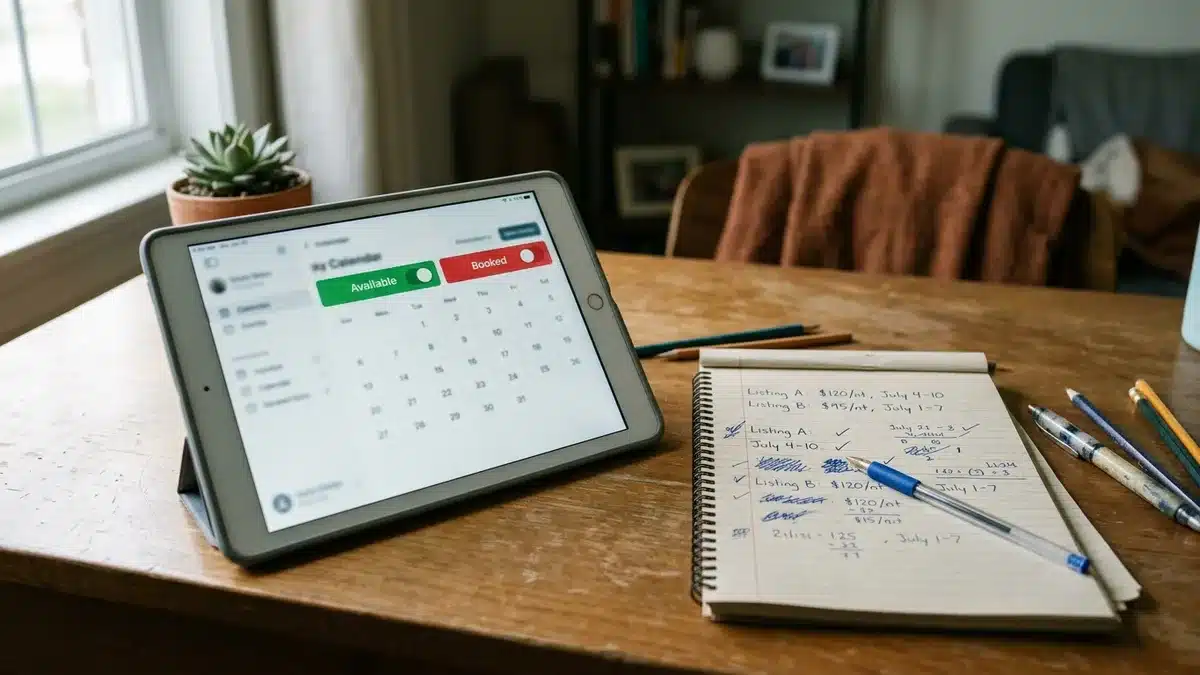
Setting Airbnb pricing means comparing your property against similar nearby listings and adjusting for your specific amenities, then layering in availability windows, minimum stay requirements, and a cancellation policy that matches your risk tolerance. Airbnb recommends using its built-in price suggestions, which factor in location, amenities, and comparable listings, as a starting benchmark rather than a fixed rule.
New hosts often price too high out of the gate, assuming their property deserves a premium before it has any reviews to justify one. Consider pricing modestly below the local comparable set for your first several bookings specifically to build review volume, then adjust upward once you have social proof. This trade-off costs some early revenue but compounds into stronger long-term positioning.
House rules and cancellation policy should be set with intention, not left at Airbnb’s defaults. A stricter cancellation policy reduces last-minute vacancy risk but can suppress your search visibility with guests who want flexibility. Decide which trade-off matters more for your specific property and guest type before publishing, and revisit the setting after your first few months of actual booking data.
How Do You Handle Guest Communication and Reviews?
Guest communication on Airbnb covers pre-booking inquiries, check-in instructions, mid-stay support, and post-stay review requests, and response speed directly affects your search ranking and Superhost eligibility. The Points Guy reports that Superhost status requires a response rate of at least 90 percent, which means slow replies carry a measurable cost beyond just a frustrated guest.
Build a small library of response templates for the questions you’ll get repeatedly: check-in timing, parking, Wi-Fi passwords, local recommendations. Templates don’t make communication feel robotic if you personalize the first line, and they cut your response time dramatically compared to typing a fresh answer every time.
Review requests should go out within a day or two of checkout, while the stay is fresh. The Points Guy notes Superhost eligibility also requires an overall rating of at least 4.8 based on the previous 365 days, so a handful of average reviews early on can meaningfully drag your average while your review count is still low.
This is precisely the manual grind that burns out new hosts fastest, answering the same five questions on repeat while juggling turnovers. Boostly Connect’s guest CRM includes automated review request sequences and live chat, so routine questions and post-stay follow-ups don’t depend on you being at your phone every evening.
What Does the First 30 Days of Hosting Actually Look Like?
The first 30 days of Airbnb hosting typically involve your listing gradually gaining search visibility as it accumulates views and inquiries, your first bookings arriving at a modest pace, and your response and cancellation metrics starting to shape your account’s standing. New listings usually don’t rank at the top of search immediately, since Airbnb weighs review history and booking track record heavily.
Use this window to nail your operational rhythm: turnover scheduling, calendar blocking around your own availability, and a consistent cleaning routine before your first guests give you a real workload to manage. If bookings feel slow in week one or two, check three things first: your pricing against current comparable listings, your photo quality, and whether your calendar has enough open availability to actually surface in search results.
By day 30, you should have enough guest data (repeat questions, common complaints, popular amenities) to refine your listing description and amenities list. This is also the point where many hosts start thinking beyond Airbnb alone. If you’re already fielding repeat-guest interest, a direct booking short term rental setup captures that demand without waiting for a second OTA booking fee.
What Does Long-Term Profitability Actually Look Like?
Long-term Airbnb profitability requires separating gross nightly revenue from every recurring cost: cleaning, utilities, maintenance, insurance, taxes, platform fees, and vacancy periods when the calendar isn’t booked. A listing that looks profitable based on nightly rate alone often isn’t once these deductions are applied consistently across a full year.
U.S. short-term rental occupancy is forecast at 57.4 percent in 2026, compared with a 57.0 percent pre-pandemic average, according to an AirDNA forecast summarized by BuildUp Bookings. That means even a well-run listing sits vacant a significant share of nights, and your budget needs to account for that reality rather than assuming near-constant occupancy.
RevPAR, revenue per available night, is forecast to rise 2.9 percent in 2026 according to the same AirDNA data, suggesting nightly rate growth is expected to offset moderating demand growth. Build your profitability model around occupancy and rate realistically, not around a best-case month you had once.
As your booking volume grows, so does your exposure to Airbnb’s commission on every single reservation, including the repeat guests who’d happily book with you directly if you gave them the option. Boostly Connect exists specifically to capture that repeat-guest revenue: every guest who books through your own site lands in your CRM, not Airbnb’s, so you own the relationship for every future stay.
Airbnb Hosting vs Co-Hosting vs Direct Booking: What Should You Actually Aim For?
These three paths solve different problems: Airbnb hosting gets you into the market fastest with built-in guest discovery, co-hosting lets you manage other people’s properties without owning real estate, and a direct booking channel reduces long-term commission dependency once you have any booking history at all. Most successful operators eventually run more than one of these simultaneously rather than choosing permanently.
| Path | Best For | Key Requirement |
|---|---|---|
| Standard Airbnb hosting | First-time hosts building initial reviews and booking history | Verified account, legal property, complete listing |
| Co-hosting for other owners | Experienced hosts wanting income without owning property | Airbnb’s Co-Host Network requires at least 10 hosted or co-hosted stays, or 3 stays totaling at least 100 nights, in the previous 12 months |
| Direct booking channel | Any host with repeat guests or an established review base | A booking website synced to your property system and guest CRM |
If you’re brand new, start with standard hosting to build a review base. Once you have consistent bookings and a few repeat guests asking whether you have “your own website,” that’s the signal it’s time to add a direct channel. Our guide to what an Airbnb host actually does day to day covers the operational side in more depth if you’re still deciding whether hosting fits your schedule.
Practical Guidance: What to Prioritize and What to Avoid
Prioritize legal verification and insurance before any furnishing spend. This single sequencing decision prevents the most expensive beginner mistake: furnishing a property you later discover can’t legally operate as a short-term rental.
- Verify legality first. Confirm zoning, HOA rules, and lease terms with your city, association, and landlord before spending on furniture.
- Budget realistically across all cost categories from the table above, not just furnishing.
- Price modestly for your first bookings to build review volume before adjusting upward.
- Build response templates early so guest communication doesn’t consume every evening.
- Track your true booking fee cost across your first quarter, then evaluate whether a direct booking channel makes sense.
- Refresh photos and descriptions after your first 30 days using real guest feedback.
- Don’t treat Airbnb as your only channel forever. Even a modest share of direct bookings compounds significantly over a multi-year hosting career.
The most common mistake we see among new hosts isn’t a bad listing, it’s treating Airbnb as the entire business model rather than one channel within it. If you’d like a structured framework for building the rest of that model, our playbook on getting more direct bookings picks up exactly where this guide leaves off.
Frequently Asked Questions
What percentage does Airbnb take from hosts?
Airbnb charges a host-side service fee on each booking, and the exact percentage depends on your chosen fee structure and cancellation policy, so check your current rate in your host dashboard. Separately, Airbnb typically charges guests around 14 percent in service fees, according to ATLAS by AvantStay (June 2026).
How much of a cut does Airbnb take overall?
Airbnb takes a cut from both sides of a transaction: a host-side service fee subtracted from your payout, and a guest-side service fee added on top of the nightly rate. The combined effect is why many hosts calculate their true per-booking margin carefully rather than relying on the listed nightly rate alone.
How do I start an Airbnb for beginners with no prior experience?
Start by creating and verifying your Airbnb account, then confirm your property is legally allowed to operate as a short-term rental in your city, HOA, and lease. From there, furnish the space to guest standards, build a complete listing with photos and an amenities list, and set competitive introductory pricing before publishing.
What disqualifies a property from being listed on Airbnb?
Common disqualifiers include local zoning laws or HOA rules that prohibit short-term rentals, lease agreements that ban subletting, failed identity verification, and missing required licenses or insurance for your listing type. Airbnb’s service and experience standards may also require background checks or certifications for certain categories of listings.
How do I integrate secure payment processing into a direct booking website?
A direct booking website needs a PCI-compliant payment gateway integrated with your property management system so guest payments and availability sync automatically without manual reconciliation. Platforms like Boostly Connect handle this by syncing directly with your existing PMS, so payment processing, live pricing, and availability all update in one connected system rather than requiring a separate plugin.
Do I need a business license to host on Airbnb?
Requirements vary significantly by city and state, and many jurisdictions require a specific short-term rental permit or general business license before you can legally operate. Check directly with your local permitting office rather than assuming your general homeowner status is sufficient, since STR-specific rules are increasingly common as of 2026.
How long does it take to get your first Airbnb booking after listing?
Timing varies by market, pricing competitiveness, and photo quality, and new listings without reviews often take longer to surface in search results than established ones. Hosts who price modestly below comparable listings and respond quickly to early inquiries typically see faster initial booking activity than those who price at a premium from day one.
Can I run Airbnb and a direct booking website at the same time?
Yes, and most experienced hosts run both simultaneously rather than choosing one over the other. Airbnb continues driving new guest discovery through its search traffic, while a direct booking site captures repeat guests and reduces the commission paid on returning stays.
Conclusion: Your Path Into Airbnb Hosting in 2026
Getting into Airbnb in 2026 comes down to a sequence, not a single decision: verify your account, confirm legality, prepare the space, build the listing, price it honestly, and manage guest communication consistently from your first booking onward. The market is large, with more than 5.5 million hosts and 2.5 billion guest arrivals recorded globally, but that scale also means differentiation through pricing, photos, and response speed matters more than ever.
The bigger long-term decision isn’t whether to join Airbnb, it’s what you do once bookings start coming in. Every guest who returns and books through Airbnb again instead of directly with you is commission you didn’t need to pay a second time. Planning for that from month one, rather than year three, is what separates hosts who scale profitably from hosts who stay stuck paying full platform fees indefinitely.
If you’re getting your first Airbnb listing off the ground and already thinking about the guests who’ll want to book with you directly next time, Boostly Connect can have your direct booking site synced to your property system in under 20 minutes, with no developer and a free plan for up to 3 listings on the Discover map. Book a demo to see exactly how it connects to the PMS you’re already planning to use.
Once your Airbnb listing is live and your first reviews start coming in, the next move is making sure repeat guests have a reason to skip the OTA next time. That’s the exact gap Boostly Connect was built to close, connecting your PMS, your own website, and your guest CRM so direct bookings grow alongside your Airbnb bookings instead of competing for your attention.