
The best website builder for short term rentals is one that syncs live availability and pricing straight from your property management system, includes a built-in CRM to capture guest data, and gives you conversion tools like discount codes without requiring a developer. General-purpose builders can produce a nice-looking page, but most fall short on the booking mechanics that actually turn traffic into reservations.
Key Takeaways
- The strongest short term rental website builders sync live availability from your PMS in real time, eliminating the double-booking risk that comes with manually updating a calendar widget.
- General-purpose builders like Wix and Squarespace work for basic online presence but usually require third-party plugins to handle two-way channel sync, which introduces breakage risk as your portfolio grows.
- Industry research shows online booking channels are expected to account for over 75 to 83 percent of vacation rental revenue by 2027, making a functional direct booking site less optional every year.
- Boostly Connect supports 8 PMS integrations and builds a WordPress-based direct booking site in under 20 minutes, with no developer and a free plan for up to 3 listings on the Discover map.
- Data portability, meaning the ability to export guest contacts and booking history, matters more than template variety when you’re comparing platforms for the long term.
- Boostly Connect pairs the website with a guest CRM and coaching model, which is why clients reach an average of 65 percent direct bookings within 12 months, or the team works for free until they get there.
If you manage even one short-term rental, you’ve probably already tried building a website. Maybe it’s a Squarespace page with a static photo gallery and a link back to your Airbnb listing. That’s not a direct booking website. It’s a digital business card, and it doesn’t move the needle on commission you’re losing to OTA platforms every month.
In our experience working with vacation rental operators across 25 countries, the gap between a “pretty” site and a site that actually books guests comes down to plumbing, not design. A guest lands on your page, checks dates, and if the calendar isn’t live, synced, and instantly bookable, they bounce back to Airbnb. Building a direct booking site without that infrastructure is why so many hosts try direct booking once, get a handful of visits and zero reservations, and give up.
This guide compares the categories of website builders available to short term rental hosts in 2026, breaks down what actually matters for conversion (not just aesthetics), and shows you where a purpose-built platform like Boostly Connect closes gaps that general website builders leave wide open.
What Is the Best Site for Short Term Rentals?
The best site for short term rentals is a purpose-built direct booking website that connects directly to your property management system for live availability, rather than a generic template site with a manually updated calendar. Purpose-built platforms remove the sync errors and double-booking risk that plague DIY approaches.
General website builders like Wix or Squarespace are fine for a restaurant menu or a portfolio site. But a short-term rental needs real-time inventory logic: dates that block automatically when a guest books elsewhere, pricing that updates when you adjust your strategy in your PMS, and a checkout flow that captures the guest’s name, email, and phone number into a system you control.
Squarespace, for example, is frequently recommended for first-time hosts because of its strong visual templates and blog tools, and it’s a reasonable starting point if you have one property and no urgency around scale. But once you’re syncing multiple platforms or managing more than a couple listings, a template site without native PMS integration becomes a manual reconciliation job every single day.
That’s specifically the problem Boostly Connect was built to solve. Rather than bolting a booking widget onto a generic template, Boostly Connect syncs directly with your existing PMS, including Hospitable, Hostfully, Lodgify, and Guesty, so your site’s calendar always reflects true availability without you touching a spreadsheet.
What Should You Look for in a Vacation Rental Website Builder?
A vacation rental website builder should be evaluated on five criteria: live PMS sync, mobile optimization, SEO structure, guest data ownership, and total cost over 12 months, not just upfront price or design flexibility. Missing any one of these creates operational friction later.
Mobile optimization deserves more weight than most hosts give it. More than half of vacation rental website traffic comes from mobile phones, according to CraftedStays research, so a builder that renders a clunky mobile checkout will quietly lose you bookings you never see in your analytics.
SEO structure matters too. A site with Google Vacation Rentals schema markup and a built-in blog structure gives search engines something to index beyond a single homepage. Sites with zero SEO foundation rarely rank for anything beyond their own brand name, which means all your traffic still has to come from paid ads or OTA referrals.
Data portability is the criterion most first-time buyers skip and later regret. If your builder can’t export guest contact data and booking history via CSV or API, you’re locked in, and switching later means starting your guest list from zero. We built Boostly Connect’s CRM specifically so every direct booking guest gets automatically captured, with your data staying yours regardless of what platform decisions you make down the road.
| Feature | Why It Matters | Common Gap in General Builders |
|---|---|---|
| Live PMS sync | Prevents double bookings and manual calendar updates | Requires third-party plugin, prone to sync errors |
| Mobile checkout | Over half of traffic is mobile | Templates often render poorly on mobile booking flows |
| Built-in CRM | Captures guest data for repeat booking marketing | Usually requires a separate email tool |
| SEO/blog structure | Drives organic traffic beyond brand searches | Basic templates, minimal schema support |
| Data export/API access | Protects against vendor lock-in | Often limited or unavailable on template platforms |

What Is the 75/55 Rule in Airbnb?
The 75/55 rule refers to a pattern some hosts use to describe balancing pricing and occupancy targets, but it isn’t an official Airbnb policy. If you’ve seen this term floating around host forums, treat it as informal shorthand rather than a documented rule, and don’t build your pricing strategy around a number Airbnb hasn’t published.
What matters more in 2026 is understanding how your occupancy and rate strategy on Airbnb compares to what you could keep if the same booking happened on your own site. Airbnb and similar OTAs commonly apply commission in the range of 8 to 15 percent on gross bookings, with some specialized channels charging up to 20 percent, according to industry benchmark data.
Instead of chasing informal “rules” you find in forums, focus on the levers you control directly: your direct booking conversion rate, your repeat guest percentage, and your total cost per booking across channels. A 2026 study by Lodgify found average short-term rental hosts see a repeat guest rate of just 5 to 8 percent, compared to 15 to 25 percent for hosts running a deliberate retention strategy, which is exactly the gap a CRM-equipped direct booking site is designed to close.
This is where a website builder alone isn’t enough. You need the marketing layer behind it. Boostly Connect pairs your direct booking site with automated email and SMS sequences for past guests, so retention isn’t dependent on you remembering to follow up manually.
What Is the 80/20 Rule for Airbnb?
The 80/20 rule, as applied loosely by some hosts, suggests that a large share of your revenue often comes from a smaller share of your guests or listings, a version of the general Pareto principle rather than an Airbnb-specific policy. It’s a useful mental model, not a hard mechanic inside the platform.
Applied practically, this means your repeat guests and referrals likely drive a disproportionate share of your profit margin, since you pay no OTA commission on a direct rebooking. Data from a GetHostAI review of short-term rental operators found repeat guests account for 1 to 26 percent of total booking value across a dataset, with a median around 5 percent, and roughly three-quarters of that repeat revenue still flows through OTAs paying standard commission.
That last stat is the real story. Most hosts are still letting Airbnb take a cut on guests who already stayed with them once and would happily book direct if given an easy path. Fixing that leak doesn’t require abandoning Airbnb. It requires a system that captures the guest’s contact details the first time and reaches back out before their next trip.
That’s precisely what the guest CRM inside Boostly Connect is built to automate. Every guest who books through your Boostly Connect website lands in your CRM automatically, with segmented email and SMS sequences ready to nudge them back before they default to searching Airbnb again.
What Is the Best Site to Use for Vacation Rentals?
The best site to use for vacation rentals depends on your portfolio size and goals: a single-property host testing the waters has different needs than a boutique manager running 15 units. General visual builders suit hobbyists; PMS-integrated platforms suit anyone serious about scaling direct revenue.
If you own one property and simply want an attractive online presence with a blog and basic booking form, a general builder can work, at least until you outgrow it. Squarespace’s visual templates are genuinely strong for this exact use case, and there’s no shame in starting there if your volume is low.
But once you’re managing multiple listings, or even one listing where you want serious direct booking volume, you need infrastructure, not just a template. A boutique property manager juggling five to twenty units cannot afford to manually update seven different calendars every time a booking comes in. The tech stack becomes the bottleneck, not the marketing.
This is the exact audience Boostly Connect was built for. Multi-property operators and boutique managers use Boostly Connect because pricing, availability, and guest data sync from one connected system across every listing, instead of managing separate tools per unit. In one case, a bed and breakfast operator using this approach reached 90 percent direct bookings and 60 percent repeat guests, a dramatic shift from the inconsistent results their original generic website produced.
How Does a Direct Booking Website Compare to Just Using Listing Platforms?
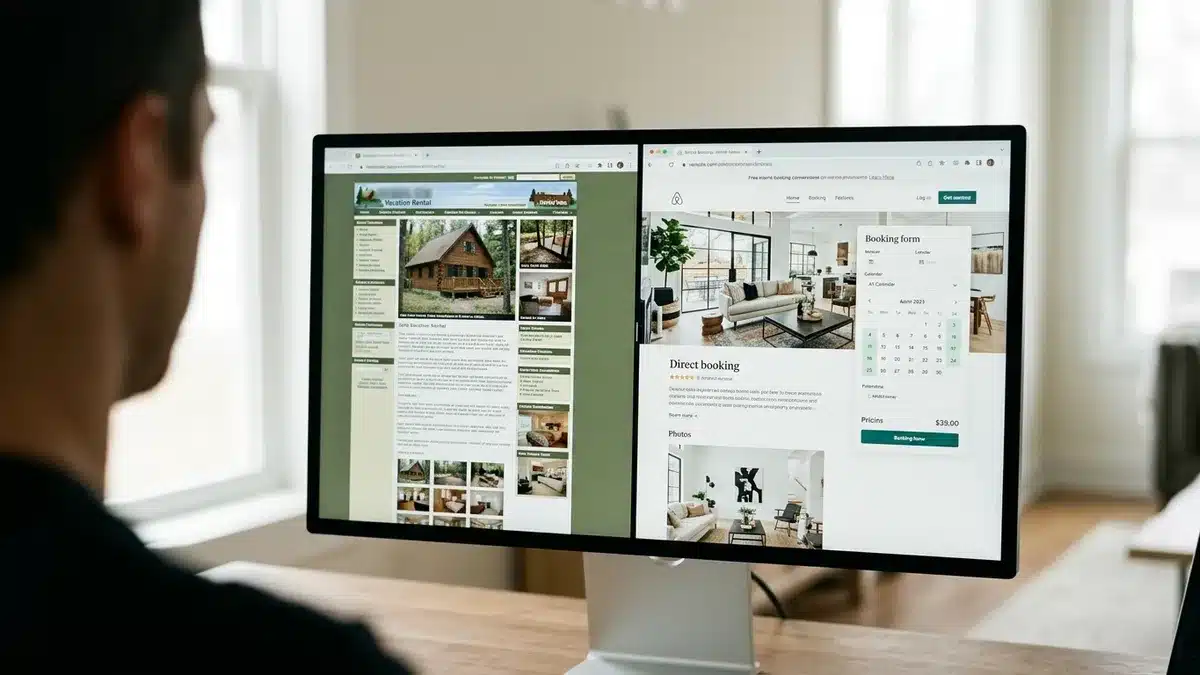
A direct booking website gives you ownership of your domain, your guest data, and your brand, while listing platforms like Airbnb and Vrbo retain control of the guest relationship and charge recurring commission on every reservation. The two aren’t mutually exclusive, and running both simultaneously is the standard approach for most hosts in 2026.
The fear we hear most often from hosts considering a direct site is losing Airbnb search ranking by “distracting” guests elsewhere. In practice, this doesn’t happen the way hosts expect. Airbnb ranks listings based on responsiveness, reviews, and booking behavior on their platform, not based on whether you also operate a separate website. You keep your Airbnb listing exactly as is and simply redirect returning guests and referral traffic to your own site.
Where the math changes is on repeat and referral bookings. A guest who found you on Airbnb once, loved their stay, and wants to rebook has no reason to pay Airbnb’s Re-book feature commission a second time if you’ve captured their contact details and can offer them a direct booking link instead.
Boostly Connect’s discount codes and direct-only offers give returning guests a concrete incentive to book direct rather than defaulting back to the app on their phone. One host, Liam, made his first £800 direct booking using a single tactic from a free Boostly challenge, which he described as the moment that showed him what was actually possible outside OTA dependency.
How Do Small Portfolios and Large Portfolios Differ in Website Needs?
Small portfolios of one to three properties typically need a straightforward booking flow and basic SEO, while portfolios of ten or more properties need centralized inventory management, multi-listing dashboards, and automation that doesn’t require adding headcount every time you add a unit. Treating both segments the same way is a common mistake in this space.
A single-property host can get away with manually checking a calendar once a day. That approach collapses the moment you’re managing eight or more units across different neighborhoods, because the operational overhead scales linearly with property count if your tools don’t scale with you.
Multi-property portfolio operators need a system where pricing, availability, and guest messaging stay unified across every listing from one login, not eight separate ones. Liam’s growth from managing his own units to overseeing 30-plus properties for other landlords happened specifically because his professional Boostly website and direct booking track record attracted local landlord attention, eventually building him a network of 50 to 60 property owners and generating an additional £10,000 a year from just one referred property.
Boostly Connect’s multi-property support keeps everything, PMS sync, website inventory, and CRM records, unified across a growing portfolio, so scaling from three properties to thirty doesn’t mean rebuilding your tech stack from scratch.
How Do You Migrate From a Listing Platform Without Losing SEO?
Migrating from Airbnb-only reliance to a direct booking website without losing search visibility means keeping your Airbnb listing active while building your own site’s SEO foundation in parallel, rather than abruptly switching channels. Search engines index your new site independently of your OTA presence, so there’s no ranking penalty for running both.
The mistake we see most often is hosts launching a direct booking site, driving a small amount of traffic to it, seeing no immediate bookings, and abandoning the project within a few months. SEO takes time to compound, and a new site with zero content history needs consistent publishing (think guest guides, local area content, and property updates) to start ranking for anything beyond branded search terms.
Structuring your vacation rental website’s SEO foundation from day one, rather than retrofitting it later, saves months of wasted effort. This includes Google Vacation Rentals schema, clean URL structure, and a blog built around the questions your actual guests ask before booking.
Boostly Connect ships every website with SEO-ready structure from launch, plus integration with Google Vacation Rentals and metasearch channels, so you’re not relying on organic search alone or hiring a separate SEO contractor to retrofit the basics.
How Should You Structure Content and CTAs for a Short Term Rental Website?
A short term rental website’s content and calls-to-action should be structured around the guest’s actual decision journey: property overview, live availability, house rules, local area guides, and a clear, low-friction path to book direct. Generic “About Us” pages that bury the booking button do more harm than good.
Your homepage needs the booking calendar visible immediately, not three scrolls down. House rules and check-in details belong on their own page, both because guests search for this information specifically and because it reduces pre-arrival messaging volume. Upsell opportunities, early check-in, late checkout, add-on cleaning, should appear at the point of booking, not buried in a post-booking email.
Discount codes and gift vouchers work best as direct-only offers, visible on your site but never extended to your OTA listings. This creates a clear incentive structure: book direct, save money, guests understand the trade instantly.
We built Boostly Connect’s website templates around this exact guest journey, with discount codes, gift vouchers, and direct-only offers embedded into the booking flow itself rather than requiring a separate plugin or manual coupon system.
How Do You Integrate Dynamic Pricing Tools Into Your Website Builder?
Dynamic pricing integration means connecting a revenue management tool to your PMS so rate changes push automatically to both your OTA listings and your direct booking website, keeping pricing consistent across every channel without manual updates. Without this integration, hosts often end up with mismatched rates between Airbnb and their own site.
Real-time demand pricing has become table stakes. If your OTA listing rate updates dynamically but your website calendar shows a stale price, you either lose the booking to confusion or lose margin by underpricing the direct channel. Tools like Beyond Pricing and PriceLabs are widely reviewed in the industry for handling this exact sync, and both integrate with major property management systems.
Because Boostly Connect syncs directly with your existing PMS rather than layering on top of it, any dynamic pricing tool already connected to your PMS pushes rate updates straight through to your Boostly Connect website automatically. You don’t manage pricing in three places. You manage it in one, and it reflects everywhere.
For hosts not yet using a dedicated pricing tool, a free listing analysis tool is a reasonable starting point to see whether your current rates are leaving demand on the table before committing to a paid platform.
What Does the ROI on a Direct Booking Website Actually Look Like?
The return on a direct booking website comes primarily from eliminated commission on repeat and referral bookings, plus the compounding value of owning guest data for future marketing. A single avoided OTA commission on a repeat guest, at typical rates of 8 to 15 percent, can offset a meaningful share of a site’s ongoing cost within a handful of bookings.
Consider Nikki, a serviced accommodation host who launched a direct booking site for a property she’d converted from a flip project. Her site drove direct bookings from zero to 40 percent, including a single booking worth £6,000, with a stated goal of reaching 60 percent direct bookings going forward.
Or consider the case of a rental portfolio built almost entirely on direct booking strategy: growth from 0 percent to 8 percent direct bookings in the first 12 months after website launch, then compounding to 55 percent over subsequent years as the operator’s reputation and repeat guest base grew.
Boostly Connect’s dashboard tracks direct booking revenue in one place, so you’re not manually reconciling numbers across your PMS, a spreadsheet, and your bank statement to figure out whether the investment is paying off. Clients on Boostly Connect reach an average of 65 percent direct bookings within 12 months, and if that target isn’t hit, the team continues working the account at no additional cost until it is.
Practical Guidance: How Do You Choose the Right Builder for Your Situation?
Choosing the right website builder for your short-term rental starts with an honest inventory of your property count, technical comfort, and growth plans, not a feature checklist copied from a review site. The right answer for a single-property hobbyist is genuinely different from the right answer for a growth-stage operator.
- Count your properties honestly. One property with low booking volume can survive on a general template site. Two or more properties, or ambitions to grow, need PMS-integrated infrastructure from the start.
- Check your current PMS integration options. If you’re on Hospitable, Hostfully, Lodgify, or Guesty, confirm your website builder syncs natively before committing, rather than relying on a third-party plugin bridge.
- Ask about data ownership explicitly. Request a straight answer on whether guest contact data and booking history export via CSV or API. If the answer is vague, that’s a signal.
- Budget for the marketing layer, not just the site. A website with zero email or CRM capability will generate traffic that never converts into repeat business.
- Set a 12-month timeline, not a 12-week one. SEO and repeat guest strategies compound. Judging a direct booking site after 60 days is the single most common reason hosts abandon a good strategy too early.
Common mistakes we see repeatedly: hosts picking a builder based purely on template aesthetics, ignoring PMS integration until sync errors start causing double bookings, and building a beautiful site with no plan for driving traffic to it. A website without a marketing engine behind it is a brochure, not a booking channel. If you want a deeper walkthrough on avoiding these traps, our guide on how to build a direct booking website without hiring a developer covers the setup sequence step by step.
Frequently Asked Questions
How long does it take to set up a direct booking website with Boostly Connect?
Boostly Connect connects to your existing PMS and builds your direct booking website in under 20 minutes, with no developer and no coding required. You review your synced listings and your site is live, with real-time availability pulled directly from your property system.
Will switching to direct bookings hurt my Airbnb search ranking?
No. Airbnb’s ranking algorithm is based on factors like responsiveness, reviews, and in-platform booking behavior, not on whether you also run a separate direct booking website. Most hosts run both channels simultaneously and simply redirect repeat guests toward their own site.
Which property management systems integrate with a direct booking website builder?
Boostly Connect supports 8 PMS integrations, including Hospitable, Hostfully, Lodgify, and Guesty, allowing you to plug in your existing system in under five minutes. Once connected, your live availability and pricing sync automatically to your website without manual calendar updates.
Do I need a developer or coding experience to launch my direct booking site?
No. Boostly Connect is designed as a no-code, guided setup process that any host can complete without technical background. The platform handles the PMS sync, website build, and CRM connection without requiring you to touch a line of code.
What happens to my guest data when someone books direct instead of through an OTA?
Every guest who books through your direct booking site is automatically captured into your own CRM, meaning their contact details stay with you rather than being retained by an OTA for its own remarketing. This is the foundation for repeat guest email and SMS marketing you control entirely.
How much can I realistically save by reducing OTA commission dependency?
Savings depend on your booking volume and current OTA mix, since online travel agencies commonly charge 8 to 15 percent commission on gross bookings, with some channels reaching up to 20 percent. Every booking shifted from an OTA to your direct site keeps that commission in your business instead.
Can a website builder like this handle multiple properties or just a single listing?
Yes. Boostly Connect supports multi-property and multi-listing management from one connected system, syncing pricing, availability, and guest data across an entire portfolio rather than requiring separate tools per unit. This scales from a single property up through large multi-property operations.
Is there an upfront cost to get started?
Boostly Connect has a free plan for up to 3 listings on the Discover map, removing the typical barrier of paying for a website build before you’ve generated a single direct booking. This lets you test the direct booking channel with minimal financial risk.
Conclusion: What’s the Real Answer Here?
The best website builder for short term rentals in 2026 isn’t decided by template variety or design flair. It’s decided by whether the platform syncs live PMS data, owns your guest relationship through a real CRM, and gives you a clear path to reduce OTA commission over time. General builders can produce a page. Purpose-built platforms produce a booking channel.
If you’re still weighing options, start with the honest inventory from the guidance section above: property count, current PMS, and your appetite for managing the marketing layer yourself. The math on commission rarely lies. Every booking that runs through an OTA instead of your own site is money and guest data you don’t get back.
Book a demo with Boostly Connect to see your PMS, website, and CRM connected in under 20 minutes, with no developer and a free plan for up to 3 listings on the Discover map.
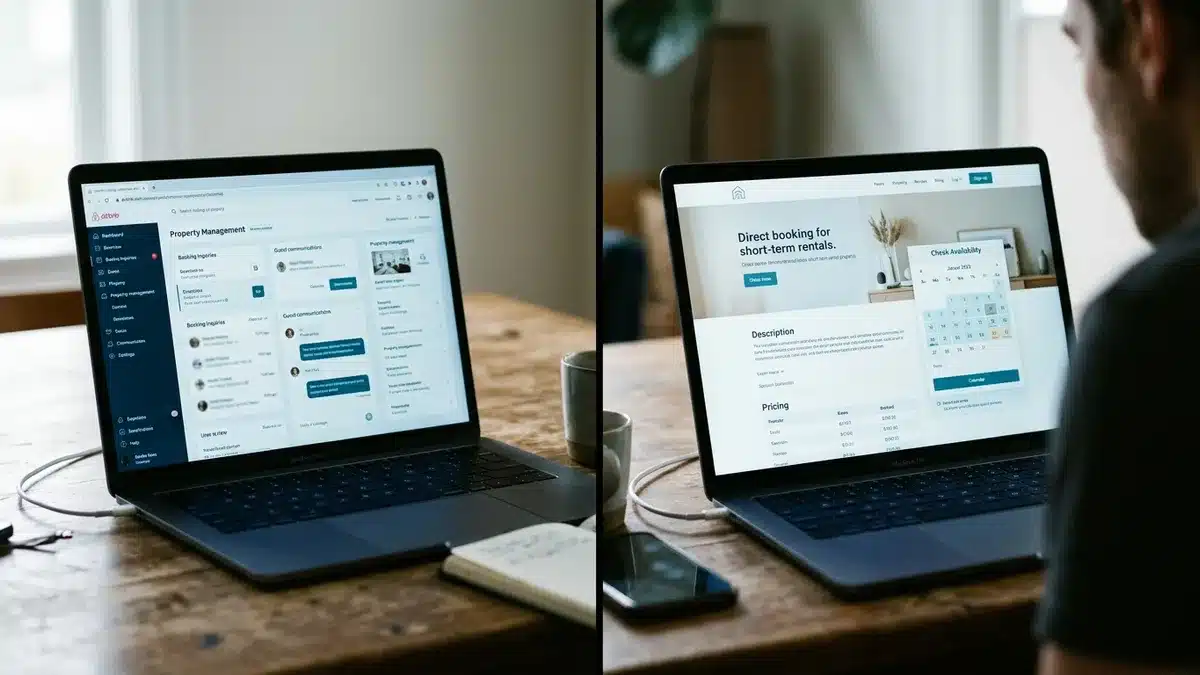
If commission bleed from Airbnb and Vrbo is the reason you’re comparing website builders in the first place, seeing your own listings synced and live on a Boostly Connect site is the fastest way to know if the fit is right. Get started with Boostly Connect and bring your own property data to the demo.