
You can build a direct booking website without touching a line of code, and in most cases you can have live availability and real pricing showing on your own domain within a single afternoon. That statement surprises a lot of hosts, because the mental image most of us carry around is a freelance developer, a six-week build, and an invoice nobody budgeted for. It doesn’t have to work that way anymore.
- You don’t need a developer or coding knowledge to build a direct booking website in 2026: no-code builders and PMS-connected platforms have replaced the custom-build model for most independent hosts.
- Commission math drives the decision: OTAs commonly charge 15 to 20 percent per reservation, so a host running $80,000 a year in bookings is handing over a substantial five-figure sum in fees alone.
- Your property management system matters more than your website theme: without a live PMS sync, you risk double bookings the moment your direct site starts generating real traffic.
- Repeat guests are the fastest win: industry benchmarks put the average repeat guest rate for direct bookings around 22 percent, meaning roughly one in five bookings can come from returning guests if you actually capture their contact data.
- A website alone won’t fill your calendar: traffic has to come from somewhere, whether that’s SEO, email to past guests, or your own social channels.
- Boostly Connect syncs your existing PMS to a WordPress-based direct booking site in under 20 minutes, with no code and a free plan for up to 3 listings on the Discover map, so the technical barrier that used to stop hosts from doing this is gone.
Most hosts who consider building a direct booking site get stuck at the same point: they assume it requires either a developer’s invoice or a steep learning curve with website builders. Neither has to be true in 2026. The tools have caught up to the ambition.
This guide walks through exactly how to build a direct booking website step by step, covering the platform decision, the technical pieces that actually matter (domain, hosting, booking engine, payments), the mistakes that sink most self-built sites, and where a done-for-you approach like Boostly Connect saves you from reinventing a wheel that’s already been built thousands of times over.
At Boostly Connect, we’ve watched thousands of hosts make this exact transition, and the pattern is consistent: the ones who succeed treat the website as one piece of a connected system, not a standalone project. That’s the frame we’ll use throughout this article.
What Is a Direct Booking Website?
A direct booking website is a site you own and control, separate from Airbnb, Vrbo, or Booking.com, where guests can check live availability, see real pricing, and pay you directly for a stay. It typically lives on your own domain, runs on a platform like WordPress, and connects to your property management system so availability updates automatically.
The core difference from an OTA listing is ownership. On Airbnb, the guest relationship, the messaging thread, and the contact data all belong to the platform. On a direct booking website, every reservation feeds your own CRM, which means you can market to that guest again without paying a platform fee to reach them a second time.
Specifically, a working direct booking site needs three connected pieces: a property management system holding your calendar and rates, a website displaying that data publicly, and a payment processor collecting funds securely. Most competitor guides treat these as separate projects. In our experience, treating them as one connected system is what separates hosts who actually convert traffic from hosts who built a pretty site nobody books through.
How to Build Your Own Booking Website: The Core Steps
Building your own booking website comes down to five sequential decisions: choosing a platform, securing a domain and hosting, integrating a live booking engine, setting up payment processing, and designing pages that convert visitors into bookers. Skipping any one of these steps is what causes most self-built direct booking sites to underperform.
1. Choose Your Platform: All-in-One vs. Independent Build
Your first decision is whether to build on a general website builder like WordPress or Wix and bolt on a booking plugin, or use a connected platform that syncs your existing PMS directly into a pre-built template. As of 2026, this is the single biggest fork in the road for hosts.
An independent WordPress build gives you full design control but requires you to separately manage hosting, a rental-specific theme, a reservation plugin, and Stripe integration, each with its own update cycle and point of failure. A connected platform trades some design flexibility for a PMS sync that just works, with no plugin conflicts to troubleshoot at 11pm before a guest tries to book.
This is exactly the gap Boostly Connect was built to close. Instead of stitching together a theme, a plugin, and a payment gateway separately, Boostly Connect connects to your existing PMS (Hospitable, Hostfully, Lodgify, Guesty, and 8 platforms total) and publishes a WordPress-based site with live availability already syncing, no developer required.
2. Secure a Domain and Reliable Hosting
A domain and hosting are the foundation of any direct booking site, and they matter because a slow-loading or unreliable site loses bookings before a guest ever sees your calendar. Your domain should match your property or brand name, not a generic address, since that’s what guests will remember and type directly next time.
Hosting quality affects load speed, uptime during traffic spikes, and how Google indexes your pages for search. A site that goes down during a weekend booking surge costs you real reservations, not just theoretical traffic.
If you’re building independently, you’ll need to research hosting providers, compare uptime guarantees, and manage renewals yourself, an ongoing task most hosts underestimate. Platforms that bundle hosting into the setup (as Boostly Connect does) remove this from your to-do list entirely, so your site stays live without you monitoring server status.
What Is the 75-55 Rule for Airbnb?
The 75-55 rule is a rule of thumb some hosts use to describe Airbnb’s search algorithm behavior around response rate and booking lead time, though Airbnb has never officially published a fixed rule under this name. In practice, it refers to the idea that maintaining strong responsiveness and booking velocity helps a listing hold its search position.
The relevance to building a direct booking website is this: many hosts hesitate to launch a direct channel because they fear it will hurt their Airbnb ranking. That fear is largely unfounded when it comes to how you promote your direct site.
Your Airbnb ranking is driven by response rate, cancellation rate, review scores, and booking activity on Airbnb itself, not by whether guests can also book you directly elsewhere. As a result, running a direct booking site in parallel with your Airbnb listing doesn’t inherently penalize your OTA performance. What actually protects your ranking is continuing to respond quickly and maintain quality on Airbnb, regardless of how much of your business shifts to direct.
We’ve worked with hosts who assumed launching a direct site meant choosing a side. It doesn’t. The two channels can run side by side, and Boostly Connect’s CRM captures direct bookers automatically so you’re building your own list without touching your Airbnb activity at all.
What Is the Best Website Builder for a Short-Term Rental Booking System?
The best website builder for a short-term rental booking system is one that connects directly to your existing property management system, since manual calendar updates are the fastest way to create a double booking. WordPress remains the most widely used foundation for direct booking sites because of its flexibility and SEO infrastructure, but the builder matters less than the sync behind it.
General-purpose builders like Wix or Squarespace can technically host a booking widget, but they weren’t built with rental-specific reservation logic in mind. You’ll often need a third-party plugin layered on top, which introduces another system that can break or fall out of sync during a software update.
Dedicated rental platforms solve the sync problem but vary widely in how many PMS providers they actually support. This is where integration depth becomes the real differentiator, not the visual template. Boostly Connect supports 8 PMS integrations, so hosts using Hospitable, Hostfully, Lodgify, or Guesty can connect their existing system without migrating their operations to a new tool first.
Our honest take: if you’re comfortable managing WordPress plugins and troubleshooting sync errors yourself, an independent build gives you more design freedom. If you’d rather spend that time marketing your listing instead of maintaining your tech stack, a connected platform is the better trade.
How Do You Build a Direct Booking Website Step by Step?
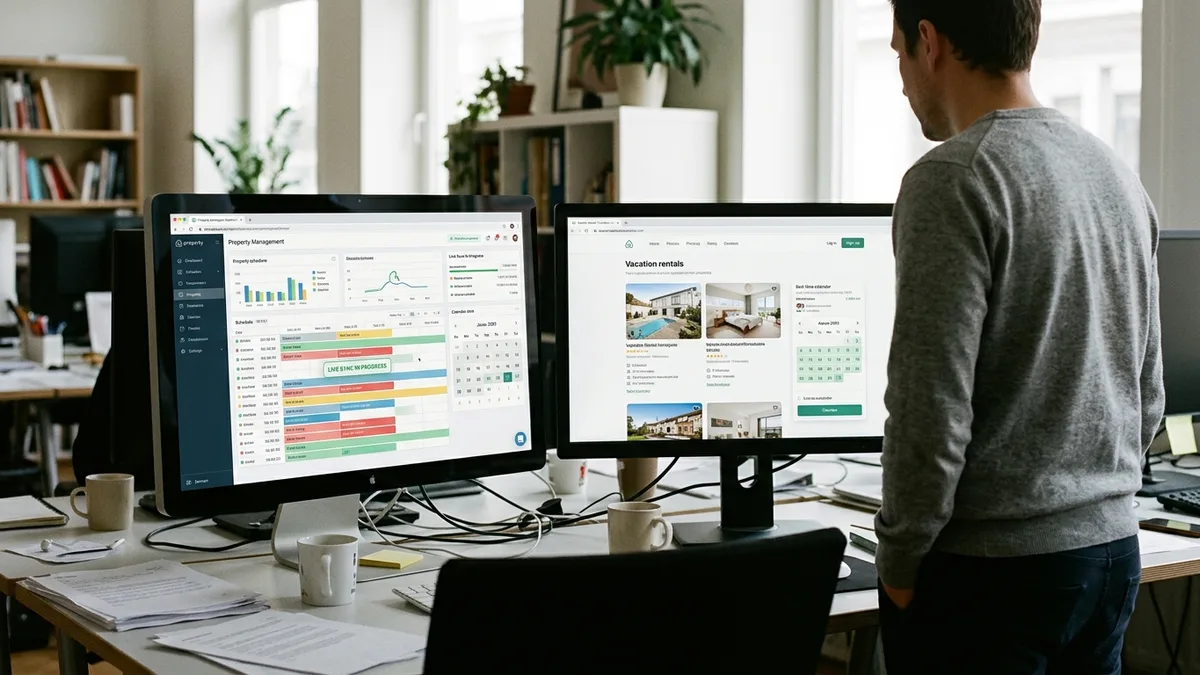
Building a direct booking website step by step involves eight sequential tasks: connecting your PMS, choosing a domain, selecting a template, setting up payments, writing your property pages, configuring your booking engine, testing the calendar sync, and publishing with SEO basics in place. Missing any single step creates a gap that either loses bookings or creates double bookings.
- Connect your PMS first, before any design work. Your availability calendar is the backbone of the site. If you design pages before the sync is live, you’ll end up rebuilding layouts around data feeds you haven’t tested yet.
- Register a domain that matches your brand. Avoid generic booking-site language; use your property or company name so repeat guests can find you by memory alone.
- Select a mobile-first template. The majority of vacation rental searches happen on phones, so a template that isn’t mobile-optimized loses bookings before a guest even sees your rates.
- Integrate secure payment processing. Stripe is the standard for direct booking sites because it supports card payments with SSL encryption and doesn’t require you to build a merchant account from scratch.
- Write property pages with real detail. Include amenities, house rules, cancellation policy, and clear terms; thin content here hurts both conversions and your SEO.
- Configure your booking engine to block dates in real time. Test this specifically. A calendar that updates every few hours instead of instantly is where double bookings happen.
- Run a test booking end to end. Book a date yourself, cancel it, and confirm the PMS reflects the change immediately.
- Publish with basic SEO in place. Title tags, meta descriptions, and a blog structure give search engines something to index from day one rather than starting from zero.
Doing all eight of these manually typically means researching a theme, testing a reservation plugin, configuring Stripe API keys, and troubleshooting sync timing between your PMS and your site, a process that can eat an entire week of evenings for a host who isn’t already comfortable with WordPress. This is the exact workflow Boostly Connect compresses into a single connected setup: connect your PMS, and live availability, real-time pricing, and a published template are ready in under 20 minutes, with no code required.
Data & Evidence: What Building It Yourself vs. Using a Connected Platform Actually Costs You
The real cost difference between a self-built direct booking site and a connected platform isn’t just dollars, it’s ongoing time and risk exposure. Below is a practical comparison based on what each approach actually requires.
| Factor | Independent WordPress Build | Boostly Connect |
|---|---|---|
| Developer or coding required | Often, for custom theme or plugin conflicts | None required |
| PMS sync setup | Manual plugin configuration, ongoing maintenance | Under 20 minutes, connects to 8 PMS platforms |
| Payment processing | Manual Stripe API integration | Built-in Stripe payments, no added booking fees |
| Guest data ownership | Depends on plugin setup | Automatically captured into your own CRM |
| Upfront cost for small portfolios | Hosting, theme, and plugin fees add up | A free plan for up to 3 listings on the Discover map |
| SEO infrastructure | Must be configured manually | SEO-optimized templates and blog structure built in |
The global vacation rental management software market was valued at 0.92 billion USD in 2026 and is projected to reach 2.38 billion USD by 2034, growing at roughly 11.1 percent annually. That growth reflects a broader shift: hosts are no longer treating direct booking infrastructure as optional. Meanwhile, professional management companies now control about 42 percent of active short-term rental listings globally as of early 2026, which means independent hosts are competing against operators who already treat their tech stack as a real business system, not an afterthought.
What Mistakes Should You Avoid When Building a Direct Booking Site?
The most common mistake hosts make when building a direct booking site is launching it and expecting traffic to arrive on its own. A website without a promotion plan behind it is a business card nobody reads, not a booking engine.
Second, many self-built sites skip legal basics entirely: a privacy policy, clear cancellation terms, and GDPR-compliant data handling if you’re marketing to international guests. This isn’t optional detail work; it’s a liability gap that most competitor guides barely mention.
Third, hosts frequently connect a booking widget without testing calendar sync speed under real conditions. If your PMS updates every few hours instead of instantly, you’re one popular weekend away from a double booking and a very awkward phone call.
Fourth, and this is where a lot of otherwise well-built sites quietly fail: no guest data capture. If your booking flow doesn’t feed a CRM, every direct booker you win is a one-time transaction instead of a relationship you can market to again. Boostly Connect’s built-in CRM automatically captures every direct booker’s contact details, so the guest you win this year is someone you can re-engage next year without paying an OTA to reach them again. If you want a deeper look at retention tactics specifically, our guide on how to re-engage past vacation rental guests goes further into the follow-up sequences that actually convert.
How Long Does It Actually Take to Build a Direct Booking Website?
How long it takes to build a direct booking website depends almost entirely on whether you’re building independently or connecting an existing PMS to a pre-built platform. An independent WordPress build with a rental theme and reservation plugin typically takes several days to a few weeks, spread across theme selection, plugin configuration, and payment setup.
A connected platform compresses that timeline dramatically because the PMS sync, template, and payment processor are already built and tested. Once your PMS is connected, the site itself can be live the same day.
Specifically, Boostly Connect syncs an existing PMS to a live WordPress site in under 20 minutes, meaning the technical build is no longer the bottleneck. What takes longer, for any approach, is the marketing layer: SEO takes months to compound, and email lists take time to build. As a result, the honest expectation isn’t “your site launches and bookings start flowing.” It’s “your site launches quickly, and now the real work of driving traffic begins.”
Is a Direct Booking Website Worth It for a Single-Property Host?
Yes, a direct booking website is worth it for a single-property host, because even a modest shift away from OTA commission adds up quickly on one property’s annual revenue. OTAs commonly charge 15 to 20 percent per booking, so a single property generating $50,000 a year in reservations is losing $7,500 to $10,000 annually to commission alone, before any repeat booking upside is considered.
Real hosts have proven this at small scale. In one case, a host who had never attempted direct bookings applied a single tactic from a free challenge and generated an $800 direct booking almost immediately, the kind of early win that changes how a host thinks about the whole channel. Another host running a bed and breakfast built direct bookings up to 90 percent of total reservations over time, alongside a 60 percent repeat guest rate, proof that the ceiling on direct bookings is far higher than most single-property hosts assume.
The trade-off worth acknowledging honestly: a single property generates less traffic than a portfolio, so SEO and email marketing take longer to compound. That’s exactly why we built the bundled marketing side of Boostly Connect (email automation, social scheduling, and channel visibility) around what a smaller host actually needs, rather than assuming every user manages ten properties.

How Do You Drive Traffic to a New Direct Booking Website?
Driving traffic to a new direct booking website requires three parallel channels: search engine visibility, email outreach to past guests, and consistent social presence pointing back to your site. A website with zero traffic sources behind it will not generate bookings regardless of how well it’s designed.
Search engine optimization takes the longest to compound but produces the most durable traffic. This means writing property and location pages with real detail, and maintaining a blog that answers the questions your guests are actually searching. If you want a full breakdown of ranking mechanics specifically, our article on how to rank your vacation rental website on Google in 2026 covers this in more depth than we have room for here.
Email to past guests is the fastest channel to activate, because those guests already know your property. Industry benchmarks for 2026 show an average repeat guest rate of 22 percent for direct bookings, meaning roughly one in five bookings can come from returning guests when hosts actively market to them instead of hoping they remember to rebook.
Social channels and metasearch visibility round out the traffic mix, particularly Google’s own vacation rental listings, which reward sites with structured, accurate availability data. For a fuller strategy on building this channel from the ground up, see our guide on how to grow your direct booking channel.
This is where the “set it and forget it” idea behind Boostly Connect matters most: the CRM runs automated review requests and repeat-stay nurture sequences without you manually drafting an email every time a guest checks out.
How Do You Choose Between Full Independence and a Connected Platform?
Choosing between building fully independently and using a connected platform comes down to how you value your time versus design control. If you’re technically confident, enjoy managing WordPress, and want a fully custom design, an independent build gives you the most flexibility with no monthly platform dependency.
If you’d rather spend your hours marketing the property instead of debugging plugin conflicts, a connected platform removes the technical layer entirely. Boutique property managers running five to twenty units in particular tend to find the maintenance overhead of an independent build multiplies fast once you’re managing several listings on one site instead of just one.
Multi-property operators face this trade-off most acutely, since manual PMS syncing across a growing portfolio is where independent builds tend to break down first. Boostly Connect supports multi-property and multi-listing setups natively, giving every property its own customizable, synced page under one connected system rather than requiring you to duplicate the setup manually for each unit. For portfolio-specific guidance, our post on how to manage multiple vacation rentals covers the operational side of scaling past a handful of units.
Frequently Asked Questions
Will building a direct booking website hurt my Airbnb search ranking?
No, running a direct booking site alongside your Airbnb listing does not directly hurt your Airbnb ranking. Airbnb’s search position is driven by response rate, cancellation rate, and review quality on its own platform, not by whether you also accept bookings elsewhere.
Do I need coding or developer experience to launch a direct booking site?
No. As of 2026, connected platforms sync directly to your existing property management system and publish a live WordPress site without requiring any code. Boostly Connect completes this setup in under 20 minutes with no developer involved.
How much commission does Airbnb actually charge hosts?
OTAs, including Airbnb, commonly charge in the range of 15 to 20 percent commission per booking, depending on the fee structure and listing type. On a $50,000 annual property, that translates to roughly $7,500 to $10,000 lost to commission every year.
Which property management systems integrate with direct booking platforms?
Widely used systems like Hospitable, Hostfully, Lodgify, and Guesty integrate with connected direct booking platforms. Boostly Connect supports 8 PMS integrations in total, allowing most hosts to connect their existing system without switching software first.
What percentage of bookings should come direct versus through OTAs?
There’s no universal target, but many mixed-portfolio hosts see 25 to 35 percent of bookings come through direct channels once a real strategy is in place. Some hosts, including bed and breakfast operators, have pushed direct bookings as high as 90 percent over time with consistent marketing.
How do I get guests to rebook directly instead of going back to Airbnb?
Capture guest contact data into your own CRM at the point of booking, then follow up with automated review requests and repeat-stay offers after checkout. Without a CRM capturing this data, most hosts have no reliable way to reach a past guest again outside the OTA.
Is a direct booking website worth it for a single-property host?
Yes. Even a single property loses a meaningful annual sum to OTA commission, and early wins are common. One host generated an $800 direct booking almost immediately after applying a single tactic, which shows the channel works at small scale, not just for large portfolios.
The Bottom Line on Building a Direct Booking Website
Building a direct booking website no longer requires a developer, a six-week timeline, or a five-figure invoice. It requires connecting your existing PMS to a platform that handles the sync, the payments, and the guest data capture automatically, then committing to the marketing work that actually fills the calendar. The hosts who succeed treat the site, the CRM, and the traffic strategy as one connected system, not three separate projects competing for their time.
If commission math has been bothering you for a while, and you’re ready to stop losing 15 to 20 percent of every booking to a platform that doesn’t know your property the way you do, the next step is seeing it work on your own listings. Get started with Boostly Connect and see your property synced to a live direct booking site in under 20 minutes, with no code, no developer, and a free plan for up to 3 listings on the Discover map.

If you’re still weighing whether to build independently or connect your PMS to a ready-made template, start by reviewing your current booking data and commission losses side by side. That single comparison is usually what convinces a host the connected route is worth the switch. Boostly Connect can show you exactly what that would look like for your property, live, in a short demo.