

A short term rental website builder is software that lets hosts create a branded booking site synced to their property management system, so guests can check live availability and book directly instead of going through Airbnb or Vrbo. The right builder connects your PMS, displays real-time pricing, and captures guest data into a CRM you actually own. At Boostly Connect, we built our platform specifically because most website builders stop at the homepage and leave hosts to figure out the booking, marketing, and guest retention pieces on their own.
Key Takeaways
- A short term rental website builder syncs your existing PMS (Hospitable or other providers) to a branded site with live availability, so guests can book without visiting an OTA.
- Setup time varies widely by platform. Boostly Connect connects an existing PMS to a website in under 20 minutes with no developer required, and there is a free plan for up to 3 listings on the Discover map.
- The vacation rental management software market was valued at $0.92 billion in 2026 and is projected to reach $2.38 billion by 2034, growing at an 11.1% CAGR, according to DataIntelO market analysis.
- A 2026 industry study found average short-term rental hosts see just 5 to 8 percent repeat guest rates, compared to 15 to 25 percent for hosts with a deliberate retention strategy.
- Most generic website builders handle the site layer only, leaving hosts to bolt on separate email, CRM, and coaching tools; Boostly Connect combines all three, with over 700 websites built and clients averaging around $59,000 a year in direct booking revenue.
- Boostly Connect pairs the website with a built-in CRM, AI-assisted guest messaging, and a 65 percent direct bookings guarantee within 12 months, or the team keeps working for free until that target is hit.
If you’re managing even a single listing in 2026, you’ve probably felt the pull between two options: stay fully dependent on Airbnb’s algorithm, or build something you actually own. A short term rental website builder is the tool that makes the second option realistic without hiring a developer or learning to code.
This guide walks through what a website builder needs to do well, how the main categories of tools stack up, and where most hosts get stuck when they try to build a direct booking channel on their own. We’ll also cover the parts of this decision that most comparison articles skip: how to weigh a white-label storefront against a PMS-native builder, and what actually changes your booking mix once the site goes live.
Global vacation rental market size sat between roughly $101 billion and $109 billion in 2026 depending on the analyst, and is expected to climb toward $109 to $138 billion by the early 2030s. That growth is pulling more hosts into direct booking infrastructure, not fewer, because OTA commission costs don’t shrink as your portfolio grows. They compound.
What Does a Short Term Rental Website Builder Actually Do?
A short term rental website builder is a platform that generates a standalone booking website for a vacation rental business, typically synced to an existing property management system so availability, pricing, and reservations update automatically. It replaces the need to manually maintain a static site alongside your Airbnb or Vrbo listings.
Specifically, the builder pulls calendar and rate data from your PMS, whether that’s Hospitable or another provider, and displays it on branded property pages. Guests browse, check dates, and pay without leaving your domain. Most modern builders also include a payment processor connection, so the booking closes on the spot rather than routing back through a third-party platform.
The gap between a basic builder and a complete system shows up after the booking happens. A generic site builder hands you a confirmation email and stops there. A system like Boostly Connect captures that guest into a CRM automatically, so the contact data, stay history, and preferences stay inside your own business instead of disappearing into Airbnb’s remarketing database. That distinction matters more than most hosts realize until their first repeat guest rebooks through the OTA because nobody ever followed up directly.
How Do PMS-Integrated Builders Compare to Generic Site Builders?
PMS-integrated builders connect directly to your property management system for live sync, while generic site builders (general-purpose platforms not built for STRs) require manual calendar updates or third-party plugins to approximate the same function. The integrated route is faster to launch and less prone to booking errors from stale availability data.
Generic builders can work for a single low-volume property where the owner updates a calendar by hand once a week. But the moment you’re managing more than one unit, or you want real-time pricing that adjusts with demand, a generic builder starts requiring plugins that were never designed to talk to each other. Industry data on this front is consistent: setup for plugin-based site builds commonly runs two to four weeks and can carry $1,000 to $3,000 in upfront development cost, according to comparison benchmarks published across STR technology reviews.
Compare that to a PMS-native approach. Boostly Connect syncs directly to 8 different property management systems in under five minutes per connection, and the full site build is typically live in under 20 minutes with no developer step in between. For a host who has already been burned by a plugin that broke a sync overnight, that difference isn’t cosmetic. It’s the entire reason the direct booking channel stays reliable.
White-Label Storefronts vs. Custom Agency Builds: Which Is Right for Your Portfolio?
A white-label STR storefront is a pre-built, templated booking site customized with your branding, while a custom agency build is a bespoke site designed from scratch by a web development team. Storefronts launch in days; agency builds typically take weeks and cost significantly more upfront.
The tradeoff is control versus speed. An agency build can produce a highly differentiated brand experience, but it also means ongoing dependence on that agency for every future change, whether it’s a new listing page or a seasonal promotion banner. A storefront model, by contrast, gives you a proven template structure that’s already optimized for booking flow and mobile display (a meaningful factor since more than half of vacation rental website traffic comes from mobile phones, per industry research).
We built Boostly Connect around the storefront-plus-ownership model deliberately: hosts get a done-for-you website synced to their PMS, but they retain full ownership of the domain, the guest data, and the brand itself. That’s different from a pure agency relationship, where the finished product often lives inside someone else’s platform. For a boutique property manager trying to look premium to owners without becoming permanently tied to a developer, this middle path tends to be the more sustainable one.
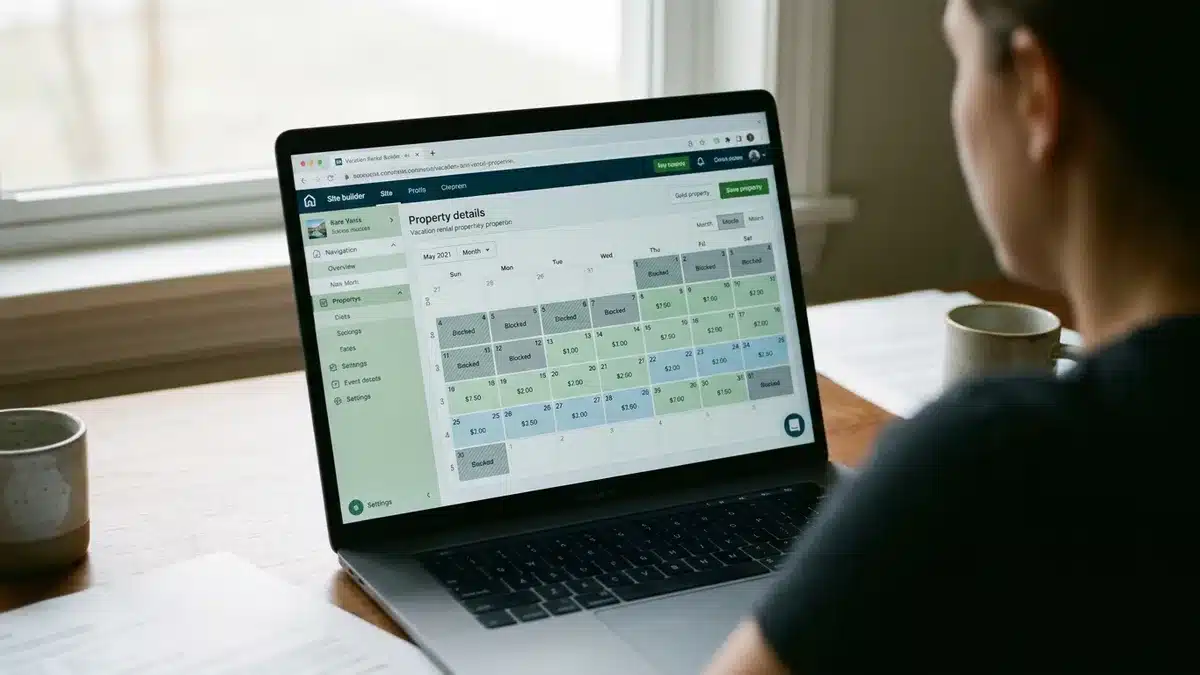
What Should You Look For When Evaluating a Direct Booking Website Builder?
The most important features in a short term rental website builder are live PMS synchronization, built-in payment processing, mobile optimization, and guest data capture into a CRM. Missing any one of these creates a workflow gap that eventually costs you either a booking or a guest relationship.
Beyond the basics, prioritize these in order:
- PMS depth: Confirm the builder supports your specific system by name, not a vague “integrations available” claim. Boostly Connect lists 8 named PMS integrations including Hospitable and other providers, which matters because a shallow integration often means partial sync, not full two-way data flow.
- Setup time and cost: Ask directly what setup requires. Some platforms need a developer and a multi-week build; others are self-serve in under an hour. Boostly Connect’s onboarding runs under 20 minutes with a free plan for up to 3 listings on the Discover map.
- SEO foundation: A site with no SEO structure never ranks, no matter how attractive the design. Look for built-in property page SEO and blog capability rather than relying on a separate SEO contractor after launch.
- Guest retention tooling: A booking site without a CRM captures a transaction, not a relationship. That’s the exact gap that keeps repeat guest rates stuck in the single digits industrywide.
- Ongoing support model: A build-and-leave agency relationship means you’re on your own for every future change. A platform with ongoing coaching, like Boostly Connect’s twice-weekly group calls, keeps hosts making progress instead of stalling after launch.
How Much Time and Cost Should You Expect to Invest?
Setup time for a short term rental website builder ranges from under 20 minutes for PMS-native platforms to two to four weeks for custom plugin-based site builds, with upfront costs spanning from zero to several thousand dollars depending on the route. The gap comes down to how much manual configuration the platform requires versus how much is automated through direct PMS sync.
For context, plugin-stitched site builds commonly carry $1,000 to $3,000 in upfront development costs on top of ongoing monthly fees, according to STR technology comparison data. Fully templated PMS-integrated builders sit at the other end: no developer, no code, and in Boostly Connect’s case, a free plan for up to 3 listings on the Discover map.
| Builder Type | Typical Setup Time | Developer Required | PMS Sync Depth |
|---|---|---|---|
| PMS-native builder (e.g., Boostly Connect) | Under 20 minutes | No | Full two-way sync across 8 systems |
| Generic drag-and-drop site builder | Days to weeks | Sometimes | Often requires third-party plugin |
| Custom-built site + plugins | 2 to 4 weeks | Yes | Varies, prone to breakage over time |
| Full agency build | Several weeks to months | Yes | Depends entirely on agency scope |
The cost comparison that matters most, though, isn’t the build price. It’s the ongoing commission bleed you avoid once the site is live. Every booking that routes through your own site instead of an OTA keeps the full nightly rate, rather than surrendering 15 to 20 percent to a third-party platform.
Can AI Features Actually Improve Your Direct Booking Site’s Performance?
AI-powered features in a short term rental website builder can generate landing page content, answer routine guest questions, and surface upsell opportunities without requiring a marketing or technical background. The value depends entirely on whether the AI is doing real work, like closing bookings, or just producing generic copy nobody reads.
In our experience working with hosts across the Boostly Connect community, the highest-value AI application isn’t content generation. It’s guest messaging. A host running five or more listings answering the same check-in questions repeatedly loses hours every week to that alone. Boostly Connect’s CRM includes AI agents built to field common questions and handle upsells automatically, which keeps pricing and availability answers accurate in real time because they’re pulling from the same live PMS sync that powers the booking calendar.
This is one of the genuine content gaps in most website builder comparisons: they mention “AI-powered” as a feature bullet without explaining what specifically it automates. If a platform can’t tell you exactly which guest touchpoints its AI handles, treat the claim skeptically.
How Do You Grow Direct Bookings Without Losing Your Airbnb Ranking?
You can grow a direct booking channel while keeping your Airbnb listing active; most hosts run both simultaneously and simply redirect repeat guests to their own site instead of abandoning the OTA outright. The fear of losing Airbnb search ranking is common, but it’s rarely the reality once a direct channel is set up correctly.
The pattern we see most consistently: hosts introduce their website to guests after the first stay, not before or during it, through a welcome guide, a post-checkout email, or a printed note left in the property. That’s a low-risk way to build direct bookings without touching your Airbnb visibility at all. If you want a deeper walkthrough of this exact transition, our guide on how to reduce Airbnb dependence without losing occupancy covers the sequencing in more detail.
One case from our own client base illustrates the ceiling on this approach. A bed and breakfast operator who started with a generic, inconsistent website eventually reached 90 percent direct bookings and 60 percent repeat guests after focusing marketing effort on their own site rather than third-party listings. That’s an extreme end of the spectrum, but it shows the mechanism works when repeat guest capture is treated as a system, not an afterthought.
How Do You Handle Guest Retention Once the Website Is Live?
Guest retention after launching a direct booking website depends on capturing contact data at the point of booking and following up automatically, since a website alone doesn’t create repeat guests, it just gives them somewhere to go. A 2026 industry study found the average short-term rental host converts just 5 to 8 percent of guests into repeat bookings, compared to 15 to 25 percent among hosts running a deliberate retention strategy.
That gap is almost entirely a CRM and follow-up problem, not a website design problem. Every guest who books through Boostly Connect’s synced site is automatically captured into the built-in CRM, which handles review request automation and repeat-stay email sequences without a host manually exporting a spreadsheet of past guest emails. For a related deep dive, see our post on how to re-engage past vacation rental guests in 2026.
A different client example shows how far this compounds over time. One property manager who launched a direct booking site attracted local landlord interest simply from the professional presence of the site itself, eventually growing a managed portfolio to more than 30 properties while reaching 55 percent direct bookings across that portfolio. The website didn’t just capture guests, it built market credibility.

What Mistakes Do Hosts Commonly Make With Direct Booking Websites?
The most common mistake hosts make with a direct booking website is launching it and expecting traffic to appear without a distribution plan, since a website with zero marketing behind it functions as a digital brochure, not a booking engine. A close second is neglecting mobile optimization, given that more than half of vacation rental website traffic arrives on a phone, according to industry research.
Other recurring mistakes worth naming directly:
- No SEO foundation at launch. A site built without keyword-targeted property pages or a blog structure has nothing for Google to rank. Our guide on why a vacation rental website isn’t ranking walks through the most common technical causes.
- Treating the website as a one-time project. A direct booking site needs ongoing content, seasonal offers, and email sequences to keep converting. This is exactly why we pair the Boostly Connect site build with twice-weekly group coaching calls rather than a build-and-disappear handoff.
- Skipping payment integration testing. A checkout flow that fails on mobile costs a booking silently, with no error message the host ever sees.
- Ignoring social proof placement. Reviews and repeat guest counts build trust on a direct site the same way they do on Airbnb; leaving them off the homepage is a missed conversion signal.
For hosts building out a broader digital presence around the website, our guide to vacation rental social media strategy covers how to drive that initial traffic without paid ads.
How Do Multi-Property Operators Scale a Website Builder Across a Portfolio?
Multi-property operators need a website builder that manages pricing, availability, and guest data across every listing from a single connected system, rather than maintaining separate tools per property. Without that consolidation, manual processes that worked at three properties start breaking down at ten or more.
Boostly Connect supports multi-property and multi-listing management from one system, with every property syncing to the same PMS, CRM, and website infrastructure. That means a portfolio operator isn’t logging into five different dashboards to update pricing across five properties. One client scaled to more than 30 managed properties while sustaining 55 percent direct bookings across the entire portfolio, largely because the underlying booking infrastructure didn’t require rebuilding for each new unit.
If you’re managing a growing portfolio and evaluating your broader tech stack, our roundup of must-have tools for short-term rental managers covers where a website builder fits alongside pricing and channel management software.
Practical Guidance: How to Choose the Right Website Builder for Your Business
Choosing a short term rental website builder comes down to matching the platform’s PMS depth and support model to your specific portfolio size and technical comfort level, not picking whichever option has the most feature bullets on its homepage.
Follow this sequence when evaluating options:
- Confirm the builder integrates natively with your current PMS by name. Don’t accept a vague “compatible with most systems” answer.
- Ask for a real setup time estimate, not a marketing claim. Request to see the process, not just hear about it.
- Check whether guest data capture and CRM functionality is included or a separate add-on. A booking without captured guest data is a missed retention opportunity.
- Evaluate the ongoing support model. A one-time build with no follow-up support leaves you stuck the moment you want to make a change.
- Confirm there’s no risk to your existing OTA visibility. A well-built direct channel should run alongside Airbnb and Vrbo, not replace them immediately.
If you’re weighing whether to build the site yourself using plugins or go with a managed platform, our comparison guide on the best website builder for short term rentals in 2026 breaks down that decision in more depth. And if you’re still deciding whether a direct booking site is worth the investment at all, our piece on what a direct booking website actually delivers walks through the ROI case in plain terms.
Frequently Asked Questions
How long does it take to set up a direct booking website with Boostly Connect?
Boostly Connect syncs an existing PMS to a live website in under 20 minutes, with no developer or coding knowledge required. The connection process itself, linking your PMS to the platform, typically takes under five minutes per property system.
Will switching to direct bookings hurt my Airbnb search ranking?
No. Most hosts run a direct booking website alongside their Airbnb listing rather than replacing it. The common approach is introducing your own site to guests after their first stay through a welcome guide or follow-up email, which doesn’t affect Airbnb visibility.
Which property management systems integrate with Boostly Connect?
Boostly Connect supports 8 PMS integrations, including Hospitable and other leading providers. Hosts can plug in their existing system and gain live availability and real-time pricing on their own website within minutes of connecting.
Do I need a developer or coding experience to launch my direct booking site?
No. Boostly Connect is designed as a no-code, done-for-you build, meaning hosts don’t need a developer or any coding background to launch a fully synced booking site.
What happens to my guest data when someone books direct instead of through an OTA?
Every guest who books through a Boostly Connect site is automatically captured into the host’s own CRM. That contact data stays with the property owner rather than being retained by an OTA for remarketing to other listings.
How much can I realistically save by reducing OTA commission dependency?
Savings scale with your booking volume, since OTAs typically charge 15 to 20 percent commission per reservation. Boostly Connect clients reaching the platform’s 65 percent direct bookings benchmark within 12 months keep a substantially larger share of gross revenue than hosts relying primarily on OTA channels.
Can a short term rental website builder handle multiple properties, or just a single listing?
Yes, platforms built for scale, including Boostly Connect, manage multi-property portfolios from one connected system. Pricing, availability, and guest data sync across every listing rather than requiring separate tools per property.
Conclusion: The Website Builder You Choose Determines How Much You Keep
A short term rental website builder is only as valuable as what happens after the site goes live: whether it captures guest data, keeps pricing accurate through PMS sync, and gives you a reason to keep improving it. The setup time gap alone, under 20 minutes versus multi-week agency builds, tells you how much manual overhead you’re signing up for with each option.
The math on OTA commissions rarely lies: every booking that routes through a third-party platform instead of your own site is revenue and guest data you don’t get back. Fixing that doesn’t require a developer, a new tech stack, or months of setup. It requires connecting the PMS you already use to a website built to convert guests, which is exactly what Boostly Connect does in under 20 minutes, backed by a 65 percent direct bookings guarantee within 12 months.

If you’re ready to see what your existing PMS looks like connected to a branded, conversion-ready booking site, book a demo with Boostly Connect and watch your listings sync in real time.