

A vacation rental social media strategy is a documented plan for what you post, where you post it, and how each post pushes followers toward your own direct booking website rather than just collecting likes. Done right, it turns Instagram followers and Facebook fans into guests who book with you directly, cutting out commission on every stay.
TL;DR
- Instagram and Facebook remain the core platforms for vacation rentals, with most operators posting 2 to 5 times per week using a mix of property photos, local content, and guest stories.
- Mobile traffic accounts for 68.5% of vacation rental marketing traffic in 2026, according to CUFinder’s vacation rental marketing benchmarks, meaning every post and linked page needs to load fast and look right on a phone.
- Profiles under 10,000 followers should target roughly a 5% engagement rate, calculated as (likes plus comments) divided by followers.
- Vacation rental paid search ads average around $1.85 cost per click as of 2026, per CUFinder, which is why organic social and email capture matter so much for smaller operators.
- Repeat guest rates for hosts without a deliberate retention strategy sit at just 5 to 8%, compared to 15 to 25% for hosts who run a real retention system, according to a 2026 Lodgify study.
- Boostly Connect ties your social content directly to a live-availability booking site and CRM, so every post has somewhere real for a follower to land, book, and become a repeat guest.
If you’re posting property photos to Instagram and hoping for the best, you’re not alone, and it’s not working the way you think it is. Most short-term rental hosts treat social media as a brand awareness exercise, disconnected from the booking calendar, the pricing engine, or the guest list. That gap is exactly why so many accounts have decent follower counts and almost no direct revenue to show for it.
In 2026, that disconnect is more costly than ever. The vacation rental market is approaching $101 billion globally this year, per Precedence Research, and professional management companies now control an estimated 42% of active short-term rental listings, meaning the casual, unstructured host is competing against increasingly sophisticated operations. A vacation rental social media strategy that doesn’t route traffic toward a direct booking system is leaving money on the table every single week.
At Boostly Connect, we work with hosts who’ve built genuinely engaged followings but never connected that audience to a conversion path. This guide walks through the platforms worth your time, the content pillars that actually perform, the posting cadence that keeps you visible without burning you out, and, critically, how to structure your social calendar so it feeds your direct booking channel instead of just decorating your feed.
1. Which Social Platforms Actually Matter for Vacation Rentals?
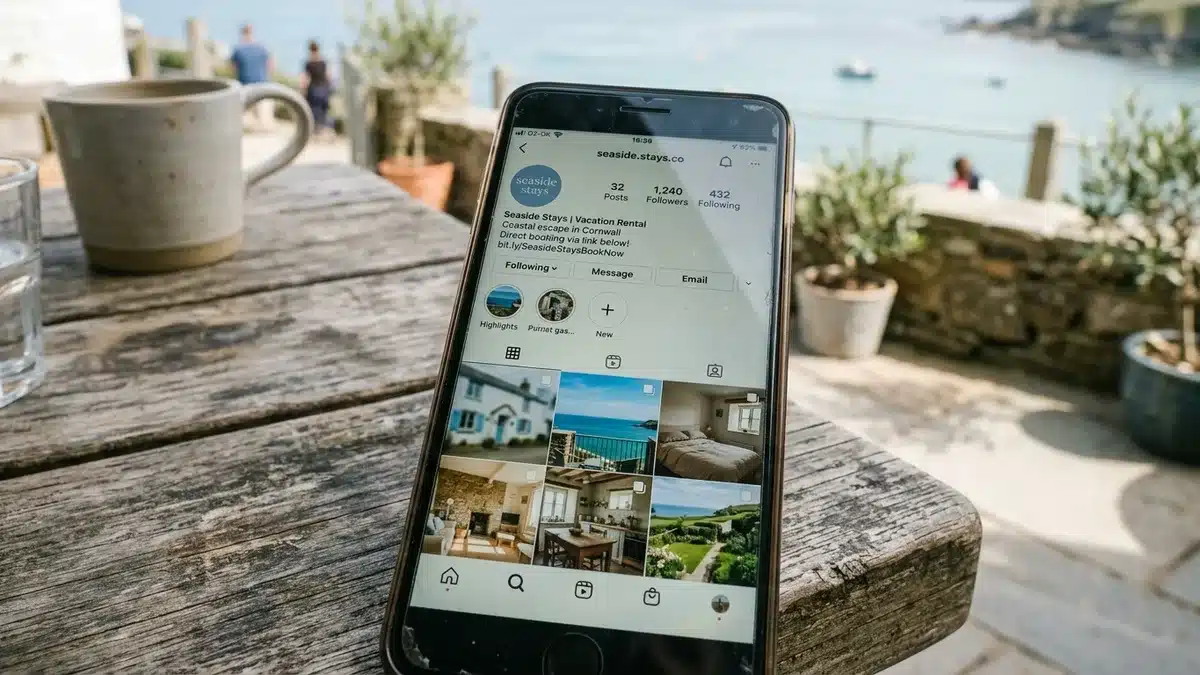
Instagram and Facebook are the foundational platforms for a vacation rental social media strategy, with TikTok, Pinterest, and LinkedIn serving as secondary channels once your core content rhythm is established. Instagram drives visual discovery and Reels reach; Facebook still converts well for local and returning-guest audiences.
Start with business profiles on both, not personal accounts. A business profile on Instagram or Facebook unlocks analytics, ad tools, and a dedicated contact button, none of which exist on a personal page. Set these up before you post anything else.
TikTok has become a legitimate discovery channel for destination-driven bookings, especially for properties in scenic or unusual locations. Short-form video showing the property, the view, and the neighborhood performs well because it mirrors how younger travelers now research trips.
Pinterest works differently: it’s a slow-burn, evergreen discovery engine rather than a real-time feed. Pins about your destination, packing guides, or “what to do near [property]” content can surface in searches for months or years after posting. LinkedIn matters mainly if you’re a boutique property manager trying to attract property owner clients, not guests.
Our advice: master Instagram and Facebook first. Adding three more platforms before you have a consistent rhythm on two just spreads your effort too thin to produce results on any of them.
2. What Content Pillars Should You Build Your Calendar Around?
Content pillars are the recurring themes that structure your posting calendar so you’re never scrambling for what to post next. For vacation rentals, the four pillars that consistently perform are property highlights, local area content, guest experience moments, and practical booking tips.
Property highlights go beyond a static exterior shot. Show the golden-hour view from the deck, the coffee setup, the reading nook. These posts sell the feeling of staying there, not just the square footage.
Local area content, restaurant recommendations, seasonal events, hiking trails, positions your account as a destination resource, not just a listing. This is also the pillar with the biggest untapped opportunity: destination-focused posts can be repurposed into SEO-friendly blog pages on your direct booking website, giving the same content a second life in Google search.
Guest experience content, reviews, photos guests share (with permission), testimonial quotes, builds trust faster than anything you can say about your own property. Booking tips, how to book direct, cancellation policy, what’s included, remove friction for followers who are close to converting.
A simple weekly rotation across these four pillars keeps content varied without requiring you to reinvent your strategy every Sunday night.
3. How Often Should You Post for a Vacation Rental Account?
Most vacation rental accounts should post 2 to 5 times per week on Instagram and Facebook, according to industry benchmarks, rotating between property photos, local highlights, and guest moments. Consistency matters more than volume: a steady 3 posts a week outperforms a sporadic burst of 10 followed by silence.
Some guides recommend daily posting, but that only works if you have the content pipeline to sustain quality. For a solo host managing 1 to 3 properties, daily posting usually means quality erodes fast. Better to commit to 3 to 4 posts weekly across feed, Reels, and Stories, with at least one clear call to action per post.
Stories deserve their own cadence. Because they disappear after 24 hours, Stories are the right place for time-sensitive content: last-minute availability, weather updates at the property, quick behind-the-scenes clips. Use Stories daily if you can, feed posts weekly.
If your peak season runs June through August, your social content should ramp up February through April, when travelers are actively researching and booking summer trips. Posting heavily in July, when most of your calendar is already booked or already lost, wastes effort on the wrong window.
This is where a lot of hosts lose the thread: they post consistently but never tie the calendar to their actual booking window or promo timing. We built the reporting inside Boostly Connect specifically so you can see which weeks are underbooked and adjust your social push accordingly, instead of guessing.
4. How Do You Structure a Social Calendar That Feeds Direct Bookings, Not Just Engagement?
A booking-aligned social calendar maps each post to a specific stage of your reservation funnel: blackout dates you don’t need to promote, low-occupancy weeks that need a push, and early-bird windows where a discount code makes sense. This is the piece most vacation rental social media advice skips entirely, and it’s the difference between a pretty feed and a feed that pays rent.
Start by pulling your calendar data. Identify the weeks with soft occupancy 60 to 90 days out. Those are your promotion targets, not your fully-booked weeks. Posting “book now” content for a week that’s already sold out just wastes a slot in someone’s feed.
Next, build in minimum-stay and early-bird logic. If your shoulder-season minimum stay drops from 5 nights to 3, that’s worth its own post specifically calling out the change, because it directly expands who can book that window.
Finally, tie promo codes to specific campaigns and track them. A discount code used only in social bios, distinct from the code used in email, lets you see exactly which channel is driving the redemption. Without that separation, you’re guessing which effort actually worked.
This is precisely the workflow gap we designed balancing OTA and direct bookings content around: your social calendar should never operate independently from your live availability data. Boostly Connect’s live-synced booking site means the availability your social team is promoting matches what’s actually bookable, in real time, with no manual double-checking against your PMS.

5. What Does a High-Converting Direct Booking CTA Actually Look Like?
A high-converting CTA on a vacation rental social post is specific, low-friction, and points to exactly one destination: your direct booking page, not your general homepage. “Book direct and save on fees, link in bio” outperforms a vague “check us out” every time because it tells the follower precisely what happens next.
Effective CTA copy names the benefit plainly. Something like: “Skip the extra booking fees, tap the link in bio to see live pricing” works because it’s concrete and immediate. Compare that to generic copy like “learn more,” which gives the follower no reason to act right now.
Your bio link matters as much as the CTA copy. A single link to your homepage forces followers to hunt for booking info. A dedicated link-in-bio landing page, showing live availability, a direct booking button, and maybe a seasonal offer, removes that hunting entirely.
Add UTM parameters to every link you post: source=instagram, medium=social, campaign=summer2026, for example. Without UTMs, you cannot separate social-driven bookings from bookings that arrived through organic search or email, and you’ll end up making budget decisions based on guesswork.
Pin a “how to book direct” post to the top of your Instagram and Facebook profiles. It sounds small, but it answers the exact question a curious follower has before they’ll ever click through: does this even work, and is it actually cheaper? A pinned explainer removes that hesitation before it costs you a booking.
6. How Should You Coordinate Social Media With Email and SMS Retargeting?
Social media retargeting for vacation rentals means following up with people who clicked through from a post but didn’t book, using email or SMS to close the loop instead of relying on the social platform alone. Most hosts never build this second touch, which means a huge share of interested traffic simply evaporates.
Here’s the typical gap: a follower clicks your Instagram bio link, browses your booking page, checks a date range, and leaves. On most host websites, that visitor vanishes with zero record of the interaction. There’s no email captured, no way to follow up, and no second chance.
A connected system changes that outcome. When someone lands on a Boostly Connect direct booking site and starts checking dates, that activity feeds into the built-in CRM, so you can trigger a follow-up email or SMS automatically instead of hoping they come back on their own. That’s a fundamentally different outcome than a static website with no capture mechanism behind it.
Practically, this means pairing every seasonal social push with a matching email sequence. If your Instagram post promotes an early-bird discount for fall, your email nurture sequence should reinforce that same offer to anyone who visited but didn’t convert. Running these separately, one team posting to social, another sending unrelated emails, wastes the overlap entirely.
For a deeper look at building that email side of the system, our piece on increasing direct bookings with content marketing covers the nurture sequence structure in more detail.
7. How Do You Audit Which Social Content Actually Converts to Bookings?
A social content audit for vacation rentals tracks which specific posts generated clicks, inquiries, and completed bookings, not just likes and comments. Most hosts stop at vanity metrics because that’s what the platform’s own analytics surface by default, but engagement and revenue are two different scoreboards.
Start with Meta Ads Manager and Instagram Insights for engagement-level data: which posts got the most reach, saves, and profile visits. Then cross-reference with Google Analytics to see which social referrals actually reached your booking page and how long they stayed.
The KPIs worth tracking monthly: engagement rate, follower growth, click-through rate to your website, and, most importantly, direct inquiries or completed bookings attributed to social traffic. For accounts under 10,000 followers, a roughly 5% engagement rate, calculated as likes plus comments divided by followers, is a reasonable benchmark to measure against.
Where this gets hard manually: reconciling social analytics, website analytics, and your booking system usually means three different dashboards and a lot of spreadsheet copy-pasting. That reconciliation problem is exactly why we built a unified reporting dashboard into Boostly Connect, so direct booking revenue tied to a specific campaign shows up in one place instead of three.
Without that unified view, you’re left guessing whether your Reels are actually paying off or just performing well on paper. Notably, industry research shows that roughly 32% of property managers now review market data weekly to guide pricing and strategy decisions, according to Key Data’s 2026 findings, a habit worth adopting for your social performance too.
8. How Do You Repurpose Social Content Into SEO-Friendly Website Pages?
Repurposing social content for SEO means taking your best-performing destination and local-area posts and rebuilding them as full pages or blog posts on your direct booking website, where they can rank in Google search long after the post disappears from a feed. This is one of the most overlooked plays in vacation rental marketing.
A Reel showing “5 things to do near [property]” gets maybe a week of meaningful reach on Instagram before the algorithm moves on. The same content, expanded into a blog post with photos, specific business names, and practical tips, can rank in search for years and keep sending direct traffic long after the original post is forgotten.
The process is straightforward: identify your top three performing local-area or destination posts each quarter, expand each into a 600 to 1,000 word page with more specific detail than the caption allowed, and publish it on your booking website’s blog. Then link back to it from future social posts covering the same topic.
This only works if your website actually has a blog structure built to rank, thin, unstructured “About Us” style pages won’t cut it. Boostly Connect ships with SEO-optimized property pages and built-in blog infrastructure, so this repurposing workflow has somewhere real to live instead of requiring a separate website rebuild first. For more on the mechanics of this, see our guide on vacation rental SEO tips that actually rank in 2026.
Data Snapshot: Vacation Rental Social Media Benchmarks for 2026
| Metric | Benchmark | Source |
|---|---|---|
| Mobile share of vacation rental marketing traffic | 68.5% | CUFinder, 2026 |
| Average paid search CPC for vacation rentals | $1.85 | CUFinder, 2026 |
| Recommended engagement rate (under 10K followers) | ~5% | Industry benchmark |
| Recommended posting frequency | 2 to 5 posts/week | Industry benchmark |
| Repeat guest rate without retention strategy | 5 to 8% | Lodgify, 2026 |
| Repeat guest rate with deliberate retention strategy | 15 to 25% | Lodgify, 2026 |
| Property managers reviewing market data weekly | 32% | Key Data, 2026 |
The mobile figure alone should shape how you build every link you post. If 68.5% of your traffic is arriving on a phone, a booking page that isn’t mobile-first is quietly killing conversions before a guest ever sees your pricing. That’s a big reason mobile-first, conversion-optimized templates are a baseline requirement, not a nice-to-have, for any direct booking site you link to from social.
What Mistakes Should You Avoid in Your Vacation Rental Social Media Strategy?
The most common mistake is treating social media as a standalone marketing channel instead of connecting it to your booking calendar, CRM, and pricing. Posting consistently without that connective tissue produces followers, not revenue.
- Linking to your homepage instead of a dedicated booking page. Every extra click a follower has to make costs you conversions, especially on mobile.
- Ignoring DMs and comments. Responding quickly, and using saved replies for common questions, builds the trust that converts a looker into a booker. Slow responses lose bookings to whichever competitor answers first.
- Posting the same content regardless of season. Promoting summer availability in July, once it’s mostly sold, wastes a slot that should have run in March.
- Never separating vanity metrics from revenue metrics. High engagement with zero tracked bookings means your content is entertaining, not converting.
- Skipping UTM tracking. Without it, you cannot prove which platform, or which specific post, actually drove a booking.
- Relying entirely on OTA remarketing tools instead of building your own list. Platform features like the Airbnb Re-book button or Airbnb’s Special Offers feature can nudge past guests to rebook, but they keep the guest relationship inside Airbnb’s ecosystem rather than your own CRM.
We regularly see hosts fix the first five mistakes overnight simply by connecting their social CTAs to a live, mobile-optimized booking page instead of a static homepage. That single change, more than any new posting hack, is usually what moves the needle.
Frequently Asked Questions
How many times per week should a vacation rental post on social media?
Most vacation rental accounts should post 2 to 5 times per week on Instagram and Facebook, rotating between property photos, local area content, and guest experience posts. Consistency matters more than volume, a steady weekly rhythm outperforms sporadic bursts.
Which social media platform is best for vacation rental bookings?
Instagram and Facebook are the strongest starting platforms for vacation rentals because they support visual storytelling, business profile analytics, and direct booking links. TikTok and Pinterest work well as secondary channels once you have a consistent posting rhythm established on the core two.
What is a good engagement rate for a vacation rental Instagram account?
For accounts under 10,000 followers, a reasonable engagement rate benchmark is around 5%, calculated as total likes plus comments divided by follower count. Accounts below this benchmark should focus on content quality and faster response times to comments and DMs rather than posting more frequently.
How do I get guests to book direct instead of through Airbnb after seeing my social posts?
Use a dedicated link-in-bio landing page pointing to your direct booking site, not your general homepage, and pin a “how to book direct” explainer post to your profile. Pairing this with UTM-tracked links lets you confirm which posts actually drive completed bookings versus just clicks.
Should I use paid ads or rely only on organic social media for vacation rental marketing?
Organic content builds the audience and trust; paid ads accelerate reach to new followers who don’t already know your property. Given that vacation rental paid search averages around $1.85 per click as of 2026, many hosts find it more cost-effective to build a strong organic content rhythm first, then layer in targeted retargeting ads to visitors who already showed interest.
How do I track whether my social media is actually driving bookings?
Add UTM parameters to every link you share on social, then cross-reference Meta Ads Manager or Instagram Insights with your website analytics and booking dashboard. This shows which specific posts generated clicks that turned into completed reservations, not just likes and comments.
Does a vacation rental social media strategy work for a single-property host?
Yes, a single-property host benefits from social media specifically because engagement and content quality matter more than volume when you have one story to tell consistently. A single property with a well-run Instagram and Facebook presence, tied to a direct booking site, can meaningfully reduce OTA dependence over time.
Conclusion: Make Every Post Earn Its Place in Your Booking Funnel
A vacation rental social media strategy only pays off when every post connects to something measurable: a live booking page, a tracked link, or a CRM entry. Posting consistently without that connective tissue builds an audience, not revenue, and 2026’s data makes the stakes clear: with 68.5% of traffic arriving on mobile and paid clicks averaging $1.85, organic social paired with a real conversion path is one of the most cost-effective channels available to independent hosts.
The hosts who get this right treat their social calendar as an extension of their booking system, not a separate creative project. That means mapping posts to actual occupancy gaps, tracking every link with UTMs, and making sure the page a follower lands on actually converts on a phone screen. Boostly Connect was built to close exactly that gap: a live-synced direct booking site, a CRM that captures every visitor who checks dates, and reporting that shows which social effort actually turned into revenue, all connected instead of scattered across three disconnected tools.
If your Instagram following has grown but your direct bookings haven’t followed, that’s usually a plumbing problem, not a content problem. Get started with Boostly Connect and see how a connected booking site, CRM, and reporting dashboard turns your existing followers into a real revenue channel.

If you’re ready to see how your social traffic could convert once it’s tied to a live booking calendar and CRM, book a demo and we’ll walk through connecting your existing PMS in real time, no developer required.