
You increase direct bookings with content marketing by publishing destination guides, guest-focused blog posts, and email sequences that answer the exact questions travelers search before they book, then linking every piece straight to your booking engine. Done consistently, this content replaces the visibility Airbnb and Vrbo currently provide, but you keep the guest relationship and the revenue.
- Content marketing works because it captures guests during the planning phase, before they ever open Airbnb, giving your own website a chance to rank for the exact searches your future guests are typing.
- Repeat guest rate for hosts with a deliberate retention strategy reaches 15-25%, compared to just 5-8% for hosts with no retention plan, according to a 2026 Lodgify study cited by StayStrat.
- Online bookings are projected to hold 66.2% market share in 2026, according to StayFi, which means your website’s content and booking flow matter more than ever.
- One Boostly-supported host reached 90% direct bookings and 60% repeat guests by prioritizing their own website and content over third-party listings.
- A single host earned an $800 first direct booking and grew to 55% direct bookings across 30+ properties, largely by building content and reputation that landlords and guests trusted directly.
- Boostly Connect syncs your existing PMS to a content-ready WordPress site in under 20 minutes, so the blog, SEO structure, and booking engine you need for content marketing are already built in, not stitched together separately.
Most hosts treat content marketing as an afterthought, something you do once you already have a website, if you have spare time. That’s backwards. In 2026, content is the single biggest lever most independent operators are leaving untouched, mostly because nobody has shown them what to actually publish and where it should point.
We work with hosts every day who are proud of their properties but have never written a blog post, sent a nurture email, or built a landing page targeting a specific search term. Meanwhile, their guests are Googling “things to do in [destination]” and “best [property type] near [landmark]” and landing on someone else’s site, usually an OTA’s, because that’s the only page that showed up.
This article breaks down ten specific content tactics you can start using this year, along with the exact search behavior each one targets and how to connect it back to your booking engine without sounding pushy. We’ll also flag where a done-for-you platform, ours included, removes the technical friction that stops most hosts from finishing what they start.
What Is a Key Benefit of Increasing Direct Bookings?
The key benefit of increasing direct bookings is keeping the commission you’d otherwise pay an OTA, typically 15 to 20 percent per reservation, while also owning the guest’s contact data for future marketing. That second part matters more than most hosts realize: when a guest books through Airbnb, their email and phone number stay inside Airbnb’s system, not yours.
That means every returning guest is a guest Airbnb can remarket to on your behalf, or worse, redirect to a competing listing. Direct bookings flip that. When a guest books through your own site, they land in your CRM, and you can email, text, or retarget them without paying a platform fee to reach your own past customers.
The financial upside compounds over time. A host generating consistent direct traffic isn’t just saving on one booking, they’re building an owned audience that gets cheaper to market to every year. That’s a fundamentally different business model than one where every guest relationship resets to zero the moment the stay ends.
How Do You Map Content to the Guest Booking Journey?
Mapping content to the guest booking journey means creating specific content types for each stage a traveler moves through: inspiration, planning, and booking. Inspiration content answers “where should I go,” planning content answers “what should I do there,” and booking content answers “why should I book with you specifically.”
Most hosts only ever write booking-stage content, usually just their listing description. That’s a mistake. If you’re not showing up during the inspiration and planning stages, a guest never even reaches the point of considering your property, because they’re finding their destination ideas and itinerary on someone else’s blog first.
Inspiration stage
This is broad content like “Best weekend getaways near [region]” or seasonal roundups. It’s designed to rank for searches happening months before a trip is booked. It rarely converts immediately, but it builds the traffic base everything else depends on.
Planning stage
This is where destination guides live: “Top 10 family-friendly things to do in [destination],” restaurant roundups, event calendars. These pages should link directly to your available properties and, ideally, to relevant dates on your booking calendar.
Booking stage
This is your property page itself, plus comparison content like “Why book direct vs. through an OTA” that addresses hesitation right before conversion. Every planning-stage page should funnel here.
We built the Boostly Connect website builder around this exact structure, with a built-in blog and SEO-optimized property pages, so inspiration and planning content sits one click away from a live booking calendar instead of being hosted somewhere disconnected from your PMS.

What Are the Four Types of Content Marketing STR Hosts Should Use?
The four content types most effective for short-term rental hosts are destination guides, guest story or user-generated content, email nurture sequences, and comparison or trust content. Each targets a different part of the funnel, and skipping any one of them leaves a gap in your direct booking strategy.
Destination guides capture search traffic during the planning phase. User-generated content builds trust with visitors who are unfamiliar with your brand. Email nurture sequences bring past guests back without new advertising spend. Comparison content overcomes last-minute hesitation at the point of booking.
1. Destination guides
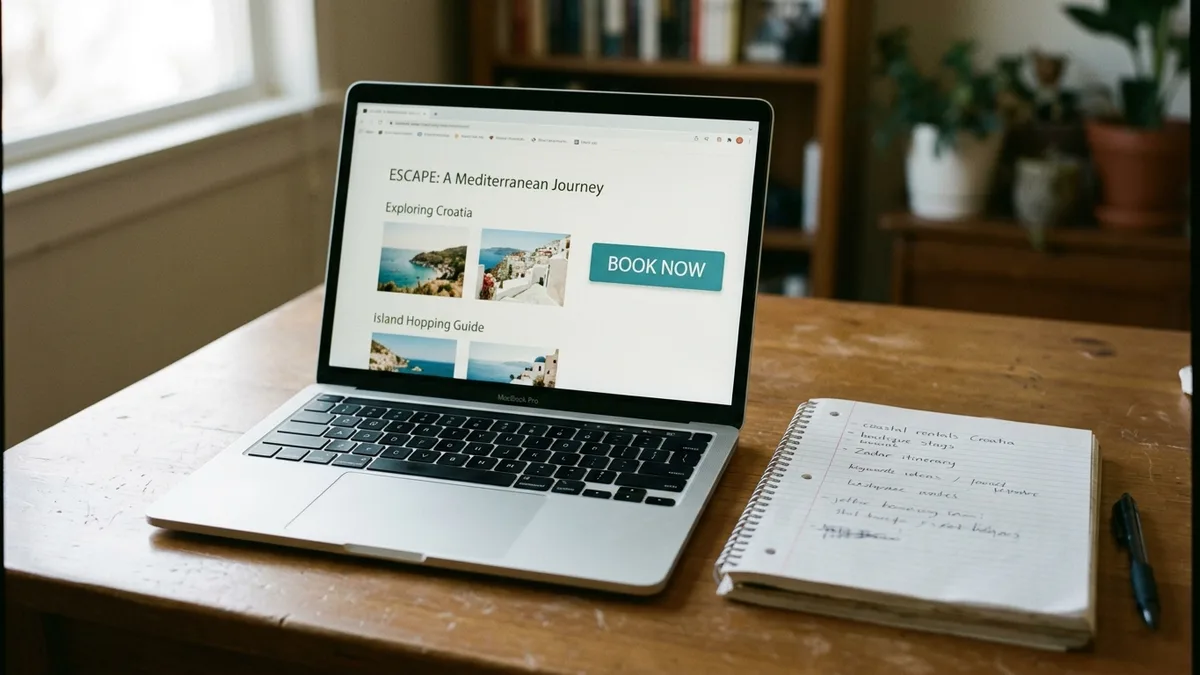
Blog posts like “Top 10 Family-Friendly Things to Do Near [Your Property]” rank for high-intent, long-tail searches and link directly to your availability calendar. These posts should be updated at least once a year to stay accurate on hours, pricing, and seasonal events.
2. User-generated content and guest stories
Real guest photos, reviews, and short testimonials embedded on your property page and social channels build the kind of trust a generic OTA listing can’t replicate. First-time visitors to your site are essentially strangers, and social proof is what convinces them you’re legitimate.
3. Email nurture sequences
Automated emails triggered after a stay, a wishlist save, or an abandoned booking attempt keep your property top of mind without manual follow-up. This is where the gap between hosts with a retention strategy (15-25% repeat guest rate) and those without one (5-8%, per the Lodgify study referenced above) becomes obvious.
4. Comparison and trust content
A short page explaining what a guest gets by booking direct versus through an OTA, rate guarantees, direct communication, flexible policies, removes last-minute doubt. This content type is underused across the industry despite being one of the highest-converting pages on a direct booking site.
How Do You Optimize Your Website and Booking Engine for Conversions?
Optimizing your booking engine for conversions means removing every unnecessary click, field, and page load delay between a visitor arriving and completing a reservation. Industry guidance consistently recommends keeping the booking button above the fold on every page and simplifying the booking form to reduce funnel drop-off.
Mobile matters more than most hosts assume. With online bookings continuing to shift toward mobile-first behavior, a booking engine that loads slowly or requires excessive scrolling on a phone screen will lose visitors before they ever see your rates.
Live pricing is non-negotiable too. If your content drives a reader to your site and they see outdated availability or have to email you to check a date, you’ve lost the advantage content marketing was supposed to create. That’s precisely why Boostly Connect syncs live availability and real-time pricing directly from your existing PMS, whether that’s Hospitable, Guesty, Lodgify, or one of 8 supported platforms, so every visitor who reaches your site through a blog post sees accurate rates instantly, not a stale calendar.
If you want a deeper breakdown of what a converting booking flow actually looks like, our guide on direct booking websites for short-term rentals covers the technical side in more depth.
How to Boost Bookings When Guests Are Also Browsing OTAs Like Booking.com?
You boost your own bookings even while guests browse OTAs like Booking.com by making sure your direct site consistently offers something the OTA listing can’t: a lower effective rate, a direct perk, or content that builds more trust than a generic listing page ever could. You’re not trying to remove the guest from the OTA ecosystem entirely, you’re giving them a reason to choose your site when they compare.
Guests frequently research on an OTA, then Google the property name directly to check for a personal website, reviews, or a better deal. If that search turns up nothing, you lose the comparison by default. If it turns up a clean, content-rich site with a rate guarantee or complimentary perk, you often win it.
This is also where Airbnb’s Special Offers feature and the Re-book button matter strategically: they’re useful for keeping a relationship warm inside Airbnb’s ecosystem, but they still route the guest and their data back through Airbnb. A direct booking site with its own retention content is the only way to fully own that second booking. Our piece on balancing OTA and direct bookings goes deeper on how to run both channels without cannibalizing either.
How Do You Use SEO and Long-Tail Keywords Around Local Experiences?
SEO for short-term rentals means targeting long-tail, location-specific search phrases that a generic OTA listing will never rank for, phrases like “pet-friendly cabin near [trailhead]” or “3-bedroom rental walking distance to [landmark].” These searches have lower volume individually but far higher booking intent than broad terms like “vacation rentals.”
Most hosts skip this because they assume SEO requires technical expertise. In reality, the biggest wins come from writing genuinely useful, specific content, not from technical manipulation. A blog post answering “what’s the best time of year to visit [destination] with kids” will outperform a thin, keyword-stuffed page every time, because it actually satisfies the searcher’s question.
Schema markup helps too. Structured data for lodging, price ranges, amenities, and check-in times helps your pages surface with richer detail in search results and increases the odds an AI assistant pulls your content into a direct answer. This is exactly why we built Boostly Connect’s property pages to be SEO-optimized by default, so hosts aren’t starting from a blank, unranked page and guessing at technical setup. For a broader rundown of tactics, our vacation rental SEO guide is worth bookmarking.
How Do You Leverage User-Generated Content and Social Proof for Trust?
User-generated content, meaning guest photos, video, and testimonials shared on social platforms and embedded on your website, builds trust faster than any professionally staged photo shoot because it shows real people actually enjoying your property. Travelers researching a direct booking site they’ve never heard of are looking for proof it’s legitimate, and UGC provides that proof instantly.
The practical version of this: ask every guest for a quick photo or short review at checkout, then feature the best ones on your property page and social feeds. Shoppable social features that link an image directly to a booking page shorten the path from “I like this photo” to “I’ve booked this stay,” cutting out extra steps that lose impatient browsers.
We see this constantly with hosts who reach strong repeat-guest numbers, the pattern isn’t just a nice property, it’s visible proof that other guests had a great experience and came back. One host we’ve worked with reached 60% repeat guests after shifting focus toward their own site and content instead of relying on OTA reviews alone. Managing this consistently across dozens of guests is exactly the kind of manual task that Boostly Connect’s guest CRM automates through review request sequences, so testimonials get collected without you chasing every guest individually.
What Are the Real Costs and Trade-offs of “Book Direct” Incentives?
Book direct incentives, such as rate guarantees, complimentary breakfast, flexible cancellation, or free upgrades, cost you margin on individual bookings but typically pay for themselves by avoiding OTA commission entirely. The trade-off only makes sense if the incentive costs less than the 15 to 20 percent commission you’d otherwise hand over.
Most competitor guides mention book direct incentives but rarely explain how to test them. Here’s the practical approach: pick one incentive, run it for a defined period, and track your direct booking share against your baseline before rolling it out permanently.
| Incentive Type | Typical Cost to Host | Best Used When |
|---|---|---|
| Rate guarantee (match or beat OTA price) | Small margin reduction per booking | Guest is actively comparing your site to an OTA listing |
| Flexible cancellation policy | Opportunity cost of lost bookings if guest cancels | Booking window is far in advance, guest is risk-averse |
| Free upgrade or add-on (late checkout, welcome basket) | Low direct cost, high perceived value | Repeat guest or referral, low acquisition cost already |
| Discount code for direct-only bookings | Fixed percentage off, but still cheaper than OTA commission | First-time direct booker you want to convert from OTA history |
Discount codes and gift vouchers are one of the simplest incentives to test because you control the exact percentage and can turn them off instantly if they’re not moving your direct booking share. Boostly Connect includes discount code and direct-only offer functionality built into the site, so testing an incentive doesn’t require a separate plugin or manual coupon tracking spreadsheet.
How Do You Structure Content So It Funnels Visitors Toward Booking Without Feeling Pushy?
You structure content to funnel visitors toward booking by placing a single, clear call to action near the top of every page and repeating it contextually, not aggressively, throughout the rest of the content. The goal is that a reader never has to scroll far to book, but also never feels like the article was written purely to sell them something.
This is the content gap most competing guides skip entirely. They’ll tell you to write a destination guide, but they won’t tell you how that guide should physically link to your booking engine. Here’s the structure we recommend:
- Open with the value, not the pitch. Answer the reader’s actual question in the first paragraph before mentioning your property at all.
- Insert one contextual link mid-content to your property page or a relevant date-specific offer, phrased naturally within a sentence about proximity or amenities.
- Close with a soft, specific CTA tied to the content’s topic, not a generic “book now” button with no context.
- Keep the booking button visible in your site’s navigation or a sticky header so readers who are ready don’t have to hunt for it.
This is the exact framework we use in our own Boostly Connect blog, and it’s the structure baked into every WordPress site we build for hosts, content and booking engine living on the same platform instead of two disconnected systems.
How Do You Repurpose the Same Content Across Blog, Email, and Social?
Repurposing content means taking one core piece, like a destination guide, and adapting it into shorter formats for email and social without rewriting it from scratch each time. This is the tactic almost no competing guide breaks down in detail, despite it being the fastest way to get more mileage out of content you’ve already created.
A single “Top 10 things to do near [property]” blog post can become an email newsletter segment, three or four social captions with a linked photo, and a retargeting ad headline, all pointing back to the same booking page. You write once and distribute five ways.
The catch is that most hosts don’t have a CRM connected to their content, so email and social live in separate tools that don’t share guest or booking data. That disconnect is exactly what Boostly Connect’s built-in CRM solves: the same content you publish on your site can trigger an automated email sequence or feed a social post without manually re-exporting guest lists or copying links between platforms. For more on the email side specifically, see our guide on the best CRM for short-term rental hosts.

What Are the 3 C’s of Hospitality and How Do They Apply to Content Marketing?
The 3 C’s of hospitality, commonly defined as comfort, care, and connection, apply to content marketing by shaping the tone of everything you publish: content should make a stranger feel comfortable booking with you, show genuine care through specific local detail, and build a connection that turns a one-time guest into a repeat one.
Comfort in content means removing uncertainty, clear photos, accurate descriptions, transparent pricing, so a reader never feels like they’re taking a risk. Care shows up in the specificity of your destination content: naming the actual trail, restaurant, or event rather than vague generalities a stranger could have written without ever visiting.
Connection is where email and CRM content matters most. A guest who receives a thoughtful follow-up email referencing their actual stay, not a generic newsletter blast, feels a personal relationship with your property rather than a transaction with a platform. That’s the exact mechanism behind hosts who report 90% direct bookings and strong repeat guest rates: the content and communication made guests feel connected enough to skip the OTA search entirely next time.
What Mistakes Should You Avoid With Direct Booking Content Marketing?
The most common mistake is publishing content that never links back to a live booking engine, treating the blog as a standalone project rather than part of the funnel. A close second is inconsistency, publishing three destination guides then abandoning the blog for six months, which tanks any SEO momentum you’d built.
- Writing generic content instead of specific detail. “Great things to do nearby” ranks for nothing. Name the actual attraction, price range, and season.
- Disconnecting content from your PMS. If your blog links to a booking page showing outdated availability, you lose the reader’s trust instantly.
- Ignoring mobile load speed. A slow-loading page with a beautiful destination guide still loses the visitor before the CTA loads.
- Never testing incentives. Publishing a “book direct” banner once and never adjusting the offer means you never learn what actually converts.
- Treating email as an afterthought. Without a CRM capturing direct booker data automatically, you lose the audience content marketing built in the first place.
How Do You Measure Whether Your Content Marketing Is Increasing Direct Bookings?
You measure content marketing performance by tracking direct booking share, the percentage of total reservations coming through your own website, on a monthly basis and correlating spikes against specific content publish dates or email sends. This is the single KPI most industry guides agree matters most, and it’s the one number that tells you whether your content strategy is actually working, not just generating traffic.
Beyond that core metric, watch which blog posts drive the most clicks to your booking calendar, which email sequences produce the highest reopen or click-through rates, and which social posts generate direct link taps rather than just likes. A reporting dashboard that pulls all three into one view saves you from stitching together separate exports from your PMS, your email tool, and your social scheduler every month, which is exactly the kind of consolidated reporting we built into Boostly Connect.
Frequently Asked Questions
What is the fastest content marketing tactic to increase direct bookings?
Email marketing to past guests is typically the fastest, since you’re reaching an audience that already trusts your property rather than starting from zero traffic. An automated post-stay email sequence with a returning-guest offer can start generating direct rebookings within weeks, provided you already have guest contact data captured outside of the OTA platform.
Do I need to be a professional writer to run content marketing for my rental?
No. The content that performs best is specific and locally accurate, not polished prose. A guide naming the actual trailhead, restaurant, or seasonal event near your property will outperform generic, well-written filler every time, because it answers the exact question a traveler searched.
Will content marketing hurt my Airbnb search ranking?
No. Building a direct booking website and content strategy runs parallel to your Airbnb listing and doesn’t affect Airbnb’s internal search algorithm. Most hosts run both channels simultaneously, using content marketing to grow the direct side while maintaining their existing OTA presence.
How often should I publish new destination content?
Consistency matters more than frequency. Publishing one solid, specific guide per month and updating older posts annually for accuracy on hours and pricing outperforms sporadic bursts of content followed by long gaps, which stall any SEO momentum you’ve built.
What’s the difference between content marketing and just having a good listing description?
A listing description sells your property to someone already looking at it. Content marketing, destination guides, blog posts, email sequences, attracts people during the planning phase, before they’ve found your property at all, and then funnels them toward booking.
Can content marketing work for a single-property host, not just multi-property operators?
Yes. A single-property host with one strong, specific destination guide and a consistent email sequence to past guests can meaningfully shift their direct booking share. The 90% direct booking result referenced earlier in this article came from a small operation, not a large portfolio.
How do I get past guests to rebook directly instead of going back to Airbnb?
Capture their contact information at the time of direct booking, then run an automated nurture sequence with a returning-guest incentive before their likely next trip window. If their data currently lives only inside Airbnb, you have no direct channel to reach them, which is the core gap a guest CRM is built to close. For more detail, see our guide on re-engaging past vacation rental guests.
The Bottom Line on Increasing Direct Bookings With Content Marketing
Content marketing is the mechanism that puts your property in front of guests before they ever consider an OTA, and pairing it with a fast, connected booking engine is how you convert that visibility into revenue you keep. The hosts seeing 55% to 90% direct booking rates in the case studies referenced throughout this guide didn’t get there with a single tactic, they built destination content, email nurture sequences, and social proof that consistently pointed back to their own site.
The mistake to avoid is treating content as a side project disconnected from your PMS and booking calendar. If your blog drives traffic to a page with outdated availability, you’ve wasted the effort. Every piece of content should exist inside a system where your property data, your guest CRM, and your marketing all update automatically together.
That’s the exact gap Boostly Connect was built to close. Your PMS syncs to a content-ready WordPress site in under 20 minutes, your guest CRM captures every direct booker automatically, and your blog, email, and booking engine all run on the same connected system instead of three disconnected tools. If you’re ready to see what that looks like for your own property, book a demo and we’ll walk through your PMS sync live.
If your content is already driving traffic but your booking page still shows outdated availability, that gap is costing you direct revenue every day it goes unfixed. Get started with Boostly Connect and see your live PMS sync running in under 20 minutes.