

You automate review requests for a vacation rental by connecting your property management system or direct booking CRM to a scheduled messaging workflow that fires at checkout, a set number of days after checkout, and again as a reminder, so guests get asked for feedback at the exact moment they are most likely to leave a 5-star review without you lifting a finger.
Key Takeaways
- The most effective automated review sequences send a first request within 48 hours of checkout and a reminder around day 9, giving guests two natural windows to respond instead of one easily-missed email.
- Industry research shows 75% of survey respondents said they would pay more for a vacation rental property if they saw better customer reviews, which means review volume and quality directly influence your rate potential, not just your booking count.
- Hosts using AI-assisted guest communication and review management report up to 40% higher rebooking rates and recover an estimated 350 to 600 euros per property per month in bookings that would otherwise slip away, according to Thereach AI’s 2026 data.
- Manually chasing reviews across Airbnb, VRBO, Google, and Booking.com typically costs operators significant time each month; automation tools built for this exact workflow can reclaim a meaningful chunk of that time, according to industry estimates.
- Personalized templates using guest name and stay-specific shortcodes consistently outperform generic copy-paste requests, and staying within each platform’s review policy window (Airbnb allows reviews for 14 days post-checkout) protects your account standing.
- Boostly Connect automates review requests as part of its guest CRM, capturing every direct booker automatically and running post-stay nurture sequences without a host manually tracking checkout dates in a spreadsheet.
If you have ever refreshed your Airbnb inbox at 11pm hoping a guest finally left that review, you already understand the problem. Review volume drives search placement on every major platform, and a thin review count quietly caps how much you can charge, no matter how good your property actually is.
In 2026, the gap between hosts who automate review requests for a vacation rental and hosts who still send manual messages is widening. Automated hosts capture feedback inside the platform’s active review window consistently. Manual hosts miss it constantly, especially across multiple properties or when they are traveling themselves.
At Boostly Connect, we work with hosts and property managers who are also trying to build a direct booking channel alongside their OTA listings, and reviews are foundational to both. A 5-star reputation converts browsers into bookers whether they land on Airbnb or on your own website. This guide walks through what actually works: timing, templates, tools, and the mistakes that quietly tank response rates.
What Are the Best Automation Solutions for Vacation Rentals?
The best automation solutions for vacation rental review requests are systems that trigger messages automatically based on a checkout event, without a host manually opening the calendar and typing a message every time a guest leaves. Specifically, these solutions fall into three categories: property management system automation rules, standalone review-request tools, and CRM-based nurture sequences.
PMS-based automation, for example, lets you build a rule that fires the moment a reservation status changes to “checked out.” Standalone tools focus narrowly on review requests and connect across Airbnb, VRBO, Google, and Booking.com from one dashboard. CRM-based systems go further: they capture the guest’s contact data permanently, so the review request is just one step in a longer relationship, not a one-off ask.
We built the review automation inside Boostly Connect into this third category on purpose. A guest who books direct through your Boostly Connect website is captured into your own CRM immediately, and the review request becomes one automated touchpoint in a broader post-stay sequence that also nurtures repeat bookings. That matters because a review-only tool solves today’s problem but leaves you starting from zero on guest retention.
If you’re comparing automation approaches, our guide on how to automate guest messaging without sounding like a bot covers the broader workflow this fits inside.
What Is the 75-55 Rule in Airbnb Reviews?
The 75-55 rule is a shorthand some hosts use to describe review response patterns: roughly 75% of guests who are prompted with a well-timed, personalized request will leave a review, while unprompted or poorly timed requests convert closer to 55% or lower. It is not an official Airbnb policy, but it reflects a consistent pattern across host communities.
The practical takeaway is that timing and personalization do the heavy lifting. A generic, delayed request loses a meaningful share of guests who simply forget, get busy, or never see the notification buried in their inbox. Specifically, requests sent within the first 48 hours after checkout, while the stay is still fresh, consistently outperform requests sent a week later.
This is exactly why automation matters more than intent. Even a diligent host who wants to hit that 75% mark will forget occasionally when juggling five, ten, or thirty reservations across a portfolio. An automated trigger doesn’t forget. It fires on schedule every single time, whether you’re managing one property or fifty.
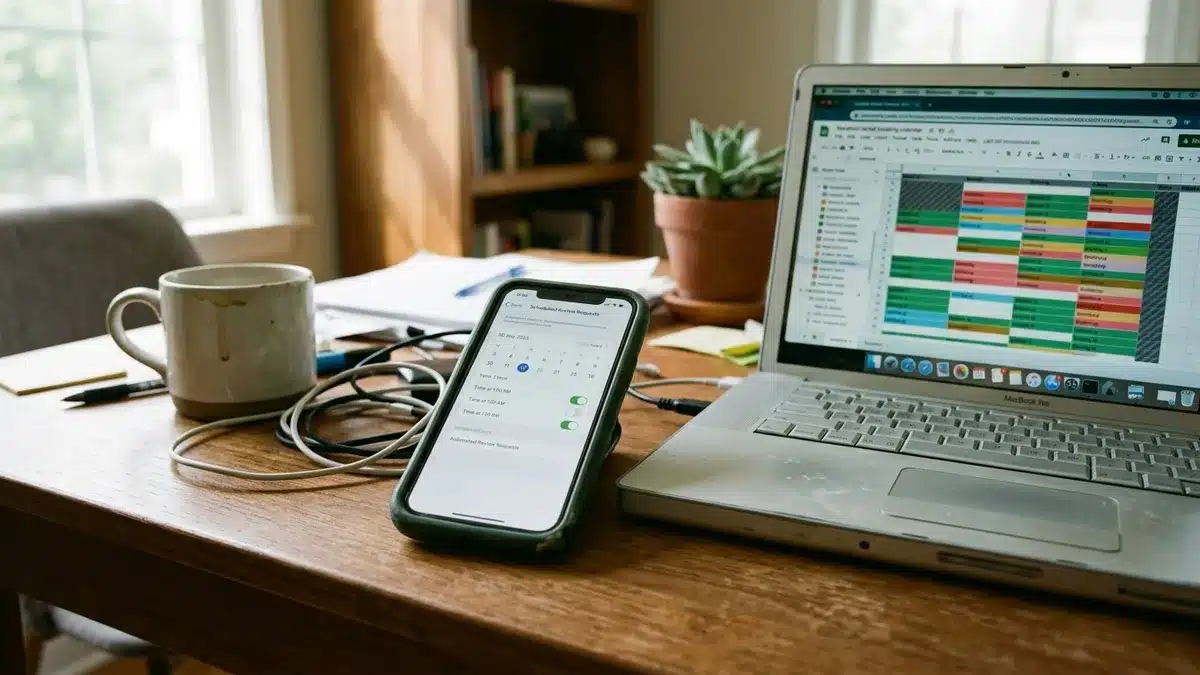
Within Boostly Connect’s guest CRM, review requests are scheduled against the actual checkout date pulled live from your connected PMS, so there’s no manual entry and no missed window. If your reservation dates shift, the schedule shifts with it automatically.
What Is the 80/20 Rule for Airbnb Hosts?
The 80/20 rule, as applied to short-term rental operations, generally suggests that 80% of your guest satisfaction and reputation outcomes come from 20% of your operational habits, most commonly communication consistency and post-stay follow-up. In review automation terms, that 20% is your review request sequence and how reliably you execute it.
Hosts who master a small set of high-leverage habits, like a consistent checkout message, a review request within 48 hours, and a reminder a week later, tend to see disproportionately better review outcomes than hosts who try to manually optimize every single guest interaction. Effort spent elsewhere yields diminishing returns by comparison.
We see this pattern across the Boostly Connect host community constantly. Operators who set up one solid automated sequence and leave it alone outperform operators who manually customize every message but skip requests when they’re busy or traveling. Consistency beats intensity here.
That’s the entire premise behind building review automation into a “set-it-and-forget-it” system rather than a manual task. Once your Boostly Connect CRM sequence is live, it runs on every reservation without you remembering to trigger it, which is the 20% of effort producing most of your reputation gains.
Can You Ask for a 5-Star Review on Airbnb?
You can ask a guest to leave a review on Airbnb, but you cannot explicitly request a 5-star rating in your message, since Airbnb’s policy prohibits incentivizing or pressuring guests toward a specific star rating. What you can do is ask for honest feedback, thank the guest for their stay, and make it easy to leave a review through a direct link or clear instruction.
Practically, this means your automated template should focus on gratitude and ease, not on directing the outcome. A line like “we’d love to hear about your stay” works within policy. A line like “please leave us 5 stars” does not, and repeated policy violations can put your account at risk across Airbnb, VRBO, and Booking.com alike.
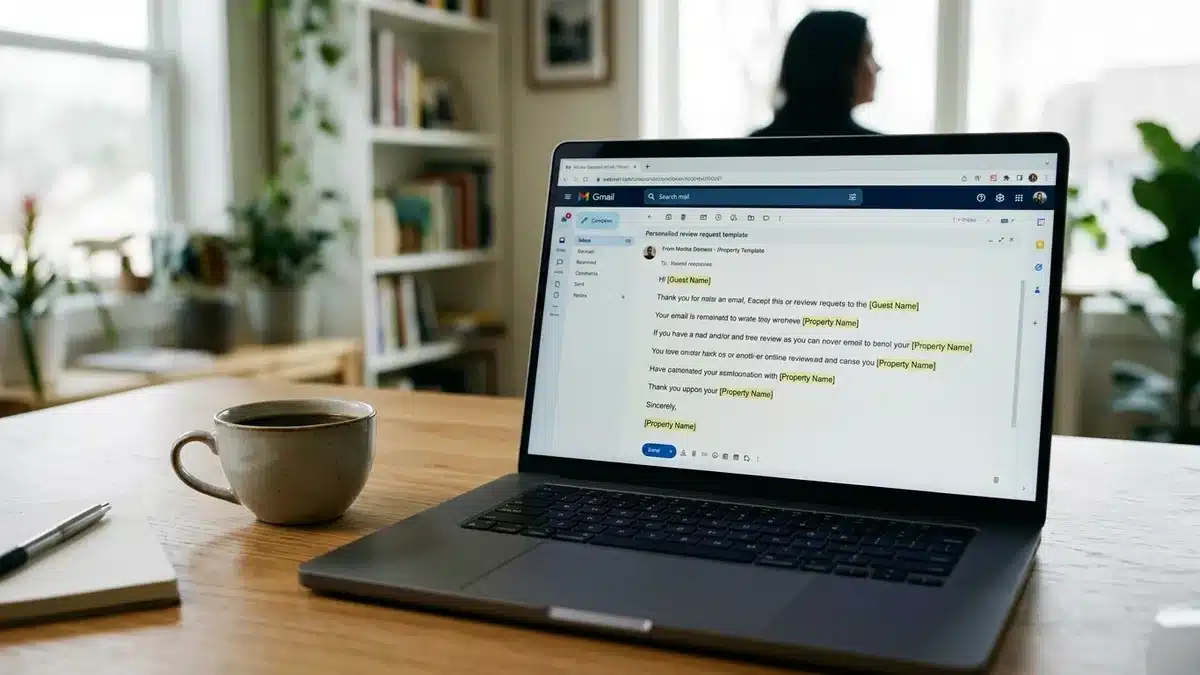
Personalization still matters enormously even within these limits. Templates that reference the guest’s actual stay details, using shortcodes for guest name, check-in date, or specific amenities they used, read as genuine rather than automated, even though they are triggered automatically behind the scenes.
Boostly Connect’s guest CRM builds these shortcodes into every automated review request, so messages pull the guest’s actual name and stay dates without you writing a custom message for every reservation. The result reads personal. The workflow behind it is entirely hands-off.
How Do You Build a Review Request Sequence That Actually Works?
An effective review request sequence for a vacation rental combines timing, channel variety, and a clear soft ask, delivered across two or three touchpoints rather than a single email. Below is a sequence structure we recommend building into any automation tool, whether that’s a PMS rule or a CRM workflow.
- Checkout day: Send a warm thank-you message as part of your standard checkout communication. Do not ask for a review here yet, just close the stay warmly.
- Day 1 to 2 after checkout: Send the first dedicated review request by email, referencing the stay specifically. Industry data shows an initial request around 48 hours post-checkout, followed by a reminder roughly a week later, captures far more responses than a single message.
- Day 5 to 7: If no review has posted, send a reminder through a second channel, such as SMS, since guests who ignore email often respond to a text.
- Day 9: A final reminder before the review window closes on platforms like Airbnb, which caps the review period at 14 days post-checkout.
Multi-channel sequencing, combining email and SMS rather than relying on one channel alone, is one of the most underused tactics in this space. Most hosts set up a single email automation and stop there, missing guests who simply don’t check email regularly during travel recovery.
Boostly Connect’s CRM supports exactly this kind of layered sequence, running email and SMS touchpoints against your live checkout data so you’re not manually tracking who’s been messaged and who hasn’t. Book a demo to see how a full sequence gets configured against your existing PMS in one sitting.
How Does Review Automation Actually Impact Occupancy and Revenue?
Review automation impacts occupancy and revenue by increasing both the volume and freshness of reviews, which directly affects search ranking placement on OTAs and conversion rates on your own direct booking website. Listings with strong, recent review activity typically rank higher in platform search algorithms and convert browsers into bookers at a noticeably higher rate.
As noted above, research indicates 75% of travelers say they’d pay more for a property with better reviews, which is a direct pricing signal, not just a booking volume signal. A property that consistently earns fresh 5-star feedback can often support higher nightly rates than a comparable property with a thin or stale review history.
The revenue impact compounds further through repeat bookings. Hosts using AI-assisted guest communication and review management report up to 40% higher rebooking rates, recovering an estimated 350 to 600 euros per property monthly in bookings that would otherwise be lost, according to Thereach AI’s 2026 findings. A guest who feels genuinely thanked and follows through with a review is also a guest who’s more likely to book direct next time, rather than defaulting back to the OTA search bar.
This is precisely the loop we built Boostly Connect to close. A guest captured into your CRM after a great stay, reminded warmly for a review, then nurtured with a direct-only offer for their next trip, is a guest who never has to rediscover you through Airbnb’s algorithm again. Our guide on how to re-engage past vacation rental guests dives deeper into that repeat-stay nurture piece specifically.
Data Snapshot: Manual vs Automated Review Request Workflows
The table below compares the practical differences between manually chasing reviews and running an automated sequence, based on patterns we consistently see across the Boostly Connect host community and broader industry data.
| Factor | Manual Review Requests | Automated Review Requests |
|---|---|---|
| Timing consistency | Depends on host remembering to send each message | Fires automatically on checkout, every reservation, no exceptions |
| Multi-channel coverage | Usually one channel (email or in-app message) | Can layer email plus SMS reminders in sequence |
| Personalization at scale | Time-intensive across multiple properties | Shortcodes auto-insert guest name and stay details |
| Scalability across a portfolio | Breaks down past a handful of properties | Runs identically whether managing 1 or 50 units |
| Guest data retention | Often lives inside the OTA, not owned by host | Captured into host-owned CRM for future marketing |
| Policy compliance risk | Higher, since wording varies message to message | Lower, since templates are pre-approved and consistent |
The clearest pattern in this comparison is scalability. A manual process that works fine for one property under your direct attention starts to fail the moment you add a second or third listing, or the moment you travel yourself and can’t check messages daily.
What Mistakes Cost Hosts the Most Reviews?
The most common mistakes that suppress review counts on vacation rental listings involve poor timing, generic messaging, and failing to diversify request channels. Understanding these mistakes matters more than chasing new tactics, since fixing the basics typically produces the biggest jump in response rate.
Sending Only One Request
A single review request, sent once and never followed up, misses guests who simply didn’t see it the first time. As covered above, a two-touch sequence, an initial request around 48 hours post-checkout plus a reminder roughly a week later, captures meaningfully more responses than one message alone.
Waiting Too Long to Ask
Requests sent two or three weeks after checkout arrive after the stay has faded from memory, and in Airbnb’s case, potentially after the 14-day review window has already closed. Immediacy matters. The sooner you ask while the experience is still fresh, the higher your response rate.
Using Generic, Copy-Paste Templates
A message that reads like it was sent to every guest who ever stayed feels impersonal and gets ignored more often. Templates that reference specific stay details, using name and date shortcodes, read as genuine even when fully automated.
Ignoring Policy Boundaries
Explicitly asking for a “5-star” rating violates platform policy and can put your account at risk. Frame requests around honest feedback instead, which stays compliant and still drives strong review volume when timing and personalization are handled well.
We built these guardrails directly into Boostly Connect’s review templates so hosts don’t have to manually police their own wording across dozens of monthly checkouts. The templates are pre-configured to stay policy-compliant while still feeling personal.

How Should You Choose a Review Automation Tool for Your Portfolio Size?
Choosing the right review automation setup depends primarily on your portfolio size, your existing PMS, and whether you also want to build a direct booking channel alongside your OTA presence. A single-property host has different needs than a boutique manager running fifteen listings.
For Solo Hosts (1 to 2 Properties)
A basic PMS automation rule, triggered on checkout, is often enough. The priority is consistency over complexity, so even a simple single-email trigger beats manual messaging entirely.
For Independent Owners (1 to 5 Properties)
At this scale, multi-channel sequencing starts paying off, since you’re managing enough volume that a missed review here and there adds up. This is also the point where connecting review automation to a guest CRM starts making sense, since you’re building enough of a guest base to justify repeat-stay marketing too.
For Boutique Managers and Portfolio Operators (5+ Properties)
Manual tracking becomes genuinely unworkable past a handful of units. You need automation that syncs against your live PMS calendar across every property simultaneously, with reporting that shows which listings are underperforming on review volume.
Boostly Connect supports multi-property portfolios through deep integrations with 8 supported platforms, including Hospitable, Guesty, Lodgify, and OwnerRez, so review automation runs identically whether you’re managing one property or dozens under one connected system. If you’re weighing your broader tech stack, our piece on must-have tools for short-term rental managers in 2026 covers where review automation fits alongside pricing and messaging tools.
Frequently Asked Questions
How much commission does Airbnb actually charge hosts?
Airbnb typically charges hosts a service fee in the range of 3% under the host-only fee structure, though many hosts operate under a split-fee model where guests also pay a service fee. Rates can vary by listing type and location, so check your specific host dashboard for exact figures.
Will building a direct booking website hurt my Airbnb search ranking?
No, maintaining an active Airbnb listing alongside a direct booking website does not directly hurt your Airbnb search ranking. Airbnb’s ranking algorithm weighs factors like response rate, review score, and booking activity on its own platform, not whether you also accept bookings elsewhere.
How long does it take to automate review requests for a vacation rental?
Setting up an automated review request sequence typically takes minutes once your property management system is connected to a compatible automation tool or CRM. Boostly Connect syncs to your existing PMS in under 20 minutes, after which review sequences run automatically on every reservation.
Do I need coding or developer experience to set up review automation?
No, most modern review automation tools, including Boostly Connect’s CRM, are built for no-code setup. You configure trigger events and message templates through a dashboard rather than writing any code.
What percentage of guests typically leave a review when asked?
Response rates vary significantly based on timing and personalization, but well-timed, personalized requests consistently outperform generic, delayed ones, as reflected in the 75-55 rule pattern discussed above. Consistent automation, rather than one-off manual asks, is the biggest lever for improving your response rate over time.
How do I get guests to rebook directly instead of going back to Airbnb?
Getting guests to rebook directly starts with capturing their contact data into your own CRM at the time of booking, then nurturing that relationship with post-stay follow-up, including review requests and direct-only offers for future stays. This is precisely the loop Boostly Connect’s guest CRM is designed to run automatically.
Is review automation worth it for a single-property host?
Yes, even single-property hosts benefit meaningfully from review automation, since manual follow-up is easy to forget during busy weeks or travel, and missed review windows on platforms like Airbnb cannot be recovered once the 14-day window closes.
Conclusion
Automating review requests for your vacation rental isn’t a nice-to-have feature anymore, it’s foundational infrastructure that protects your search ranking, your nightly rate potential, and your repeat guest pipeline all at once. As covered above, well-timed, multi-channel sequences consistently outperform single, generic asks, and the data backs it: research shows 75% of travelers would pay more for a property with strong reviews, and hosts leaning on automated guest communication report meaningfully higher rebooking rates.
The hosts who solve this fastest treat review automation as one piece of a larger connected system, not a standalone task bolted onto their existing workflow. That’s exactly what we built into Boostly Connect: a guest CRM that captures every direct booker automatically, runs your review request sequence against live checkout data, and feeds straight into repeat-stay nurture campaigns, all without you tracking a single date manually. As we move further into 2026, the gap between automated hosts and manual hosts will only widen as OTA algorithms lean even harder on review recency and volume.

If chasing reviews manually across Airbnb, VRBO, and Google has been eating into your week, book a demo with Boostly Connect and we’ll walk you through connecting your existing PMS and setting a full review request sequence live, typically in one sitting.