
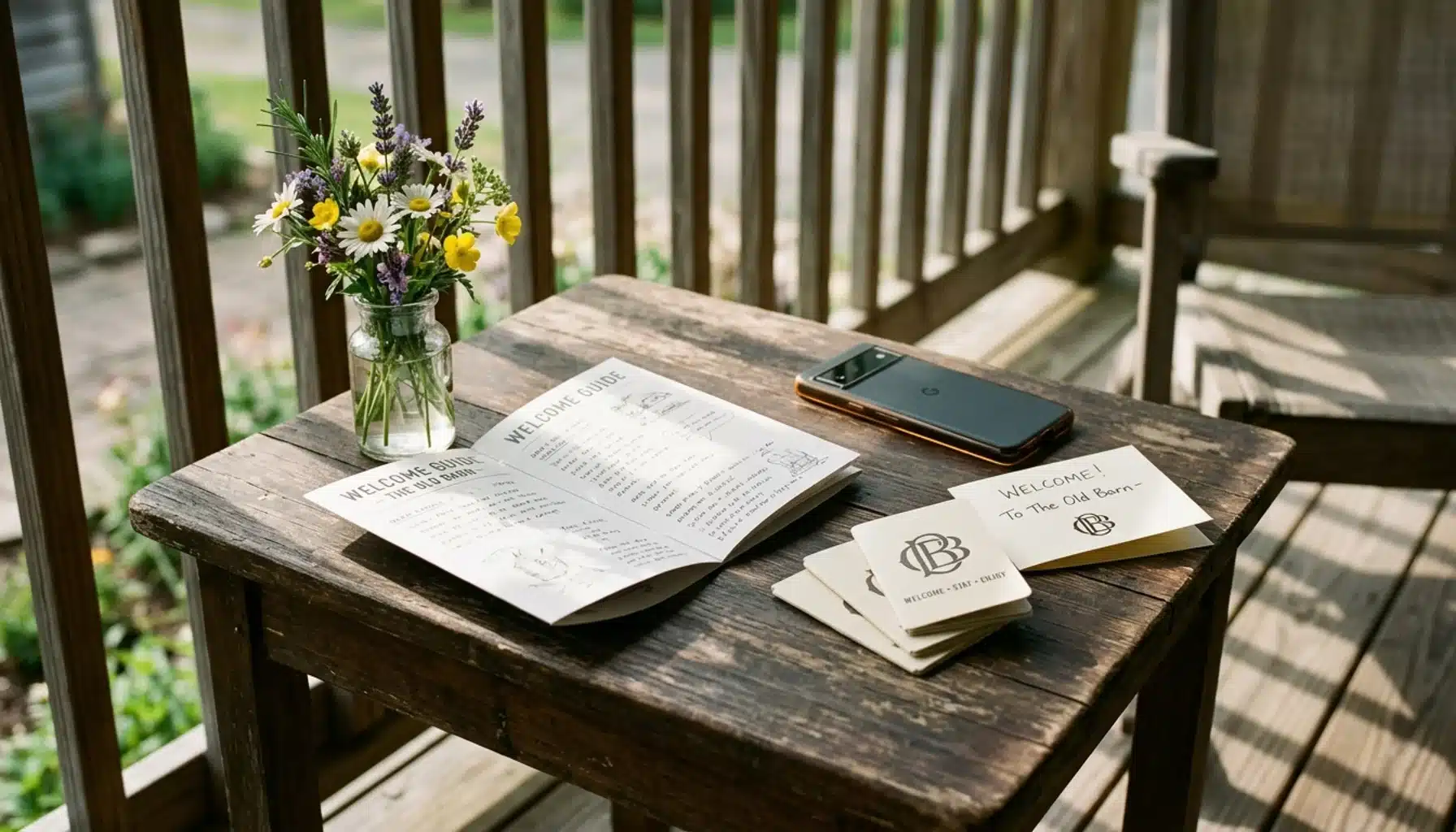
Vacation rental brand building is the process of turning a single Airbnb listing into a recognizable, independently searchable business that guests remember, recommend, and return to without needing Airbnb to find you again. Most hosts skip this step entirely. They optimize a listing title, upload decent photos, and call it a brand. It isn’t. A real vacation rental brand survives the moment a guest closes the Airbnb app.
- Vacation rental brand building means designing a guest experience, visual identity, and post-stay relationship that exists independently of any OTA listing.
- The global vacation rental market is projected to reach roughly $106.47 billion in 2026, according to Grand View Research, meaning more operators than ever are competing for the same guest attention.
- Professional management companies now control an estimated 42% of active short-term rental listings globally as of early 2026 (Data Intelo), which means unbranded, generic hosts are getting squeezed out of visibility.
- One Boostly-supported B&B reached 90% direct bookings and 60% repeat guests by building a brand guests actively sought out, not just a listing they stumbled on.
- Airbnb intentionally limits how much brand identity you can push through its own platform, so the real brand-building work has to happen on channels you own.
- Boostly Connect gives you the direct booking website, CRM, and marketing infrastructure to carry your brand past checkout instead of losing it back to the OTA.
Here’s the uncomfortable truth about most short-term rental “brands” in 2026: they don’t exist past the Airbnb search results page. Guests book because of star rating, photos, and price. They don’t remember the property name. They definitely don’t remember the host’s name. And when they want to travel to the same city again, they open Airbnb, not your website, because Airbnb is the only relationship they ever had.
We wrote this guide because we’ve watched thousands of hosts inside the Boostly Connect community try to fix this the wrong way, by redesigning a logo or picking a new color palette, and wonder why nothing changes. Vacation rental brand building isn’t a design project. It’s a system of decisions that starts before a guest books and continues long after they’ve left a review.
Below are the 10 moves that actually separate a memorable vacation rental brand from just another listing in a search grid. We’ll cover identity, guest experience, and the technical infrastructure (websites, CRM, email) that lets a brand persist once the guest is no longer inside Airbnb’s ecosystem.
1. Define the Specific Guest You Want to Remember You
Brand building starts with narrowing, not widening, your audience. A property marketed to “everyone” gets remembered by no one. Define a specific traveler type, families with young kids, remote workers on extended stays, couples celebrating anniversaries, and design every decision around that person specifically.
For example, a mountain cabin marketed generically as “cozy retreat” competes against thousands of identical listings. The same cabin marketed specifically to remote-working couples who want reliable Wi-Fi and a dedicated desk setup becomes memorable because it solved one problem precisely, instead of solving every problem vaguely.
This is also where niche differentiation pays off financially. Guests who feel specifically understood are more likely to return directly instead of rebrowsing Airbnb, and repeat guests are the foundation of every direct booking strategy we’ve seen work at scale, including the portfolio operator in our case studies who grew from a handful of properties to 30-plus units by building a reputation with one specific type of guest.
2. Build a Visual Identity That Works Off Airbnb, Not On It
A vacation rental’s visual identity is the consistent set of colors, fonts, logo, and photography style that makes a property recognizable outside the Airbnb interface. This matters because Airbnb strips most branding elements from your listing anyway, no custom logo placement, no branded header, no visible domain name.
That’s precisely why your visual identity has to live somewhere Airbnb can’t touch it: your own direct booking website. If your only visual presence is an Airbnb listing page, you have no brand at all once a guest leaves the app. You have a SKU.
This is exactly the gap Boostly Connect’s website design and development service was built to close. We sync a host’s existing property management system directly into a branded WordPress site in under 20 minutes, so the logo, colors, and photography that represent your business actually exist somewhere a guest can find again in 2026 and beyond, independent of any OTA’s design constraints.

What Is the 3-7-27 Rule of Branding?
The 3-7-27 rule of branding refers to the idea that a consumer typically needs roughly 3 seconds to form a first impression, 7 touchpoints before they consider a brand memorable, and up to 27 interactions before genuine loyalty forms. Applied to vacation rentals, this means a single great Airbnb stay is nowhere near enough to build lasting recall.
Most hosts stop investing in the guest relationship the moment checkout happens. That’s the single biggest mistake in vacation rental brand building. If loyalty requires multiple touchpoints, and your only touchpoint is the Airbnb app during the stay itself, you’ve used up one interaction out of the seven or more needed.
Practically, this means your brand needs pre-arrival messaging, in-stay communication, post-stay follow-up, and periodic re-engagement emails, all under your own name and design, not Airbnb’s. We built the Boostly CRM specifically to automate this touchpoint sequence, capturing every direct booker into your own guest database and running review requests and repeat-stay nurture emails without you manually tracking who stayed when. Without a system like this, most hosts simply lose track after the first two touchpoints and the loyalty never compounds.
3. Design a Consistent Voice Across Every Channel
Brand voice is the consistent tone and language style a property uses across its website, emails, social posts, and guest messages. Inconsistency here is subtle but corrosive: a formal Airbnb bio paired with casual Instagram captions and robotic automated messages reads as three different businesses, not one.
Pick a tone, warm and casual, polished and upscale, adventurous and rustic, and apply it everywhere. Guests notice inconsistency even when they can’t articulate why a brand feels “off.” A mismatched voice is one of the fastest ways to make an otherwise solid property forgettable.
This is a section where most hosts underestimate the workload. Writing consistent copy across a website, email sequences, and social captions takes real time, and it’s one reason our email marketing and social media management services exist inside Boostly Connect: so the same brand voice carries through every channel without you drafting each piece from scratch every week.
What Is the 75-55 Rule for Airbnb?
The 75-55 rule references guest behavior data showing that a meaningful share of travelers say they would pay more for a property with stronger reviews and, separately, that many would rebook a property directly if given the option instead of returning through the OTA. According to survey data cited across the industry, roughly 75% of respondents said they would pay more for a vacation rental if they saw stronger customer reviews.
The practical takeaway for vacation rental brand building is this: reviews are brand equity. A property with a consistent stream of specific, detailed reviews mentioning the same strengths (fast check-in, thoughtful welcome basket, responsive host) is building recognizable brand associations, not just a star rating.
But reviews alone don’t convert guests to direct bookers. You need a way to reach past guests once the review is posted. Enso Connect research found that more than 55% of vacation rental managers are collecting guest data, while roughly 22% collect none at all, as of late 2022. If you’re in that 22%, you have no way to leverage the brand equity a great review just created. That’s the exact gap a guest CRM closes, and it’s why Boostly Connect automatically captures contact details from every direct booking into a host-owned database rather than leaving them stranded inside Airbnb’s messaging system.
4. Make the Pre-Arrival Experience Recognizably Yours
Pre-arrival communication is the first opportunity to reinforce brand identity before a guest ever sets foot in the property. A generic, copy-pasted check-in message feels like a transaction. A branded, personal message that reflects your specific tone and includes local details feels like the start of a relationship.
Specifically, include something Airbnb’s automated messaging can’t replicate: a personal note referencing the guest’s trip purpose, a curated local recommendation list branded with your property name, or an early invitation to book directly next time at a preferred rate.
Manually sending this to every guest doesn’t scale past a handful of bookings a month. That’s where automated messaging built around your brand voice, rather than a generic template, becomes essential. Our guide on how to automate guest messaging without sounding like a bot walks through exactly how to keep this personal at scale.
5. Own the In-Stay Experience With Small, Repeatable Details
In-stay branding refers to the small, consistent details a guest encounters during their actual stay that reinforce who you are as a host or company, beyond the property itself. This includes welcome materials, signage, local guidebooks, and even the design of your Wi-Fi network name.
The goal is repeatability, not extravagance. A $20 welcome basket that looks identical across every property you manage builds more brand recognition over a year than a single expensive one-off gesture. Consistency is what guests remember; novelty fades.
Boutique property managers we work with often underestimate how much this consistency matters when scaling past a few units. If you’re managing multiple listings and the guest experience varies property to property, guests can’t form a coherent picture of your brand at all. Our guide to managing multiple vacation rentals covers how to standardize this without turning it into a full-time job.
Who Is the Largest Vacation Rental Company?
Airbnb remains the dominant global platform by listing volume and guest search share, though Vrbo (owned by Expedia Group) and Booking.com’s vacation rental inventory also represent significant portions of the market. The important distinction for independent hosts and property managers isn’t which platform is largest, it’s understanding that none of them are your brand.
These platforms are distribution channels. Renting shelf space from Airbnb, no matter how large its market share, doesn’t make Airbnb’s brand your brand. Guests booking through a large platform associate the trustworthy, familiar experience with the platform itself, not with the individual property owner, unless you’ve deliberately built recognition that survives outside that ecosystem.
This is precisely why the vacation rental management software market, valued at roughly $0.92 billion in 2026 and projected to reach $2.38 billion by 2034 according to Data Intelo, is growing so fast. Hosts are actively investing in infrastructure, direct booking websites, CRMs, channel managers, to build something that isn’t dependent on any single large platform’s continued goodwill.
6. Build a Direct Booking Website That Actually Reflects the Brand
A direct booking website is the digital home where your brand identity, pricing, and availability exist independent of any OTA’s design template and commission structure. Without one, your brand has no permanent address. Guests who want to find you again after their Airbnb stay have nowhere to go except back to Airbnb.
This is the single biggest structural gap in vacation rental brand building, and it’s the one competitors covering this topic tend to gloss over. A logo and a color scheme mean nothing if there’s no branded destination for a guest to actually visit and book through.
We built Boostly Connect around this exact problem. The platform syncs an existing PMS (supporting 8 integrations, including Hospitable, Guesty, Lodgify, and Hostfully) directly to a branded WordPress website with live availability and real-time pricing, in under 20 minutes, with no developer and no code required. Every guest who books through that site is automatically captured into your own CRM instead of disappearing back into Airbnb’s guest database. If you want a deeper walkthrough, our post on how to build a direct booking website without hiring a developer covers the full process step by step.
| Brand Touchpoint | Airbnb-Only Presence | Owned Direct Booking Website |
|---|---|---|
| Guest contact data | Retained by Airbnb, not accessible for remarketing | Captured into your own CRM automatically |
| Visual branding control | Limited by Airbnb’s template constraints | Fully custom logo, colors, and photography |
| Repeat booking path | Guest re-searches Airbnb, may find a competitor first | Guest returns directly to your branded site |
| Commission on repeat stays | 15-20% OTA commission on every booking | No added commission on direct-booked stays |
What Is the 80/20 Rule for Airbnb?
The 80/20 rule as applied to Airbnb hosting suggests that roughly 80% of a property’s booking outcomes, revenue, reviews, repeat interest, tend to come from around 20% of the effort a host puts in, typically the highest-leverage activities like guest experience consistency and photography quality, rather than from the sheer volume of listing tweaks or pricing adjustments.
For vacation rental brand building specifically, the 20% that matters most is usually the guest relationship infrastructure: capturing contact data, sending consistent post-stay communication, and giving guests a reason and a place to rebook directly. Hosts who chase the remaining 80% of low-leverage tasks, constant listing description tweaks, minor amenity additions, often see diminishing returns.
In our experience working with operators inside the Boostly Connect community, the highest-leverage move is almost always the same: stop treating each booking as a one-time transaction and start treating it as the first touchpoint in a longer brand relationship. That single mental shift changes which 20% of your time actually moves the needle.

7. Design Post-Stay Communication That Outlasts the Review Request
Post-stay branding refers to the communication sequence a host or manager sends after checkout to keep the property top-of-mind long after the guest has left, beyond the standard review request. Most hosts send one automated review ask and stop. That’s the entire content gap most articles on this topic miss.
Specifically, the hosts who build memorable brands treat the post-stay window as an alumni relationship: a thank-you note referencing something specific from the stay, seasonal offers a few months later, and occasional content (local event updates, property improvements) that keeps the brand visible without being salesy.
This is where the math gets real. Airbnb’s own Special Offers feature and Re-book button let you nudge past guests, but both keep the relationship, and the commission, inside Airbnb’s ecosystem. A branded post-stay email sequence sent from your own domain does the same job without handing Airbnb another cut. This is exactly the workflow the Boostly CRM automates: review requests and repeat-stay nurture sequences that run without you manually tracking who stayed and when. We’ve also written a deeper piece on how to re-engage past vacation rental guests in 2026 if you want the full playbook.
8. Balance Airbnb’s De-Branding Rules With Real Brand Visibility
Airbnb’s platform policies intentionally limit how much outside branding, contact information, or off-platform booking language a host can display within a listing, a practice sometimes called de-branding. This isn’t a loophole to fight; it’s a structural reality that shapes where brand building actually has to happen.
You can’t put your website URL in an Airbnb listing description. You can’t push guests to email you directly during the booking process. What you can do is build the relationship legitimately during and after the stay, through in-person materials, personal messaging tone, and post-stay email sequences sent once contact information is legitimately in your possession.
This is why we consistently tell hosts inside Boostly Connect to think of Airbnb as a discovery channel, not a brand channel. The discovery happens on Airbnb. The brand relationship has to happen everywhere else: your website, your email list, your social presence. Our guide to balancing OTA and direct bookings covers the specific tactics that stay within platform rules while still building recognition outside them.
9. Measure Whether Your Brand Is Actually Memorable
Brand recall measurement means tracking concrete signals that guests remember your property specifically, not just your listing generically, after they’ve checked out. Most hosts never measure this at all, which is a major gap in how vacation rental brand building typically gets discussed online.
Practical signals worth tracking include: the percentage of bookings that come from returning guests, the percentage of direct traffic to your website versus OTA referral traffic, direct mentions of your property name (not just “the Airbnb we stayed at”) in reviews, and repeat booking rate over a 12-month period.
In our own case data, one B&B using this exact framework reached 90% direct bookings and 60% repeat guests, numbers that only happen when guests actually remember and seek out the property by name rather than rediscovering it through an Airbnb search. Similarly, one operator we’ve worked with grew from zero direct bookings to 55% direct bookings across 30-plus properties over several years, a trajectory only possible once guests started recognizing and recommending the brand specifically. The reporting dashboard inside Boostly Connect tracks direct booking revenue and repeat guest rate in one place, so you’re not stitching this together across three disconnected spreadsheets.
10. Turn Your Brand Into a Referral Engine, Not Just a Listing
A referral-driven vacation rental brand is one memorable enough that guests recommend it by name to friends and family, rather than simply suggesting “check Airbnb for something similar.” This is the highest form of brand recall and the hardest to manufacture artificially.
It only happens when every earlier step compounds: a specific niche identity, consistent visual and voice branding, a genuinely differentiated pre-arrival and in-stay experience, and post-stay communication that keeps the relationship alive. Skip any one of these and referrals stay accidental instead of systematic.
One operator in our network built enough local reputation this way that landlords started approaching him to manage their properties, eventually growing a network of 50 to 60 rental owners and adding an estimated $10,000 a year in additional property revenue purely from referral-driven trust. That’s what vacation rental brand building looks like when it actually works: the brand starts working for you, not the other way around.
Frequently Asked Questions
What does vacation rental brand building actually mean if I only have one property?
Even a single property benefits from a distinct name, consistent visual identity, and a direct booking website separate from your Airbnb listing. Brand building isn’t reserved for multi-property portfolios; it’s what makes a single property capable of generating repeat and referral business instead of depending entirely on Airbnb’s search algorithm every time.
How long does it take to see results from vacation rental brand building?
Meaningful brand recognition typically builds over months, not weeks, since it depends on accumulating multiple guest touchpoints (the 3-7-27 pattern referenced earlier). Direct booking growth compounds gradually as repeat guests and referrals start replacing first-time OTA discovery.
Do I need a logo and custom color scheme to build a real brand?
Visual identity helps, but it’s not the foundation. Consistency across guest communication, the experience itself, and a place for guests to rebook you directly matter more than logo polish. Many hosts over-invest in visual design and under-invest in the CRM and website infrastructure that actually captures repeat guests.
Will building a brand and direct booking website hurt my Airbnb ranking?
No credible evidence suggests maintaining a direct booking presence alongside an active, well-managed Airbnb listing damages your Airbnb search ranking. Airbnb ranks listings based on responsiveness, reviews, and booking performance on its own platform, independent of whether you also operate a separate branded website.
What’s the biggest mistake hosts make when trying to build a vacation rental brand?
Stopping all brand communication the moment checkout happens. Most hosts send one review request and never contact the guest again, which wastes the brand equity a great stay just created. Post-stay nurture sequences are consistently the most underused lever in vacation rental brand building.
Can a boutique property management company build one unified brand across multiple owner properties?
Yes, and it’s often more effective than branding each property separately. A consistent management-company brand across a portfolio builds recognition faster because guests encounter the same standards, communication style, and booking experience across every property, which strengthens recall property by property.
Conclusion: Build the Brand Guests Can Actually Find Again
Vacation rental brand building comes down to one test: can a guest who loved your property find and book it again without opening Airbnb? If the answer is no, you have a listing, not a brand, no matter how good the photography or the reviews look. The market is only getting more crowded, with global vacation rental value projected near $106.47 billion in 2026, so the operators who build real, ownable brand infrastructure now will be the ones guests remember in a search field that keeps expanding.
The framework above, niche definition, consistent identity, a direct booking website, and automated post-stay nurture, works because we’ve watched it work across our own community of over 2,000 hosts. The next step is making sure your brand actually has somewhere to live once a guest leaves Airbnb.
If your brand currently ends the moment a guest closes the Airbnb app, that’s the exact gap Boostly Connect was built to close. Book a demo and we’ll show you your property synced to a branded direct booking site, with your own CRM capturing every guest automatically, in under 20 minutes.