

Short term rental digital marketing works only when it moves a guest from seeing your property to booking it directly on your own site, not when it just drives clicks to an Airbnb listing you don’t fully control. The tactics below are ranked by how directly they convert traffic into revenue you keep, not by how much buzz they generate. Most operators chase traffic. The ones who actually grow a direct channel chase conversion.
- A direct booking website with live PMS sync converts traffic other channels can’t capture, since Airbnb search traffic never reaches a page where you own the guest relationship.
- Industry benchmarks suggest allocating 2 to 5 percent of gross booking revenue to a short-term rental marketing program, meaning $100,000 in annual revenue justifies roughly $2,000 to $5,000 a year in spend.
- A dataset of short-term rental operators found repeat guests account for a median of 5 percent of total booking value, and roughly three-quarters of that repeat revenue still flows back through OTAs paying 12 to 20 percent commission, according to GetHostAI.
- The 2026 Vacation Rental Industry Outlook surveyed 244 short-term rental professionals representing more than 43,000 properties, underscoring how mainstream direct booking strategy has become across the industry.
- Marketing benchmarks for 2026 show an average repeat guest rate of 22 percent for direct bookings, according to CUfinder, meaning one in five bookings comes from returning guests when hosts run a retention program.
- Boostly Connect syncs your existing PMS to a live, SEO-ready direct booking website in under 20 minutes, capturing every direct booker automatically into your own CRM so retention marketing has something to work with.
If you’ve spent the last year posting property photos on Instagram and wondering why your direct bookings still sit near zero, you’re not alone. Most short-term rental digital marketing content online focuses on traffic generation: SEO tips, social posting cadences, ad budgets. Almost none of it addresses what happens after someone clicks. That gap is exactly where most hosts lose the game.
At Boostly Connect, we’ve watched thousands of hosts run solid social and SEO campaigns that generate real visitors, only to funnel every one of them into a slow, unoptimized site with no live availability and no clear call to action. Traffic without conversion infrastructure is just a vanity metric. In 2026, with the vacation rental market pushing past $106 billion according to Grand View Research, the operators pulling ahead are the ones treating their direct channel as infrastructure, not a side project.
This article ranks ten tactics by how directly they turn a visitor into a paying direct guest. We’ll cover the funnel structure most guides skip entirely, how to handle rate parity without breaking OTA terms, and a post-stay email sequence built to convert repeat guests instead of just thanking them.
1. Build a Direct Booking Website With Live Availability, Not a Digital Brochure
A direct booking website is the foundation of short-term rental digital marketing, and it only works if it shows real-time availability and pricing synced from your property management system. A static site with a “contact us” form is a dead end, not a funnel.
Most hosts skip this step because they assume it requires a developer. It doesn’t have to. Specifically, when your PMS connects directly to your site, guests see live calendars and instant pricing the moment they land, the same experience they get on Airbnb, minus the commission. This is precisely the gap we built Boostly Connect to close: it syncs to 8 supported PMS platforms, including Hospitable, Guesty, Lodgify, and OwnerRez, in under 20 minutes with no code and a free plan for up to 3 listings on the Discover map.
Without live sync, hosts either manually update a booking calendar (which breaks the moment they forget) or worse, list stale availability that costs them the sale on the spot. For a deeper walkthrough of what a converting site needs, see our guide on how to build a direct booking website without hiring a developer.
As of 2026, mobile-first design isn’t optional. A majority of vacation rental research happens on phones, and a site that requires pinch-to-zoom loses bookings before a guest even sees your rates.
2. Structure a Real Funnel From Cold Traffic to Confirmed Booking
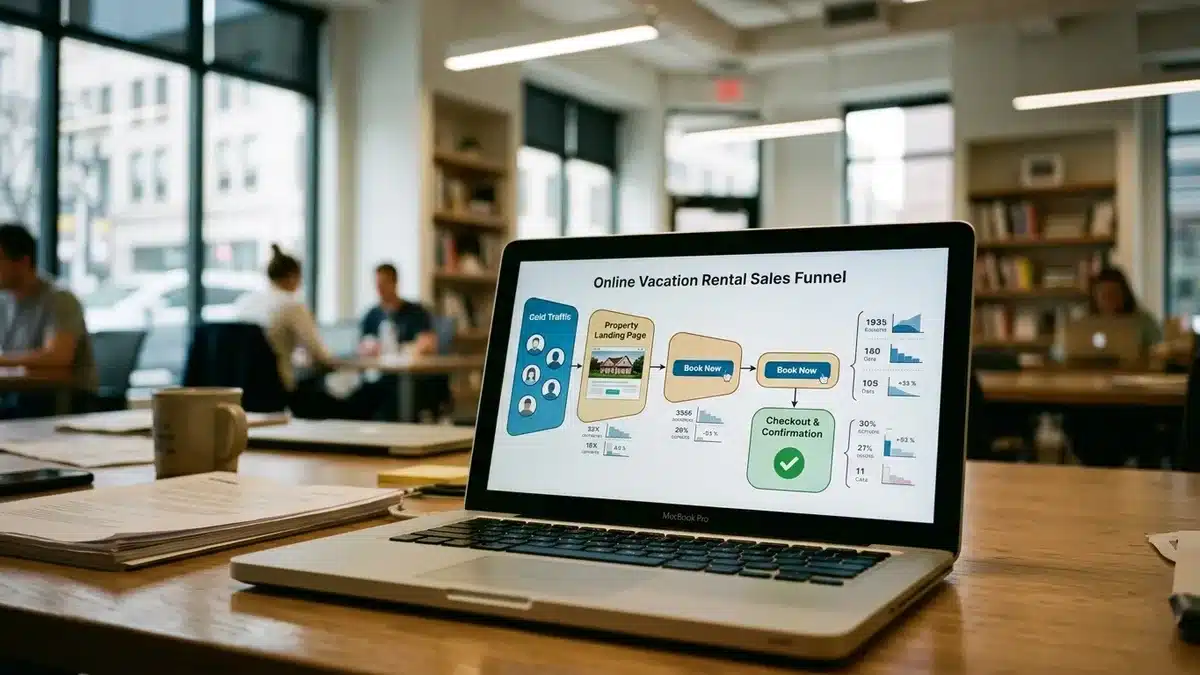
A conversion funnel for short-term rental digital marketing maps the exact path a stranger takes from first touch (search, social, ad) to confirmed direct booking, with specific landing pages and calls to action at each stage. Most competing guides mention “the funnel” without ever describing what it looks like in practice.
Here’s the structure that actually works: first, a visitor discovers your property through organic search, a paid ad, or a social post. Second, they land on a property-specific page, not your homepage, that answers their exact search intent. Third, that page shows live pricing and a single clear call to action, something like “Check dates” rather than a generic “Learn more.” Fourth, they complete payment through a secure processor like Stripe with no added booking fees.
The step most hosts miss is the second one. Sending paid traffic to a generic homepage instead of a matching property page kills conversion rates immediately, because the visitor has to re-search for what they already clicked to see.
Boostly Connect’s customizable property pages solve this by giving every listing its own page with photos, amenities, and live rates, so ad and social traffic lands exactly where intent meets availability. Retargeting visitors who abandoned a booking with a specific offer, “Winter dates still open” or “Pet-friendly stays available”, closes far more of this funnel than a generic remarketing ad ever will.
3. Handle Rate Parity Without Violating OTA Terms
Rate parity in short-term rental digital marketing refers to the practice of matching or discounting your direct site prices relative to OTA listings, and it must be handled carefully to avoid violating individual platform terms of service. Most articles on this topic avoid the subject entirely because it’s genuinely tricky.
Airbnb and other OTAs generally don’t prohibit you from offering lower prices on your own website. What they restrict is advertising a lower price for the same listing inside their platform. In practice, this means you can legally offer a direct-only discount code, a free night for longer stays, or a loyalty rate exclusively on your own site, as long as you’re not undercutting your OTA listing within the OTA’s own interface.
Instead of a blanket percentage discount (which invites scrutiny), most successful hosts use value-adds: a complimentary late checkout, a welcome basket, or a flexible cancellation policy available only through direct booking. This sidesteps parity concerns while still giving guests a reason to book direct.
Boostly Connect’s discount codes and gift voucher features let you create direct-only offers that live entirely on your own site, separate from your OTA listings, so you’re incentivizing direct traffic without touching your Airbnb pricing at all. If you’re unsure how commission math affects your bottom line before setting these offers, our breakdown of how much Airbnb commission actually costs is a useful starting point.
4. Tailor Your Marketing Approach to Your Specific Property Type
Short-term rental digital marketing tactics differ meaningfully depending on whether you operate a luxury whole-home rental, a budget cabin, or an urban loft, and treating all three the same wastes ad spend and content effort. This is one of the biggest gaps in most marketing guides, which offer one-size-fits-all advice.
A luxury whole-home property, for example, converts best through high-production video tours, partnerships with one or two micro-influencers per quarter, and email sequences that emphasize exclusivity and privacy. A budget cabin, by contrast, converts on practical value: proximity to a specific trailhead, cost transparency, and reviews that mention cleanliness and reliability. An urban loft audience responds to walkability content, nearby restaurant and nightlife call-outs, and shorter-form video showing the neighborhood, not just the unit.
The paid ad strategy should shift too. Luxury properties generally justify a higher test budget and longer-form retargeting sequences, while budget-friendly units often perform better with a smaller daily test spend focused on last-minute booking windows, since that audience books closer to the stay date.
Boostly Connect’s multi-property support lets portfolio operators run different messaging and offers per listing type from one connected system, instead of manually managing separate ad accounts or CRMs for each property category. If you manage a mixed portfolio, our guide on how to manage multiple vacation rentals covers the operational side of this in more depth.
5. Run a Structured Social Media Cadence, Not Random Posting
A structured social media cadence for short-term rental marketing means posting consistently across two to three platforms with defined content pillars, rather than posting whenever inspiration strikes. Consistency, not volume, is what search and social algorithms reward.
A strong baseline is three to four posts per week across Instagram and Facebook, mixing content across four pillars: the property itself, the surrounding destination, guest social proof, and the people behind the business. TikTok works well for short property tours; Facebook tends to build community around returning guests and local audiences.
Batch your content once a month and schedule it weekly. This is the single biggest time-saver hosts overlook, because posting in the moment rarely happens consistently once the property gets busy. Evergreen highlight categories, “Families,” “Pet-friendly,” “Winter”, keep older content discoverable long after it’s posted.
Respond to messages and comments within a few business hours. Slow response times on social don’t just hurt engagement metrics, they signal to potential guests that you’re not attentive, which bleeds into booking hesitation. If message volume is your bottleneck, that’s precisely where automated response handling matters, something we cover in our piece on automating guest messaging without sounding like a bot.
Boostly Connect’s CRM includes AI agents that field common inquiries and pricing questions automatically, so social-driven traffic gets a fast response even outside business hours, converting more lookers into bookers without adding staff time.
6. Invest in SEO and Content Marketing Built for Direct Bookings
SEO for short-term rental digital marketing means optimizing your direct booking site, not your OTA listing, to rank for searches your ideal guest actually types into Google. This distinction matters because ranking well on Airbnb’s internal search does nothing for your direct channel.
Location-based keywords matter most here: searches like “cabin near [trailhead]” or “pet-friendly rental in [neighborhood]” convert at a higher rate than generic property-type searches, because the searcher has already narrowed their intent. Publishing destination guides on your own site, then repurposing them into social carousels and short video, extends the reach of a single piece of content across multiple channels.
Technical basics still trip up most hosts: mobile page speed, a clean sitemap, and a site structure Google can actually crawl. A site built without SEO in mind from day one usually needs significant rework later, which is why we build every Boostly Connect site on SEO-optimized property pages and a built-in blog from the start rather than bolting SEO on afterward. For the technical side of this, our vacation rental SEO tips for 2026 guide walks through the specifics.
If your site has been live for months with no organic traffic, something structural is usually wrong. We’ve diagnosed this repeatedly in our own client base; see why a vacation rental website isn’t ranking for the most common causes.

7. Run Paid Social and Search Ads With a Realistic Test Budget
Paid advertising in short-term rental digital marketing works best as an always-on awareness channel rather than a one-time campaign, using short video and carousel formats that highlight both the property and the destination. A common starting point is a modest daily test budget, often in the $10 to $20 per day range, run during peak booking windows roughly two to three months before the main season.
Retargeting is where paid spend earns its keep. Someone who visited your site or engaged with a social post but didn’t book is a warmer lead than cold traffic, and a retargeting ad with a specific, time-relevant offer, “Check dates for spring break” instead of a generic “Book now”, converts noticeably better.
Track cost per acquisition monthly, not just impressions or clicks. A campaign that generates traffic but no bookings isn’t working, no matter how good the engagement metrics look. Use UTM parameters (source=instagram or facebook, medium=social or paid, campaign=season) so you can actually see which channel produced which booking, rather than guessing.
Because Boostly Connect captures every direct booker into your own CRM automatically, you can trace a booking back to the exact campaign that drove it, closing the reporting loop that scattered spreadsheets and disconnected ad dashboards usually leave open.
8. Build an Email Retention Sequence That Actually Converts Repeat Guests
A post-stay email sequence is a series of timed messages sent after checkout designed to move a guest from one-time booker to repeat direct booker, and almost no marketing guide lays out the actual sequence step by step. This is one of the biggest content gaps in the space, and it’s also one of the highest-leverage tactics available.
Here’s a sequence that works in practice: a thank-you and review request within 24 to 48 hours of checkout, a “here’s what’s new at the property” update around the two-month mark, a seasonal offer three to four months out timed to their likely next travel window, and a direct-only loyalty discount around the anniversary of their stay.
According to a 2026 Lodgify study, hosts without a deliberate retention strategy see repeat guest rates of just 5 to 8 percent, while hosts running structured retention marketing achieve 15 to 25 percent. CUfinder’s 2026 benchmarks put the average repeat guest rate for direct bookings at 22 percent, meaning roughly one in five bookings comes from a returning guest when retention is handled well.
The problem most hosts hit is that Airbnb retains the guest’s contact data, so there’s no email list to send this sequence to in the first place. That’s the exact trap Boostly Connect was built to break: every guest who books direct lands automatically in your own CRM, so the retention sequence has real contact data to run against instead of a guest history you don’t own. For a deeper look at the mechanics, see how to re-engage past vacation rental guests in 2026 and our guide on choosing a CRM built for short-term rental hosts.
9. Use Local Partnerships and Community Marketing to Build Trust
Local partnership marketing means building relationships with nearby businesses, tour operators, and event organizers who can refer guests directly to your property, bypassing OTA discovery entirely. This tactic gets little attention in most digital marketing content, but it compounds over time in a way paid ads don’t.
A partnership with a local restaurant, guide service, or event venue that cross-promotes your rental costs nothing but a conversation and often a reciprocal mention. Guests referred this way tend to book direct by default, since they never encountered your listing through an OTA search in the first place.
This tactic scales particularly well for hosts managing multiple properties in one market. One operator we’ve seen build this kind of local network expanded from managing a handful of personal units to overseeing dozens of properties for other owners, largely because a professional-looking direct booking site gave local landlords a reason to trust the operation. That same pattern, a strong direct site attracting property owner inquiries, shows up repeatedly across growth-stage rental businesses.
Boostly Connect’s multi-listing support and reporting dashboard make it straightforward to show a property owner exactly what direct booking revenue looks like across a portfolio, which matters if local partnerships eventually turn into management opportunities. For the operational side of scaling this way, see our guide on how to grow a vacation rental business.
10. Track the Right Metrics So You Know What’s Actually Working
Analytics for short-term rental digital marketing means tracking sessions, direct booking conversions, and assisted conversions across your website and ad channels, not just social media likes or follower counts. Vanity metrics feel good and mean almost nothing for revenue.
Industry benchmarks suggest allocating 2 to 5 percent of gross booking revenue to marketing, so if you’re not tracking what that spend produces in actual direct bookings, you have no way to know if the ratio is working for your property. Review this monthly, not annually, since seasonal shifts in demand change what’s performing.
A reporting dashboard that connects your ad spend, your website traffic, and your actual booking revenue in one place removes the guesswork that comes from checking three separate platforms and trying to reconcile the numbers by hand. This is exactly the visibility gap Boostly Connect’s reporting dashboard closes, tracking direct booking revenue and ROI in one place instead of stitching together PMS reports, ad platform dashboards, and a separate spreadsheet.
Adjust your strategy quarterly based on what the data actually shows, not based on what tactic is trending in host Facebook groups that quarter.
How Should You Compare These Tactics Against Each Other?
The table below ranks each tactic by its typical time to see results and its direct impact on booking conversion, based on how these channels actually behave in practice for short-term rental operators.
| Tactic | Time to First Results | Primary Conversion Impact |
|---|---|---|
| Direct booking website with live PMS sync | Immediate once live | Highest, removes the biggest funnel bottleneck |
| Funnel structure and landing pages | Immediate | High, prevents traffic from bouncing |
| SEO and content marketing | Several months | Compounding, long-term organic growth |
| Post-stay email retention sequence | 1 to 2 booking cycles | High for repeat guest revenue |
| Paid social and search ads | Weeks | Fast but ongoing cost, best for awareness |
| Social media cadence | Weeks to months | Moderate, builds trust and reach |
| Local partnerships | Months | Moderate, compounds over years |
Notice that the highest-impact tactic, the direct booking site itself, is also the one most hosts treat as a one-time project rather than ongoing infrastructure. Every other tactic on this list depends on that foundation working correctly.
What Mistakes Should You Avoid With Short Term Rental Digital Marketing?
The most common mistake is spending on traffic generation, ads, SEO, social, before fixing a conversion-broken website. If your site loads slowly, doesn’t show live pricing, or buries the booking button, every dollar spent driving traffic to it is partially wasted.
Second, many hosts assume shifting focus to direct bookings will tank their Airbnb ranking. In practice, a healthy direct channel and a healthy OTA presence aren’t mutually exclusive; Airbnb’s ranking algorithm responds to your response rate, review quality, and booking activity on their platform, not to the existence of a separate website.
Third, hosts frequently ignore rate parity nuance and either overcorrect (matching OTA prices exactly, killing the incentive to book direct) or undercorrect (discounting so heavily on OTAs that it violates platform terms). Value-adds solve this more cleanly than blanket discounts.
Fourth, retention gets treated as an afterthought. A single thank-you email is not a retention strategy. Without a structured sequence, most of that repeat guest value quietly flows back through OTA commission, exactly the pattern GetHostAI’s research found across their operator dataset.
Frequently Asked Questions
How much commission does Airbnb actually charge hosts?
Airbnb typically charges hosts a service fee that, combined with payment processing, generally lands in the mid-teens percentage range per booking, though exact fees vary by host type and region. Over a full year of bookings, this adds up to a substantial recurring cost that a direct booking channel can help offset.
Will building a direct booking website hurt my Airbnb search ranking?
No. Airbnb’s ranking algorithm weighs your response rate, review scores, and booking activity on their platform, not whether you also operate a separate direct booking site. Running both channels in parallel is standard practice for established hosts.
Which property management systems integrate with direct booking platforms like Boostly Connect?
Boostly Connect supports 8 PMS integrations, including Hospitable, Guesty, Lodgify, OwnerRez, and Hostfully, allowing most hosts to connect their existing system without switching software.
How long does it take to set up a direct booking website?
With a PMS already in place, connecting it to Boostly Connect and getting a live site takes under 20 minutes, with no developer or coding knowledge required.
What percentage of bookings should come direct versus through OTAs?
There’s no universal number, but many operators building a serious direct channel target somewhere between 40 and 65 percent direct bookings within a year of launching a dedicated site and marketing program, depending on their starting point and effort level.
How do I get guests to rebook directly instead of going back to Airbnb?
Capture their contact information at the time of booking, then run a structured post-stay email sequence with a review request, a property update, and a direct-only offer timed to their likely next trip. Without owning that contact data, most repeat bookings default back to the OTA where the guest first found you.
Is a direct booking website worth it for a single-property host?
Yes, particularly because Boostly Connect has a free plan for up to 3 listings on the Discover map, meaning a single-property host can test the direct channel without meaningful upfront investment. The main ongoing requirement is consistent marketing, not additional software cost.
Conclusion: Build the Infrastructure Before You Chase More Traffic
Short term rental digital marketing only pays off when your direct booking site can actually convert the traffic your SEO, social, and paid efforts generate. The tactics that matter most, live PMS-synced websites, a real funnel, retention email sequences, all depend on infrastructure most hosts never build properly. As the vacation rental market approaches $106.5 billion in 2026 according to Grand View Research, the operators winning the direct booking game are the ones treating this as a system, not a scramble of disconnected tactics.
If you’ve been generating traffic without a matching increase in direct bookings, the problem usually isn’t your marketing effort. It’s the foundation underneath it. Get started with Boostly Connect and see your property synced to a live, SEO-ready direct booking site in under 20 minutes, with your own CRM capturing every guest who books direct from day one.

If you’re ready to stop losing repeat guests back to Airbnb, book a demo and we’ll walk through connecting your existing PMS live, so you can see exactly what a converting direct booking site looks like for your property before you commit to anything.