

Does Airbnb give hosts access to guest email addresses after checkout? No. Airbnb has never shared actual guest or host email addresses with other members, and hosts follow up with guests through Airbnb’s own messaging. The legitimate way to own a guest’s email is to earn it through a direct booking.
Key Takeaways
- Airbnb has never shared actual guest or host email addresses with other members, so hosts do not receive a guest’s real email at booking or after checkout.
- Airbnb’s email alias feature, an anonymous forwarding address, was retired on September 30, 2023, and an alias was never the guest’s real address.
- Hosts can still follow up with guests through Airbnb messaging after a stay; availability and limits are set by Airbnb, so check its current Help Center guidance.
- When you hold no contact data, repeat guests rebook on Airbnb by default, and you pay OTA commission (typically 15 to 20 percent) on a guest you already earned.
- Boostly Connect syncs your PMS to a WordPress direct booking site in under 20 minutes and captures every direct guest into your own CRM, so the email list you own grows with every direct booking.
Open your Airbnb inbox after a great stay and you’ll find a message thread, a review, and a calendar entry. You will not find an email address you can export. For a host paying 15 to 20 percent on every reservation, that gap decides who owns your best guests, and in 2026 more hosts are noticing it.
At Boostly Connect, we have worked with more than 2,000 hosts across 25 countries, and one question surfaces early: where do the guest emails live? Our founder, Mark Simpson, recovered over $30,000 a year in platform fees by answering it for his own rentals. The short version is that Airbnb keeps them, and it keeps them by design.
Below, we separate three things people blur together: holding an email address, being able to message a guest, and being allowed to market to a guest. We cover the retired alias feature, the off-platform rules, your privacy responsibilities, post-checkout automation, and how to build a list that belongs to you.
Does Airbnb Give Hosts Access to Guest Email Addresses After Checkout?
Airbnb does not give hosts a guest’s real email address at any point, including after checkout. Its Help Center states that actual email addresses are not shared between members. What a host receives is a message thread tied to the reservation, and that thread is the only contact channel the platform provides.
Email address versus message thread
A message thread lets you write to a guest and read replies inside Airbnb. An email address lets you write to them anywhere, store them in your own tools, and contact them years later. Airbnb provides the first and withholds the second. Plenty of articles blur that line, which is why the question keeps resurfacing.
What changes at checkout
Nothing changes on the address question. The reservation completes, and the message thread remains your route to the guest. The 2023 host update restates that Airbnb has never shared actual guest or host email addresses, so no later moment exists when one appears in your account.
Most hosts feel the cost of OTA dependence at exactly this point. You can serve a guest perfectly, collect a five-star review, and hold nothing that lets you invite them back. We built Boostly Connect so the next stay for that guest can start on your own website, with their details captured into your own CRM the moment they book.
How Did Airbnb Email Aliases Work, and Are They Still Available?
An Airbnb email alias was an anonymous forwarding address that relayed messages between a host and a guest without exposing either person’s real email. Airbnb retired the feature on September 30, 2023, so any template or automation that still references an alias works from an outdated setup.
What an alias looked like
The alias resembled an ordinary address, a string such as stephanie-dfsnsns@guest.airbnb.com. Mail sent to it was forwarded to the guest, and the guest’s real address stayed hidden. The email-anonymization page said attachments could reach 15 MB and that hosts could include links, which made aliases a convenient way to send house manuals.
Why an alias was never a contact list
Some hosts saved aliases in spreadsheets and treated them as a mailing list. That never worked as intended. An alias belonged to one reservation conversation, it forwarded mail instead of identifying anyone, and it no longer exists. If a saved document or scheduled message still points to one, replace it.
The update steered hosts toward other ways to share documents and stay details, and the message thread is the first place to start. For longer material, many hosts include a digital guidebook link in a scheduled message. In our experience, hosts who rebuilt their workflow after the retirement ended up with a cleaner system: stay information flows from the PMS, and guest contact data lands in a CRM only when the guest books direct.

Can Hosts Still Contact Guests After a Reservation Ends?
Yes. Hosts can message guests through Airbnb’s messaging system after checkout, and that thread is the intended channel for service follow-up such as thank-you notes and lost-item questions. The thread does not reveal an email address, and it does not give you permission to market to guests outside Airbnb.
How long the thread stays useful
Airbnb controls how long a completed reservation’s thread remains available and what it allows, and those details can change. Check the current Help Center guidance before you build a follow-up sequence around a specific window. Keep every message tied to the stay: a thank-you, a forgotten item, a note about the review.
Two platform tools are worth knowing. The Airbnb Re-book feature lets past guests quickly rebook the same property. The Airbnb Special Offers feature lets you send a guest a tailored offer.
We tell hosts to use them. Running Airbnb alongside a direct channel is normal, and most of our hosts do exactly that. The limitation is ownership: the guest, the conversation, and any future marketing stay on Airbnb’s side of the fence, which is the gap our direct booking sites and CRM were designed to close.
What Does Airbnb Allow Hosts to Do With Guest Contact Information?
The Off-Platform and Fee Transparency Policy restricts how hosts collect and use guest contact details. As the Help Center describes it, hosts may not sell, share, or use guest contact information for marketing communications, and may not add guests to a contact list. A narrow exception covers legal and compliance needs.
The legal and compliance exception
The policy permits additional contact or identity information when it is required for legal or compliance reasons, such as local laws, HOA rules, or building-security rules. The requirement and the reason must appear in your listing description. A host who simply prefers an email address does not qualify.
When a guest asks for another channel
The request has to come from the guest. Asking every guest to email you so you can build a list is the pattern the policy targets.
| Selling or sharing guest contact information | Prohibited | Applies to any outside party |
| Collecting extra details for local law, HOA, or building-security rules | Narrow exception | State the requirement and reason in your listing description |
| Moving to another channel because the guest asked after booking | Permitted, subject to other requirements | The request must come from the guest |
| Handling guest personal information | Host responsibility | Follow the privacy laws that apply to you |
Policy wording changes, so read the current version rather than relying on a summary, including ours. A guest who books on your own website is a relationship you created directly, which puts you on different footing than a guest who arrived through Airbnb. Marketing consent rules still vary by country, so confirm yours.
What Should You Do With Guest Contact Details You Already Have?
The host privacy standards make hosts responsible for complying with applicable privacy laws when handling personal information, but the published guidance gives no detailed retention or deletion procedure.
That silence leaves you to make sensible decisions. Depending on where you and your guests are located, laws such as GDPR and CCPA may apply. A privacy professional can tell you what your situation requires. In the meantime, an audit takes an afternoon and removes the biggest risks.
- List every place guest contact details sit today: spreadsheets, phone contacts, old PMS exports, and saved messages.
- Mark where each contact came from. A guest from Airbnb and a guest who booked on your website carry different expectations.
- Stop using any Airbnb-sourced contact for marketing communications or list building.
- Delete or secure details you kept for a one-off reason, such as a building-security requirement.
- Write down where your direct guests gave their details and what they agreed to receive.
Step five is where a system beats a spreadsheet. The CRM that comes with Boostly Connect records each direct booking as it happens, so you never need to reconstruct where a contact came from. For a deeper walkthrough of the principle, see our guide on owning guest data from Airbnb.
How Do You Automate Messages to Guests After Checkout?
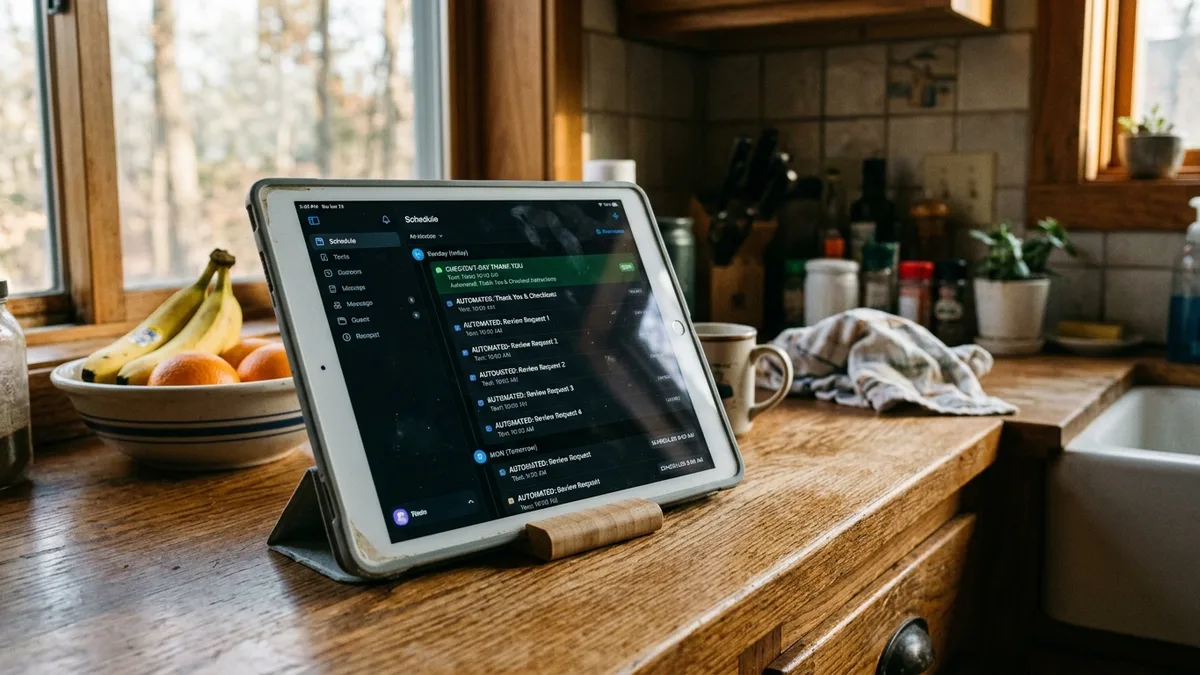
Automating post-checkout messages means scheduling a short sequence, such as a thank-you note and a review request, that sends from your property management system or CRM when a reservation ends. For Airbnb stays, the sequence typically runs on Airbnb’s thread. For direct bookings, it can run by email and SMS.
Setting up the sequence
- Confirm which scheduled triggers your PMS supports, such as checkout day or the day after.
- Write one thank-you message in your own voice, with the guest’s name and the property name filled in by the tool.
- Add a review request that sends after the thank-you, not in the same message.
- For past Airbnb guests, point to Airbnb’s own Re-book or Special Offers tools rather than to an outside channel.
- Test the sequence on a completed reservation before it goes live for everyone.
What to look for in guest messaging software
The best guest messaging software for Airbnb hosts depends on how many channels you run. Look for a tool that connects to your PMS, handles OTA threads plus direct-guest email or SMS, and stores history in one place. Our opinion: a tool that only automates Airbnb’s thread gives you a tidier inbox and still no list.
| Approach | Who you can reach | Who owns the contact data |
|---|---|---|
| PMS automated messaging | Guests on OTA threads, plus direct guests depending on setup | Varies by PMS and by how each booking arrived |
| Boostly Connect direct booking site with CRM | Guests who book on your own website, by email and SMS | You, inside your own CRM |
Boostly Connect plugs into your existing system (Hospitable, Hostfully, Lodgify, Guesty, and 23 others among 27 integrations) so you keep the PMS you already use. The Boostly CRM adds email and SMS automation for past-guest nurture, automated review requests, and repeat-stay sequences. Live chat and AI agents field routine guest questions and upsells, which reclaims your evenings.
Why Do Returning Guests Keep Rebooking Through Airbnb?
The repeat booking trap is what happens when a returning guest rebooks through Airbnb because the host never owned a way to reach them directly. Each repeat stay then carries the platform’s commission again, typically 15 to 20 percent, on a guest the host already won.
How the trap works
A guest who loved your place returns to the app they used to find it. Airbnb holds their contact details and can show them other listings, including your competitors. You hold a review. That asymmetry is the whole problem, and it compounds with every happy guest you serve.
What the repeat numbers look like
A 2026 Lodgify study, reported by StayStrat, found the average short-term rental host has a repeat guest rate of just 5 to 8 percent, while hosts with a deliberate retention strategy reach 15 to 25 percent. The difference is not better hospitality. It is having a channel to reach people after they leave.
If you want the annual figure for your own portfolio, our breakdown of what Airbnb commission costs you per year gives you the math. For the follow-up side, our guide on how to re-engage past vacation rental guests covers what to send once you have permission to send it. Boostly Connect was built specifically to stop this trap, which is why every direct guest lands in your CRM automatically.
How Do You Build a Guest Email List You Own?
A guest email list you own comes from guests who book on your own website, where the booking form captures their details directly into your CRM. Airbnb keeps guest emails private by design, so a direct booking is the one clean point where a guest’s contact information reaches you.
The setup, step by step
The process is shorter than most hosts expect. Connect your PMS, review the synced listings, and your direct booking site is live. Plugging in a PMS takes under five minutes, and the full WordPress site is typically up in under 20 minutes. You need no developer and no coding, and there is no upfront cost for up to 10 listings.
The site shows live availability and real-time pricing from your PMS, so guests see the same calendar you do. Every direct booking flows into the Boostly CRM with no export step. For hosts comparing options, our piece on what to look for in a direct booking website lists the criteria we would apply, and a CRM for short-term rental hosts who own their guest list explains why the CRM piece matters as much as the site.
What the results can look like
In one case, a bed and breakfast run by a couple who handled everything themselves reached 90 percent direct bookings and 60 percent repeat guests after taking control of their own marketing. Across our community, we guarantee 65 percent direct bookings within 12 months, or we work for free until you get there.
No. Keep your Airbnb listings active, protect your ranking by serving those guests well, and let your own site take the guests who are ready to come direct. Our hosts run both channels at once. Over time, the share that arrives through your own site grows because you can finally reach people after they leave.

What Mistakes Do Hosts Make With Post-Checkout Guest Contact?
The most common mistake is treating Airbnb’s message thread as if it were a customer database. The thread belongs to a single reservation, Airbnb controls it, and nothing in it exports to a CRM. Hosts who build their follow-up strategy on top of it find the foundation missing when they need it.
- Keeping alias-based automations alive. Anything built around email aliases stopped working after September 30, 2023, and silent failures leave guests without stay information.
- Collecting more than the stay requires. Asking every guest for a personal email “just in case” invites a policy problem and a privacy problem at once.
- Skipping the audit. Old spreadsheets with unknown origins are a liability, because you cannot say how or why you hold the data.
- Waiting for the commission bill to hurt. Every month without a direct channel is a month of repeat guests going back through the platform.
The fix for the last one is the least technical. If you need a plan for getting more direct bookings for your vacation rental, start with the site and CRM, then add campaigns once the list exists. That sequence is how we coach hosts through our twice-weekly group calls.
Where Does This Leave You in 2026?
Does Airbnb give hosts access to guest email addresses after checkout? No. You get a message thread, a few platform tools such as Re-book and Special Offers, and policy rules that keep guest contact details out of your marketing. The legitimate path to a list you own runs through direct bookings.
Start with what you can control this week: audit the contact data you hold, retire anything built on aliases, and keep every Airbnb follow-up tied to the stay. Platform privacy rules are unlikely to loosen through 2026 and beyond, so the hosts with their own site and CRM will keep more of their repeat revenue.

If you want your returning guests to book with you instead of through Airbnb, the fastest route is a direct booking website tied to your own PMS and CRM. Book a demo with Boostly Connect and we will sync your listings and show your site running on your own property data in under 20 minutes. You need no developer and no code, and your first 10 listings carry no upfront cost.
Frequently Asked Questions
No. Airbnb has said it has never shared actual guest or host email addresses with other members. You see messages in the reservation thread, not the address behind the guest’s account.
No. Airbnb retired the email alias feature on September 30, 2023. An alias was an anonymous forwarding address, never the guest’s real email, so any workflow still using one needs rebuilding around Airbnb messaging or your PMS.
Can hosts contact guests after a reservation ends?
Yes, through Airbnb’s messaging. Check Airbnb’s current Help Center guidance for how long a completed reservation’s thread stays available. Keep follow-ups tied to the stay, such as a thank-you note or a lost-item question.
Narrow exceptions exist for legal and compliance requirements, which must be disclosed in your listing description. Confirm the privacy laws that apply to you with a qualified professional.
Across OTAs, we typically see 15 to 20 percent commission on every reservation. That recurring cost is why owning the repeat guest matters.
Airbnb gives hosts a message inbox and tools like Re-book and Special Offers, not a CRM where you hold guest records. To keep a guest database, you need your own system. The Boostly CRM captures every direct-booking guest automatically.
How do I get guest emails legitimately?
Earn them through direct bookings. When a guest books on your own website, they enter their details on your form and those details flow into your CRM. Boostly Connect syncs your PMS to a WordPress site in under 20 minutes so that capture happens automatically.