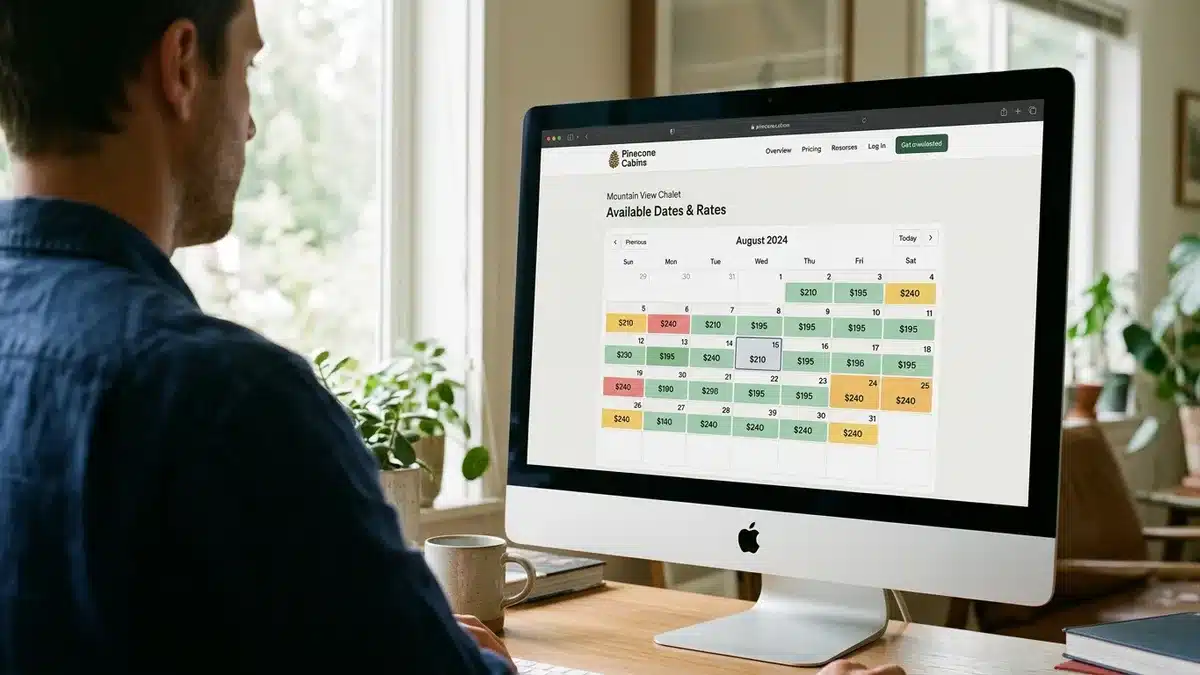

To set pricing on your vacation rental direct booking site and stay competitive, start from your comparable listings’ total checkout price, set a base rate and a profit-protecting floor, then keep your direct total equal to or slightly below what guests see on Airbnb or Vrbo. Sync rates from your PMS so every channel stays consistent.
Key Takeaways
- Compare total checkout prices (nightly rate, cleaning fee, taxes, service fees), not nightly rates alone, when benchmarking your direct site against OTA listings.
- Build a base rate from your real costs and a floor rate that protects margin, then let demand, season, lead time and day of week move the price between floor and ceiling.
- Keep direct and OTA rates consistent; compete with perks and the absence of guest-side service fees, not by undercutting yourself into a margin problem.
- Seasonal tiers, weekly discounts and minimum-stay rules shape booking patterns; test each change against conversion and net revenue, not occupancy alone.
- Measure pricing changes using direct-site conversion, inquiry-to-booking rate, net revenue per available night and channel mix.
- Boostly Connect syncs your PMS rates and availability to a done-for-you WordPress direct booking site, so the price a guest sees on your site always matches the price you set.
Introduction
If you are paying an OTA 15 to 20 percent on every reservation, pricing your own site is the lever that decides whether a direct booking is actually worth more to you. Price too high and guests close the tab and rebook on Airbnb. Price too low and you give away the margin you built the site to protect.
At Boostly Connect, we have watched more than 2,000 hosts across 25 countries work through this exact question. The pattern is consistent: hosts who treat pricing as a routine with a floor, a ceiling and a review schedule outperform hosts who guess and adjust when they feel nervous.
This guide walks through benchmarking, base and floor rates, seasonal tiers, discounts, direct-booking incentives and how to tell whether a change worked. As of 2026, U.S. short-term-rental supply keeps growing while demand growth is projected to moderate from 4.7% in 2026 to 4.1%. Guests have more choice, so price comparison matters more than it did a year ago.
What Factors Determine Vacation Rental Nightly Rates?
Vacation rental nightly rates are determined by local demand, seasonality, the rates of comparable properties, local events, booking lead time, day of week and your own operating costs. Your property’s amenities, photos, review history and booking restrictions also shift what guests will pay compared with the nearest competing listing.
Demand-side factors you cannot control
Seasonality, local events, school holidays and competing supply set the ceiling on what the market will bear. U.S. occupancy is forecast to average 57.4% in 2026, and RevPAR is forecast to rise 2.9%, so you should expect rates to carry more of the revenue growth than volume.
Supply-side factors you control
You control your cost floor, minimum stays, cleaning fee, discount structure and how quickly you react to slow booking pace. Lead time matters too: dates 60 days out and dates 7 days out should not carry the same price logic. A weekend 60 days away can hold its rate while you wait for demand, but an unsold weekend one week away usually needs a trimmed price or a lower minimum stay.
We built Boostly Connect so the rates you control inside your PMS flow straight to your own website through live sync. Whatever you decide in the pricing layer is what the guest sees at checkout, with no manual re-entry in between.

How Do You Benchmark Against Comparable Listings?
Benchmarking means selecting a small set of genuinely comparable properties, usually five to eight, and recording their total prices across several date windows. Comparable means similar location, size, bedroom count, amenities and review quality, not simply the same neighborhood.
Choose a real comp set
Most pricing guides tell you to pick competitors but not how. Match on bedrooms and sleeping capacity first, then on location and standout amenities such as a hot tub or waterfront access. Then adjust for review count and photo quality: a listing with a handful of reviews should not anchor your rate. Keep the comp list in a simple spreadsheet with one row per listing and one column per date window, so you can see the gaps at a glance.
Compare the checkout total, not the nightly rate
This is the gap most content skips. Build the apples-to-apples total for the same dates on each channel: nightly rate, cleaning fee, taxes where applicable, any guest service fee the OTA adds and the cancellation terms attached. A listing that looks cheaper per night can cost more at checkout, and your direct site can win on total even when the nightly number is higher.
Check three windows for every comp: next 14 to 30 days, 60 to 90 days out, and a peak weekend. Rates and restrictions behave differently in each. For public market context, you can browse the RentCast rental market search tool as a starting reference.
How Do Hosts Calculate a Profitable Base Rate and Floor?
A base rate is your standard nightly price in a normal demand period, and a floor rate is the lowest price you will accept without losing money. Calculate both from real costs: mortgage or rent, utilities, cleaning, supplies, payment processing, insurance and the profit you want per booked night.
Work backward from costs
- Add your fixed monthly costs and your per-stay costs (cleaning, linens, consumables).
- Divide per-stay costs by your average length of stay to get a per-night cost.
- Add direct-channel payment processing costs, which are lower than OTA commission but not zero.
- Add your target profit per night. The result is your floor.
- Set your base rate above the floor using your comp set as the guide.
- Set a ceiling for peak dates, then recalculate all three whenever your costs change.
Few guides tell you to recalculate. Cleaning costs, insurance and average stay length drift, and a floor that was safe last year can be a loss-maker in 2026. Discount only as far as the floor allows, even when the calendar looks slow.
Our clients get this ready to use: Boostly Connect pulls the rates you maintain in Hospitable, Hostfully, Lodgify, Guesty or any of the 27 supported PMS integrations, so your floor and ceiling logic lives in one place and the site follows it.
How Should Vacation Rental Rates Change by Season?
Seasonal pricing divides the year into peak, shoulder and off-peak tiers, each with its own base rate. Practitioner guidance suggests a variation of roughly 25 to 40 percent between tiers, but that is a starting framework, not a market rule, so test it against your own booking pace.
How to build your tiers
Look at your last full year of bookings and mark the weeks where you sold out early and the weeks that sold late. Then mark the weeks that stayed empty. Those groups become peak, shoulder and off-peak. Holiday windows such as Christmas and New Year may justify a 5 to 7 night minimum stay.
Setting seasonal rates in your software
In most PMS tools you create rate periods with a date range, nightly price and minimum stay. Set the periods once, then layer day-of-week adjustments on top. Weekend nights typically carry a premium, and mid-week nights in off-peak months can drop 15 to 20 percent below peak rates, according to ATLAS by AvantStay (June 2026).
Because Boostly Connect syncs directly from your PMS, a seasonal tier you set on Monday is live on your direct site the same day. That removes the lag where the OTA shows a new rate and your own site still shows the old one.
How Do You Keep Direct Pricing Competitive With Airbnb and Vrbo?
You stay competitive by keeping your direct total at or slightly below the OTA total for identical dates and by adding direct-only value, not by running a permanently lower nightly rate. Rate parity across channels protects your relationships with guests and avoids confusing anyone who compares the two.
Why guests still book direct
Guests who compare notice the guest-side service fee the OTA adds at checkout. Your direct site does not have to add an equivalent fee, so an identical nightly rate can already produce a lower total. That is a legitimate, honest advantage.
Direct perks that cost less than a discount
Early check-in, late checkout, a welcome basket or a flexible cancellation window can persuade a guest without cutting your rate. Hosts also offer a best-rate guarantee. Some operators who move to direct report higher daily rates, but that is a vendor-reported figure with no stated methodology, so do not budget around it.
Direct-booking discount advice conflicts across the industry, so test instead of copying. Start with a small incentive, watch conversion and margin for a month, then raise or remove it. A discount that lifts conversion but erodes net revenue per night is a loss.
We designed the Boostly Connect website with discount codes, gift vouchers and direct-only offers built in, so you can run these tests without a developer.
How Do Discounts, Minimum Stays and Fees Affect Your Price?
Length-of-stay discounts, minimum-night rules and fee structure change the effective price a guest pays and the kind of booking you attract. They often matter more than a nightly rate change because they shape which dates fill and how many turnovers you absorb.
Weekly and monthly discounts
Booking 7 or more nights often triggers a weekly discount, according to ATLAS by AvantStay (June 2026). Published practitioner ranges vary widely, from about 10 to 15 percent for weekly stays to 20 to 30 percent for monthly stays in the off-season. Treat those as test starting points and confirm against your cost per turnover.
Orphan nights and calendar shape
A single open night trapped between two bookings is worth less than an open night with free dates on both sides, because few guests can book a stay that spans the gap. Lower the minimum stay on those gaps or discount them modestly rather than leaving them empty.
Cleaning fees and the total price
Guests compare the final number. A low nightly rate with a large cleaning fee can feel like a trick, and a fee that is too low forces you to subsidize turnovers. Decide where your cost recovery sits and show it clearly.

What Is the Best Dynamic Pricing Approach for Vacation Rentals?
Dynamic pricing is the practice of adjusting nightly rates automatically based on demand, seasonality, local events, competitor rates and booking lead time. It works best when you give the tool a floor and ceiling and review its output weekly rather than trusting it blindly.
What the data says
According to AvantStay (June 2026), dynamic pricing helped hosts achieve a 46% increase in total bookings per listing. That is a single operator’s reported result, so use it as a signal that rate flexibility matters rather than a promise.
Choosing a tool
Several dedicated pricing platforms exist, and review sites such as Capterra and G2 let you read verified user feedback before you commit. Whatever you choose, confirm it connects to your PMS, because that is the connection that feeds your direct site. For background on demand-based pricing, the guide to real-time demand pricing is a useful read.
Boostly Connect does not replace your pricing tool. We sit downstream of it: whatever your PMS publishes, our live sync shows on your site. See our breakdown of real-time pricing on a vacation rental website for how that connection works.
How Do You Know Whether a Pricing Change Worked?
A pricing change worked if it improved net revenue per available night without hurting conversion or channel mix. Occupancy and nightly rate alone mislead you, because a discount can raise occupancy while lowering profit.
Metrics to track
| Metric | What it tells you | Warning sign |
|---|---|---|
| Direct-site conversion rate | Whether visitors accept your price | Traffic steady, bookings falling |
| Inquiry-to-booking rate | Whether price or terms stall decisions | Many inquiries, few bookings |
| Net revenue per available night | Real profit after fees and discounts | Occupancy up, revenue flat |
| Channel mix | Share of bookings coming direct | Repeat guests returning to OTAs |
| Booking pickup (last 7 days) | Which future dates are selling | Dates 60 days out not moving |
A weekly pricing routine
- Review booking pickup from the last seven days and note which future dates sold.
- Check open gaps in the next 14 to 30 days and 60 to 90 days.
- Compare your total price with your comp set for the same dates.
- Change one variable at a time so you can attribute the result.
- Record the outcome and revisit in two to four weeks.
The Boostly Connect reporting dashboard tracks direct booking revenue and ROI in one place, so you are not reconciling a PMS export, a spreadsheet and a bank statement to answer these questions.
What Mistakes Do Hosts Make When Pricing a Direct Booking Site?
The most common pricing mistakes are undercutting the OTA on every date, letting direct and OTA rates drift apart, ignoring the checkout total and never recalculating the floor. Each one quietly erodes the margin the direct channel exists to protect.
- Permanent deep discounts. A large standing discount trains guests to expect it and gives away the commission you saved.
- Manual rate updates. Editing prices by hand on a website plugin creates sync errors and double bookings. We built our integration to remove that failure point.
- Judging by occupancy alone. Full calendars at a rate below your floor are a loss with good optics.
- Forgetting repeat guests. Returning guests who rebook on an OTA cost you the commission again. Our guide on how to re-engage past vacation rental guests covers moving them to your site.
You do not need to abandon Airbnb to fix this. Most hosts run both channels and send repeat guests to their own site. Our walkthrough on balancing OTA and direct bookings explains the split.
What Does Good Direct Booking Pricing Look Like in Practice?
Good direct booking pricing means a consistent rate across channels, a transparent total, a tested incentive and a regular review cycle. In our client results, hosts who treat pricing and marketing as one system reach strong direct shares over time.
One property owner in our case studies grew direct bookings from 0% to 8% in the first 12 months after launching a Boostly website, then reached 55% as strategies compounded over later years. Another host reached 40% direct bookings after launch and landed a single £6,000 booking through the site. Neither result came from a deep permanent discount; both came from a site that converted visitors and a pricing approach that held margin.
Our clients reach 65% direct bookings within 12 months, or we work for free until they do. Pricing is one piece of that. The site, the CRM and the twice-weekly coaching calls cover the rest. For the traffic side of the equation, read how to get more direct bookings for your vacation rental.

Frequently Asked Questions
How do I set pricing on my vacation rental direct booking site?
Benchmark five to eight comparable listings by checkout total, calculate a base rate and a cost-based floor, then keep your direct total equal to or slightly below the OTA total. Sync rates from your PMS so they never drift.
Should my direct booking price be lower than Airbnb?
Equal or slightly lower works best. Guests often pay a service fee on OTAs, so matching the nightly rate can already give them a lower total. Add perks like late checkout instead of a deep standing discount.
How do I set seasonal rates in vacation rental software?
Create rate periods in your PMS with a date range, nightly price and minimum stay for peak, shoulder and off-peak seasons. Add day-of-week adjustments on top, then review pickup against your calendar monthly.
What is the best dynamic pricing software for vacation rentals?
The best choice is the one that connects to your PMS and lets you set a floor and ceiling. Read verified reviews before committing, and test it on one or two listings first. Boostly Connect then carries those rates to your direct site.
How can I reduce manual work and automate my vacation rental operations?
Connect your PMS, website and CRM so rates, availability and guest records sync automatically. Boostly Connect links all three, removing repeated data entry and the sync errors that come from separate plugins.
How do I build a direct booking website that stays synced with my PMS availability and rates?
Use a platform with native PMS integration rather than a manual plugin. Boostly Connect syncs your existing PMS to a WordPress site in under 20 minutes, with live availability and real-time pricing, and no developer needed.
What is the best way to process payments for direct vacation rental bookings?
Use a payment processor that is PCI DSS compliant and show trust signals at checkout, such as a security lock and a clear deposit policy. Include processing fees when you calculate your floor rate.
How often should I change my vacation rental prices?
Review weekly, and change one variable at a time. Dates within 60 days deserve the closest attention, while dates further out can follow your seasonal tiers.
Conclusion: How Do I Set Pricing to Stay Competitive in 2026?
To set pricing on your vacation rental direct booking site and stay competitive in 2026, benchmark the full checkout total, protect a cost-based floor, keep rates consistent across channels and test every incentive against net revenue. The commission you save is the margin that pays for a smarter offer.
Supply keeps growing while demand growth cools, so the hosts who win will price deliberately and review often. Book a demo of Boostly Connect to see your own PMS rates flow to a direct booking site in under 20 minutes, with no developer and no upfront cost for your first 10 listings.