

Vacation rentals SEO is the practice of optimizing your own booking website, not your Airbnb or Vrbo listing, so it ranks in Google search results for terms guests actually type when planning a trip. It matters in 2026 because OTA algorithms control your visibility on their platforms, while a properly optimized website puts that control back in your hands.
Key Takeaways
- Vacation rentals SEO refers to optimizing a host’s own website, not an Airbnb or Vrbo listing, which operate on closed algorithms hosts cannot fully influence.
- Off-peak and mid-week bookings can drop 15 to 20 percent below peak rates, according to AirDNA’s research on real-time travel demand, which is exactly the gap a well-ranked website can help fill with direct search traffic.
- Demand for short-term rentals is projected to grow 4.1 percent year-over-year in 2026, per AirDNA’s 2026 Outlook Report, meaning more searchers are hunting for properties directly, not just through OTA apps.
- Vacation rentals earn a Net Promoter Score of 50.9 compared to 41.8 for hotels, according to a 2026 Alchemer study, showing guest loyalty that SEO content can convert into repeat direct traffic.
- A site with zero on-page SEO foundation (missing property schema, thin content, no blog) rarely ranks regardless of how good the property photos are.
- Boostly Connect ships direct booking websites with SEO-ready property pages and blog infrastructure built in from day one, so hosts do not need to hire a separate SEO contractor to compete for organic traffic.
If you have ever typed your own vacation rental into Google and found nothing but your Airbnb listing on page one, you already understand the problem. Airbnb, Vrbo, and Booking.com own the search real estate for your property name because most hosts never built anything else worth ranking. That is not a minor inconvenience. It is the reason every guest who wants to rebook has to go back through the OTA and hand over another 15 to 20 percent commission.
Vacation rentals SEO in 2026 looks different than it did five years ago. Google’s AI Overviews now answer a chunk of travel queries before a searcher clicks anything, and metasearch integrations like Google Vacation Rentals have opened new discovery paths outside the traditional OTA apps. At Boostly Connect, we’ve watched thousands of hosts make the exact same discovery: their OTA listing was never going to be their SEO asset. Their own website was always the missing piece.
This guide covers what actually moves the needle for a short-term rental website in 2026: on-page fundamentals, technical setup that most hosts skip, content strategy that keeps a site relevant year-round, and the tradeoffs between doing it yourself and building on infrastructure designed for this exact job.
What Makes Vacation Rentals SEO Different From Regular Local SEO?
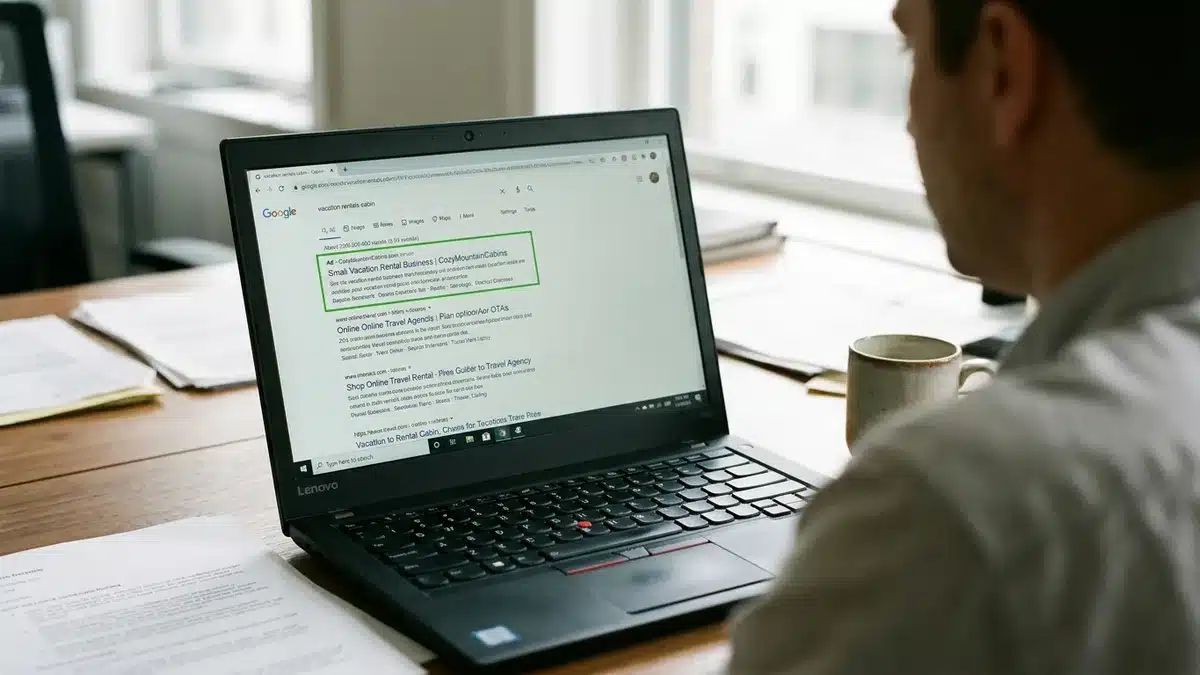
Vacation rentals SEO differs from standard local SEO because the searcher is planning travel to a place they do not live, not looking for a nearby business. A restaurant optimizes for “near me” searches from local traffic. A vacation rental optimizes for destination plus property-type searches from people who live hundreds or thousands of miles away.
This changes almost everything about keyword strategy. Instead of targeting “cabin rental near me,” you are targeting “pet-friendly cabin rental Gatlinburg” or “3 bedroom lakefront rental Lake Tahoe.” Specifically, the searcher’s intent sits somewhere between navigational (they already know they want a rental in that destination) and commercial (they are comparing several options before booking).
As a result, your website needs destination-specific landing pages, not just a generic homepage describing your property. Google rewards pages that map cleanly to a search query. A single page trying to rank for every destination and amenity combination will lose to a competitor with dedicated pages for each one.
This is also where most self-built vacation rental websites fail. Hosts build one page, add a booking widget, and wonder why nothing ranks. Boostly Connect’s website builds include a blog structure and SEO-optimized property pages specifically so hosts have somewhere to house this destination and amenity content, rather than cramming it all onto a single homepage that Google cannot parse cleanly.
How Do You Set Up the Technical SEO Foundation?
Technical SEO for a vacation rental website means the structural elements that let Google crawl, index, and understand your site correctly: fast page speed, mobile responsiveness, clean URL structure, and schema markup identifying your pages as lodging content. Without these, even great written content struggles to rank.
Mobile responsiveness is not optional in 2026. Most travel research happens on a phone, and Google indexes the mobile version of your site as the primary version for ranking purposes. If your booking calendar breaks or loads slowly on mobile, you lose both rankings and bookings simultaneously.
Schema markup, specifically the LodgingBusiness or Vacation Rental schema types, tells search engines what kind of page they are looking at. This helps your listing appear with rich results, such as star ratings or price ranges, directly in search results. Most DIY website builders do not implement this correctly, which is a quiet but significant ranking disadvantage.
Site speed matters because a live pricing and availability sync pulling directly from your property management system, whether that is Hospitable, Guesty, Lodgify, Hostfully, or OwnerRez, needs to load fast without dragging down the whole page. This is exactly the kind of plumbing Boostly Connect handles under the hood: your PMS syncs to your WordPress site in under 20 minutes, with live availability and pricing built for speed rather than bolted on as an afterthought plugin.
What Content Actually Ranks for a Vacation Rental Website?
Content that ranks for vacation rental websites combines destination guides, property-specific landing pages, and seasonal blog posts answering the exact questions travelers search before booking. Generic “welcome to our rental” copy rarely ranks for anything competitive.
Destination guides work because they capture searchers earlier in their planning process, before they have picked a specific property. A guide titled “Best time to visit [destination] with a large group” can rank for informational searches and then funnel that reader toward your booking page. This is a top-of-funnel play, but it compounds over time as more pages accumulate authority.
Property-specific pages need unique descriptions, not templated copy repeated across every listing. Google penalizes duplicate or thin content, and a page that reads identically to thousands of other rental listings gives search engines no reason to rank it above a competitor.
Seasonal and evergreen blog content extends your site’s relevance beyond the property pages themselves. This is where our guide on vacation rental SEO tips that actually rank in 2026 goes deeper into keyword research specifics, and where our piece on increasing direct bookings with content marketing covers the editorial calendar side of things. Notably, hosts who treat their blog as a permanent asset, rather than a one-time launch task, see compounding traffic gains rather than a single spike.
How Does OTA Ranking Compare to Owned Website Ranking?
OTA ranking and owned website ranking operate on completely different systems, and understanding the difference is the first step toward building a real direct booking channel. An Airbnb search ranking is controlled entirely by Airbnb’s internal algorithm, which weighs response rate, review recency, and booking conversion, factors you can influence but never fully control. A Google ranking for your own site is influenced by SEO fundamentals you own outright.
The table below breaks down the practical differences hosts need to understand when deciding where to invest their marketing time.
| Factor | OTA Listing Ranking (Airbnb, Vrbo) | Owned Website Ranking (Google/SEO) |
|---|---|---|
| Who controls the algorithm | Airbnb, Vrbo, or Booking.com internally | You, through on-page SEO and content decisions |
| Guest data ownership | Retained by the platform for its own remarketing | Captured into your own CRM when you control the site |
| Commission on resulting bookings | 15 to 20 percent per booking | None on the booking itself |
| Ranking factors you influence | Response rate, reviews, pricing competitiveness | Page speed, content quality, schema, backlinks |
| Longevity of ranking gains | Resets with algorithm changes and policy updates | Compounds over time as domain authority builds |
| Repeat guest capture | Guest often returns through the OTA app | Guest can rebook directly, no platform in the middle |
This is the exact tension we built Boostly Connect to resolve. You do not have to choose between the two channels. Most hosts run both simultaneously and use their direct booking website specifically to capture repeat guests and organic search traffic that the OTA never sends their way in the first place.
What Role Does Google Vacation Rentals Play in 2026?
Google Vacation Rentals is a metasearch integration that displays properties directly within Google’s travel search results, alongside organic search listings and paid ads. It gives independently listed rentals a discovery surface beyond traditional organic ranking, competing directly with OTA listings inside the same search results page.
For hosts without a technical team, connecting to Google Vacation Rentals independently can be a heavy lift involving feed formatting and ongoing data maintenance. As a result, most solo hosts skip it entirely and rely solely on OTA visibility, leaving an entire discovery channel untapped.
Boostly Connect integrates with Google Vacation Rentals and metasearch channels as part of the connected PMS-to-website setup, giving properties an additional discovery surface without requiring the host to manage a separate feed manually. This is one of the clearer examples of why “just build a website” undersells what actually needs to happen behind the scenes for a rental site to compete for search visibility in 2026.
If your current site is not showing up anywhere in Google’s travel results, the gap is usually structural rather than content-related. Our article on why a vacation rental website isn’t ranking walks through the eight most common causes we see across client audits, and it is worth checking before assuming your content needs a rewrite.
Deep Dive: Why Do Most Vacation Rental Websites Never Rank at All?
The most common reason a vacation rental website never ranks is that it was built as a digital brochure, not a search asset. A five-page site with a hero image, an amenities list, and a contact form gives Google almost nothing to index or rank. There is no content depth, no internal linking structure, and usually no blog at all.
We see this pattern constantly at Boostly Connect: a host pays a freelancer or uses a generic drag-and-drop builder, launches the site, and never touches it again. Six months later they conclude “SEO doesn’t work for vacation rentals” when the real issue is that nothing was ever built to rank in the first place.
Backlinks matter here too, and they are the piece almost every independent host ignores. A domain with zero external links pointing to it has almost no authority signal for Google to work with, regardless of on-page quality. Local tourism board directories, guest blog mentions, and partnerships with nearby businesses are realistic backlink sources for a vacation rental site, more realistic than trying to compete for links the way an ecommerce brand would.
The other overlooked factor is update frequency. A static site that has not changed in two years signals staleness to search engines. Sites with an active blog, updated seasonal content, and fresh property descriptions get crawled more often and treated as more relevant. This is precisely why Boostly Connect’s platform includes built-in blog infrastructure rather than treating content as a bolt-on feature you have to source separately.
One case from our own client base illustrates the upside of getting this right. A UK-based serviced accommodation host, working through significant property renovation costs, launched a Boostly website and grew direct bookings to 40 percent of total reservations, including a single booking worth £6,000. That growth did not come from luck. It came from having a site actually structured to capture search demand instead of sitting dormant as a digital business card.

How Should You Prioritize Your SEO Efforts as a Host?
Prioritizing vacation rentals SEO effort means starting with technical fixes before content, and content before backlink outreach, because each layer depends on the one beneath it. A beautifully written blog post on a slow, unindexed site will not rank no matter how good the writing is.
Here is the order we recommend to hosts starting from zero:
- Confirm your site is mobile responsive and loads quickly, testing on an actual phone, not just a desktop preview.
- Add schema markup identifying your pages as lodging or vacation rental content so search engines categorize them correctly.
- Build unique, specific property pages for each listing rather than reusing templated descriptions across multiple units.
- Launch a blog with destination guides and seasonal content targeting the questions your past guests actually asked before booking.
- Pursue realistic backlinks through local tourism directories, partnerships with nearby attractions, and guest posting where relevant.
- Track your direct booking traffic and revenue separately from OTA traffic so you can see what your SEO work is actually producing.
Common mistakes worth naming directly: hosts skip the technical foundation and jump straight to blogging, hosts write property descriptions once and never revisit them for two years, and hosts assume a single listing page can rank for every destination-plus-amenity combination a guest might search. All three mistakes are fixable, but they compound if left alone.
The tradeoff to understand honestly: SEO is not fast. If you need bookings next week, paid ads or OTA visibility will outperform SEO in the short term. But SEO is the only channel that compounds without an ongoing spend increase, which is exactly why it is worth the setup investment even for a single-property owner. This is also where automating the mechanical parts of SEO, syncing pricing, structuring pages, connecting to metasearch, matters more than most hosts realize. Reducing that manual load is a big part of what we cover in our guide to reducing manual work in a vacation rental business.
What About Guest Retention and Repeat Search Traffic?
Guest retention through SEO means capturing returning visitors who search for your property by name directly, rather than losing them back to the OTA where they first booked. A vacation rental with strong guest satisfaction naturally generates branded searches, people typing your property’s actual name into Google, and that traffic is worthless if it lands on nothing but your Airbnb listing.
Vacation rentals as a category earn a Net Promoter Score of 50.9 compared to 41.8 for hotels, according to a 2026 Alchemer study, which tells you something important: guests who stay in short-term rentals are more likely to return and recommend the property than hotel guests are. That loyalty is wasted if there is no owned website for those branded searches to land on.
Many vacation rentals see repeat booking rates between 10 and 25 percent depending on market and property type, based on Hostex data. Every one of those repeat guests who rebooks through Airbnb instead of a direct site represents a second, third, or fourth commission payment on a relationship you already earned once. Our guide on how to re-engage past vacation rental guests in 2026 covers the email and CRM side of closing that gap.
Boostly Connect captures every direct booking guest automatically into a CRM, so the contact data from a search-driven booking stays with you rather than disappearing back into the OTA’s remarketing system. That is the difference between a one-time SEO win and a compounding guest relationship you can market to again next season.
Data and Evidence: What Do the Numbers Actually Say?
The numbers behind vacation rentals SEO point toward growing search demand and a widening loyalty gap that favors owned websites. Demand for short-term rentals is projected to grow 4.1 percent year-over-year in 2026, according to AirDNA’s 2026 Outlook Report, meaning the pool of searchers actively looking for rental properties is expanding, not shrinking.
At the same time, off-peak and mid-week bookings can run 15 to 20 percent below peak rates, per AirDNA’s research on real-time travel demand. A well-optimized website that ranks for shoulder-season and mid-week searches gives you a direct channel to fill those lower-demand periods without relying solely on OTA visibility during slow stretches, which is when OTA algorithms tend to favor properties willing to discount most aggressively.
These figures matter for one reason: they show the search demand exists. The question is whether it lands on your website or someone else’s OTA listing. Building the technical and content foundation to capture that traffic is the work vacation rentals SEO actually describes, and it is work most independent hosts underinvest in relative to how much they spend on OTA-facing effort like photography and review management.
Frequently Asked Questions
Does SEO actually matter if most of my bookings come through Airbnb?
Yes, because SEO builds a channel Airbnb does not control and cannot take away in a policy change. Even hosts who keep the majority of their bookings on OTAs benefit from an owned website that captures branded searches and repeat guests who would otherwise rebook through the platform again.
How long does it take for vacation rentals SEO to show results?
SEO results typically build gradually over months rather than days, since search engines need time to crawl, index, and rank new content. Technical fixes like schema markup and mobile speed can show impact faster than content-driven rankings, which depend on accumulated authority and fresh, ongoing publishing.
Will focusing on my own website hurt my Airbnb search ranking?
No. Building a direct booking website has no bearing on your Airbnb algorithm ranking, which is based on factors like response rate, reviews, and booking conversion within that platform. Most hosts run both channels simultaneously without any conflict.
Do I need a developer to set up SEO for my vacation rental website?
Not necessarily. Platforms like Boostly Connect build SEO-optimized property pages and schema markup into the website setup itself, syncing to your existing PMS in under 20 minutes without requiring coding knowledge or a developer.
What is the biggest SEO mistake independent hosts make?
The most common mistake is building a static, brochure-style website with no blog, no unique property page content, and no ongoing updates. Search engines reward sites that publish fresh, specific content regularly, and a site that has not changed in years signals irrelevance rather than authority.
Which property management systems work best for a direct booking SEO strategy?
Any PMS with reliable API access works, and Boostly Connect currently supports 8 integrations including Hospitable, Guesty, Lodgify, Hostfully, and OwnerRez. The key requirement is a live sync between your PMS and website so pricing and availability data stays accurate for both guests and search engines indexing your pages.
Can vacation rentals SEO help with repeat bookings, not just new guests?
Yes, and this is often the most overlooked benefit. Guests who had a great stay frequently search for the property by name later, and if that search lands on your own site instead of an OTA listing, you capture the rebooking without paying a second commission on a guest relationship you already earned.
Conclusion: Where Should You Start With Vacation Rentals SEO?
Vacation rentals SEO comes down to a simple reality: search demand for short-term rentals is growing, guest loyalty in this category outpaces hotels, and almost none of that advantage helps you if your only online presence lives inside an OTA algorithm you do not control. The hosts who capture this traffic are the ones who built a real website, not a placeholder.
Getting there does not require a developer, a separate SEO agency, or months of guesswork. It requires connecting the PMS you already use to a website built to rank and convert from day one, which is exactly what Boostly Connect is built to do in under 20 minutes.

If OTA commissions are quietly eating into your margin every month while your own website sits invisible in search results, book a demo to see exactly how Boostly Connect’s SEO-ready website and PMS sync work together out of the box.