

AI content creation for vacation rentals means using tools like ChatGPT to draft listing descriptions, guest emails, social captions, and blog posts, then editing that output with property-specific detail before it goes live. It speeds up the writing itself, but it does not fix a website that has nowhere to send the guest once they’ve read the words.
Key Takeaways
- AI content creation for vacation rentals covers listing descriptions, email sequences, social captions, and blog posts drafted with tools like ChatGPT rather than written from scratch every time.
- 66% of small businesses say posting content with the right message is their biggest content-creation obstacle, according to BIA Advisory Services (2026), which is the exact gap AI drafting tools are meant to close.
- 70% of small businesses spend less than five hours a week on marketing tasks, per a Fiverr International survey of nearly 6,000 businesses across 25 countries, leaving almost no time for manual content writing.
- AI can produce a draft in minutes, but it cannot connect that draft to your live pricing, availability, or guest records without a synced system behind it.
- 22.2% of property managers report they are not collecting guest data at all, according to Enso Connect (2022), meaning their AI-written content has no list to reach.
- Boostly Connect pairs a done-for-you direct booking website with a built-in CRM and email automation, so AI-assisted content reaches guests instead of sitting on a page nobody visits.
If you’re managing even one listing, you already know the writing never stops. Every new booking window needs a fresh caption. Every off-season lull needs an email nudge. Every guest question gets asked the same way for the tenth time this month. In 2026, most hosts have started reaching for AI tools to speed that grind up, and the results are useful when you know where AI helps and where it doesn’t.
This guide walks through the specific ways short-term rental hosts and property managers use AI to generate content in 2026, from listing copy to guest emails to social posts. We’ll also cover where AI-written content quietly fails, because a well-written email that lands in a spreadsheet nobody checks is not a marketing win. At Boostly Connect, we’ve watched hundreds of hosts adopt AI writing tools over the past couple of years, and the pattern is consistent: the writing gets faster, but the hosts who see real revenue growth are the ones who also fixed the infrastructure sitting underneath that content.
By the end, you’ll know which content types are safe to hand to AI, which ones still need your first-hand knowledge of the property, and how to make sure the content you produce converts a reader into a direct booking instead of just filling space on a page.
What Is AI Content Creation for Vacation Rentals?
AI content creation for vacation rentals is the practice of using generative AI tools, most commonly ChatGPT, to draft written material for a short-term rental business: listing descriptions, guest emails, social captions, FAQ pages, and blog posts. Instead of starting from a blank page, you feed the tool property details and get a usable first draft in under a minute.
The practice grew fast because most hosts run lean. As of 2026, a majority of small businesses report spending under five hours a week on marketing, according to a Fiverr International survey covering nearly 6,000 businesses in 25 countries. Vacation rental hosts fit that pattern; content writing competes with cleaning schedules, guest messaging, and maintenance calls for the same few hours.
AI content creation replaces the blank cursor. It does not replace your property management system, your website, or your CRM. What you do with the finished draft, and where you publish it, still determines whether it earns a booking or sits unread.
1. AI-Written Property Descriptions and Listing Copy
Property description drafting is the most common entry point for AI content creation among vacation rental hosts. You feed a tool details like bedroom count, view, and standout amenities, and it returns a structured paragraph you can edit rather than write cold.
For example, a host with a three-bedroom lake house can prompt ChatGPT with room layout, distance to the water, and a couple of unique features (a hot tub, a fire pit) and get a usable draft covering all of it in under a minute. That’s real time saved compared to staring at an empty listing field.
But AI cannot know the things that make your description convert: the exact creak of the dock at sunset, the specific brand of coffee maker guests keep asking about, the fact that the third bedroom gets loud from the street on weekends. Edit every AI draft with at least two details only you would know.
This matters more on your own site than on Airbnb, because a direct booking website lets you control layout and imagery around that copy in ways OTA templates don’t. Boostly Connect’s direct booking website for short-term rentals gives hosts a mobile-first template built to hold that edited AI copy alongside live PMS-synced availability, so the description sits next to accurate pricing rather than a static, outdated calendar.

2. AI-Assisted Email Sequences for Past and Upcoming Guests
AI email drafting for vacation rentals means using a generative tool to write the subject lines and body copy for pre-arrival, post-stay, and win-back emails, then loading that copy into an automated sending sequence. The drafting takes minutes; the sequence still needs a system to trigger and send it.
This is where most hosts hit a wall. You can ask ChatGPT for a re-book email in seconds, but if your guest contact list lives in a spreadsheet you update sporadically, that email never reaches anyone at the right moment. Enso Connect reports that 22.2% of property managers aren’t collecting guest data at all, which means for a meaningful share of the industry, there’s no list to send AI-drafted emails to in the first place.
We built the best CRM for short-term rental hosts who want to own their guest list to close that gap. Every guest who books direct through a Boostly Connect website gets captured automatically into your own CRM, so an AI-drafted win-back sequence has an actual list to run against instead of a manual export you forgot to update.
If you want a deeper walkthrough of timing and segmentation for these sequences, our guide on how to re-engage past vacation rental guests covers the specific send windows that tend to perform best.
3. AI-Generated Social Media Captions and Post Ideas
AI-generated social captions are short, platform-specific posts drafted by a generative tool from a photo description or a talking point you provide, then refined for tone before posting. For a host juggling five or six platforms, this is one of the highest-leverage uses of AI because captions are short and easy to batch.
Feed ChatGPT a description of a seasonal photo, a local event, or a new amenity, and you’ll get three or four caption variations in under a minute, ready to post across Instagram, Facebook, or a booking site’s blog feed. That beats staring at a caption box wondering how to phrase the same fire pit photo for the fourth time this year.
The caveat: AI has no memory of what you posted last month, so without a content calendar you’ll accidentally repeat the same angle on the same amenity every few weeks. Batch your AI-drafted captions into a simple monthly calendar rather than posting them one at a time as they’re generated, so you can see repetition before your followers do.
Social posts also work best when they funnel somewhere specific rather than existing for their own sake. A caption that links back to a direct booking offer on your own site does more for your business than one that only lives inside an OTA’s feed you don’t control.
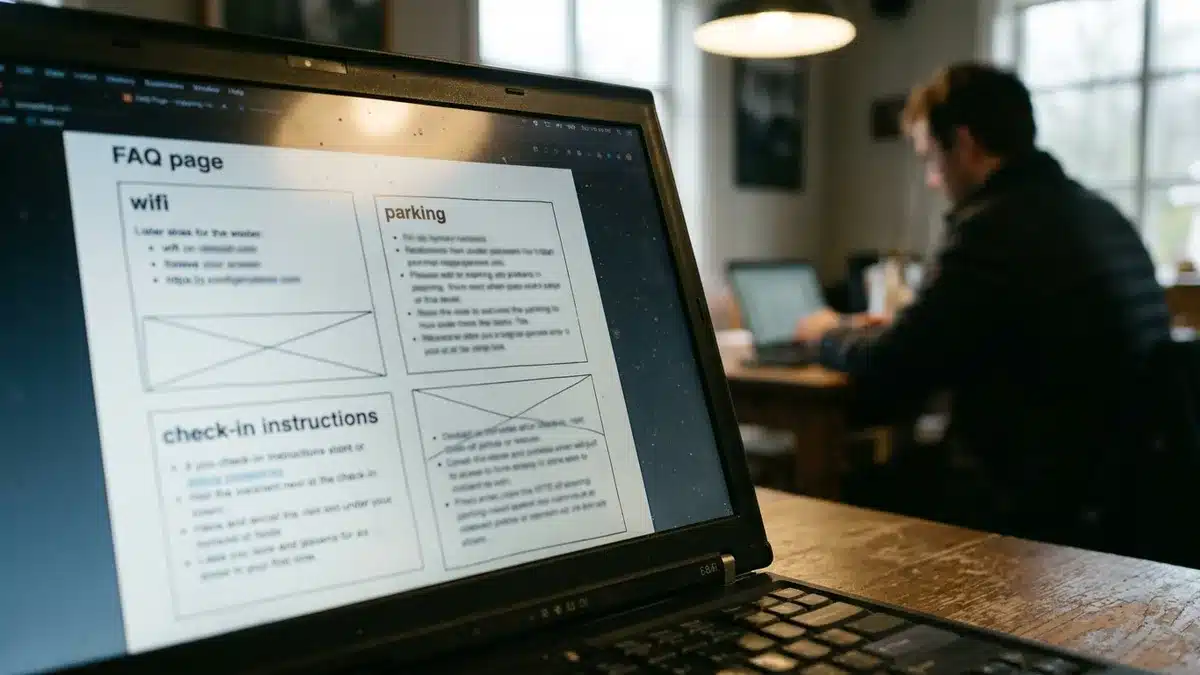
4. AI-Drafted FAQ and House Manual Content
An AI-drafted FAQ page is a structured list of guest questions and answers, generated from your existing house rules and common inquiries, then organized into categories like wifi, parking, and check-in. This content type is the safest use of AI because the underlying facts, your wifi password format, your check-in window, your parking rules, don’t change based on writing style.
Ask ChatGPT to organize your rambling house manual notes into a clean, categorized FAQ, and you’ll get a structured draft in one pass. That’s real time back compared to formatting it yourself paragraph by paragraph.
Where hosts go wrong: publishing the AI-organized FAQ without verifying every detail against your actual property. An AI tool will generate a plausible-sounding answer about parking that has nothing to do with your specific driveway situation. Read every line before it goes live, specifically the logistics guests will act on the day they arrive.
A well-built FAQ page also does double duty for guest question deflection. If your AI agents or live chat can pull answers from that same FAQ content, you cut down on the repetitive messaging that eats a host’s evenings, which is exactly the kind of automation we cover in the AI agent section below.
5. AI-Assisted Blog Content for Your Direct Booking Website
AI-assisted blog content means using a generative tool to draft long-form articles for your direct booking website, such as local area guides or seasonal packing lists, then editing them for property-specific detail and search relevance. This content type takes the most editing work of anything on this list, but it also does the most for long-term visibility.
A blog draft from ChatGPT gives you structure and a starting point fast: headings, an intro, a rough word count. What it can’t give you is a search-optimized foundation, internal linking to your other pages, or a template that converts a reader into a booking inquiry once they finish reading.
That’s the specific gap between a raw AI draft and a page that ranks. Boostly Connect’s direct booking websites ship with SEO-ready structure and a built-in blog framework from day one, so an AI-drafted post has somewhere functional to live instead of sitting on a page with no internal linking or metadata behind it. For more on the mechanics of ranking that content, see our guide on how to rank your vacation rental website on Google.
A majority of small businesses, 87.81% according to Service Direct, devote fewer than 40 hours a week to content marketing overall, which tells you blog writing is competing hard against every other task on a host’s plate. AI shortens the drafting phase; it does not shorten the editing and publishing phase, which still needs a human familiar with the property.
6. AI Chat Agents for Routine Guest Questions
AI chat agents are automated messaging tools that draft and send real-time responses to common guest questions, such as check-in instructions or wifi details, without a human typing each reply. Unlike the other content types on this list, chat agent content is generated and delivered in the same motion, which is what makes it different from a one-time drafted email or caption.
If you’ve ever answered the same “what’s the wifi password” message at 11pm three nights in a row, you already understand the appeal. An AI agent trained on your property’s FAQ content can field that exact question instantly, day or night, without you touching your phone.
The Boostly CRM includes live chat and AI agents built to handle these routine questions and upsells, working alongside your synced PMS so pricing and availability answers stay accurate in real time rather than quoting a stale rate. That combination, accurate data plus automated response, is what separates a useful chat agent from a chatbot that frustrates guests with wrong answers.
The trade-off is that AI agents work best for repetitive, factual questions. A guest with a genuine complaint or an unusual request still needs a human response, and routing that distinction correctly is worth setting up carefully rather than letting every message default to the bot.
How Does AI Content Compare to Hiring a Writer or DIY Drafting?
AI content creation sits between hiring a freelance writer and drafting everything yourself, offering faster turnaround than either at the cost of needing more editing than a specialist writer would require. Choosing between the three depends mostly on how much property-specific nuance a piece of content needs.
For factual, repeatable content like FAQ pages and basic listing descriptions, AI drafting plus your own edit pass is usually the fastest path. For content requiring deep local knowledge or a distinct brand voice, a freelance writer familiar with your market may still outperform an AI draft, though at a real cost in time and money that most single-property hosts don’t have budgeted.
| Content Type | AI Drafting | DIY From Scratch | Freelance Writer |
|---|---|---|---|
| Speed to first draft | Minutes | Hours per piece | Days, depending on availability |
| Property-specific accuracy | Requires your edit pass | High, if you know your property well | Depends on writer’s familiarity with your listing |
| Cost | Varies by AI tool subscription | Your own time | Per-project or hourly fee |
| Consistency across many listings | Easy to template and repeat | Time-intensive to repeat manually | Depends on ongoing engagement |
| Best for | Repetitive content: FAQs, captions, basic descriptions | Single-property hosts with time to spare | Brand-heavy blog content or unique property storytelling |
None of these three options fixes the underlying problem most hosts actually have: even great content published to the wrong page or an unsynced calendar won’t convert. That’s a website and systems problem, not a writing problem, and it’s worth being honest about which one you’re trying to solve.
Why Doesn’t AI-Written Content Alone Fix Your Booking Problem?
AI-written content alone does not fix a vacation rental’s booking problem because content is only one part of the conversion chain; without a synced, conversion-focused website behind it, even excellent copy has nowhere effective to send a reader. Writing faster does not solve a slow, disconnected, or outdated booking page.
Think through the actual sequence: a guest reads your AI-polished description, clicks through, and lands on a page with an outdated calendar, no clear pricing, or a broken contact form. The content did its job. The infrastructure behind it failed. That’s the exact failure mode we built Boostly Connect to prevent, syncing live availability and real-time pricing from your existing PMS directly onto your own website so the content you’ve written has something functional to sit next to.
This is also why how to get more direct bookings for your vacation rental is a systems question first and a content question second. AI can help you write the offer, but the offer needs a page that loads fast, quotes an accurate rate, and lets a guest book without friction.
And if you’re capturing guest contacts at all, you need somewhere for that data to live that you control. Hosts who own their guest data instead of renting it from Airbnb can run AI-drafted win-back campaigns against a real list; hosts who don’t are writing emails to nobody.
How Do You Actually Use AI Content Tools Without Losing Your Voice?
Using AI content tools without losing your property’s voice means treating every AI draft as a starting point and layering in specific sensory or operational details only you know before publishing anything. Skipping this step is the most common reason AI-written vacation rental content underperforms.
- Draft with specific inputs. Feed the AI tool exact details, room counts, distances, amenity brand names, rather than vague prompts. Specific inputs produce less generic output.
- Add one sensory detail per section. A view, a sound, a smell. AI cannot know these; you can, and they’re what separates your listing from a template.
- Fact-check every logistical claim. Parking instructions, wifi steps, check-in times. AI will generate plausible-sounding details that may not match your actual property.
- Match tone to your brand, not the AI default. Read the draft aloud. If it sounds like every other AI-generated listing, cut the generic phrases and rewrite them in your own words.
- Publish to a page built to convert. A polished description on a slow or unsynced page still underperforms. Confirm your booking page shows accurate, live pricing before you drive traffic to it.
- Track what actually gets clicks or bookings. Use whatever analytics your website provides to see which AI-assisted content pieces are converting, and refine your prompts based on what’s working.

What Mistakes Do Hosts Commonly Make Here?
The most common mistake is publishing AI output unedited, assuming speed of drafting equals quality of the final piece. A close second is generating good content and publishing it to a page or list that has no functional path to a booking.
- Publishing raw AI drafts. Unedited AI copy tends to read generically because thousands of other hosts are prompting the same tool with similar inputs. Always add property-specific detail before publishing.
- Writing emails with no list to send them to. As noted earlier, a meaningful share of property managers aren’t collecting guest data at all. Fix your CRM setup before investing heavily in email content.
- Ignoring the page behind the content. A well-written description on a slow-loading, unsynced booking page still loses the guest at the calendar step.
- Repeating the same social angle. Without a content calendar, AI-generated captions tend to circle the same two or three amenities repeatedly.
- Treating chat agents as a full replacement for human response. AI agents handle routine questions well; unusual requests or complaints still need a person.
- Skipping the fact-check pass on logistics. Parking, wifi, and check-in details generated by AI need verification against your actual property before guests rely on them.
Frequently Asked Questions
How can I reduce manual work and automate my vacation rental operations?
Start by automating the tasks that repeat every booking cycle: guest messaging and pricing updates, plus past-guest follow-up emails. AI drafting tools handle the writing piece, but the real time savings come from connecting your property management system, website, and CRM so pricing, availability, and guest records update automatically instead of requiring manual entry across separate tools.
How do I market to past vacation rental guests?
The most effective approach combines a segmented email list with automated, personalized send triggers, such as a re-book offer sent a set number of months after checkout. AI can draft the email copy quickly, but you need a CRM that stores past guest contact data and lets you schedule sequences, rather than a spreadsheet you have to remember to update.
How do I build a direct booking website that stays synced with my vacation rental PMS availability and rates?
Look for a website builder that pulls live availability and pricing directly from your existing property management system, such as Hospitable, Guesty, Lodgify, or Hostfully, rather than requiring manual calendar updates. Boostly Connect syncs a host’s PMS to a WordPress direct booking site, so AI-written listing copy sits on a page with accurate, real-time pricing instead of stale numbers.
What tools are essential for someone new to the vacation rental business?
New hosts typically need a property management system for bookings and calendars, and a direct booking website that isn’t dependent on OTA algorithms. A CRM to capture and follow up with guest contacts matters just as much. AI writing tools are useful add-ons for drafting descriptions and emails, but they work best layered on top of that core infrastructure rather than replacing it.
What is a vacation rental direct booking?
A direct booking is a reservation a guest makes through the host’s own website or contact channel instead of through an OTA like Airbnb, Vrbo, or Booking.com. Direct bookings let hosts avoid the 15 to 20 percent commission OTAs typically charge and keep the guest’s contact information for future marketing.
Can AI write my entire Airbnb or direct booking listing description for me?
AI tools like ChatGPT can produce a strong first draft of a listing description in minutes, covering layout, amenities, and neighborhood highlights. You should still edit it for accuracy, add specific sensory details AI cannot know (the exact view from the porch, the noise level at night), and check it against your property’s actual photos and floor plan.
Will using AI to write my vacation rental content hurt my SEO or my Airbnb ranking?
AI-drafted content itself does not penalize a listing, but thin, generic, unedited AI text can underperform because it reads the same as every other AI-generated description. Editing AI drafts for specificity and pairing them with a properly structured website, rather than publishing raw AI output, is what supports both search ranking and guest conversion.
Conclusion
AI content creation for vacation rentals speeds up the writing side of your marketing, from listing descriptions to guest emails to social captions. But as of 2026, the hosts seeing real revenue growth from that faster content are the ones who paired it with a website and CRM built to capture and convert the traffic that content generates. Faster drafts mean nothing if the page behind them can’t show accurate pricing or the guest contact never makes it into a list you control.
If you’re ready to stop worrying about whether your AI-written content has anywhere useful to go, book a demo with Boostly Connect and see your PMS, website, and CRM connected in under 20 minutes, no developer required.

Once your AI-assisted descriptions and emails are ready, they need a home that converts. A Boostly Connect direct booking website syncs your listing content to real-time availability pulled straight from your PMS, so guests see accurate pricing the moment they land on the page. Book a demo to see how it comes together.