

The Airbnb fees change replaces the old split model, where hosts paid about 3% and guests paid a separate 14.1% to 16.5% service fee, with a single host-paid fee that most hosts see at 15.5%. Your payout drops by the full fee, while guests see a lower checkout total unless you raise your listed price.
Key Takeaways
- The Airbnb fees change consolidates the service fee into one charge paid by the host. Airbnb says most hosts pay 15.5%, and some pay between 14% and 16% depending on circumstances.
- Before the change, hosts generally paid about 3% and guests paid a separate fee of 14.1% to 16.5% of the booking subtotal. The new fee comes out of your payout instead.
- The fee applies to the booking subtotal, which generally includes the nightly price plus host-added charges such as cleaning fees and pet fees. Taxes sit outside it.
- On a $700 subtotal with an unchanged listed price, payout falls from $679.00 to $591.50. Raising the subtotal to about $803.55 restores the old payout.
- Airbnb’s Help Center says hosts cannot switch back after migrating, so confirm your account status and rollout deadline before you change prices.
- Direct bookings carry no OTA commission. Boostly Connect syncs your PMS to a WordPress direct booking site in under 20 minutes and captures every direct guest into your own CRM.
If your payout statements started showing a larger deduction and no separate guest service line, you have seen the Airbnb fees change firsthand. Hosts connected through a PMS or channel manager such as Hospitable, Guesty, Lodgify, or OwnerRez moved to the host-only fee first, and the remaining hosts are migrating on the schedule shown in their own accounts. In 2026, this is the structure you plan around.
At Boostly Connect, we built our platform because OTA commissions of 15 to 20 percent on every reservation drain margin. This change makes that drain visible in your own payout. Our founder, Mark Simpson, recovered over $30,000 a year in platform fees himself, so we read fee announcements as operators first.
Below you will find the mechanics, worked payout numbers, rollout timing, pricing responses, and the one lever Airbnb cannot touch: bookings that never go through Airbnb.
What Changed in Airbnb’s Host Service Fee Structure?
Airbnb’s host-only fee is a single service fee, charged to the host and deducted from each payout, that replaces the earlier split between a host fee and a guest fee. Airbnb says most hosts pay 15.5% under the new model, while some typically pay between 14% and 16%, depending on circumstances.
How the old split worked
Hosts generally paid about 3% while guests paid a separate service fee of 14.1% to 16.5% of the booking subtotal. Guests saw that fee as its own line at checkout, so your nightly rate looked lower than the total they paid.
How the new fee works
Guests no longer see a separate Airbnb service line. The full fee comes out of your payout. The percentage applies to the booking subtotal, which generally includes the nightly price and host-added charges such as cleaning fees and pet fees. Taxes are outside the calculation.
In our experience working with vacation rental operators, the hosts least rattled by this announcement already had a direct booking site absorbing a large share of their reservations. That is the position Boostly Connect is designed to create.
What Does the Airbnb Fees Change Mean for Your Payout?
Under the host-only model, your payout equals the booking subtotal minus the fee, about 15.5% for most hosts, so every dollar of cleaning fee and add-on charges is reduced too. The table below uses an illustrative booking: three nights at $200 plus a $100 cleaning fee, which makes a $700 subtotal.
| Line item | Old split fee | New fee, same listed price | New fee, price raised to hold payout |
|---|---|---|---|
| Booking subtotal | $700.00 | $700.00 | $803.55 |
| Host fee | 3% = $21.00 | 15.5% = $108.50 | 15.5% = $124.55 |
| Guest service fee | 14.1% = $98.70 | None | None |
| Guest pays, before taxes | $798.70 | $700.00 | $803.55 |
| Host payout | $679.00 | $591.50 | $679.00 |
This example assumes the low end of the old guest fee range and excludes taxes. Treat it as arithmetic, not a forecast of your account.
At an unchanged price, you lose $87.50 on this stay. Raising the subtotal to $803.55 puts the guest about $4.85 above what they paid before. If the old guest fee had been 16.5%, the same raise would look cheaper to guests than it used to.
A shorter stay shows the same pattern. Take two nights at $150 plus a $60 cleaning fee, a $360 subtotal. Payout falls from $349.20 to $304.20. Holding $349.20 requires a subtotal near $413.25, against $410.76 under the old structure.
Running this across a year of reservations in a spreadsheet is tedious. The Boostly Connect reporting dashboard tracks direct booking revenue in one place, so you can compare it against what Airbnb deducted.
Why Is Airbnb Charging 15% and Why Do the Fees Feel So High?
Airbnb’s roughly 15% host fee, 15.5% for most hosts, is a platform commission that pays for listing exposure and payment handling, and it feels high because you now carry all of it in one visible deduction. Airbnb describes the change as a simplification of its service fees.
Add the old numbers together and a booking carried a combined fee of roughly 17.1% to 19.5% of the subtotal. On paper, the single 15.5% fee takes less in total. What changed is who sees the charge, and the answer is you, on every statement.
For context, Vrbo service fees run between 5 and 15 percent, according to ATLAS by AvantStay (June 2026), which puts Airbnb at or above the top of that band. Airbnb also lists more than 9 million properties worldwide, according to StayFi (2026), so it has little incentive to discount for any single host.
That 15 to 20 percent band is the commission range we built Boostly Connect to shrink. Our breakdown of how much Airbnb commission costs you per year shows how quickly it compounds across a full calendar.
Why Is Airbnb Changing My Prices?
When your Airbnb prices appear to change after a fee update, the cause is usually the removed guest fee line, a price adjustment made by you or your pricing tool, or a rate rule in your PMS, not a rewrite of your nightly rate by Airbnb. Check these four places first:
- The checkout breakdown: guests now see a different total because the separate service line is gone.
- Your pricing tool: dynamic pricing may have pushed new rates when the fee model changed.
- PMS rules: markups or channel-specific adjustments in Hospitable, Guesty, Lodgify, or OwnerRez can override earlier rates.
- Your own edits: a manual increase to cover the fee, which Airbnb’s price-adjustment guidance anticipates.
Boostly Connect syncs live availability and real-time pricing from your PMS to your direct site. Whatever rate your PMS holds shows up on both channels, so you can see any gap between Airbnb and direct at a glance.

Which Hosts and Reservations Does the Fee Change Affect, and When?
Airbnb moves hosts onto the single-fee structure in cohorts, and its Help Center says a host cannot switch back once migrated. Deadlines for price adjustments differ by region, and your account shows the exact date that applies to you.
| Host group | Published timing | What to do |
|---|---|---|
| Hosts outside the European Economic Area | Price adjustment deadline of September 15 | Confirm your status in your Airbnb account |
| Hosts in the European Economic Area or Switzerland | Price adjustment deadline of October 13 | Confirm your status in your Airbnb account |
| Hosts connected through property-management software or a channel manager (reported for the U.S. and Canada) | Moved to the 15.5% host-only fee on an earlier schedule | Check your payout breakdown for the fee line |
Third-party pages disagree on dates and regional details, including arrangements in markets such as Brazil and Mexico. When the sources conflict, treat Airbnb’s Help Center and your own account as the final word on the Airbnb fees change.
For reservations made before your migration, open a confirmed booking and read the payout breakdown. The fee line shows which structure applies to that reservation. If you run several listings, Boostly Connect’s multi-property support keeps pricing, availability, and guest data unified, so you apply a fee-driven rate change once instead of listing by listing.
What Is the Best Pricing Software for Airbnb Hosts After the Fee Change?
The right pricing software after the Airbnb fees change is whichever tool connects to your PMS or channel manager, supports channel-specific adjustments, and shows you the net payout after the host-only fee. Dynamic pricing was valuable before the change. Now it also has to account for a deduction that lands entirely on your side.
Judge any tool on four points:
- It writes rates through your PMS, so every channel receives the same update.
- It lets you set a different markup for Airbnb than for direct bookings.
- It shows payout, not just the listed price.
- It runs on a schedule, so nobody re-keys rates by hand.
Skip any tool that makes you re-enter prices manually per platform. Before you set a different rate on Airbnb than elsewhere, review Airbnb’s current terms on pricing across channels.
Boostly Connect is not a pricing engine. It displays the real-time pricing your PMS already holds on your own website, so the output of your pricing tool reaches guests who book direct. Our guide to real-time pricing on a vacation rental website explains how that sync works.
How Can You Avoid Paying the Airbnb Service Fee?
You cannot avoid the Airbnb service fee on a reservation made through Airbnb, but you can avoid it on reservations that never touch Airbnb, which means moving returning guests and referrals to a direct booking website you own. You do not have to leave the platform to do this. Most hosts run both channels and redirect repeat guests to their own site.
Airbnb’s own tools keep the money on Airbnb. The Re-book button and the Special Offers tool help with repeat stays, but each booking settles through Airbnb and the fee still applies.
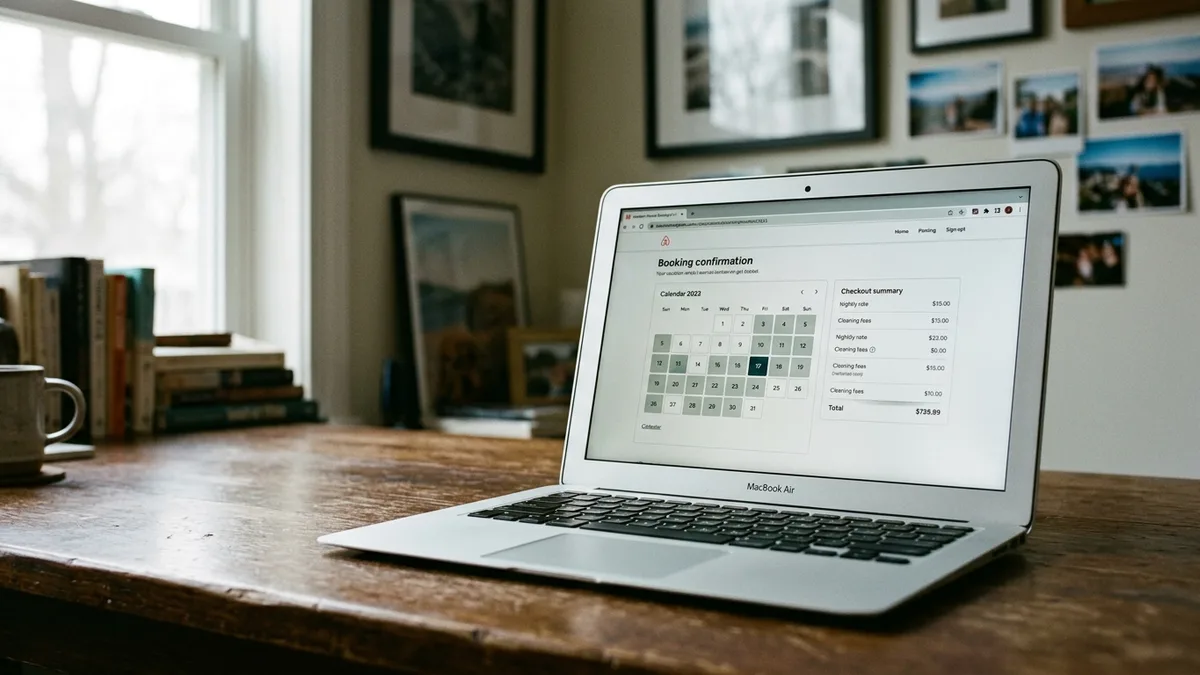
The numbers are worth testing. A $700 subtotal nets $591.50 on Airbnb at 15.5%. The same stay booked direct nets the full amount before payment processing, whose cost varies by processor, so confirm yours. Even a direct discount for returning guests can leave you ahead.
The results we see support this. One bed and breakfast reached 90% direct bookings with 60% repeat guests, and a portfolio of 30+ properties climbed to 55% direct bookings. Hosts on Boostly Connect get a done-for-you WordPress site linked to their PMS, with no developer and no upfront cost for up to 10 listings. We guarantee 65% direct bookings within 12 months, or we work for free until you get there.
Our guide to choosing a direct booking website for short-term rentals covers what to look for, and the piece on balancing OTA and direct bookings shows how to keep Airbnb running alongside it.
How Do Airbnb, Vrbo, and Direct Booking Fees Compare in 2026?
In 2026, the Airbnb host-only fee sits at or above the top of the published Vrbo range, while a direct booking carries no OTA commission at all. The table puts the structures side by side using only published figures.
| Channel | Who pays | Published rate | Guest data |
|---|---|---|---|
| Airbnb, host-only model | Host, deducted from payout | 15.5% for most hosts; some between 14% and 16% | Retained by Airbnb |
| Airbnb, former split model | Host and guest | Host about 3%; guest 14.1% to 16.5% | Retained by Airbnb |
| Vrbo | Varies by booking | Service fees between 5% and 15% (ATLAS by AvantStay, June 2026) | Platform-controlled |
| Direct booking with Boostly Connect | No platform commission | Payment processing costs vary by processor | Captured into your own CRM |
The last column matters as much as the percentages. A commission is a one-time cost. Guest data you do not own is a recurring one, because the guest rebooks through the platform instead of you.
What Do Most Hosts Miss in the Airbnb Fee Fine Print?
The fee fine print is the set of mechanics beneath the headline percentage, and it changes your margin more than the 15.5% figure suggests. Two details deserve a close read.
Your cleaning fee is now part of the fee base
A $100 cleaning fee generates $15.50 in Airbnb fees at the standard rate. If your cleaner is paid out of that fee, your own margin on turnover just shrank. Some hosts raise the cleaning fee; others fold the cost into the nightly rate. Test both against your booking mix.
Taxes stay out, and there is no way back
Sources describe the old guest fee as a percentage of the booking subtotal, not of taxes, and the same logic applies to the new host fee. Because Airbnb’s Help Center says a migrated host cannot switch back, model your numbers before you accept the new terms, not after.
Pro tip: pull twelve months of payouts and recompute each one at 15.5%. The gap is your annual exposure, and it tells you how much direct volume you need to offset it. Our Boostly Connect CRM then keeps those direct guests reachable by email and SMS, so you are not rebuilding demand from scratch each season.

How Do You Protect Your Margin After the Fee Change?
Protecting your margin after the Airbnb fees change means recalculating payouts, choosing a deliberate pricing response, and shifting repeat demand to a channel you own. Work through these steps in order:
- Confirm your migration status and deadline in your Airbnb account and Help Center.
- Pull your last twelve months of payouts and recompute them at 15.5% to find the gap.
- Choose a pricing response: raise nightly rates, raise the cleaning fee, extend minimum stays, or absorb the fee on selected dates.
- Push the new rates through your PMS or pricing tool so every channel stays consistent.
- Launch a direct booking site connected to that PMS, so returning guests have somewhere to book. Boostly Connect syncs it in under 20 minutes across 27 supported PMS integrations.
- Invite past guests to rebook direct, after reviewing Airbnb’s current terms on off-platform communication. Our guide to re-engaging past vacation rental guests has the sequence.
Common mistakes cost hosts more than the fee itself. Some absorb the increase silently for months. Others raise only the nightly rate and forget the cleaning fee. Many assume a lower checkout total will lift bookings, when guests compare total trip cost and your competitors may have raised prices too.
What Is the Smartest Response to the Airbnb Fees Change in 2026?
The Airbnb fees change moved a fee of roughly 15.5% onto your side of the ledger, and the cleanest fix is to reduce how many reservations pay it. Recompute your payouts, set a deliberate price response, and build a channel you own.
If you want to see what that channel looks like connected to your own PMS, book a demo of Boostly Connect. We will show you the direct booking site, the CRM capture, and the reporting dashboard using your own property data. Setup takes under 20 minutes, with no developer and no upfront cost for your first 10 listings.
Frequently Asked Questions
What percentage does Airbnb take from hosts?
Airbnb says most hosts pay 15.5% under the single host-only fee, and some pay between 14% and 16% depending on circumstances. Before the change, hosts paid about 3% and guests paid a separate service fee of 14.1% to 16.5%. The fee applies to the booking subtotal, not to taxes.
How much of a cut does Airbnb take compared with a direct booking?
On an Airbnb reservation, the cut is the service fee on the subtotal, about 15.5% for most hosts. A direct booking carries no OTA commission, only payment processing costs that vary by processor. Across a year of bookings, that gap adds up quickly.
What is an Airbnb host?
An Airbnb host is a person or business that lists a property on Airbnb for guests to book and receives a payout after each stay. Hosts set prices, house rules, and availability, while Airbnb handles payments and charges the service fee. Hosts can also take direct bookings on their own website alongside Airbnb.
What CRM does Airbnb use?
Airbnb does not publish which internal systems it uses, and hosts do not receive a CRM of their own. The platform keeps the guest relationship and the marketing access that comes with it. To own that data, you need your own system; our guide to owning guest data from Airbnb explains how, and the Boostly Connect CRM captures every direct booker automatically.
Can I switch back to the old Airbnb fee structure?
Airbnb’s Help Center states that once a host migrates to the single-fee structure, the host cannot switch back. Check your account status and deadline before you accept the new terms.
Will guests pay less after the Airbnb fee change?
Not necessarily. Removing the separate guest fee line lowers the visible checkout breakdown, but hosts may raise listed prices to offset the larger deduction. Compare the total trip cost, not the line items.
Do I have to leave Airbnb to benefit from direct bookings?
No. Most hosts keep Airbnb for discovery and redirect returning guests to their own website. Running both channels lets you keep Airbnb visibility while lowering the share of revenue that pays the platform fee.