

To capture and own guest data from your short-term rental bookings, take reservations through your own direct booking website, sync every booking into a CRM you control, and record marketing consent at the point of collection. Airbnb and other OTAs keep the guest relationship; your own site and CRM keep it with you.
Key Takeaways
- Guest data you own comes mainly from direct bookings, where the booking form writes contact details into a database you control.
- Holding an email address and having permission to market to it are two separate things, so record consent, timestamp, source, and purpose for every contact.
- OTA reservations give you operational contact details for fulfilling the stay; treat them as service data, not as a marketing opt-in list.
- Wi-Fi portals, digital guidebooks, check-in forms, and post-stay surveys can add consented contacts from guests who first booked elsewhere, subject to platform terms and privacy law.
- A CRM tied to your PMS stops duplicate profiles and keeps booking source, stay history, and preferences in one record per guest.
- Boostly Connect syncs your PMS to a WordPress booking site and captures every direct guest into your own CRM automatically.
Why Don’t You Own Your Guest Data When Bookings Come From Airbnb?
OTA guest data belongs to the platform relationship, not to you. Airbnb passes along what you need to host a stay, such as a name, a phone number, and trip messages, but its Host Privacy Standards limit how you can use that personal information. You are a data recipient, not a data owner.
That gap shows up in a predictable way. A guest has a great stay, goes home, and the next time they search for a rental they open Airbnb. The platform shows them your competitors alongside you. You never had a platform-approved way to reach them, so you cannot even say hello.
We call this the repeat booking trap, and it is the problem we built Boostly Connect to solve. Founder Mark Simpson recovered over $30,000 a year in platform fees himself, and the guest list kept paying back. For a deeper look at the mechanics, see our guide on how to own guest data from Airbnb.
Many property managers still collect no guest data at all. If you are one of them, you rent out properties while someone else builds the audience.
What Guest Data Can a Short-Term Rental Host Collect?
Guest data for a short-term rental falls into two groups: operational data you need to fulfill a stay, and marketing data you may use for later outreach. Operational data includes name, contact details, dates, and party size. Marketing data requires clear permission from the guest before you use it.
Fields worth collecting
A useful guest record typically holds name, email, phone, country, language, booking dates, property, booking source, revenue, special requests, review score, and tags such as repeat stay or anniversary trip. Collect phone numbers only when you have a real use for them, such as arrival coordination or text updates the guest agreed to. For example, a host who tags “anniversary trip” can send a direct-booking offer eleven months later, right when the guest starts planning.
Fields to skip
More is not better. Every extra field adds retention duty, security exposure, and form friction. If you cannot name the decision a field will inform, leave it off. GDPR and CCPA both expect you to limit collection to what you need, and any platform storing guest personal data should have a privacy policy and data processing terms in place.
Our CRM keeps these fields attached to a single guest profile, with booking history synced from your PMS, so you are not rebuilding the record from spreadsheets after every stay.

How Does a Direct Booking Website Capture Guest Data Automatically?
A direct booking website captures guest data at the moment of purchase. The guest fills in the checkout form on your site, and the details write straight into a database you control. Nothing is masked, nothing is filtered by a third party, and nothing depends on a platform’s permission.
This is the cleanest route to ownership because collection and consent happen in one step. You add an unticked marketing opt-in box to the checkout, and the guest’s choice is stored with the booking. A guest who books direct has already told you they want to deal with you.
The practical obstacle for most hosts is traffic and tooling. A booking page that does not sync with your PMS creates double entry, and a plugin stack that breaks causes missed bookings. What to look for in a direct booking website covers the evaluation criteria in detail.
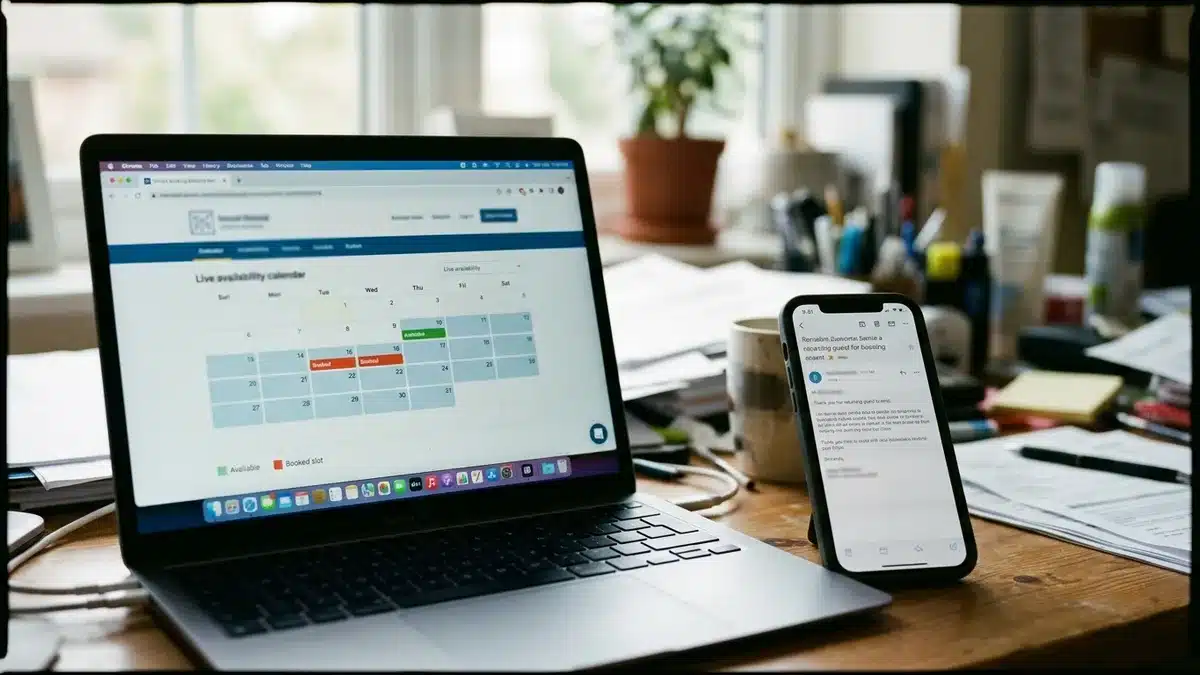
Boostly Connect connects your existing PMS (Hospitable, Hostfully, Lodgify, Guesty, and others across 27 supported integrations) to a WordPress site, so live availability and real-time pricing appear on your own domain. Every guest who books direct lands in your CRM without a manual export. Setup takes under 20 minutes with no developer, and there is no upfront cost for up to 10 listings.
What Is a Vacation Rental CRM and How Does It Work?
A vacation rental CRM is a database that stores one profile per guest, with contact details, stay history, booking source, preferences, and communication records. It turns a pile of reservations into a list you can segment and contact, such as past guests from last summer or everyone who booked twice.
Without one, most hosts rely on PMS exports and spreadsheets. That works until you manage more than a handful of stays; then duplicates, outdated emails, and untracked opt-outs pile up. A guest who unsubscribed in March gets emailed in June because the list was copied across three files.
A CRM tied to your PMS removes that drift. Bookings flow in, profiles update, and tags such as direct, repeat, or review-left attach automatically. Our comparison of the best CRM for short-term rental hosts who own their guest list lays out what to demand from any tool.
The Boostly CRM includes email, SMS, social, and live chat in one place, plus AI agents that answer guest questions and upsell. Because it sits on the same sync as your website and PMS, the guest record is complete the moment a booking lands.

Can You Collect Contact Details From Guests Who Booked on Airbnb?
You can invite OTA guests to share contact details with you voluntarily, but you cannot treat the contact information the platform passes along as a marketing list. Collection has to happen through channels where the guest actively opts in, and you must follow platform terms and privacy law.
This is where most guides blur an important line. Airbnb’s Host Privacy Standards describe what may be transferred to a host, and they restrict using it beyond the stay. Separately, platform rules discourage steering guests off-platform before the booking is made. Read the current official terms before building any workflow around OTA guests, because platforms revise them often.
Consent-based touchpoints that work after check-in
Once a guest is in your property, you can offer something of value in exchange for an email address. Common options are a Wi-Fi login page, a digital guidebook with local tips, a check-in form, a QR-code welcome card, and a post-stay survey. The guest chooses to share, and you record that choice.
A concrete example: place a QR-code card on the kitchen counter that opens your guidebook with your favorite local restaurants. The guest enters an email to unlock a free coffee-shop tip sheet, ticks an unchecked opt-in box, and your CRM tags the contact as “Airbnb, guidebook opt-in.” Two weeks after checkout, a short survey reaches that same guest, and a direct-only offer follows if the review is positive.
For a re-engagement plan that fits around these touchpoints, read how to re-engage past vacation rental guests in 2026. Boostly Connect does not require you to abandon Airbnb to do any of this. Most hosts run both channels and simply invite repeat guests to book direct next time.
Which Collection Method Gives You the Best Data Quality?
Booking-engine forms give the highest data quality because the guest is paying and supplies accurate details. Wi-Fi portals, guidebooks, and surveys reach OTA guests but yield less complete records. The right mix depends on how many guests you have and how much friction you can tolerate.
| Method | Guest friction | Data quality | Consent clarity | Reaches OTA guests? |
|---|---|---|---|---|
| Direct booking checkout form | Low, part of paying | High, accurate and complete | Strong, opt-in box stored with booking | No, direct guests only |
| Wi-Fi login portal | Medium, a gate before internet | Variable, some use throwaway emails | Needs a clear opt-in checkbox | Yes |
| Digital guidebook | Low, guest wants the content | Good, engaged guests | Strong if opt-in sits beside the form | Yes |
| Check-in form | Medium, extra step | High for operational fields | Keep operational and marketing consent separate | Yes |
| Post-stay survey | Low, optional | Good, but lower response volume | Strong, guest acts after the stay | Yes |
Our view: do not rely on one method. Direct checkout builds the core list; a guidebook plus a survey brings in the guests who first booked elsewhere. A Wi-Fi gate is the most likely to annoy, so use it last and only with an unticked marketing box.
How Do You Record Consent and Stay Compliant With Privacy Law?
Owning guest data does not mean you can contact guests however you like. Possessing an email address does not grant permission to market to it. You need to record each guest’s choice, when and where it was given, and what they agreed to, and you must honor withdrawals.
What to record for every contact
- The choice the guest made (opted in or not)
- A timestamp for when they made it
- The collection source, such as checkout form, guidebook, or survey
- The stated purpose, such as promotional offers or stay updates
Handling withdrawal and suppression
When a guest unsubscribes, add them to a suppression list that survives list imports and exports. Never delete the record entirely, since you need proof not to contact them again. Commercial email also carries unsubscribe and sender identification duties; check the Federal Trade Commission’s CAN-SPAM compliance guidance, and consult GDPR rules if you host guests from the EU.
Separate operational from marketing use
Name, dates, and phone for arrival are operational. Using them for promotions is marketing and needs its own permission. Keep the two flags in separate fields so a guest who only wanted check-in texts never receives a discount campaign. We built the Boostly CRM so that opt-in status travels with the profile, and unsubscribes are honored across email and SMS sequences. For legal specifics in your jurisdiction, confirm requirements with a qualified professional or the relevant official source.
How Do You Merge OTA, PMS, and Direct Guest Records Without Duplicates?
Merging guest records means matching profiles from OTA reservations, your PMS, and direct bookings into one record per person, while keeping each source’s consent status intact. The risk is double entries and wrongly treating OTA-supplied emails as marketing opt-ins.
Start with one source of truth. Your PMS already holds every reservation, so the CRM should read from it rather than from manual exports. Match on email first, then on name plus phone, and flag near-matches for review instead of auto-merging them. For example, “Jon Smith” and “Jonathan Smith” with the same phone number deserve a human look before you combine them.
Keep a booking source tag on every profile: direct, Airbnb, Vrbo, or Booking.com. That tag does two jobs. It tells you which guests are still locked inside an OTA, and it stops you from mixing an OTA operational contact into a marketing list by accident.
Operators typically run three to five software tools, which is exactly how records fragment. Boostly Connect links your PMS, website, and CRM so every tool works from the same bookings, and you avoid chasing sync errors by hand. For a portfolio, the same system works across every listing; see how to manage multiple vacation rentals without chaos.

What Does Owning Guest Data Actually Earn You?
A guest list you own earns repeat bookings without paying commission. Industry research puts the typical host’s repeat guest rate at 5 to 8 percent, while hosts with a deliberate retention strategy reach 15 to 25 percent, according to a 2026 Lodgify study (via StayStrat). Retention is the payoff of everything above.
Compare the economics. A repeat guest who rebooks through an OTA still costs you the standard commission, which we cover in how much Airbnb commission costs you per year. Research on operator datasets also found that roughly three-quarters of repeat guest revenue flows through OTAs at standard commissions of 12 to 20 percent, according to GetHostAI (2026). That is revenue from people who already liked you.
Our own clients show what the shift looks like. One bed and breakfast reached 90 percent direct bookings and 60 percent repeat guests after taking marketing into its own hands. A property manager who launched a Boostly website grew from 0 percent to 55 percent direct bookings over time, and the professional site also drew landlords asking him to manage their properties.
The guarantee behind our model is specific: clients reach 65 percent direct bookings within 12 months, or we work for free until they do. Email sequences, review requests, and repeat-stay offers run from the CRM, so the list you build keeps earning. For tactics, see how to get more direct bookings for your vacation rental.
How Do You Set Up Guest Data Capture Step by Step in 2026?
Setting up guest data capture takes five steps: connect your PMS, launch a direct booking site, add a consent checkbox, build post-stay touchpoints, and automate follow-up from the CRM. You can finish the first two the same day, then layer in the rest over a few weeks.
- Connect your PMS. Sync your listings, availability, and pricing so your site and CRM read from one source of truth.
- Launch your own booking site. Run it alongside Airbnb rather than replacing it. Direct checkout is where clean, consented data starts.
- Add an unticked marketing opt-in. Store the choice, timestamp, and source with the booking.
- Add touchpoints for OTA guests. Offer a digital guidebook, a QR welcome card, or a post-stay survey that invites guests to opt in voluntarily.
- Automate follow-up. Send a review request after checkout and a direct-only offer ahead of the guest’s likely next trip.
In 2026, with available U.S. short-term rental listings projected at 1.77 million, according to AirDNA’s 2026 Outlook Report, competition for repeat guests is only getting tighter. A list you own is the one part of your business a new listing down the street cannot copy.
Boostly Connect handles steps one through three in a single connection, with twice-weekly group coaching to help you with the rest. If you want to see it with your own property data, we cover wider growth in grow your direct booking channel from zero.
Frequently Asked Questions
How do I collect guest data from vacation rental guests?
Start with your own direct booking website, where the checkout form writes details into your database. For guests who booked elsewhere, offer opt-in touchpoints such as a digital guidebook, a Wi-Fi portal, a check-in form, or a post-stay survey. Record consent for each one.
Does Airbnb let me keep and market to my guests’ email addresses?
Airbnb passes along limited details so you can host a stay, but its Host Privacy Standards restrict using that personal information for other purposes. Treat OTA contact details as operational data, and check the current official terms before using them in any outreach.
What is the best guest CRM for vacation rentals?
Look for a CRM that syncs from your PMS, keeps one profile per guest, tags booking source, stores consent status, and runs email or SMS automation. The Boostly CRM includes email, SMS, social, live chat, and AI agents, and captures every direct guest automatically.
How do I set up a direct booking website with a guest CRM?
Connect your PMS to a booking site, then connect the site to a CRM so each reservation creates or updates a guest profile. Boostly Connect does this in under 20 minutes without a developer, with 27 PMS integrations and no upfront cost for up to 10 listings.
What guest data can short-term rental hosts collect?
Hosts commonly collect name, email, phone, country, language, stay dates, property, booking source, special requests, and review score. Collect only fields you will use, and keep operational data separate from marketing permission.
What are the best direct booking tools for rental hosts?
Choose a tool that integrates with your existing PMS, shows live availability and pricing, and feeds a CRM you control. A site alone solves checkout but not guest follow-up, so an all-in-one setup reduces the plugins you have to keep in sync.
How can I reduce manual work and automate my vacation rental operations?
Connect your PMS, website, and CRM so bookings, guest records, and follow-up messages move without manual exports. Automating review requests and repeat-stay offers saves the most time, and AI agents can answer routine guest questions.
Will collecting guest data hurt my Airbnb ranking?
Running a direct channel alongside Airbnb does not require you to leave the platform. Most hosts keep both and invite repeat guests to book direct, which captures their data without touching your listing.
Conclusion: How Do You Capture and Own Guest Data From Your Bookings?
To capture and own guest data from your short-term rental bookings, take reservations through your own website, store every guest in a CRM tied to your PMS, and record consent at collection. Use guidebooks, Wi-Fi portals, and surveys to bring in guests who booked on an OTA first.
The repeat guests you already earned are the cheapest bookings you will ever win, as long as you can reach them. In 2026, with listings growing and demand growth moderating, that owned list matters more each season.
If you want a direct booking site, a guest CRM, and your PMS connected in under 20 minutes, book a demo with Boostly Connect and we will walk through it using your own property data. There is no upfront cost for your first 10 listings.