
A website for vacation rental hosting only works if it connects live to your property management system, shows real availability, and captures every guest’s contact details into a system you own. Anything less, a static page with a “contact us” form or an embedded OTA widget, functions as a brochure, not a booking engine. In our experience at Boostly Connect, the hosts who see real direct booking traction are the ones who treat their own site as core infrastructure, not a side project.
Key Takeaways
- A working website for vacation rental use needs three connected pieces: live PMS-synced availability, real-time pricing, and a CRM that captures guest data at checkout.
- Industry research shows over 50% of vacation rental website traffic now arrives on mobile, according to CraftedStays 2026 data, so mobile-first design is not optional.
- Static or template-only sites without booking calendar sync are the most common reason a direct booking page sits dormant while Airbnb and Vrbo keep the traffic.
- Boostly Connect syncs directly with 8 PMS platforms, including Hospitable, Guesty, Lodgify, Hostfully, and OwnerRez, and can have a site live in under 20 minutes with no developer required.
- Hosts do not need to abandon Airbnb or Vrbo to benefit from a direct booking site; most run both channels simultaneously and route repeat guests toward their own domain over time.
- Boostly Connect’s website builder captures every direct booking guest automatically into a host-owned CRM, so contact data stays with the property owner instead of the OTA.
If you manage even one short-term rental in 2026, you have almost certainly asked whether a standalone website is worth building. The honest answer depends on what “website” means to you. A static page that lists your amenities and links out to Airbnb is not a booking tool, it is a digital business card. A functioning direct booking site needs live inventory, a payment flow, and a way to remember who your guests are after checkout.
This guide walks through what a working vacation rental website actually requires from a technical standpoint, where independent hosts commonly waste money on the wrong builder, and how the setup differs for a single-property owner versus a 20-unit portfolio operator. We built Boostly Connect specifically because most hosts were stitching together plugins that broke every time a PMS updated its API, and that pattern still shows up constantly in conversations with new users.
We will cover the technical requirements first, since that is the part most generic “website builder” content skips entirely, then move into cost comparisons, common mistakes, and a practical setup checklist you can follow this week.
What Makes a Website Actually Function as a Vacation Rental Booking Tool?
A functional vacation rental website is one where a visitor can see real-time availability, get an accurate quote, and pay for their stay without leaving the site or waiting on a manual reply. That requires four connected systems working together: a property management system (PMS) feed, a booking calendar, a payment gateway, and a guest data capture point.
Specifically, the booking calendar has to pull live inventory from wherever you already manage reservations, whether that is Hospitable, Guesty, Lodgify, Hostfully, or OwnerRez. Without that sync, you risk double bookings the moment a guest reserves through Airbnb and your website simultaneously.
Pricing has to update in real time too. If your nightly rate changes on your PMS but not on your site, you either underprice a stay or send a guest an inaccurate quote, both of which cost money and trust.
Boostly Connect handles this by syncing directly to your existing PMS in under 20 minutes, pulling live availability and pricing onto a WordPress site without requiring a developer or any custom coding.
How Do You Choose Between a DIY Builder and a Done-for-You Website?
Choosing between a DIY website builder and a done-for-you platform comes down to how much time you have and how many properties you manage. A single-property owner with light traffic expectations can sometimes get by with a basic template site. A host running multiple listings almost always needs a system built for scale.
DIY builders are fine when your goal is simply having a searchable presence and you are not depending on the site for meaningful revenue. But the moment you want live PMS sync, dynamic pricing, or guest data capture, generic builders start requiring third-party plugins that were not designed to talk to each other.
That is where most breakage happens. A plugin update on one end, a PMS API change on the other, and suddenly your calendar shows a booked night as available. We see this constantly with hosts who come to Boostly Connect after a plugin-based site failed them mid-season.
Boutique property managers running 5 to 20 units, in particular, need a single connected system rather than a patchwork of tools, since managing separate logins and sync schedules per property does not scale.
What Technical Requirements Does a Direct Booking Site Actually Need?
The technical requirements for a working vacation rental website include booking calendar sync, a channel manager or PMS integration, a secure payment gateway, and mobile responsiveness. Skipping any one of these turns the site into a lead form rather than a transaction engine.
First, calendar sync has to be bidirectional. Availability updates made on Airbnb or Vrbo need to reflect on your own site within minutes, not hours, or you risk the exact double-booking problem mentioned earlier.
Second, mobile responsiveness is not a nice-to-have. According to CraftedStays 2026 research, more than 50% of vacation rental website traffic arrives on mobile devices. A site that renders poorly on a phone screen loses bookings before a guest even reaches the calendar.
Third, payment processing needs to handle deposits, full payments, and refunds without routing guests to a third-party checkout page that breaks your branding. For a deeper look at getting this piece right, our guide on how to accept payments for direct bookings the right way covers gateway options in more detail.
Boostly Connect’s website builder handles the PMS sync, calendar, and mobile layout as one connected package rather than requiring you to source and configure each piece separately.
What Does a Direct Booking Website Cost Compared to OTA Commission?
The real cost comparison for a vacation rental website is not the build price against a monthly subscription fee. It is the ongoing OTA commission you keep paying versus a one-time setup with no recurring percentage taken per booking. Airbnb and Vrbo commissions typically range from 15 to 20 percent per reservation, a cost that compounds with every booking regardless of how long you have used the platform.
A direct booking website does not eliminate OTA fees for the bookings that still come through Airbnb or Vrbo. But every reservation that shifts to your own site keeps that commission in your business instead.
In one case we track closely, a bed and breakfast owner grew direct bookings to 90% of total reservations after focusing marketing efforts on their own website rather than third-party listings, alongside a 60% repeat guest rate. That is an outlier on the high end, but it illustrates the ceiling when a host commits to the channel.
Boostly Connect has a free plan for up to 3 listings on the Discover map, which removes the typical barrier of paying a developer thousands of dollars before a single direct booking comes through.
| Factor | OTA-Only Listing | Direct Booking Website |
|---|---|---|
| Per-booking commission | Typically 15 to 20 percent | None on direct reservations |
| Guest data ownership | Retained by the platform | Captured into host-owned CRM |
| Setup effort | Minimal, listing-based | Varies by builder; Boostly Connect syncs PMS in under 20 minutes |
| Repeat guest control | Platform can remarket guest to competitors | Host controls email, SMS, and offers |
How Do You Get a Vacation Rental Website Found on Google?
Getting a vacation rental website to rank on Google requires SEO-optimized property pages, structured content, and additional discovery surfaces beyond organic search results, such as Google Vacation Rentals or metasearch integrations. A site with zero SEO foundation almost never ranks against established OTA domains on its own.
Specifically, property pages need descriptive titles, location-based keywords, and fast load times. A generic template with stock photography and no unique copy gives Google nothing to differentiate your listing from thousands of similar pages.
Additionally, getting listed on Google Vacation Rentals gives your property a visibility surface that operates independently from traditional organic search rankings. We cover this integration in detail in how to get listed on Google Vacation Rentals in 2026.
If your site has been live for months with no traffic movement, the issue is often structural rather than content-related. Our breakdown of why a vacation rental website isn’t ranking walks through the eight most common causes we see.
Boostly Connect ships websites with SEO-optimized property pages and a built-in blog structure from day one, rather than requiring a separate SEO contractor after launch.
How Do You Capture and Keep Guest Data From Website Bookings?
Guest data capture on a vacation rental website means every direct reservation automatically feeds a CRM that the host owns, rather than staying locked inside a third-party platform. Without this step, a website functions as a one-time transaction tool instead of a relationship-building asset.
Airbnb retains guest contact information and can use it to remarket that same guest to competing properties later. That is the repeat booking trap: a guest stays with you once, loves the property, then books through Airbnb again next time because you never captured their email or phone number directly.
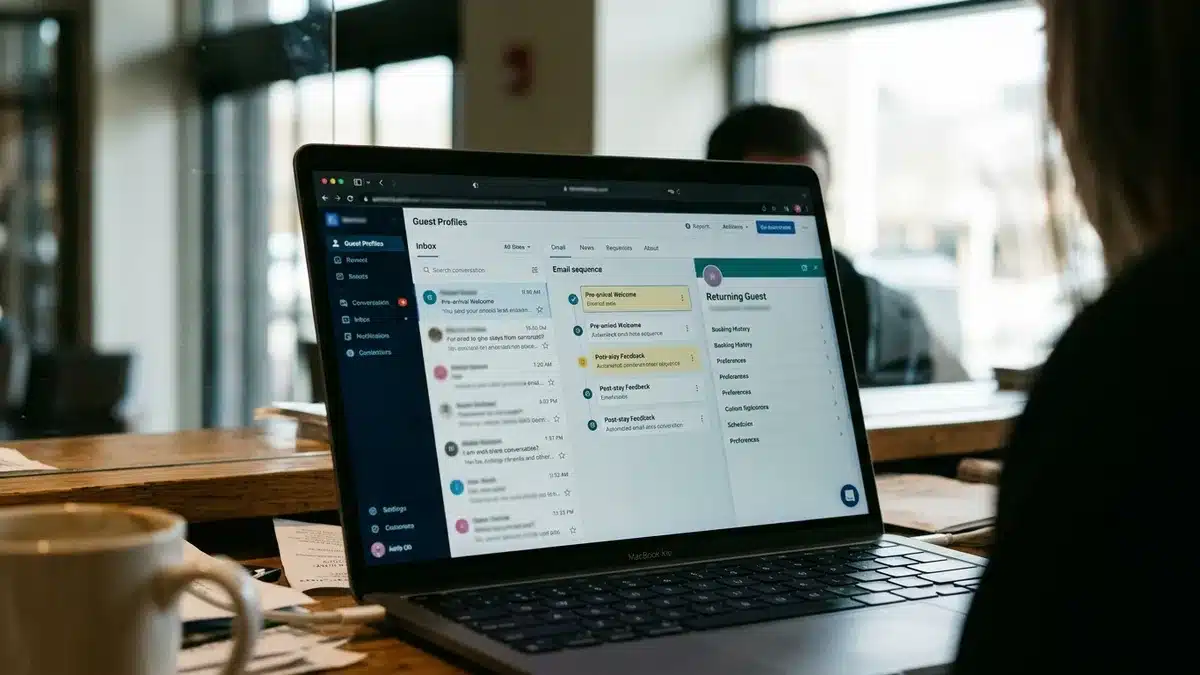
Boostly Connect’s website builder automatically routes every direct booking guest into the host’s own CRM, which includes built-in email and SMS automation for review requests and repeat-stay offers.
In one case study we reference often, a self-managed property owner grew from having no dependable returning-guest system to a 60% repeat guest rate after shifting marketing focus to a direct-booking website with CRM capture built in.
If manual list-building and spreadsheet exports have been your only guest retention system so far, our piece on automating review requests for your vacation rental shows what a connected alternative looks like.
What Should Multi-Property Operators Prioritize Differently?
Multi-property operators need a website builder that manages pricing, availability, and guest data across every listing from a single connected system, rather than requiring separate logins and sync schedules per property. Manual processes that work fine for one property break down fast at 10, 20, or more units.
Boutique property managers running 5 to 20 properties typically need a system that reinforces a premium brand presentation to owners, since a disconnected tech stack signals disorganization to the very owners they are trying to retain as clients.
At scale, this becomes an operational necessity, not a preference. One operator we tracked grew from a handful of self-managed properties to more than 30 units under management, reaching a 55% direct booking rate across the portfolio, driven largely by a professional website that attracted landlords looking for management services in the first place.
Boostly Connect supports multi-property and multi-listing management from one connected system, so pricing, availability, and CRM data stay unified across every property rather than fragmented per unit. For operators actively scaling, our guide on how to grow your direct booking channel covers the sequencing that tends to work best.
What Legal and Compliance Details Should Hosts Check Before Launching?
Legal compliance for a vacation rental website depends primarily on the property’s local jurisdiction, not the website itself. Short-term rental permits, occupancy taxes, and zoning restrictions vary widely by city and state, and a website builder does not remove the obligation to comply with them.
Many municipalities have introduced licensing schemes, rental caps, or increased tax requirements in recent years as part of broader efforts to manage housing supply and neighborhood impact. These rules change frequently and differ by location, so verify current requirements with your local permitting or zoning office rather than relying on outdated guidance.
Notably, none of this compliance burden is unique to direct booking websites specifically. The same permit and tax obligations apply whether a guest books through Airbnb, Vrbo, or your own domain. A website simply changes who processes the payment and who owns the guest relationship afterward.
If you are unsure what applies to your property, check with your city’s business licensing department or a local short-term rental attorney before launching any new booking channel, direct or otherwise.
Common Mistakes Hosts Make When Building a Vacation Rental Website
The most common mistake hosts make is launching a website with no PMS connection, resulting in a static calendar that requires manual updates. This alone accounts for most abandoned direct booking sites we encounter.
- Skipping PMS integration entirely. A site without a live sync to Hospitable, Guesty, Lodgify, or whichever system you already run requires manual calendar updates, which almost always fall behind within weeks.
- Launching with zero SEO structure. A beautiful design with no keyword-optimized property pages sits invisible on page five of Google results indefinitely.
- Ignoring mobile design. Given that over half of vacation rental site traffic is mobile according to CraftedStays, a desktop-only layout loses bookings before the guest even sees your calendar.
- No guest data capture at checkout. A booking with no CRM entry means the guest relationship ends the moment they check out, and they default back to Airbnb next trip.
- Trying to fully replace OTAs on day one. Most hosts run Airbnb and Vrbo alongside their direct site indefinitely, gradually shifting repeat guests toward direct booking rather than pulling listings cold.
If your current setup has one or more of these gaps, our guide on building a direct booking website without hiring a developer walks through the fix step by step.
How Do You Keep Airbnb Bookings While Growing Your Direct Channel?
Keeping Airbnb bookings while growing a direct channel means running both simultaneously rather than treating direct bookings as a full replacement strategy. Most hosts who succeed with direct bookings never delist from Airbnb or Vrbo; they simply redirect returning guests toward their own site over time.
For example, you can encourage past guests to save your listing using tools like the Airbnb Wishlists feature, while separately building an email sequence that offers a direct-booking incentive for their next stay. Some hosts also use Airbnb’s own Special Offers feature to test guest response to discounts before shifting that guest fully to a direct channel.
The fear of losing Airbnb search ranking by focusing on a direct site is common but largely misplaced. Airbnb’s ranking algorithm weighs factors like response rate, review quality, and booking history on its own platform, not whether you also operate a separate website. For more on balancing both channels without sacrificing occupancy, see how to balance OTA and direct bookings.
Boostly Connect is built around this exact dual approach: hosts keep their existing OTA listings active while their direct booking site captures repeat guests who would otherwise cycle back through Airbnb.
Frequently Asked Questions
How long does it take to set up a direct booking website with Boostly Connect?
Boostly Connect syncs to an existing PMS and generates a live direct booking website in under 20 minutes, with no developer or coding knowledge required. The setup connects your property system, website, and CRM as one working unit from the start.
Will switching to direct bookings hurt my Airbnb search ranking?
No. Airbnb’s ranking algorithm is based on factors like response time, guest reviews, and booking activity on its own platform, not whether you also run a separate website. Most hosts keep both channels active simultaneously without any ranking penalty.
Which property management systems integrate with Boostly Connect?
Boostly Connect supports 8 PMS integrations, including Hospitable, Guesty, Lodgify, Hostfully, and OwnerRez. Hosts can connect their existing system in under five minutes and immediately pull live availability and pricing onto their own site.
Do I need a developer or coding experience to launch my direct booking site?
No developer or coding knowledge is required. Boostly Connect’s setup process connects your PMS to a WordPress-based website through a guided process designed for hosts with no technical background.
What happens to my guest data when someone books direct instead of through an OTA?
Every guest who books through a Boostly Connect website is automatically captured into the host’s own CRM. That data stays with the property owner rather than being retained by a third-party platform for its own remarketing purposes.
How much can I realistically save by reducing OTA commission dependency?
Since Airbnb and Vrbo commissions typically run 15 to 20 percent per booking, every reservation shifted to a direct channel keeps that percentage in your business instead. The exact savings depend on your booking volume and average nightly rate, so calculate it against your own reservation history rather than a generic estimate.
Can Boostly Connect handle multiple properties or just a single listing?
Boostly Connect supports both single-property owners and multi-property portfolios from one connected system, keeping pricing, availability, and guest data unified across every listing rather than requiring separate tools per property.
Conclusion: What a Website for Vacation Rental Success Actually Requires
A website for vacation rental hosting only earns its keep when it connects live to your PMS, captures guest data automatically, and gives repeat visitors a reason to book with you directly instead of cycling back through Airbnb. The technical pieces, calendar sync, mobile responsiveness, SEO structure, and CRM capture, all have to work together, not in isolation.
As of 2026, the hosts seeing the strongest direct booking growth are the ones who stopped treating their website as a static brochure and started treating it as connected infrastructure. That shift does not require abandoning Airbnb or Vrbo. It requires connecting the systems you already use to a site built to convert.

If OTA commissions are quietly eating into your margin every month and your current site still requires manual calendar updates, get started with Boostly Connect and see your PMS, website, and CRM connected as one system in under 20 minutes.