

An STR website is a short-term rental operator’s own booking site, built to show live availability, take direct reservations, and capture guest data without routing the transaction through Airbnb, Vrbo, or Booking.com. It runs on the host’s domain, connects to their property management system (PMS), and exists specifically so guests can book without a platform commission attached.
Key Takeaways
- An STR website is a host-owned booking site connected to a PMS like Hospitable, Guesty, Lodgify, or Hostfully, distinct from an OTA listing page.
- Industry research shows offline booking behavior still accounted for over 70% of vacation rental market share in 2026, meaning most guests still call, email, or return to a known site rather than book blind online, which is exactly the traffic an STR website is built to capture.
- More than 50% of vacation rental website traffic comes from mobile phones, according to CraftedStays (2026), so a mobile-first build isn’t optional.
- Global vacation rental market size is projected to reach $101.37 billion in 2026, per Precedence Research, and a growing share of that revenue is shifting toward direct booking channels as hosts push back on OTA commission structures.
- A poorly built STR website (no PMS sync, no SEO structure, no CRM) usually sits dormant. Hosts who saw results, like the B&B that reached 90% direct bookings using Boostly, paired the website with active marketing and guest data capture, not a static page alone.
- Boostly Connect builds a done-for-you STR website on WordPress, synced to your existing PMS in under 20 minutes, with guest data automatically flowing into your own CRM instead of staying locked inside Airbnb.
If you’ve searched “str website” hoping for a straight answer, you’re probably one of two people: a host trying to figure out what a direct booking site actually needs to include, or an operator comparing website builders after getting tired of handing Airbnb and Vrbo a cut of every reservation. Either way, the confusion is understandable. There’s a lot of vague marketing language floating around this topic and not much specificity about what actually makes an STR website convert.
This guide breaks down what an STR website is, what it needs technically and structurally, and where most hosts go wrong building one. Boostly Connect has built more than 700 of these sites for hosts and property managers, and the pattern we see over and over is the same: hosts either launch a beautiful but static page that never gets a booking, or they never launch at all because the PMS integration feels too technical to attempt alone.
We’ll cover the core features an STR website needs, how it differs from a basic listing page, what the 80/20 rule means for your booking mix, and the practical setup steps to get one live in 2026. By the end, you’ll know exactly what to prioritize whether you build it yourself or bring in a done-for-you platform.
What Are STR Sites?
STR sites, short for short-term rental websites, are independently hosted booking platforms that display a property’s availability, rates, and photos while processing reservations directly through the owner’s own payment system. Unlike an Airbnb or Vrbo listing page, an STR site belongs entirely to the host, not the platform.
The distinction matters because ownership determines control. On Airbnb, the platform owns the listing page, the guest messaging thread, and, notably, the guest’s contact information. On an STR site, you own all three. That means when a guest stays once and wants to rebook, they can find your site directly, whether through a saved bookmark, a repeat guest email, or a branded search on Google, instead of defaulting back to the OTA search results where competitors are one scroll away.
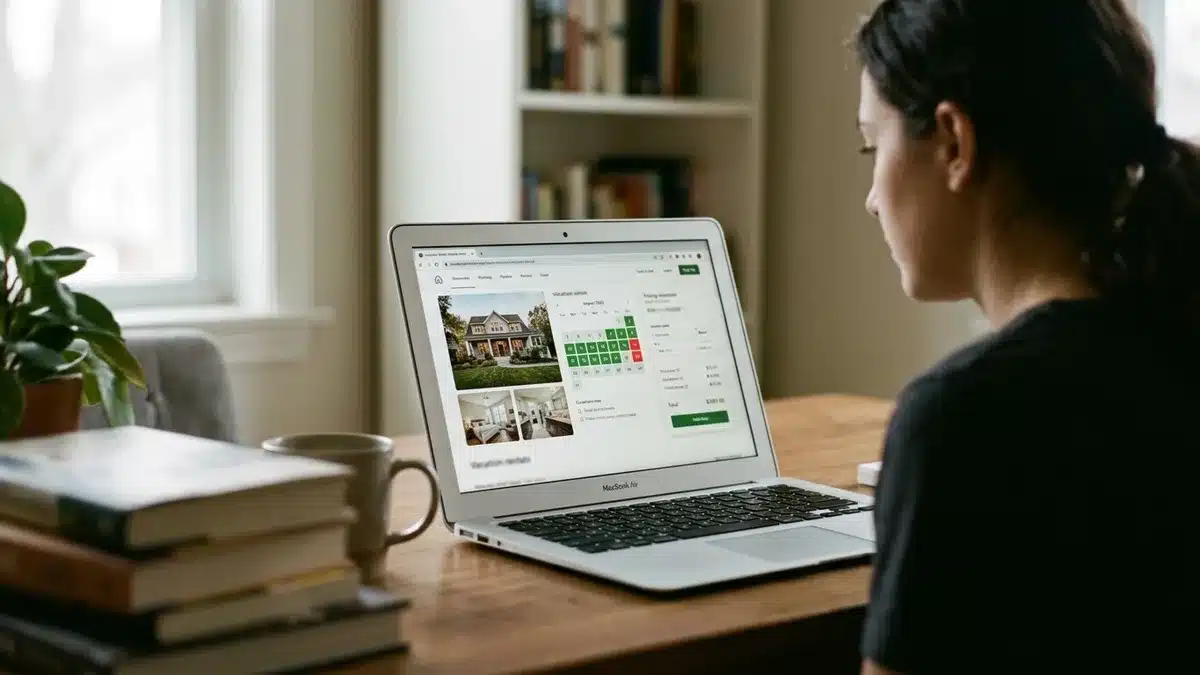
Functionally, a working STR site needs a live calendar synced to your PMS, a secure checkout, mobile-responsive design, and some mechanism to capture guest contact details post-booking. Static websites without PMS integration technically qualify as “STR sites” in a loose sense, but they don’t function as booking engines. They’re brochures. Boostly Connect exists specifically to close that gap, syncing your existing PMS directly to a live WordPress site so availability and pricing update automatically instead of requiring manual double-entry.
What Is the Best Short-Term Rental Website?
The best short-term rental website is one that combines live PMS-synced availability, a fast mobile checkout, and built-in guest data capture, rather than the flashiest design template. Speed and function beat aesthetics for conversion, particularly since most visitors arrive on a phone.
Design matters less than most hosts think. A visually stunning site with a broken sync between your calendar and your PMS will overbook rooms and frustrate guests. Conversely, a plain-looking site that loads fast, shows accurate real-time pricing, and lets a guest complete checkout in under two minutes will consistently outperform a prettier competitor with friction in the booking flow.
Three specific factors separate a high-performing STR website from a forgettable one, in our experience working across hundreds of these builds:
- PMS integration depth. A site connected to platforms like Hospitable, Guesty, Lodgify, OwnerRez, or Hostfully updates pricing and availability automatically. A site without that connection requires manual updates, which is where double-bookings and stale pricing creep in.
- Mobile-first checkout. Since more than half of vacation rental site traffic is mobile, according to CraftedStays (2026), a checkout flow designed for desktop first will lose bookings before the guest ever reaches payment.
- CRM capture at the point of booking. The best sites don’t just take a payment; they automatically log the guest’s name, email, and stay history into a CRM so the host can market to them again without manual list-building.
This is exactly the combination Boostly Connect was built around: a WordPress site with real-time PMS-synced pricing, plus a built-in CRM that captures every direct booking guest automatically, so the site works as an acquisition engine rather than a static listing.
What Is an STR Portal?
An STR portal, in the government and regulatory sense, is an official online system that municipalities use to process short-term rental registration, licensing, and compliance documentation. This is different from a host’s own booking website, though the terms sometimes get confused in search results.
Cities that have implemented licensing requirements typically run a dedicated registration portal, often on a subdomain separate from the main city website, where hosts submit property details, proof of tax compliance, emergency contact information, and sometimes required training certificates. These portals are strictly administrative. They don’t take bookings, display availability, or generate revenue. They exist purely for local government tracking and enforcement.
Many cities have introduced licensing schemes, registration requirements, and zoning restrictions specifically targeting short-term rentals in response to affordability and overtourism concerns. If you operate in a regulated market, you’ll likely need to complete a municipal STR portal registration in addition to building your booking-facing STR website. These are two separate systems serving two separate purposes, and confusing them can lead hosts to think a government portal will somehow generate bookings. It won’t. It’s paperwork infrastructure, not marketing infrastructure.
Because registration requirements, portal names, and exact documentation change by jurisdiction and update frequently, always confirm current requirements directly with your local permitting or regulatory affairs office rather than relying on secondhand summaries, including this one. What’s consistent across most markets, though, is that your booking website and your regulatory registration are independent systems that don’t talk to each other. You’ll need both, but only one of them drives revenue.
What Is the 80/20 Rule for Airbnb?
The 80/20 rule, as applied to short-term rentals, generally refers to the idea that a large share of an operator’s repeat revenue tends to come from a small share of loyal, returning guests, rather than one-time bookers found through cold OTA search traffic. Applied practically, it means retention marketing deserves outsized attention relative to constant new-guest acquisition.
The problem is that on Airbnb, you structurally can’t apply this rule well. The platform controls the guest relationship, limits direct contact after checkout, and actively encourages guests to rebook through Airbnb’s own search rather than your specific property. Airbnb does offer tools like the Re-book button and Special Offers feature for hosts wanting to re-engage past guests, and guests can also save your property using Wishlists, but all of these keep the guest inside Airbnb’s ecosystem rather than moving them to a channel you control.
An STR website flips this. When a returning guest books direct instead of rebooking through Airbnb, you keep 100% of that reservation’s value and the guest’s contact data stays in your own CRM permanently. This is precisely the trap Boostly Connect was engineered to solve: every guest who books through your STR website is automatically captured, so the next stay doesn’t require Airbnb’s search algorithm to surface your listing again.
We’ve seen this play out concretely. One B&B operator using Boostly reached 90% direct bookings and 60% repeat guests, largely by owning the guest relationship instead of leaving it inside a third-party platform. Another host, after applying direct booking tactics from a free challenge, generated an £800 booking from a single tactic, then recovered a £3,000 course investment within six months once the strategy scaled across a growing portfolio. Neither result came from a static website; both came from combining the site with active retention marketing.
How Does an STR Website Compare to an OTA Listing?
An STR website and an OTA listing serve the same booking function but differ fundamentally in ownership, cost structure, and guest data access. The table below breaks down the practical differences hosts should weigh.
| Factor | STR Website (Direct Booking) | OTA Listing (Airbnb, Vrbo, Booking.com) |
|---|---|---|
| Commission per booking | None from the platform itself; you set your own fee structure | Typically 15-20% commission charged to host and/or guest |
| Guest data ownership | Captured directly into your own CRM | Retained by the platform for its own remarketing |
| Discovery method | SEO, repeat guests, referrals, direct search | Platform’s internal search algorithm |
| Pricing control | Fully controlled by the host | Subject to platform display rules and fee stacking |
| Repeat booking flow | Automated via CRM email/SMS sequences | Depends on guest returning to the platform search |
| Setup effort | Requires PMS integration and website build | Requires only a listing profile |
Notably, this isn’t an either/or decision. Most successful operators run both channels simultaneously. Booking.com and Expedia Group alone control a combined majority share of vacation rental inventory placement, according to AltexSoft (2022), and Airbnb has more than 7 million active listings across 220 countries, which means OTA visibility still matters for new guest discovery. The strategic move is using OTAs for first-time discovery and your STR website for retention, repeat stays, and referral traffic where you keep the full booking value.
What Does an STR Website Need Technically to Convert Bookings?
A converting STR website needs live PMS-synced availability, a fast and secure checkout, mobile responsiveness, and integrated guest communication tools. Missing any one of these typically results in a site that looks professional but produces few or no actual reservations.
Start with the calendar sync. If your availability calendar isn’t pulled live from your PMS, whether that’s Hospitable, Guesty, Lodgify, Hostfully, or OwnerRez, you’re manually updating two systems every time a booking comes in anywhere. Miss an update once and you’ve got a double-booking and an angry guest. This single point of failure is the most common reason hosts abandon direct booking websites after a rocky first few months.
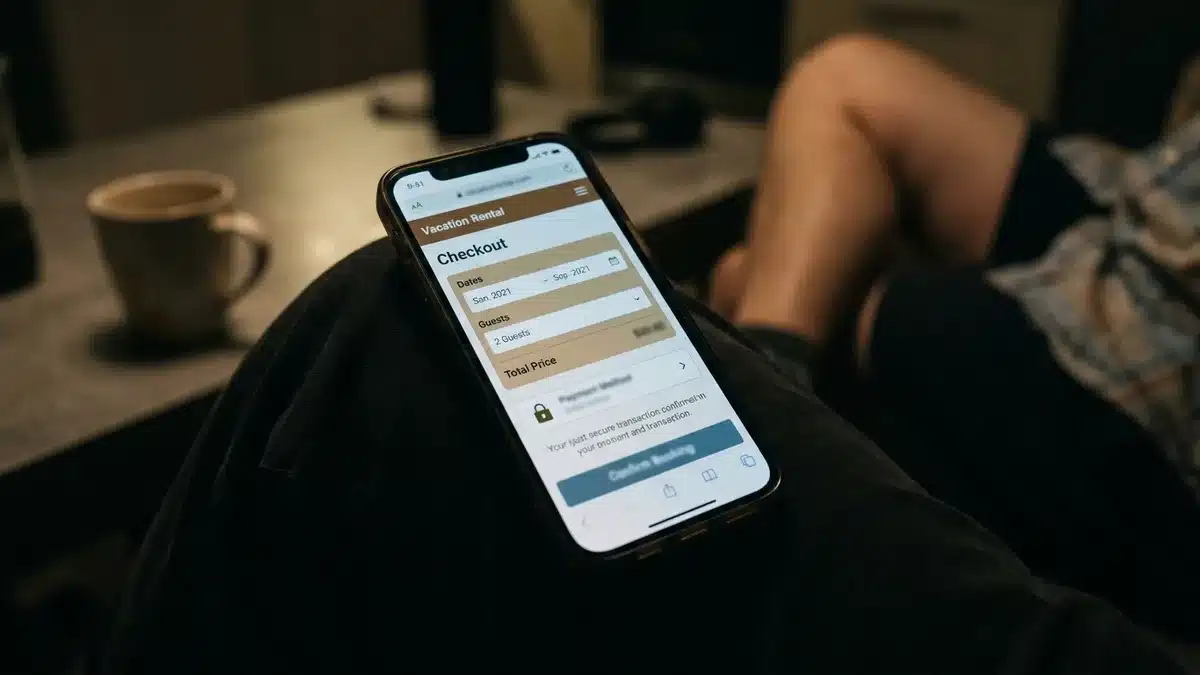
Checkout security matters just as much. Guests need to see visible trust signals, a clear deposit or cancellation policy, and a secure payment processor before they’ll hand over a card number to a site that isn’t Airbnb. A checkout screen with a visible lock icon and transparent pricing breakdown converts noticeably better than a vague “contact us to book” form.
Guest communication automation rounds out the technical requirements. Once a guest books, an STR website should trigger a confirmation, pre-arrival instructions, and post-stay review requests without the host manually sending each one. This is the exact combination we built into Boostly Connect: PMS sync, secure checkout, and CRM-driven messaging running together so the site functions as a full booking system, not just a landing page. For hosts trying to automate that messaging layer specifically, our guide on automating guest messaging without sounding like a bot covers the sequencing in more detail.
How Do You Handle STR Registration and Compliance Alongside Your Website?
STR registration and compliance are separate legal obligations that exist independently of your booking website, and they need to be handled through your local government’s official registration process, not through your website builder. Confusing the two can leave a host operating an unregistered property while assuming a slick website equals legal compliance.
Requirements vary significantly by city and change frequently, so specifics here should always be verified with your local permitting office rather than taken as fixed. That said, a common pattern across regulated markets includes registrant details, proof of applicable occupancy tax remittance, property owner authorization, emergency contact information, and sometimes a required training certificate before a listing can legally operate. Some cities also require hosts to provide a government-issued registration number to any platform where the property is listed, including your own STR website.
Notably, the compliance burden is real and increasing. Short-term rental hosts and platforms face increasingly complex compliance operations due to frequent regulatory changes, which can restrict listings in certain markets entirely. If you’re expanding into a new market or adding units, budget time specifically for confirming current registration rules before your STR website goes live in that jurisdiction, since a registration lapse can mean a platform removes your listing regardless of how well your direct site converts.
This is also where owning your own guest data becomes an operational advantage, not just a financial one. If a regulatory change forces a temporary pause on OTA listings in your market, a host with an established STR website and CRM still has a direct channel to their existing guest base. A host who has only ever operated through OTA listings has no fallback channel at all.
What Content and SEO Does an STR Website Need to Actually Rank?
An STR website needs on-page SEO structure, including optimized property pages, a blog or content section, and technical basics like fast load speed and mobile indexing, to rank in organic search results. Without this foundation, even a well-built booking site with perfect PMS integration will sit invisible to anyone not already searching your brand name by name.
Most hosts build a beautiful site, connect it to their PMS, and then wonder why it generates zero organic traffic six months later. The answer is almost always the same: no content strategy, no keyword targeting, and no local search optimization. A booking engine without discoverability is a locked door with no sign on it.
Google’s shift toward AI-generated overviews in search results in 2026 has made structured, question-answering content more important than ever, not less. Sites built with clear headings, FAQ sections, and specific answers to guest questions get pulled into AI Overviews and cited by tools like ChatGPT and Perplexity far more often than generic marketing pages. For a deeper breakdown of what specifically drives this, our post on vacation rental SEO tips that actually rank in 2026 covers the technical checklist. If your site is already live but underperforming, 8 real causes your vacation rental website isn’t ranking walks through the most common failure points we see in audits.
This is precisely why Boostly Connect ships every STR website with SEO-ready structure from day one, including Google Vacation Rentals integration for additional discovery surfaces beyond organic search, rather than requiring hosts to hire a separate SEO contractor after launch.
How Do You Turn Website Visitors Into Direct Guests?
Converting STR website visitors into paying guests requires a clear conversion path: accurate real-time pricing, an easy checkout, and a reason to book direct instead of defaulting to a familiar OTA. Traffic alone doesn’t produce revenue if the path from landing page to confirmed reservation has friction.
The single biggest conversion killer we see across audits is a mismatch between the listed price on the STR website and the price the guest remembers seeing on Airbnb. If your direct site doesn’t offer a clear reason to book there instead, discount codes, gift vouchers, or a direct-only rate, guests default to whatever platform they already trust. Building in a direct-booking incentive, even a modest one, gives hesitant guests a concrete reason to skip the OTA.

Payment friction is the second most common issue. If your checkout requires an email exchange before a guest can pay, you’ve added a step your OTA competitor doesn’t have. Our guide on accepting payments for direct bookings the right way covers the specific setup choices that reduce this friction without adding compliance risk.
Once a booking is captured, the follow-up matters just as much as the initial conversion. Automated review requests and stay-history tracking keep that guest in your retention funnel for their next trip. Our post on how to automate review requests for your vacation rental fast covers the mechanics of that follow-up sequence, which is also built directly into Boostly Connect’s CRM so it runs without manual list management.
What Mistakes Do Hosts Commonly Make Building an STR Website?
The most common STR website mistakes involve treating the site as a one-time project instead of ongoing infrastructure, skipping PMS integration, and launching without any plan to drive traffic to it. Each of these mistakes is fixable, but they compound when combined.
- Building a static site with no PMS sync. This forces manual double-entry of availability and pricing, which breaks down within weeks for any host managing more than one listing.
- Launching with zero traffic strategy. A beautiful website that nobody finds generates nothing. Hosts need an active plan combining SEO content, social channels, and past guest outreach from day one, not as an afterthought.
- No guest data capture at checkout. Without automatically logging guest details into a CRM, every direct booking is a missed opportunity for the next stay.
- Fear of losing Airbnb ranking. Many hosts hesitate to promote their own site because they worry Airbnb will penalize their listing visibility. In practice, most hosts run both channels simultaneously without issue, using the STR website specifically for repeat and referral guests rather than replacing OTA traffic entirely.
- Underestimating the manual workload of managing separate tools. A website, a PMS, and a CRM that don’t talk to each other require constant manual reconciliation, exactly the kind of breakable, stitched-together stack Boostly Connect was designed to eliminate by connecting all three into one automatically synced system.
If your current setup already touches on some of this and you’re trying to reduce the operational load specifically, reducing manual work in your vacation rental business and building a direct booking website without hiring a developer both go deeper into the step-by-step fixes.
How Long Does It Take to Launch an STR Website?
Launching a fully functional STR website with PMS integration typically takes far less time than most hosts expect once the property system is already in place, though the exact timeline depends on whether you’re building manually or using a done-for-you platform. The bottleneck is almost never design; it’s the PMS-to-website sync.
Hosts building manually, stitching together a website builder, a separate booking plugin, and a manually connected calendar, often spend weeks troubleshooting sync errors between systems that were never designed to talk to each other. Every plugin update risks breaking the connection, and every broken connection risks a double-booking.
Boostly Connect was specifically engineered to compress this timeline. Because the platform supports 8 PMS integrations, connecting your existing system, whether that’s Hospitable, Guesty, Lodgify, Hostfully, or another supported platform, takes under five minutes, with the full website syncing live availability and real-time pricing in under 20 minutes total, with no developer and no coding required. For up to 3 listings, there’s a free plan that puts your properties on the Discover map, and your own website starts at $29/month.
The setup speed matters less than what happens after launch, though. One host who launched a professional website found it attracted local landlords who wanted him to manage their properties directly, eventually growing his portfolio from a handful of units to more than 50 through referral demand the site generated. That kind of outcome depends on pairing fast technical setup with sustained marketing effort, not the launch speed alone.
Frequently Asked Questions
What is an STR website exactly?
An STR website is a short-term rental operator’s own booking site, hosted on their own domain and connected to their property management system, allowing guests to book directly without going through Airbnb, Vrbo, or Booking.com and without the platform commission attached to that reservation.
Do I need a developer to build an STR website?
No. Modern STR website platforms, including Boostly Connect, are built specifically so hosts can launch without coding knowledge or a developer, connecting an existing PMS to a live WordPress site through a guided setup process rather than custom development work.
Will building my own STR website hurt my Airbnb ranking?
Most hosts run an STR website alongside their existing Airbnb listing without any ranking penalty, since the two channels serve different purposes. Airbnb ranks listings based on factors like response rate, reviews, and booking history on its own platform, not based on whether a host also markets a separate direct booking site.
Which PMS platforms integrate with STR websites?
Common PMS platforms that integrate with STR direct booking websites include Hospitable, Guesty, Lodgify, Hostfully, and OwnerRez, among others. Boostly Connect specifically supports 8 different PMS integrations, allowing most hosts to connect their existing system in under five minutes.
What happens to guest data when someone books through my STR website instead of an OTA?
When a guest books directly through your own STR website, their contact information, stay history, and preferences are captured into your own CRM rather than being retained by the OTA. This means you can market directly to that guest for future stays instead of relying on the platform to resurface your listing.
Is an STR website the same as a government STR registration portal?
No. An STR website is your own booking platform for taking direct reservations, while an STR portal typically refers to a municipal government system used for short-term rental licensing and compliance registration. Hosts in regulated markets usually need both, but they serve entirely separate functions.
How much can I realistically save by shifting bookings from OTAs to a direct STR website?
Savings depend on your current OTA commission structure and how much of your booking volume you shift to direct channels, since OTAs commonly charge in the 15-20% commission range per reservation. Hosts who successfully build repeat and referral traffic through their own site keep that full commission amount instead of paying it out on every booking.
Can an STR website handle multiple properties, or is it just for a single listing?
STR websites can handle multiple properties within a single connected system, syncing pricing, availability, and guest data across every listing rather than requiring a separate site or tool per property. This is particularly relevant for boutique property managers and portfolio operators scaling beyond a handful of units.
Conclusion
An STR website works best when it’s treated as active booking infrastructure, not a static brochure page. The hosts who see real results, like the B&B that reached 90% direct bookings, or the operator whose site attracted enough landlord interest to grow a 50-plus property portfolio, all paired a properly synced website with consistent marketing effort behind it. A site with no PMS sync, no SEO structure, and no guest data capture simply won’t produce those outcomes, regardless of how polished the design looks.
If you’re weighing whether to build this yourself or bring in a platform that handles the PMS sync, CRM, and SEO structure together, the math is usually straightforward once you total what OTA commissions cost you annually against the setup effort of a done-for-you site. In 2026, with compliance requirements tightening in many markets and OTA fee structures showing no sign of easing, owning your own booking channel isn’t a future project, it’s current infrastructure most operators are already missing.

If you’re ready to see what an STR website connected to your own PMS actually looks like in practice, rather than a generic template, book a demo with Boostly Connect and watch your listings sync and go live in under 20 minutes.