

A rental booking website is a site owned by the property host, not a third-party marketplace, where guests can check live availability and pay directly for a short-term rental stay. The best ones sync in real time with the host’s existing property management system so pricing and calendars never go stale. In 2026, hosts who run one alongside Airbnb and Vrbo typically keep more of every reservation dollar, because there’s no 15 to 20 percent commission taken off the top.
Key Takeaways
- A rental booking website works best when it syncs live with your property management system (PMS), not as a static page you update by hand.
- In Q4 2026, Airbnb accounted for 54 percent of US reservations and 45 percent of revenue, while direct bookings fell to 21 percent of reservations, according to Short Term Rentalz / Key Data’s Q1 2026 US Booking Windows Report.
- Online booking is projected to hold 66.2 percent market share in 2026, according to StayFi, which means a rental booking site with a clunky checkout is actively losing you reservations.
- You do not need to abandon Airbnb or Vrbo to run a direct booking website. Most operators run both channels at once and simply redirect repeat guests to their own site.
- Hosts who invest in a proper direct booking setup and CRM, rather than a static template, tend to see meaningfully higher repeat guest rates over time.
- Boostly Connect builds a done-for-you rental booking website that syncs your existing PMS in under 20 minutes, so guests see real availability without you touching a spreadsheet.
If you’re managing even two or three listings, you’ve probably already felt the specific sting of an OTA commission statement. Fifteen to twenty percent gone, every single booking, before you’ve paid a cleaner or covered a utility bill. A rental booking website is how you stop that leak without walking away from the guest volume Airbnb and Vrbo still bring you.
At Boostly Connect, we’ve watched thousands of hosts make this exact transition, from fully OTA-dependent to running a real direct channel alongside their listings. The pattern repeats itself: hosts who wait too long to build a rental booking website lose track of who their guests even are. Every returning guest just goes back to the platform that originally sent them, because nobody ever gave them a reason, or a link, to book anywhere else.
This guide covers what actually makes a rental booking website convert in 2026, how to choose or build one without hiring a developer, and where most hosts get the setup wrong. We’ll also walk through the comparison points nobody else covers clearly: fee structures, PMS syncing, and what happens to your guest data depending on which path you choose.
What Is the Best Website to Search for Rentals?
The best website to search for rentals depends on whether you’re a guest browsing inventory or a host trying to capture that guest directly. For guests, large marketplaces aggregate the most listings in one place. For hosts, though, the “best” rental booking website isn’t the one with the most competing inventory next to yours, it’s the one that’s entirely your own.
Marketplace search functions work by pulling thousands of listings into one filterable results page. That’s useful for a guest comparing ten properties in one neighborhood. It’s terrible for you as a host, because your property sits one click away from a competitor’s, often ranked by algorithmic factors you don’t control.
A rental booking website flips that dynamic. Instead of competing inside someone else’s search results, you become the destination. Guests who already know your property, whether from a past stay, a referral, or your own marketing, land on a page with no competing listings, no algorithm, and no commission on the transaction that follows.
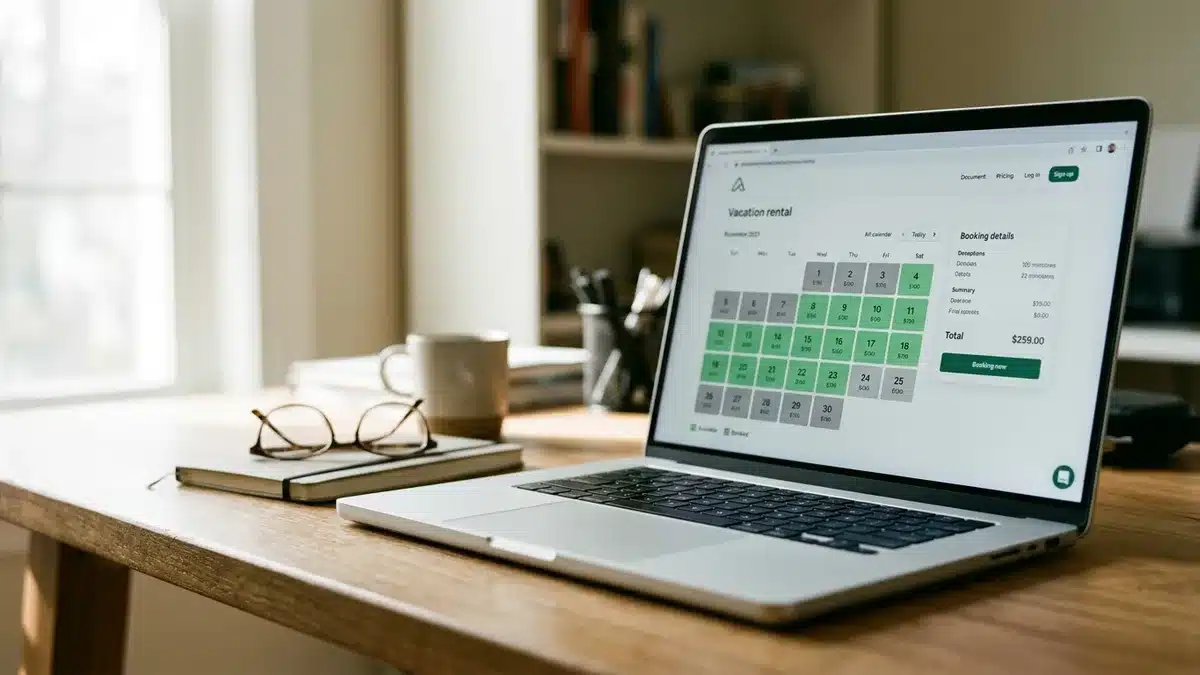
That’s specifically the gap a direct booking website built without hiring a developer is designed to close. Boostly Connect’s approach connects your existing PMS so the availability guests see on your own site is exactly as current as what’s on Airbnb, updated automatically rather than manually.
What’s the Best Website for Rental Properties If You’re the Host?
For a host, the best website for rental properties is a self-owned, PMS-connected site rather than a listing on a shared marketplace. Ownership matters because it determines who keeps the guest’s contact information, who controls pricing display, and who absorbs the commission on every booking.
Most independent owners try one of three routes: a static template builder, a basic booking-engine plugin bolted onto WordPress, or a fully connected system that syncs PMS, website, and CRM together. The first two routes tend to break down as soon as volume increases, specifically because calendar syncing has to be maintained manually or through fragile plugin chains.
Boutique property managers running five to twenty units feel this most acutely. A tech stack cobbled together from separate tools for booking, email, and calendar sync creates the exact kind of sync errors that erode guest trust when a “available” date turns out to be already booked.
We built the connected infrastructure short-term rental managers actually need around this specific failure point. Boostly Connect supports 8 PMS integrations, including Hospitable, Hostfully, Lodgify, and Guesty, so your rental booking website reflects live pricing and availability without a second system to babysit.
What Is the Best Site to Use for Vacation Rentals as a Guest Coming Back?
The best site for a returning vacation rental guest is whichever one makes rebooking effortless and personal. For a guest who already stayed with you once, that should never require going back through a marketplace search. It should be your own rental booking website, ideally one that remembers who they are.
This is where most hosts leave real money behind. A guest checks out, has a great stay, and six months later searches Airbnb again instead of typing your property name directly. That’s not guest disloyalty, it’s a design failure. Nobody captured their email, sent a thank-you sequence, or gave them a direct-only reason to skip the platform next time.
Airbnb does provide some retention tools of its own. Hosts can use the Airbnb Special Offers feature to send discounts to past guests, and returning guests can use the Airbnb Re-book feature to quickly reserve the same property again. But both tools keep the guest relationship, and the commission, inside Airbnb’s ecosystem.
A rental booking website with an actual CRM behind it solves this differently. Every guest who books direct through Boostly Connect gets automatically captured into your own contact database, not Airbnb’s. That’s how a bed and breakfast we worked with reached 90 percent direct bookings and 60 percent repeat guests, by owning that relationship instead of renting it back from a platform every time.
What Is the Best Website to Book a Rental Car or Property For, and Why Does the Booking Flow Matter?
The booking flow on a rental website refers to the number of steps, clicks, and fields a guest completes between choosing dates and completing payment. Industry data on rental booking platforms suggests that a typical online rental checkout completes in under two minutes when the flow is well designed, and the average online rental booking value across platforms runs around $400.
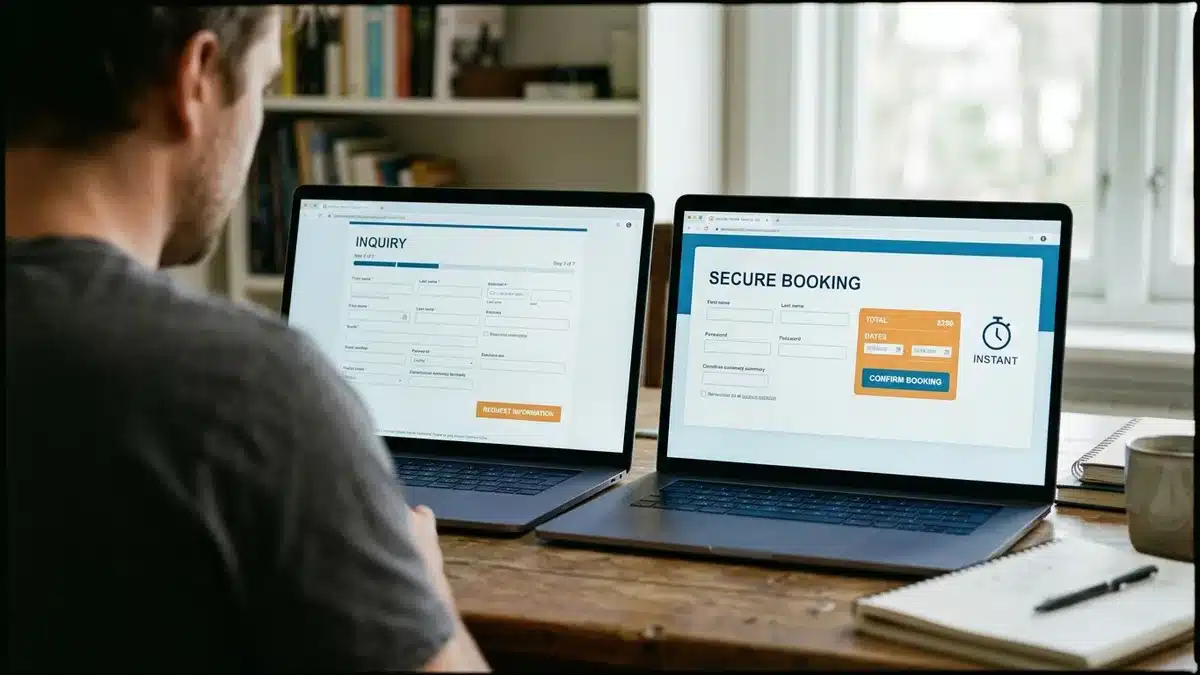
A slow, confusing checkout is one of the most underrated reasons a rental booking website fails to convert, even when the property itself is appealing. If a guest has to leave the page to check a separate calendar, wait for a manual quote, or fill out a lengthy inquiry form before seeing a price, most will simply return to Airbnb where checkout is already familiar.
Notably, online rental booking platforms overall are growing at roughly twice the pace of the broader rental market, largely because operators are shifting away from manual, phone-based, or inquiry-only booking workflows. That shift rewards hosts whose direct site checkout feels as instant as an OTA’s.
This is exactly why Boostly Connect’s website templates are built with conversion in mind from the first click, not as an afterthought bolted onto a generic page. Live pricing pulls directly from your synced PMS, so a guest sees the same real-time rate and availability they’d find on Airbnb, minus the platform markup, and completes checkout in the same visit.
How Do You Choose or Evaluate a Rental Booking Website Setup?
Evaluating a rental booking website setup means comparing fee structure, PMS integration depth, guest data ownership, and checkout speed, not just visual design. Most hosts pick based on how a template looks, then discover months later that it doesn’t sync with their calendar or capture any guest information at all.
The Comparison Framework Most Hosts Skip
Few resources walk hosts through a structured, side-by-side evaluation of what actually differs between a bare-bones site builder and a fully connected system. Here’s the framework we recommend before committing to any option.
| Evaluation Criteria | Static Template / DIY Builder | Booking Plugin Only | Fully Connected System (PMS + Site + CRM) |
|---|---|---|---|
| Calendar accuracy | Manual updates required | Syncs, but often breaks with updates | Live sync from your existing PMS |
| Guest data capture | None built in | Basic, no automation | Automatic capture into a guest CRM |
| Setup involvement | DIY, ongoing maintenance | Requires plugin troubleshooting | Connected in minutes, no developer needed |
| Repeat guest marketing | Manual, if done at all | Not included | Automated email/SMS nurture built in |
| Best fit | Single property, very low volume | Hosts comfortable with technical upkeep | Growing hosts and multi-property operators |
A single-property owner with very low booking volume can honestly get by on a basic static page for a while. We won’t pretend otherwise. But the moment you’re managing multiple listings, or trying to build a repeat guest base, the manual sync and missing CRM in the first two columns become the exact bottleneck that stalls growth.
Boostly Connect was built specifically for that third column: a rental booking website that connects your PMS, your site, and your guest CRM so all three run without you touching them daily. If you want to see the mechanics of this without a sales pitch first, our piece on reducing manual work in a vacation rental business breaks down exactly where the manual hours disappear to.
How Does Fee Structure Compare Across Booking Channels?
Fee structure comparison across rental booking channels shows a consistent pattern: marketplaces charge a recurring commission on every transaction, while a direct booking website has no per-booking commission once it’s built and connected. In Q4 2026, Airbnb represented 54 percent of US reservations and 45 percent of revenue, according to Short Term Rentalz’s Key Data report, a gap that reflects how much of that transaction volume still funnels through commission-based channels.
The math compounds fast. A host running five properties at moderate occupancy loses a meaningful percentage of gross revenue every month to commission, whether or not they ever build an alternative. That’s money that doesn’t come back, and it’s separate from the guest data loss, since the platform, not the host, retains that guest’s contact information for future remarketing.
We’ve seen this play out concretely. One rental operator we worked with made his first direct booking worth £800 after applying a single tactic from a free challenge, a modest number on its own, but proof that the direct channel works the moment you give guests a reason to use it. He later scaled that same rental booking website approach to a portfolio of over 30 properties, reaching 55 percent direct bookings.
Boostly Connect’s founder, Mark Simpson, personally recovered over $30,000 annually in platform fees after making this same shift, which is why the platform’s entire structure is designed around eliminating that recurring loss rather than just discounting it slightly.
What Does Guest Data Ownership Actually Mean for a Rental Booking Website?
Guest data ownership refers to who retains a guest’s contact information, booking history, and communication preferences after checkout, the host or the platform. On a marketplace listing, that data typically stays with the platform, which can use it to remarket the same guest toward other properties, including your direct competitors.
Most hosts never think about this until they’ve lost a guest they thought was loyal. The guest didn’t defect on purpose. They just searched Airbnb again because that’s the only place they had a saved login and payment method.
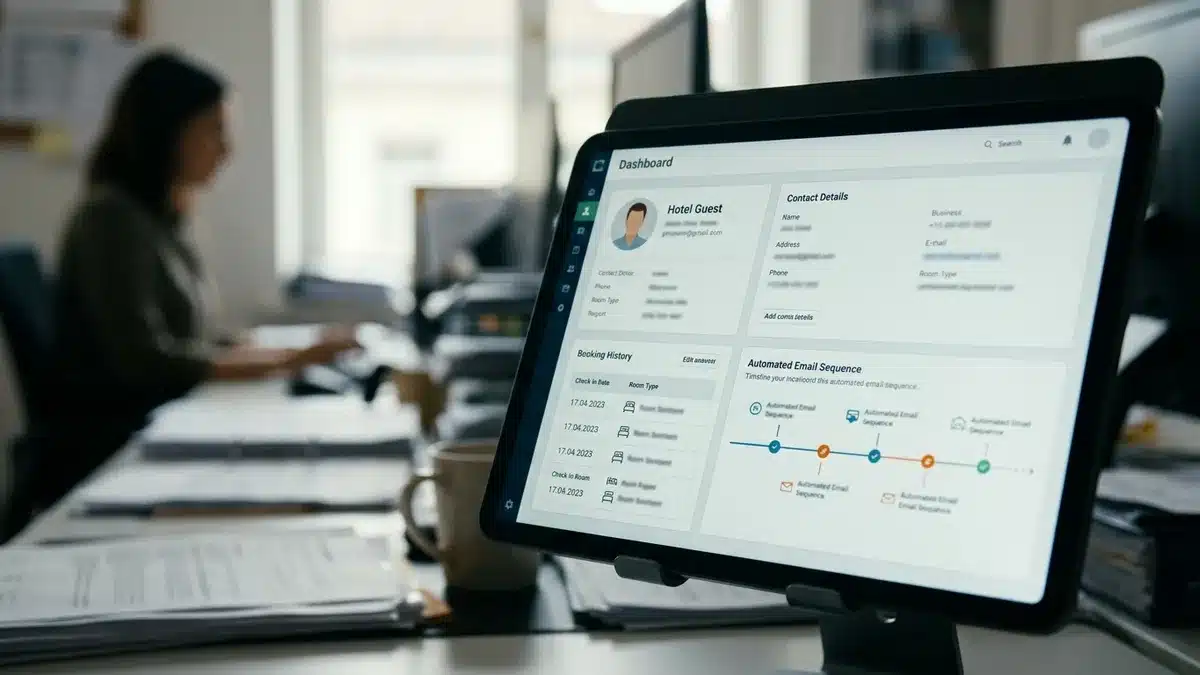
A rental booking website with a CRM behind it changes who owns that relationship. When a guest books through your own site, their contact details, stay history, and preferences flow into a system you control, not one the marketplace controls. That data becomes the foundation for the review requests, repeat-stay offers, and win-back sequences covered in our guide on how to re-engage past vacation rental guests.
Boostly Connect automatically captures every direct booking guest into its built-in CRM, so you’re not manually exporting spreadsheets or paying for a bolt-on email tool separately. Rather than manually chasing past guest emails, hosts using this system see repeat-stay offers go out automatically, without lifting a finger after the initial setup.
Will Building a Direct Rental Booking Website Hurt Your Airbnb Ranking?
Building a direct rental booking website does not directly hurt your Airbnb search ranking, because Airbnb’s algorithm weighs factors like response rate, review scores, and booking acceptance on its own platform, not whether you also operate an outside site. This is one of the most common fears we hear, and it’s worth addressing directly rather than glossing over.
Most hosts running a successful direct channel keep their Airbnb listing fully active at the same time. The two channels serve different guests: new guests still find you on Airbnb, while returning guests and referrals get redirected to your own rental booking website. You’re not choosing one over the other, you’re adding a second revenue channel next to the first.
Where hosts sometimes get this wrong is trying to funnel every guest away from Airbnb immediately, including first-time bookers who found you specifically through that platform’s search. That approach can actually violate platform terms around circumventing bookings within an active reservation. The smarter approach targets repeat guests and organic direct traffic, people who already know your property by name.
Our take: keep both channels running. Boostly Connect’s clients typically reach an average of 65 percent direct bookings within 12 months while their Airbnb listings remain live and active the entire time. That’s the balance worth aiming for, not an either-or decision.
What Role Does SEO Play in a Rental Booking Website’s Performance?
SEO for a rental booking website refers to how well your site’s pages are structured to appear in organic Google search results and AI-powered search tools, independent of any marketplace listing. A site with zero SEO foundation, no property page structure, no blog, no local search signals, essentially never ranks, no matter how nice it looks.
This is the gap between a page that exists and a page that generates its own traffic. Many hosts build a rental booking website, publish it once, and wait. Nothing happens, because nothing was built to be found. Search engines need structured property pages, clear location signals, and fresh content to know the site exists and is relevant.
Additionally, Google Vacation Rentals and metasearch integrations offer discovery surfaces beyond organic search alone, giving a direct booking site more paths to visibility than search ranking by itself. For a deeper technical breakdown of where these efforts commonly fail, see our guide on why a vacation rental website isn’t ranking and our companion piece on vacation rental SEO tips that actually rank in 2026.
Instead of hiring a separate SEO contractor, hosts working with Boostly Connect get SEO-ready property pages and a built-in blog structure from day one, plus a direct integration path toward Google Vacation Rentals, rather than assembling that groundwork themselves after the fact.
What Should You Prioritize When Setting Up a Rental Booking Website?
Prioritizing the right elements when setting up a rental booking website means focusing first on live PMS sync, second on checkout speed, and third on guest data capture, in that order. Design polish matters less than these three functional pillars, though most first-time builders get the order backwards.
- Connect your PMS first. Whether you run Hospitable, Hostfully, Lodgify, or Guesty, get live calendar and pricing sync working before anything else. A beautiful site with a stale calendar loses guest trust immediately.
- Simplify the checkout to as few steps as possible. Given that online rental checkouts typically complete in under two minutes on well-built platforms, your own site should match that pace, not exceed it.
- Build in automatic guest data capture. Every completed booking should feed a CRM automatically, not require manual export later.
- Add a repeat-guest nurture sequence. Automated emails after checkout, review requests, and win-back offers keep guests coming to your site instead of a marketplace search bar.
- Layer in SEO structure from launch. Property pages, location pages, and a blog give your rental booking website a way to generate its own traffic over time.
The most common mistake we see: hosts spend weeks perfecting visual design while their calendar sync and CRM sit unconfigured. Fix the plumbing before the paint. If your processes are breaking down as you try to juggle multiple properties on top of this setup, our guide to balancing OTA and direct bookings covers how to sequence the transition without disrupting either channel.
How Long Does It Actually Take to Launch a Rental Booking Website?
Launching a rental booking website with a connected PMS typically takes under 20 minutes when the integration is built for it, rather than weeks of custom development. That figure surprises most hosts, who assume a direct site requires a developer, a design brief, and a lengthy build process similar to a custom business website.
The setup time collapses specifically because of the PMS integration layer. Instead of manually inputting property details, photos, and pricing rules, connecting an existing PMS like Hospitable or Guesty pulls that data directly, syncing it to a pre-built, conversion-tested template. No developer, no coding knowledge, and no upfront cost for the first ten listings changes the calculus entirely for a host who assumed this project would take months.
Multi-property operators managing 20 or more units benefit even more from this speed, since manual setup time would otherwise multiply across every listing. A connected system keeps pricing, availability, and guest data unified across the whole portfolio from one dashboard, rather than replicating a build process property by property.
If your processes are already straining as you scale past a handful of units, book a demo to see how Boostly Connect manages multiple properties from one connected system rather than a patchwork of separate tools per listing.
Frequently Asked Questions
How long does it take to set up a direct booking website with Boostly Connect?
Most hosts have their rental booking website live with synced availability in under 20 minutes, connecting an existing PMS like Hospitable, Hostfully, Lodgify, or Guesty without writing any code.
Will switching to direct bookings hurt my Airbnb search ranking?
No. Airbnb’s ranking factors relate to your activity on its own platform, such as response rate and reviews, not whether you also run a rental booking website elsewhere. Most hosts run both channels simultaneously.
Which property management systems integrate with Boostly Connect?
Boostly Connect supports 8 PMS integrations, including Hospitable, Hostfully, Lodgify, and Guesty, syncing live availability and pricing to your rental booking website automatically.
Do I need a developer or coding experience to launch my direct booking site?
No developer or coding experience is required. Boostly Connect’s rental booking website connects to your existing PMS and syncs automatically, with a free plan for up to 3 listings on the Discover map.
What happens to my guest data when someone books direct instead of through an OTA?
Guest contact information and booking history flow automatically into your own CRM rather than staying with a third-party marketplace, giving you a record you control for future marketing.
What is the best website to book a rental car or property for a returning guest?
For a returning guest, the best option is usually the property’s own direct rental booking website, since it skips marketplace search and lets the guest rebook the exact property they already know.
Can Boostly Connect handle multiple properties, or just a single listing?
Boostly Connect supports multi-property and multi-listing management from one connected system, keeping pricing, availability, and guest data unified across an entire portfolio rather than per property.
Conclusion
The math on OTA commissions rarely lies: every booking that runs through Airbnb or Vrbo instead of your own rental booking website is money, and guest data, you don’t get back. As of 2026, with direct bookings sitting at roughly 21 percent of US reservations against Airbnb’s 54 percent share, the gap is still wide open for hosts willing to close it. Fixing this doesn’t require a developer, a new tech stack, or months of setup. It requires connecting the systems you already use to a site built to convert.
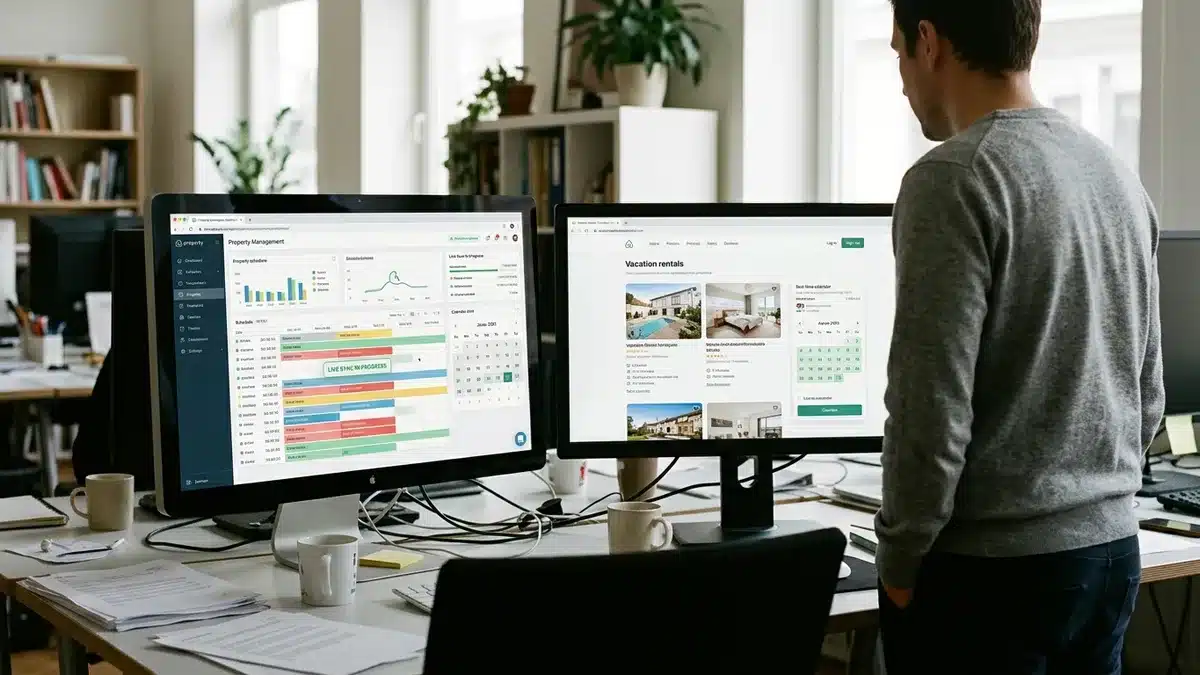
Curious what a rental booking website connected directly to your own PMS looks like in practice, with your own property data instead of a demo template? Book a demo with Boostly Connect and see your calendar, pricing, and guest CRM connected in under 20 minutes.