

The best website builder for vacation rentals in 2026 is one that connects directly to your property management system, syncs live availability without manual updates, and captures every guest’s contact information into a CRM you own. Generic drag-and-drop builders can produce an attractive page, but most fail at the one job that actually matters: converting browsers into direct bookings instead of Airbnb or Vrbo reservations.
Key Takeaways
- A vacation rental website builder needs live PMS syncing, not just design templates, or you will spend hours manually updating calendars.
- Generic builders like all-purpose website platforms lack native short-term rental features such as real-time pricing sync and guest data capture.
- Data portability matters: your booking history and guest contacts should export freely, never locked inside one vendor’s system.
- Google Vacation Rentals listing and schema markup require structured data most generic builders don’t configure out of the box.
- Repeat booking rates in the vacation rental industry commonly fall between 10 and 25 percent, according to Hostex, which makes owning your guest CRM valuable long term.
- This approach solves this by syncing your existing PMS to a direct booking site in under 20 minutes, with guest data automatically captured into your own CRM.
If you’ve spent any time comparing vacation rental website builders, you’ve probably noticed the same problem we see with hosts every week: most tools are either too generic (built for restaurants and photographers, not short-term rentals) or too rigid (locked-in booking engines with no PMS flexibility). Neither actually solves the core issue, which is getting guests to book direct instead of paying Airbnb or Booking.com their cut.
At our company, we built our platform specifically because we watched hundreds of hosts launch a beautiful-looking website that never generated a single booking. The design wasn’t the problem. The absence of live availability syncing, guest data capture, and search visibility was. This article breaks down what actually separates a functional direct booking website from a decorative one, and where each type of builder fits depending on your portfolio size.
We’ll compare feature sets, walk through the content gaps most builder comparisons skip (data portability, schema setup, migration paths), and give you a clear framework for choosing. As of 2026, the vacation rental software market continues expanding fast, and the builder you pick now determines how much of that growth you actually capture versus hand over in OTA commissions.
What Is the Best Website for Vacation Rentals?
The best website for vacation rentals is a site built specifically for short-term rental hosting, with live PMS-synced availability, a working booking engine, and guest data capture, rather than a general-purpose template site. General website builders can host photos and a contact form, but they were never designed to sync a calendar in real time or convert a visitor into a paying direct guest.
Most hosts start with a general-purpose builder because it’s familiar and cheap to launch. The problem shows up three months later, when the calendar on the site doesn’t match the actual PMS availability because nobody updated it manually. Guests book, then get an awkward cancellation message. That’s the exact trap a PMS-connected site avoids: your availability calendar pulls live data, so what’s shown online always matches what’s actually free.
This is precisely why we designed our platform around PMS integration first, design second. Our platform connects directly to your existing property management system, whether that’s Hospitable, Hostfully, or other providers, so your website always displays real-time pricing and availability without you touching a spreadsheet.

How Can I Build a Website for My Vacation Rental Business?
Building a vacation rental website in 2026 requires three connected components: a property management system for operations, a website that syncs live data from that system, and a CRM that captures guest contact details at checkout. Skipping any one of these creates a gap that eventually costs you bookings, either through outdated availability or lost guest relationships.
Most independent owners try to stitch this together with separate tools: a website builder for the front end, a spreadsheet for pricing notes, and no CRM at all. It works for a while, until a returning guest emails asking about their old reservation dates and nobody can find the record. That guest, understandably, goes back to Airbnb next time, because at least Airbnb remembers who they are.
We built our platform to remove that gap entirely. Connecting your PMS takes under five minutes across all 8 supported integrations, and once it’s live, every direct booking automatically feeds guest contact data into your own CRM rather than disappearing into a spreadsheet nobody checks. If you want a step-by-step walkthrough of the setup process without hiring a developer, our guide on how to build a direct booking website covers the exact sequence.
What Is the Best Software to Manage Vacation Rentals?
The best software to manage vacation rentals combines property management (pricing, availability, guest messaging) with a connected website and guest relationship layer, rather than treating these as separate purchases. A PMS alone handles operations but doesn’t generate direct traffic. A website builder alone generates a page but doesn’t manage your calendar.
Industry data shows the global vacation rental management software market was valued at $0.92 billion in 2026 and is projected to reach $2.38 billion by 2034, growing at roughly 11.1 percent annually according to market research from Data Intelo. That growth reflects a real shift: hosts are consolidating tools instead of running five disconnected apps.
Our platform fits into this consolidation directly. Rather than asking you to buy a separate PMS, a separate website builder, and a separate email tool, it layers on top of the PMS you already use and adds the website plus CRM as one connected system. That’s the difference between a set-it-and-forget-it infrastructure and a stack you’re constantly babysitting for sync errors. If manual busywork is your biggest complaint right now, our piece on reducing manual work in your vacation rental business digs into where hosts lose the most hours.
What’s the Best Platform for Short-Term Rentals?
The best platform for short-term rentals depends on your portfolio size and technical comfort, but for most independent owners and boutique managers in 2026, the deciding factor is native PMS integration paired with built-in CRM and marketing automation. A platform that only builds pages leaves you responsible for everything downstream: SEO, email nurture, guest retention, and analytics.
For a solo host with one listing and minimal traffic ambitions, a basic template builder might genuinely be fine. We’ll say that plainly: if you’re not trying to grow direct bookings meaningfully, a simple no-frills page can work. But the moment you want repeat guests to rebook without going through Airbnb, or you’re managing more than a couple of units, you need infrastructure, not just a page.
That’s the gap our platform fills for growth-stage operators. Beyond the website itself, it includes AI agents that field routine guest questions and upsells automatically, live chat, and email and SMS sequences built to re-engage past guests without manual list-building. For a deeper look at re-engagement mechanics specifically, see our guide on how to re-engage past vacation rental guests.
Direct Booking Website vs Generic Builder: What Actually Differs?
A direct booking website purpose-built for short-term rentals differs from a generic website builder primarily in three areas: PMS connectivity, guest data ownership, and OTA-independent booking flow. Generic builders (the kind marketed to any small business) treat a booking form as a contact form with dates attached. That’s rarely enough for a vacation rental operation running real occupancy.
| Feature | Generic Website Builder | Booking-Engine-Only Tool | This Platform |
|---|---|---|---|
| Live PMS sync | Not native, requires plugins | Sometimes, limited PMS list | 8 native PMS integrations |
| Setup time | Days to weeks with plugins | Varies by provider | Under 20 minutes, PMS sync under 5 minutes |
| Guest CRM included | No, needs separate tool | Rarely included | Built-in, automatic capture on every booking |
| Coaching or support model | Self-service help docs | Ticket-based support | Twice-weekly group coaching calls |
| Coding required | Often for custom features | Minimal | None, no developer needed |
| Upfront cost for first listings | Varies by plan | Varies by provider | A free plan for up to 3 listings on the Discover map |
Notice the gap in the middle column too. Booking-engine-only tools solve reservations but often skip the CRM and coaching layer entirely, leaving you to figure out guest retention on your own. That’s the specific gap we built our platform to close: PMS depth, a genuine CRM with AI agents, and ongoing coaching, rather than a one-time build-and-walk-away service.
How Should You Handle Data Portability and API Access?
Data portability refers to your ability to export guest records, booking history, and content from your website builder without losing that data or your search rankings if you ever switch providers. This is one of the most overlooked factors in builder comparisons, and it’s a real risk: a locked-in system means your guest list, reviews, and SEO equity belong to the vendor, not you.
Before committing to any vacation rental website builder, ask directly whether guest data and booking records export via CSV or API, and whether your content and URLs remain intact if you migrate hosting. Well-documented APIs for channel managers, pricing tools, and analytics matter more as your portfolio scales, because manual re-entry across systems becomes unworkable past a handful of properties.
Our platform is built on an open content system specifically because it avoids proprietary lock-in. Your content lives on a platform you can export, and because every guest who books direct feeds into your own CRM (not ours to retain or resell), your contact data stays yours if your business needs ever change. Guest ownership, not platform ownership, is the entire point.
How Do You Set Up SEO and Schema for Google Vacation Rentals?
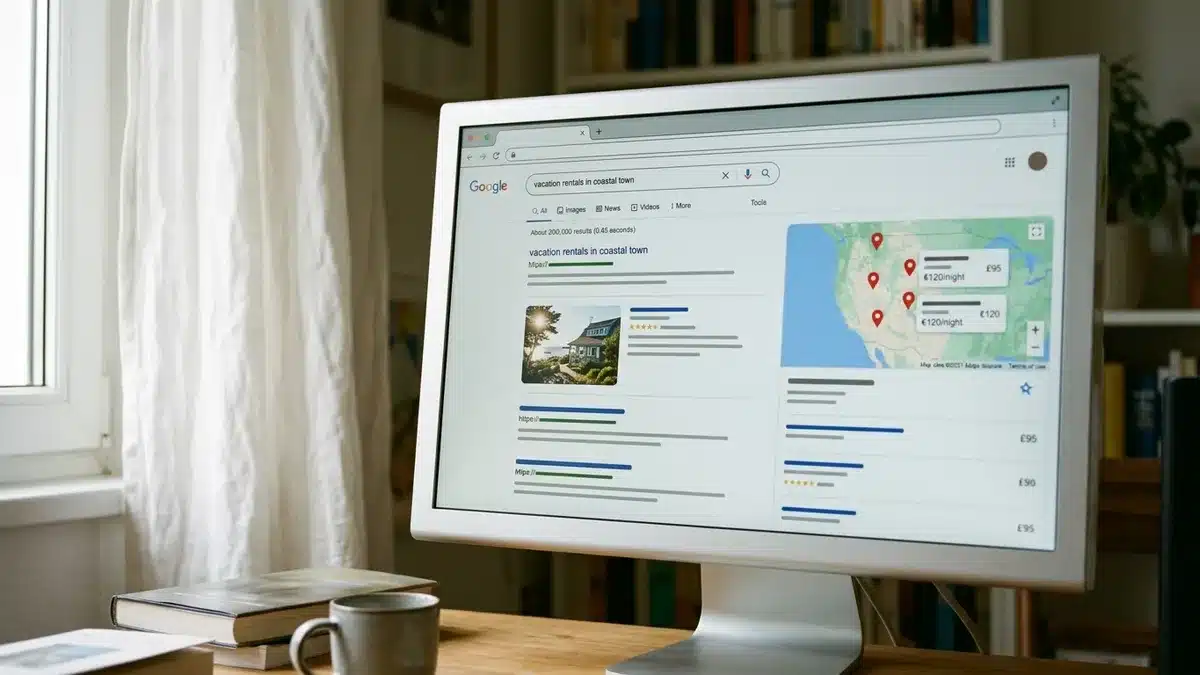
Setting up SEO and schema for Google Vacation Rentals means adding structured data markup to your property pages so Google can display your listing directly in vacation rental search results, alongside your pricing and availability. Without this markup, your site can rank in general search but won’t appear in the dedicated vacation rentals search experience that increasingly drives bookings.
The steps most hosts skip: first, confirm your website platform supports schema.org structured data for lodging businesses. Second, ensure your pricing and availability data updates dynamically rather than sitting static, since Google penalizes stale listing data. Third, submit your feed for review through Google’s vacation rental integration process.
Because generic builders weren’t designed with lodging schema in mind, hosts frequently need a developer or plugin just to get this configured correctly. Websites built on our platform ship SEO-ready with lodging schema built in from launch, which is why we point hosts to our guide on how to get listed on Google Vacation Rentals as a companion resource rather than a separate project. If your existing site already struggles to rank at all, our article on why your vacation rental website isn’t ranking covers the most common causes.
How Do You Migrate From a Generic Builder to a Rental-Specific One?
Migrating from a general website builder to a rental-specific platform involves four practical steps: auditing your existing content and URLs, exporting guest and booking data, connecting your PMS to the new platform, and redirecting old URLs to preserve any search ranking you’ve already earned. Skipping the redirect step is the single most common mistake we see, and it can erase months of SEO progress overnight.
First, list every page on your current site and note which ones actually receive traffic, since those need 301 redirects to their new equivalents. Second, export any guest contact list or booking history in CSV format before you cancel your old subscription. Third, connect your PMS to the new platform (this is the step that takes under five minutes on our platform, versus days of manual re-entry on tools without native sync). Fourth, verify live availability displays correctly before pointing your domain to the new site.
Common migration mistakes to avoid
- Canceling the old hosting account before confirming data export completed successfully.
- Forgetting to redirect blog post URLs, which quietly kills organic traffic built over years.
- Launching the new site without testing the booking flow end-to-end with a real date range.
We walk hosts through this exact migration process as part of onboarding, because a rushed switch without redirects is worse than staying on a mediocre builder longer.
What Does Long-Term Cost Look Like for One Property vs a Portfolio?
Total cost of ownership for a vacation rental website builder scales very differently for a single-property owner compared to a 20-plus unit portfolio operator. A single owner mainly weighs subscription cost against OTA commission savings. A portfolio operator has to weigh that same math across every unit, plus the added labor cost of managing disconnected tools at scale.
Professional property management companies now control an estimated 42 percent of active short-term rental listings globally as of early 2026, according to industry data, which tells you scale is the direction this market is heading. If your website builder can’t add properties without linear cost or setup time, that scaling math gets ugly fast.
Our platform’s free plan for up to 3 listings on the Discover map is designed with exactly this in mind: a boutique manager growing from five properties to fifteen shouldn’t need to renegotiate pricing or rebuild their site from scratch. Multi-property support runs through the same connected PMS, website, and CRM system, so pricing, availability, and guest data stay unified across every unit rather than fragmenting per listing.
What’s the Real ROI of Switching to a Direct Booking Website?
The return on investment from switching to a direct booking website comes primarily from avoided OTA commissions, which typically run 15 to 20 percent per booking on major platforms, combined with repeat guest revenue you’d otherwise lose to remarketing by the OTA itself. The math compounds every year you delay, because every guest who books through Airbnb instead of your own site is a contact you never get to nurture again.
We’ve watched this play out across our own client base. One bed and breakfast owner increased direct bookings to 90 percent using our platform, alongside a 60 percent repeat guest rate, largely by taking control of their own marketing rather than depending on third-party visibility. In another case, a host who had never built a direct booking channel made his first direct sale, an £800 reservation, from a single tactic during a free strategy challenge, and later scaled to 55 percent direct bookings across a 30-plus property portfolio.
Those aren’t universal guarantees, and results vary by market and effort. But the pattern holds: hosts who own their booking website and guest CRM consistently pull a growing share of revenue away from OTA dependency over time. Our clients reaching 65 percent direct bookings within 12 months isn’t an outlier result, it’s the expected outcome of connecting the right systems. And if that milestone doesn’t happen, we work for free until it does.
How Do You Keep Airbnb Bookings While Growing Direct Bookings?
You don’t need to abandon Airbnb to grow your direct booking channel. Most successful hosts run both simultaneously, using Airbnb for new guest discovery while redirecting returning guests toward their own site for rebookings. Airbnb itself supports this partially through its Re-book feature and its Special Offers tool, though both keep the relationship inside Airbnb’s ecosystem rather than yours.
The fear we hear most often is losing Airbnb search ranking by focusing energy elsewhere. That fear is largely unfounded if you keep your Airbnb listing active and well-reviewed while building your direct channel in parallel. Your Airbnb presence and your own website aren’t competing for the same guest at the same moment, they’re targeting different stages of the guest relationship.
Our platform’s CRM automates the part hosts usually neglect: emailing past guests directly, with discount codes and personalized offers that never touch Airbnb’s cut. That’s a meaningfully different approach than manually exporting guest lists after every checkout, which is what most self-managed hosts do (or more accurately, don’t do, since it rarely happens consistently). For tactics that don’t require a paid ad budget, see our guide on getting more Airbnb bookings without ads.
Practical Guidance: How Do You Choose the Right Builder for Your Situation?
Choosing the right vacation rental website builder starts with an honest inventory of your portfolio size, technical comfort, and growth goals, rather than picking based on template design alone. Use this checklist before committing to any platform.
- Confirm native integration with your specific PMS (ask by name: Hospitable, Hostfully, or whichever system you already run).
- Verify guest data exports freely and isn’t retained exclusively by the platform vendor.
- Check whether lodging schema and Google Vacation Rentals compatibility are built in or require a separate developer.
- Ask how long setup actually takes, and whether you need coding knowledge for basic changes.
- Evaluate whether the platform includes a CRM and guest nurture automation, or only a static contact form.
- Confirm pricing scales sensibly as you add properties, rather than requiring a full re-quote at each tier.
A common mistake we see: hosts choose a builder based purely on visual templates, then discover six months later there’s no way to automate guest follow-up or track real ROI. Our reporting dashboard exists precisely to close that gap, giving hosts a single view of direct booking revenue instead of reconciling numbers across a PMS, a spreadsheet, and a bank statement by hand. For a broader toolkit view beyond just the website, our roundup of must-have tools for short-term rental managers is worth reading alongside this comparison.
Frequently Asked Questions
How long does it take to set up a direct booking website with this type of platform?
Most hosts have their PMS connected in under five minutes and their full direct booking website live in under 20 minutes, with no developer or coding knowledge required. This applies across all 8 supported PMS integrations.
Will switching to direct bookings hurt my Airbnb search ranking?
No. Running a direct booking website alongside an active Airbnb listing doesn’t hurt your Airbnb ranking, since the two channels target different points in the guest journey. Most hosts keep both running simultaneously and simply redirect repeat guests toward their own site.
Which property management systems integrate with this type of platform?
This platform supports 8 PMS integrations, including Hospitable, Hostfully, and other systems. Connecting an existing system takes under five minutes and immediately syncs live availability and pricing to your website.
Do I need a developer or coding experience to launch my direct booking site?
No. This platform is built as a no-code system, and hosts routinely launch their full website in under 20 minutes without touching any code or hiring outside help.
What happens to my guest data when someone books direct instead of through an OTA?
Every guest who books direct through this platform is automatically captured into your own CRM, meaning contact data stays with you rather than being retained by the OTA for remarketing to competing hosts.
How much can I realistically save by reducing OTA commission dependency?
Major OTAs commonly charge 15 to 20 percent commission per booking, so every reservation shifted to a direct channel keeps that full margin with the host instead. The founder of this platform personally recovered over $30,000 annually in platform fees by making this exact shift.
Can this platform handle multiple properties or just a single listing?
This platform supports both single listings and large portfolios, with a free plan for up to 3 listings on the Discover map and multi-property management built into the same connected PMS, website, and CRM system.
Conclusion: What’s the Best Website Builder for Vacation Rentals in 2026?
The best website builder for vacation rentals in 2026 is the one that treats your PMS, website, and guest CRM as a single connected system rather than three separate purchases you have to stitch together yourself. Generic builders can produce a page. Only a rental-specific platform can produce bookings, retain guest data, and scale with your portfolio without breaking every time you add a unit.
If you’re weighing this decision right now, start with the checklist above: confirm PMS integration by name, verify data portability, and check whether Google Vacation Rentals schema is built in from day one. The setup time and cost of switching are almost always smaller than the OTA commission you’ll keep paying by staying put.

If you’re ready to stop losing bookings to Airbnb’s algorithm and see your own PMS-connected website built out in under 20 minutes, book a demo and walk through the setup with your own property data live on screen.