
A website builder for property management is a tool that lets short-term rental hosts and property managers launch a booking-ready website connected to their existing property management system, without hiring a developer. The best options sync live availability and pricing directly from your PMS, so your site never shows outdated calendars or stale rates.
Key Takeaways
- The best website builder for property management syncs directly with your PMS (Hospitable, Guesty, Lodgify, Hostfully, or similar) so availability and pricing update automatically, with no manual entry.
- Roughly 70% of short-term rental bookings now happen on mobile devices in 2026, which means your builder needs a mobile-first checkout, not just a mobile-friendly layout.
- Average vacation rental website conversion sits around 0.32%, while top-performing direct booking sites reach 1.2% to 2.1%, largely because of built-in CRM and email follow-up rather than a static page.
- Around 18% of travelers who start their search on an OTA are expected to finish on a direct booking site in 2026, according to SiteMinder data cited by some providers, making a fast, credible website a real revenue lever.
- General-purpose builders (Wix, Squarespace) can work for a single listing with low volume, but they typically lack native PMS sync, CRM automation, and channel management that portfolio operators need.
- Boostly Connect builds a done-for-you direct booking website on WordPress, synced to your PMS in under 20 minutes, with a built-in CRM on Accelerator and above and a free plan for up to 3 listings on the Discover map.
If you manage anywhere from one listing to a growing portfolio, you’ve probably already tried a generic website builder and hit the same wall: it looks fine, but it doesn’t talk to your booking software. You end up manually updating a calendar widget while your real availability lives somewhere else entirely. That gap is exactly why the phrase website builder for property management gets searched so often in 2026, hosts are done accepting a website that’s disconnected from the business it’s supposed to represent.
We wrote this guide from the perspective of a company that builds these websites for a living. Boostly Connect has watched thousands of hosts make this exact transition, from a static page or an OTA-only presence to a website that actually converts. The pattern repeats: hosts who choose a builder based on templates and design alone end up rebuilding within a year, once they realize design was never the real problem. Sync, conversion, and guest data ownership are.
By the end of this guide, you’ll know what separates a general-purpose website builder from one actually built for property management, what a realistic setup process looks like, and where most portfolio operators lose money without realizing it.
What Is the Best Website Design for Property Management?
The best website design for property management is one built around live PMS data rather than static content, meaning your availability calendar, pricing, and booking flow update automatically without manual input. A design-first approach that ignores this sync layer will always underperform, no matter how polished the templates look.
Most property management website design conversations focus on color palettes, hero images, and typography. Those matter for first impressions, but they’re not what determines whether a visitor books. Specifically, the design elements that move the needle are: a visible, real-time booking widget above the fold, mobile-first checkout forms, and a clear path from property page to confirmed reservation in three clicks or fewer.
In our experience building over 700 websites for hosts and property managers, the biggest design mistake we see is a beautiful homepage sitting on top of a broken or absent booking engine. A visitor lands, browses photos, gets excited, then hits a “contact us” form instead of a live calendar. That’s where the booking dies. Boostly Connect’s WordPress templates are built conversion-first: live availability and real-time pricing sit directly on the property page, pulled straight from your connected PMS, so design and function work together instead of one propping up the other.
How Do I Create a Website for My Rental Property?
Creating a website for your rental property in 2026 involves four core steps: connecting your property management system, choosing a design template, setting up your booking and payment flow, and configuring guest data capture. A host with a single listing can realistically complete this in under an hour using a purpose-built platform, versus days or weeks with a generic site builder and manual plugins.
Step 1: Connect Your Property Management System
Before touching design, connect your PMS. If your booking data lives in Hospitable, Guesty, Lodgify, Hostfully, or OwnerRez, that connection is what feeds live availability to your new site. Skip this step and you’re back to manually updating calendars, which is how double bookings happen.
Step 2: Choose a Template Built for Rentals, Not Generic Business Pages
A rental property needs a photo-forward layout with an embedded booking calendar, not a generic services page template built for a law firm or consultant. Templates matter less than whether the platform supports a booking widget natively, rather than bolting one on through a third-party plugin.
Step 3: Set Up Booking and Payment Flow
Your payment flow needs to handle deposits, full payments, and cancellation policies without redirecting guests off-site. Every redirect is a drop-off point. Learn more about how to accept payments for direct bookings the right way before you go live, since payment friction is one of the most common reasons a direct booking site underperforms an OTA listing.
Step 4: Capture Guest Data on Every Booking
Every direct booking should feed a CRM automatically, capturing name, email, and stay history. Without this step, you’ve built a website that generates bookings but tells you nothing about who’s booking or whether they’ll come back. This is a step manual builders almost always skip. Boostly Connect routes every guest who books direct into its built-in CRM automatically, so the contact stays with you rather than disappearing into an OTA’s database. That’s the difference between a website and infrastructure.

Which Website Builder Is Best for a Rental Business?
The best website builder for a rental business is one with native PMS integration, since that determines whether your site shows real-time availability or requires manual updates. General-purpose builders like Wix or Squarespace can produce an attractive page for a single low-volume listing, but they typically require third-party booking plugins that create sync gaps as you scale.
Purpose-built rental site builders bundle booking widgets, calendars, and channel sync, and industry pricing for these tools commonly runs from roughly $12 to $33 per month per listing depending on the plan and commission structure. That cost adds up quickly for a five- or ten-property portfolio, and many of these tools still stop short of including a CRM or automated guest follow-up.
Here’s how the main categories stack up for a property management use case:
| Builder Type | PMS Sync | Best Fit | Key Limitation |
|---|---|---|---|
| General-purpose builder (Wix, Squarespace-style) | Requires third-party plugin | Single listing, very low volume | No native CRM, manual sync risk grows with each added listing |
| Purpose-built rental booking engine | Native, but limited PMS options | Small independent owners | Per-listing monthly fees, minimal marketing automation |
| AI-generated site builder | Varies by provider | Fast, generic launch | Templates not tailored to rental conversion behavior |
| Boostly Connect | Native across 8 PMS platforms, live in under 20 minutes | 1 to 20+ properties, boutique managers to portfolio operators | Built specifically for STR direct booking, not general business use |
If you’re an independent owner with one property and minimal booking volume, a generic builder plus a plugin can work fine. Once you’re managing multiple units or want repeat guests to rebook without going through an OTA, the sync gap and missing CRM become expensive. That’s precisely the segment Boostly Connect built for: hosts scaling past the point where manual updates make sense.
What Platforms Do Property Managers Use?
Property managers in 2026 typically use a combination of a PMS for operations (Hospitable, Guesty, Lodgify, Hostfully, or OwnerRez), a website builder for the guest-facing booking experience, and a CRM for guest communication and marketing. Many managers still run these three systems separately, which creates data silos and manual reconciliation work.
The trend we’re seeing across our own base of 2,000-plus hosts across 25 countries is consolidation. Managers are actively moving away from stitching together a PMS, a standalone website plugin, and a bolt-on email tool, in favor of platforms where all three are natively connected. Boostly Connect’s own architecture reflects this: your PMS, website, and CRM operate as one system rather than three separate subscriptions that need to be kept in sync manually.
For boutique property managers specifically, the platform choice also signals brand positioning to the owners you manage properties for. A disconnected tech stack looks improvised. A single connected system, PMS to website to CRM, looks like the kind of infrastructure a serious operator runs. If you’re evaluating your current setup, our post on must-have tools for short-term rental managers in 2026 breaks down where most managers are over-tooled and under-connected.
What Should You Look for in a Property Management Website Builder?
The most important factors when choosing a property management website builder are native PMS integration, mobile checkout speed, built-in guest data capture, and SEO readiness out of the box. A platform missing any one of these four typically requires an expensive workaround later.
PMS Integration Depth
Confirm the builder connects directly to your existing PMS rather than through a generic calendar import. Boostly Connect supports 8 PMS integrations, including Hospitable, Guesty, Lodgify, and Hostfully, with setup typically completed in under five minutes once you have your PMS credentials ready.
Mobile-First Checkout
With roughly 70% of 2026 bookings happening on mobile, according to industry benchmarks tracked by StayFi, a builder that only offers a “responsive” desktop layout instead of a true mobile-first checkout flow will bleed conversions. Test the booking path on your own phone before committing to any platform.
Native CRM and Guest Data Ownership
Ask directly: where does guest contact data go after a booking? If the answer is “nowhere, it just confirms the reservation,” you’re building a website without building a business asset. Boostly Connect routes every direct booking into its CRM automatically, which is what powers repeat-guest email sequences later.
SEO Foundation
A site with zero SEO structure at launch, no schema markup, no optimized property page titles, no blog architecture, will rarely rank regardless of how much content you add later. If your current site is struggling, our guide on why a vacation rental website isn’t ranking covers the eight most common causes we see.
Accounting and CRM Integration Depth
This is a gap most builder comparisons skip entirely. If you’re a boutique property manager reporting revenue back to property owners, ask whether the builder’s booking data exports cleanly to your accounting workflow, or whether reconciling direct bookings against owner statements becomes a manual monthly task. Some AI-generated builders and general-purpose platforms offer no accounting-side integration at all, leaving managers to manually cross-reference bookings against bank deposits. A connected system where PMS, website, and CRM already share data reduces this reconciliation load significantly, since the booking record, the guest contact, and the payment all originate from the same sync rather than three disconnected exports.
How Does SEO and Mobile Design Affect Booking Conversion?
SEO and mobile design directly determine whether your property management website generates bookings or sits idle, since a site that doesn’t rank never gets found, and a site that doesn’t convert on mobile loses the majority of the traffic it does earn. Average vacation rental website conversion rates hover around 0.32%, while top operators reach 1.2% to 2.1%, a gap almost entirely explained by mobile checkout friction and weak SEO foundations.
Notably, this is where general website builders and purpose-built rental platforms diverge most sharply. A generic builder might produce a fast-loading, attractive page that still fails to rank because it lacks schema markup identifying it as a lodging business, or because property pages aren’t structured for local search intent. Meanwhile, a rental-specific builder with SEO baked in from launch gives you a real chance at organic visibility without hiring a separate SEO contractor.
Google Vacation Rentals integration adds another discovery surface beyond organic search entirely. If your builder doesn’t support this, you’re relying solely on your own domain authority to compete, which is a slow build for a brand-new site. For a deeper look at ranking mechanics specifically, see our guide on vacation rental SEO tips that actually rank in 2026, and our comparison of the best search engines for vacation rentals in 2026 if you’re deciding where to focus discovery efforts first.
How Do You Set Up a Direct Booking Website Without a Developer?
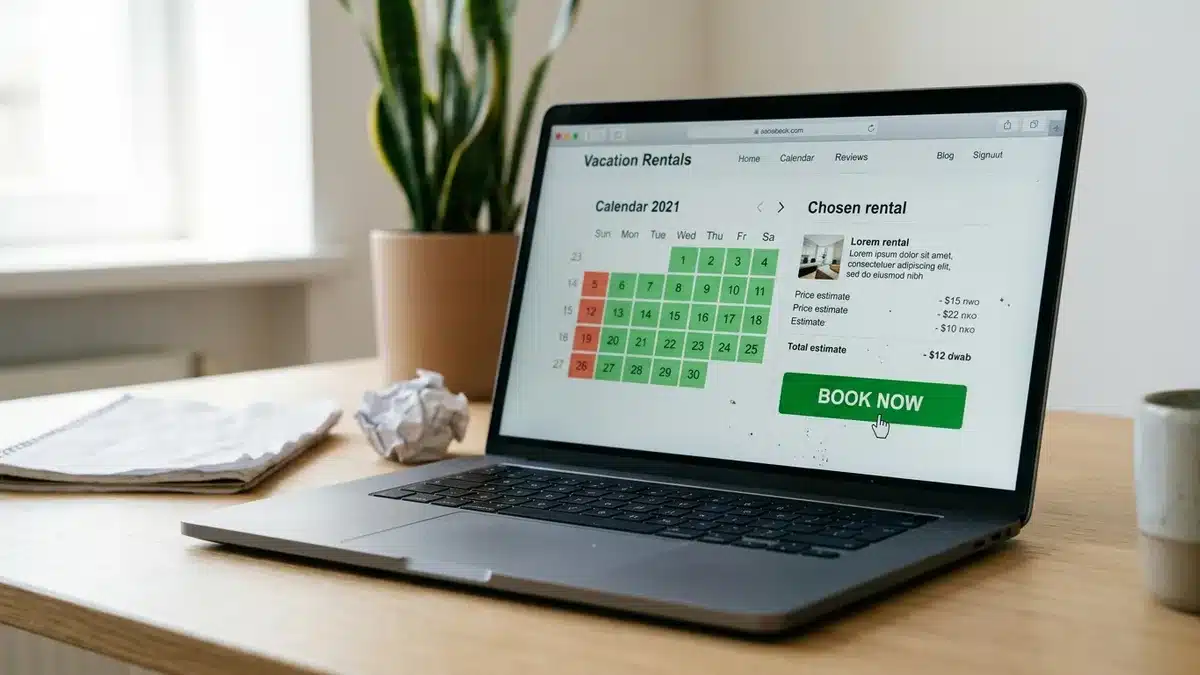
Setting up a direct booking website without a developer is possible in 2026 through platforms that handle the PMS connection, template design, and hosting on your behalf, requiring only that you supply your PMS login and property photos. The realistic setup window for a no-code, PMS-connected platform is under 20 minutes for the initial sync, though full site customization typically takes longer.
The manual alternative, hiring a freelance developer to build a custom WordPress site with a booking plugin bolted on, commonly runs into weeks of back-and-forth and ongoing maintenance costs whenever the PMS updates its API. We’ve talked to tech-averse, self-managing hosts who tried this route once, got burned by a broken sync six months later, and swore off custom development entirely.
Boostly Connect exists specifically for that reader: someone who wants a working, PMS-synced, mobile-optimized website without touching code or managing a developer relationship. The setup connects your PMS, generates your property pages from existing listing data, and goes live, typically within 20 minutes for the technical sync, with a free plan for up to 3 listings on the Discover map. For a step-by-step walkthrough of the broader process, see our guide on how to build a direct booking website without hiring a developer.
What Does Guest Data Ownership Actually Mean for Property Managers?
Guest data ownership means the contact information, stay history, and preferences of every guest who books your property stay in a system you control, rather than being retained exclusively by the OTA where the booking originated. When an OTA owns this data, that guest is available for the OTA to remarket to your competitors the next time they search.
This is arguably the most underdiscussed factor in choosing a website builder for property management, because it’s invisible until a guest you thought was “yours” books a similar property through the OTA instead, months later. Repeat guests going back to Airbnb or Vrbo because they never had a reason to book direct is a documented pattern we call the repeat booking trap, and it’s expensive precisely because it’s silent.
In one case from our own client base, a bed and breakfast owner moved from an inconsistent, generic website setup to a Boostly-built site focused on direct bookings and reached 90% direct bookings with 60% of guests returning as repeat stays. That kind of repeat-guest rate is only possible when the guest relationship, and the data behind it, belongs to the property owner rather than the platform. Boostly Connect’s CRM captures every direct booking automatically so that follow-up, review requests, and repeat-stay offers happen without the host manually rebuilding a guest list from scratch. Our piece on how to re-engage past vacation rental guests in 2026 goes deeper into the specific email sequences that drive this kind of return-guest behavior.
Practical Guidance: How Do You Choose Between Builder Options?
Choosing between website builder options for property management comes down to matching the platform’s depth to your portfolio size and growth plans, not picking the most feature-dense option available. Here’s a practical framework:
- Single listing, low booking volume: A general-purpose builder with a basic booking plugin may genuinely be enough. Don’t overbuy infrastructure you won’t use yet.
- One to five listings, actively growing: Prioritize native PMS sync and basic CRM capture. This is the tier where manual sync errors start costing real money.
- Five to twenty listings, boutique management: Prioritize a connected system your owner clients can see reflected in your brand. A disjointed tech stack undermines the premium positioning boutique managers are trying to build.
- Twenty-plus listings, portfolio operator: Prioritize automation depth, specifically automated guest messaging and reporting, since manual processes break down predictably at this scale.
Common mistakes we see repeatedly: choosing a builder based on template aesthetics alone, underestimating mobile checkout friction, and assuming SEO can be “added later” rather than built into the launch. Each of these mistakes is fixable, but fixing them after launch always costs more time than building correctly the first time. If reducing that manual overhead is your main goal right now, our guide on how to reduce manual work in your vacation rental business is a useful next read.
Frequently Asked Questions
What is the best website builder for property management in 2026?
The best website builder for property management in 2026 is one that connects natively to your existing PMS, offers mobile-first checkout, and captures guest data automatically into a CRM. Platforms like Boostly Connect are built specifically for this, syncing 8 PMS platforms directly rather than relying on generic plugins.
How long does it take to build a property management website?
A no-code, PMS-connected platform can typically get your initial PMS sync live in under 20 minutes, though full customization of photos, copy, and branding usually takes longer. Custom-built sites with a freelance developer commonly take several weeks depending on complexity and revision cycles.
Do I need coding experience to build a rental property website?
No. Purpose-built platforms designed for property managers, including Boostly Connect, handle the PMS connection, template design, and hosting without requiring any coding knowledge. You typically only need your PMS login credentials and property photos to get started.
Will switching to a direct booking website hurt my Airbnb ranking?
No, and this is one of the most common fears we hear from hosts. Most hosts run their Airbnb listing and their own direct booking website simultaneously, using the website to capture repeat guests and new direct traffic while keeping their OTA listing active for new guest discovery.
Which PMS platforms integrate with property management website builders?
Common PMS platforms that integrate with modern property management website builders include Hospitable, Guesty, Lodgify, Hostfully, and OwnerRez. Boostly Connect supports 8 PMS integrations in total, letting hosts connect their existing system rather than migrating to a new one.
How much does a property management website builder cost?
Costs vary widely by platform and feature set. Purpose-built rental booking engines commonly charge per listing per month, while general-purpose builders may charge a flat monthly fee plus separate costs for booking plugins. Boostly Connect has a free plan for up to 3 listings on the Discover map, so check current details directly with the platform.
Can a property management website builder handle multiple properties?
Yes, platforms built for property managers rather than individual hosts are designed to support multiple listings from a single connected dashboard. Boostly Connect syncs pricing, availability, and guest data across an entire portfolio from one system, rather than requiring a separate setup per property.
What happens to guest data collected through a direct booking website?
When a guest books through your own website rather than an OTA, their contact information and stay history should be captured into a CRM you own and control. Boostly Connect automatically routes every direct booking into its built-in CRM, keeping guest data with the property owner rather than the booking platform.
Where Do You Go From Here?
The core answer hasn’t changed throughout this guide: a website builder for property management only works if it connects natively to the PMS you already use, captures guest data automatically, and performs on mobile, where roughly 70% of bookings now happen. Design matters, but sync and conversion determine whether that design ever gets seen by a guest ready to book.
As we move further into 2026, the operators pulling ahead aren’t the ones with the flashiest templates. They’re the ones who stopped treating their website as a brochure and started treating it as infrastructure, connected to their booking system and their guest relationships, not sitting apart from both.
If you’re ready to stop losing bookings to a disconnected tech stack, book a demo with Boostly Connect and see your own PMS data synced to a live direct booking website in under 20 minutes. No developer, a free plan for up to 3 listings on the Discover map, and a CRM built in from Accelerator to capture every guest who books direct.