

There is no single best search engine for vacation rentals because the answer depends on whether you’re a traveler comparing prices or a host trying to get found. For travelers, aggregator tools like Google Vacation Rentals, HomeToGo, and cozycozy pull listings from multiple platforms into one search. For hosts, the real question isn’t which search engine to use, it’s how to make sure your own property shows up on it, and on Google, without paying a commission every time.
Key Takeaways
- Aggregator search tools like HomeToGo and cozycozy pull inventory from Airbnb, Vrbo, and Booking.com into a single comparison page, but they typically route the final booking back to the original platform, so the OTA still collects its fee.
- Google itself functions as the largest vacation rental search engine in practice, since most travelers start a trip search on Google before ever opening a dedicated app.
- The global vacation rental market is projected to reach approximately $106.5 billion in 2026, according to Grand View Research, and property management software supporting that market is growing even faster, at a 9.7% CAGR through 2034.
- Hosts who rely solely on OTA search visibility have no control over ranking algorithms, pricing display, or guest data ownership after checkout.
- Many vacation rentals see repeat booking rates between 10% and 25% depending on market and property type, according to Hostex, which means guests who already know your property are searching for you by name, not through a generic search engine.
- Boostly Connect builds a direct booking website that syncs live availability from your existing PMS, so your property becomes searchable and bookable on Google directly, without needing a third-party aggregator to find you.
If you searched for the best search engine for vacation rentals, you’re probably trying to solve one of two very different problems. Maybe you’re planning a trip and want to compare prices across platforms in one place. Or maybe you’re a host or property manager wondering how guests actually find rentals in 2026, and whether there’s a smarter way to get discovered than just listing on Airbnb and hoping.
We work with short-term rental hosts every day at Boostly Connect, and this question comes up constantly, usually framed as “how do I get my property to show up when people search?” The honest answer is that no single search engine dominates vacation rental discovery the way Google dominates general web search. Instead, travelers bounce between a handful of aggregators, direct OTA apps, and plain old Google searches. This guide breaks down what each option actually does, where the gaps are, and why building your own searchable, bookable website matters more than picking the “right” search engine.
What Is the Best Search Engine for Vacation Rental Places?
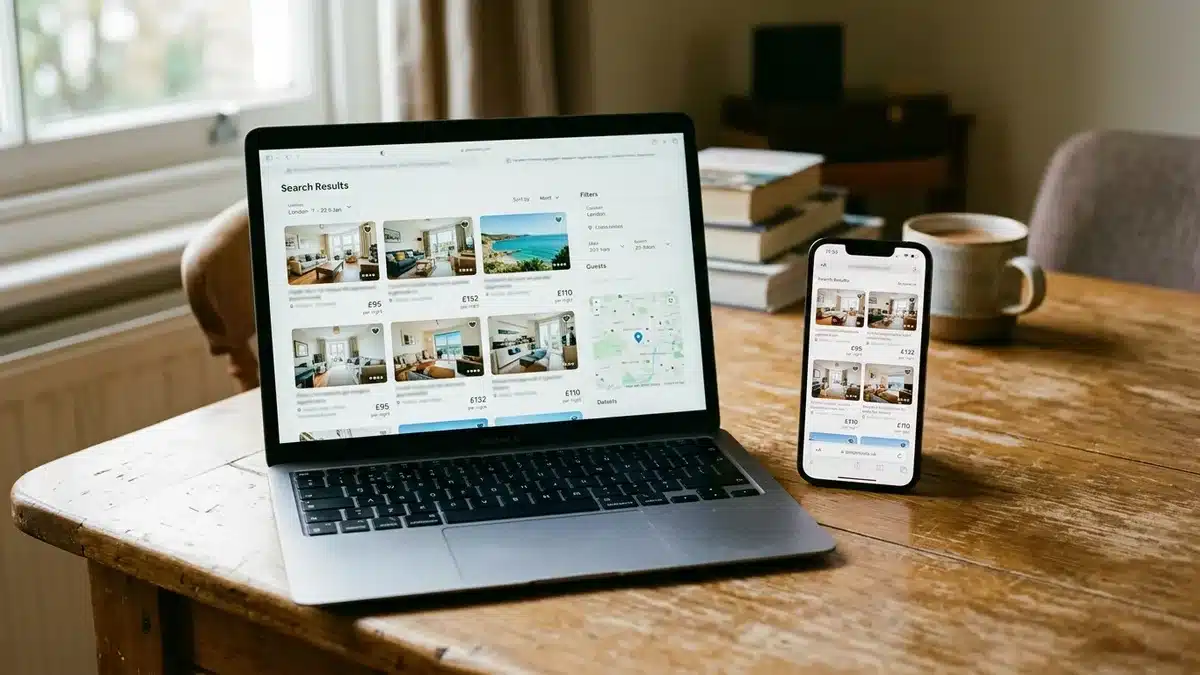
The best search engine for vacation rental places is not a single tool but a combination of Google search, dedicated aggregator sites, and OTA apps, each serving a different stage of the traveler’s decision process. Google functions as the entry point for most trip planning, while aggregators like HomeToGo and cozycozy compare listings across platforms once a traveler has narrowed down a destination.
Specifically, HomeToGo pulls cabin, condo, and villa listings from multiple booking sites into one comparison view, letting travelers filter by price and amenities before clicking through to book. Cozycozy takes a similar approach but also blends in hotel and bed-and-breakfast inventory alongside Airbnb and Vrbo listings, giving travelers a wider net in a single search.
As a result, most bookings still get finalized on the original platform, whether that’s Airbnb, Vrbo, or Booking.com, because aggregators typically function as comparison layers rather than direct booking engines themselves. That distinction matters for hosts: showing up on an aggregator doesn’t reduce your OTA commission exposure, it just adds another discovery channel feeding the same OTA checkout.
Which Vacation Rental App Is Best?
The best vacation rental app depends on what the traveler prioritizes: Airbnb remains the most recognized app for unique, individually hosted properties, while Vrbo tends to appeal to travelers seeking whole-home rentals without shared spaces. Booking.com’s app blends hotel and vacation rental inventory for travelers who want both options in one place.
For hosts, the app a guest uses to find your property is largely out of your control. What you can control is whether that guest, once they’ve stayed with you, ever needs to open an app again to rebook. This is where most hosts leave money on the table. A guest who loved their stay defaults back to searching Airbnb because that’s the only “app” they associate with your property, even though they’d happily book you directly if given an easy way to do it.
That’s a gap we built Boostly Connect to close. Every guest who books through your direct site gets automatically captured into your own CRM, so the next time they’re planning a trip, you can reach them by email or text instead of hoping they remember which app to reopen. Our platform’s automated review request and repeat-stay sequences run in the background, meaning the guest relationship doesn’t end at checkout.
How Does Google Function as a Vacation Rental Search Engine?
Google functions as the largest vacation rental search engine by volume because most travelers begin trip research with a general search rather than opening a dedicated booking app first. A traveler searching “cabin rental Gatlinburg pet friendly” is using Google as their search engine, and Google then surfaces a mix of OTA listings, aggregator pages, and direct host websites in response.
This is the single biggest missed opportunity for independent hosts. If your only online presence is an Airbnb listing, Google has nothing of yours to rank, your property only appears buried inside Airbnb’s own search results, competing against every other listing on the platform. A direct booking website, by contrast, gives Google a page with your property’s name, location, and amenities to index and rank on its own merit.
We’ve seen this play out directly with hosts in our network. One bed-and-breakfast operator built their entire growth strategy around owning this search layer, eventually reaching 90% direct bookings and 60% repeat guests by focusing on their own website rather than relying on third-party listing visibility. That’s not a fluke, it’s what happens when you stop treating Google as someone else’s channel and start treating it as yours. If your site currently isn’t showing up at all, our guide on why vacation rental websites don’t rank walks through the most common technical causes.
What Is the 80 20 Rule for Airbnb?
The 80 20 rule for Airbnb generally refers to the idea that roughly 80% of a host’s bookings or revenue tends to come from a smaller share of high-performing factors, whether that’s a subset of listings, repeat guests, or peak-season dates, while the remaining 80% of effort or inventory contributes a smaller share of results. Applied practically, it means hosts should identify which levers actually move revenue and stop spreading equal effort across everything.
In our experience advising multi-property operators, the practical version of this rule shows up in guest retention. A small number of returning guests, and the word-of-mouth referrals they generate, often account for a disproportionate share of a portfolio’s most profitable bookings, since these guests require no marketing spend and no OTA commission to reacquire. Hostex data puts typical repeat booking rates for vacation rentals between 10% and 25%, and an Alchemer 2026 study found vacation rentals earn a Net Promoter Score of 50.9 compared to 41.8 for hotels, a strong signal that guests are more loyal to great short-term rental stays than typical hospitality benchmarks suggest.
The 80 20 lesson for hosts is straightforward: instead of chasing every possible OTA search algorithm tweak, focus your effort on the guests most likely to rebook and refer, then give them a direct channel to do it. That’s precisely the gap our guide on re-engaging past vacation rental guests addresses, and it’s also why the Boostly CRM automatically segments returning guests instead of requiring you to manually track who’s stayed before.
Is There Another Site Besides VRBO and Airbnb?
Yes, alternatives to Vrbo and Airbnb exist across several categories: aggregator search engines like HomeToGo and cozycozy, hotel-inclusive platforms like Booking.com, niche regional booking sites, and, most importantly for hosts, your own direct booking website. Each alternative solves a different part of the discovery and booking problem.
Aggregators solve discovery breadth by pulling multiple platforms’ inventory into one search. Regional or niche sites solve for specific traveler segments, such as pet-friendly stays or extended-stay corporate housing. But none of these alternatives solve the core problem hosts actually face: every booking that flows through a third-party site comes with a commission attached and zero guest data ownership.
A direct booking website is the only “alternative” that removes both of those costs simultaneously. Specifically, a site built on your own domain, synced to your existing property management system, gives travelers a place to find and book you without an intermediary taking a cut or holding onto your guest’s contact information. That’s the exact mechanic Boostly Connect automates: connecting your PMS (whether that’s Hospitable, Hostfully, Lodgify, or Guesty) to a live, searchable website in under 20 minutes, with no developer required.

How Do Aggregators, OTAs, and Direct Sites Compare for Vacation Rental Search?
Choosing where to focus your discovery strategy requires understanding what each channel actually delivers to a host, not just what it delivers to a traveler. The table below breaks down the core differences based on how each channel handles commission, guest data, and ranking control.
| Channel Type | Commission Exposure | Guest Data Ownership | Host Ranking Control |
|---|---|---|---|
| Aggregator search engines (HomeToGo, cozycozy) | Routes to originating OTA, commission still applies | Retained by originating platform | None; ranking set by aggregator algorithm |
| OTA apps (Airbnb, Vrbo, Booking.com) | Typical published commission of 15 to 20 percent | Retained by OTA for its own remarketing | Limited; controlled by platform search algorithm |
| Google organic search | None on organic traffic itself | Depends on where the click lands | Host-controlled if the destination page is the host’s own site |
| Direct booking website (Boostly Connect) | No commission on bookings made through the site | Captured directly into host’s own CRM | Full control over SEO, branding, and page content |
Notice the pattern: every channel except a direct booking website either takes a cut, keeps the guest data, or both. This is exactly why we built Boostly Connect around ownership rather than just visibility. Getting found is only half the equation, keeping the relationship and the margin is the other half.
How Does Airbnb Compare to Traditional Hotels or Direct Vacation Rental Sites?
Airbnb differs from traditional hotels primarily in inventory type and pricing structure, offering individually owned properties with variable amenities rather than standardized hotel rooms with consistent service levels. Compared to a direct vacation rental website, Airbnb adds a marketplace layer, meaning the platform controls search visibility, pricing display, and guest communication rather than the host.
For first-time travelers, Airbnb and traditional hotels both offer built-in trust signals, reviews and star ratings for Airbnb, brand consistency for hotels. A direct booking website has to build that trust independently, typically through its own review display, clear photography, and transparent policies. This is a real trade-off worth acknowledging: a brand-new direct site with zero reviews won’t out-convert an established Airbnb listing overnight.
That said, once a host has an established guest base, a direct site converts that trust into commission-free revenue. This is why we recommend hosts run both channels simultaneously rather than abandoning Airbnb outright. Our guide to balancing OTA and direct bookings covers exactly how to sequence that transition without losing your existing Airbnb visibility.
What Is the Verification Process for Airbnb Hosts and Guests?
Airbnb’s verification process requires hosts and guests to confirm identity through government-issued ID, a verified phone number, and in many cases a profile photo before completing a booking. This system exists to build trust between strangers transacting through a marketplace where neither party has met in person.
For hosts building a direct booking website, replicating this trust layer matters just as much, even though there’s no marketplace enforcing it for you. Specifically, a direct site should display real guest reviews, clear cancellation policies, and secure payment processing to reassure first-time visitors they’re not booking through an unverified page. Our guide to accepting payments for direct bookings covers how to set up secure checkout without the marketplace layer Airbnb provides.
Notably, Airbnb’s verification system also protects hosts through its host and guest protections program, something independent direct sites need to address through their own insurance and clear house rules, since that safety net doesn’t automatically transfer over when a guest books outside the platform.
How Does Airbnb Handle Disputes or Emergencies During a Stay?
Airbnb handles disputes and emergencies through its built-in resolution center and host guarantee programs, which mediate conflicts between guests and hosts and, in some cases, provide financial protection for property damage. This centralized dispute system is one of the genuine advantages of booking through a major OTA rather than an unfamiliar direct site.
When a guest books direct, that mediation layer doesn’t exist automatically. Hosts running direct booking channels need clear house rules, a documented security deposit or damage policy, and a responsive communication system in place before a problem happens, not after. This is exactly the gap in-house guest messaging tools need to fill. If a guest has an issue at 11pm and there’s no one to answer, that’s a churn risk regardless of which channel they booked through.
We built the Boostly CRM’s live chat and AI agent features specifically to close this gap, so direct booking guests get the same responsiveness they’d expect from a major platform’s support system, without you needing to staff a 24-hour help desk yourself. Our guide to automating guest messaging breaks down how to set this up without sounding robotic.
What Are Practical Tips for Budgeting With Airbnb Fees?
Budgeting for Airbnb fees means accounting for the platform’s published host service fee, which typically runs in the range widely cited across the industry as 15 to 20 percent of the booking subtotal, on top of any cleaning fees or taxes collected. Travelers should also expect Airbnb’s guest service fee added at checkout, which varies by reservation.
For hosts, the real budgeting exercise is calculating what that commission costs annually across your full booking volume, not just per reservation. Mark Simpson, who founded Boostly Connect, personally recovered over $30,000 annually in platform fees once he shifted a meaningful share of his bookings to a direct channel. That’s not a hypothetical, it’s the exact math that motivated the platform’s build.
If you’re trying to estimate your own exposure, start by pulling your last 12 months of OTA payout statements and calculating the total commission line item. Most hosts are surprised by the number once they see it isolated from the rest of their revenue. Our guide to reducing Airbnb dependence without losing occupancy walks through how to make that transition gradually instead of all at once.
What Should First-Time Hosts Know About Getting Found in Search?
First-time hosts need to understand that search visibility on OTAs and search visibility on Google are two entirely separate systems requiring different strategies. OTA visibility depends on internal ranking factors like response rate, review score, and pricing competitiveness within that platform’s algorithm. Google visibility depends on your own website’s content, structure, and backlink profile.
Here’s a practical starting checklist for first-time hosts building search visibility beyond their OTA listing:
- Claim your own domain name that matches your property’s brand, not a generic address tied to a listing platform.
- Build a direct booking page with live availability synced from your property management system, so Google has fresh, indexable content to crawl.
- Publish location-specific content about your area, since generic property descriptions rarely rank against established travel sites.
- Capture guest emails at booking so your search strategy isn’t the only way returning guests find you again.
- Monitor which keywords bring traffic using free tools like Google Search Console, so you know what’s actually working.
This is precisely the setup process we automate at Boostly Connect. Instead of hiring a developer to build a site from scratch, our platform connects your existing PMS directly to a WordPress site built for search from day one. Our guide to building a direct booking website without a developer covers the full setup sequence in detail.
What Mistakes Do Hosts Commonly Make With Vacation Rental Search Visibility?
The most common mistake hosts make is treating OTA listing optimization as their entire search strategy, leaving zero presence anywhere Google or an aggregator might otherwise surface their property directly. A second common mistake is building a direct website once and never updating it, which causes both search rankings and guest trust to stagnate over time.
A third mistake, and one we see constantly among growth-stage operators, is failing to capture guest contact information at the point of direct booking. Without a CRM, every guest relationship resets to zero after checkout, meaning you’re paying to reacquire the same guest through an OTA a second, third, or fourth time. Liam, one of the hosts in our network, made his first direct booking worth £800 using a single tactic from a free challenge, and within 12 months of launching a professional website, grew that into 55% direct bookings across a portfolio that eventually expanded to over 30 properties.
The fix for all three mistakes is the same: build a direct booking site that syncs automatically with your existing tools, so visibility, content freshness, and guest capture aren’t three separate manual projects competing for your time.
Frequently Asked Questions
What is the best search engine for vacation rental places?
There isn’t one single best search engine; most travelers use a mix of Google, aggregators like HomeToGo and cozycozy, and OTA apps directly. Hosts get the most value from focusing on Google visibility through their own direct booking website, since that’s the only channel they fully control.
Which vacation rental app is best for hosts to be listed on?
Airbnb and Vrbo remain the two most recognized apps for vacation rental discovery, with Booking.com adding hotel-inclusive search. But no app replaces the value of a direct booking website, since apps control your visibility, pricing display, and guest data, while your own site doesn’t.
Is there another site besides Vrbo and Airbnb for vacation rentals?
Yes, aggregators like HomeToGo and cozycozy compare listings across multiple platforms, and Booking.com blends hotels with vacation rentals. The most important alternative for hosts, though, is a direct booking website, which removes commission and keeps guest data in-house.
Does switching to a direct booking website hurt my Airbnb search ranking?
No, running a direct booking site alongside your Airbnb listing does not affect your Airbnb search ranking, since Airbnb’s algorithm evaluates your listing based on response rate, reviews, and pricing within its own platform. Most hosts run both channels simultaneously without any conflict.
How long does it take to set up a direct booking website with Boostly Connect?
Boostly Connect syncs your existing property management system to a live, direct booking WordPress website in under 20 minutes, with no developer or coding knowledge required. The platform supports 8 PMS integrations, so most hosts can connect their existing system in under five minutes.
What happens to my guest data when someone books direct instead of through an OTA?
When a guest books through a direct booking website, their contact information is captured automatically into the host’s own CRM rather than being retained by the OTA. This means the host, not the platform, owns the relationship for future marketing and repeat-stay outreach.
Can a direct booking website handle multiple properties, not just one listing?
Yes, direct booking platforms built for scale, including Boostly Connect, support multi-property and multi-listing setups from a single connected system. All properties sync to the same PMS, CRM, and website infrastructure, so operators aren’t managing separate tools for each unit.
Conclusion: There’s No Single Best Search Engine, But There Is a Better Strategy
The best search engine for vacation rentals isn’t one app or aggregator, it’s a combination of Google, comparison tools, and OTA visibility working alongside a direct booking channel you actually control. As the global vacation rental market approaches an estimated $106.5 billion in 2026 according to Grand View Research, the hosts who win aren’t the ones chasing every algorithm, they’re the ones who own a searchable, bookable presence outside the platforms that take a cut of every reservation.
Building that presence doesn’t require a developer or months of setup. It requires connecting the property management system you already use to a website designed to convert, which is exactly what Boostly Connect does in under 20 minutes. If OTA commissions and disconnected search visibility are costing you bookings every month, book a demo with Boostly Connect and see your own direct booking site built out with your live property data.

If you’re ready to stop relying on a third-party search engine to decide whether guests find your property, Boostly Connect connects your PMS, website, and CRM into one system built to get you found on Google and booked directly. See what that setup looks like with your own listings before committing to anything.