

Marketing a vacation rental in 2026 means building a system across your own website, search visibility, email, and social channels so guests can find and book you directly instead of defaulting to an OTA. The hosts who do this well treat marketing as infrastructure, not a once-a-year task, and they measure it against a specific number: what percentage of bookings come from their own channel versus Airbnb or Vrbo.
Key Takeaways
- Effective vacation rental marketing combines OTA listing optimization with a direct booking website, SEO, email, and social proof, not any single tactic alone.
- The global vacation rental market is projected to reach roughly USD 106 to 109 billion in 2026 according to multiple 2026-updated industry forecasts, meaning competition for guest attention keeps rising every year.
- Industry benchmarks show vacation rental marketing emails average a 24.2% open rate and a 2.9% click-through rate, making email one of the higher-return channels available to hosts.
- Mobile devices generate roughly 68.5% of vacation rental website traffic, so any marketing plan that isn’t mobile-first is leaving bookings on the table.
- The direct booking repeat guest rate across the industry averages around 22%, which is why guest retention marketing matters as much as new guest acquisition.
- Boostly Connect handles the technical backbone of this playbook, a done-for-you direct booking website synced to your PMS with a built-in CRM, so marketing efforts actually convert instead of dead-ending on a page nobody built to sell.
If you’re managing one property or twenty, marketing a vacation rental in 2026 looks different than it did even three years ago. Guests research more, compare more, and expect a site that feels as polished as the OTA listing they clicked in from. At the same time, OTA commissions of 15 to 20 percent per booking keep eating into margin, which is exactly why more independent owners and boutique property managers are building marketing systems that don’t depend entirely on Airbnb’s algorithm.
We wrote this guide from the operator’s seat, not a marketing agency’s. At Boostly Connect, we work with hosts across 25 countries who are trying to solve the same problem: how do you market a rental well enough that guests choose to book direct, without spending every evening on tasks a system could handle for you. This article walks through the specific steps, in order, starting with your listings and ending with the retention loop that keeps guests coming back without an OTA in the middle.
Step 1: Optimize Your OTA Listings as the Foundation
OTA listing optimization is the process of refining your Airbnb and Vrbo profiles with better photos, titles, and descriptions so they rank higher in platform search and convert more browsers into bookers. This matters because most guests still discover new rentals on these platforms first, even if you eventually want them booking direct.
Your title should highlight what makes the property specific, not generic. Industry guidance consistently recommends featuring a standout amenity or proximity to a known attraction rather than a flat description like “cozy 2BR cabin.” Your description should use sensory, concrete language: a “chef’s kitchen with a five-burner gas range” earns more clicks than “nice kitchen.”
Photos matter more than most hosts assume. A well-rounded gallery typically covers the exterior, entry, living area, kitchen, each bedroom, bathrooms, your hero amenity such as a hot tub or pool, the best view, a workspace shot, outdoor dining, and a night ambience photo. Skipping several of these categories is one of the most common reasons listings underperform in search.
Once your OTA listing is strong, the goal shifts to capturing that same guest attention on a channel you actually own. That’s where Boostly Connect comes in: your synced PMS data means the photos, pricing, and availability you perfect on Airbnb can populate your own direct booking site automatically, so you’re not maintaining two separate content libraries by hand.
Step 2: Build a Direct Booking Website That Actually Converts
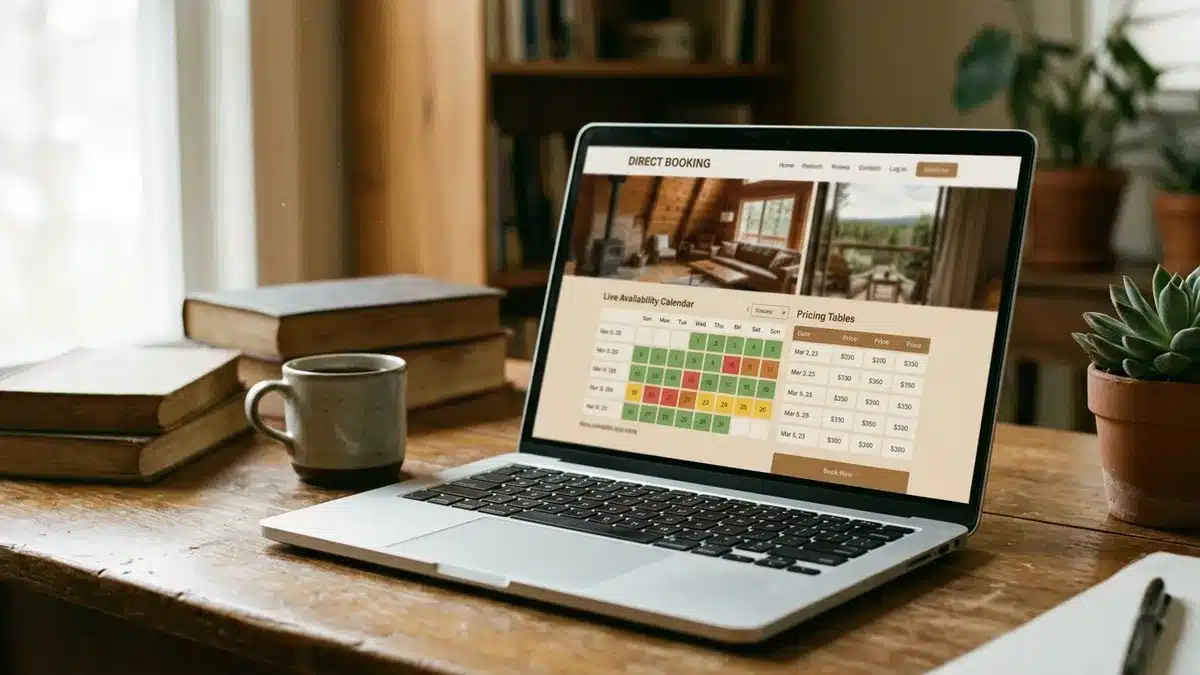
A direct booking website is a property page you own outside of any OTA, where guests can check live availability and pay you directly without a platform commission. Building one is the single highest-leverage move in vacation rental marketing because every booking that lands here keeps 100 percent of the guest relationship with you.
Most first-time attempts fail for one reason: nobody built the site to actually generate or capture traffic. A static page with a phone number isn’t marketing, it’s a digital business card. A conversion-ready site needs live pricing, a bookable calendar, and an SEO structure that gives it a fighting chance in Google search results.
This is precisely the gap we built Boostly Connect to close. The platform builds a mobile-first WordPress site synced to your existing property management system, meaning your live availability and real-time pricing update automatically without a developer touching a line of code. Setup connects to your PMS in under five minutes across 8 supported integrations, and the full site typically goes live in under 20 minutes.
For hosts who’ve tried a DIY builder before and watched it sit dormant, the difference is the conversion layer: discount codes, gift vouchers, and direct-only offers built into the template itself, designed to give guests a concrete reason to skip the OTA next time.
How Do You Rank a Vacation Rental Website on Google?
Ranking a vacation rental website on Google requires SEO-optimized property pages, local search signals, and consistent content that targets what travelers actually search for. Without this foundation, even a beautifully designed site sits invisible while OTA listings absorb all the search traffic.
Start by claiming your property on Google Maps, which helps with local search visibility and lets guests leave public reviews tied to your business name rather than an OTA profile. Then build out property pages with the same structured detail an OTA listing requires: specific amenities, neighborhood context, and a clear description of who the property suits.
A blog attached to your site helps too, but only if it targets real search intent rather than generic filler. If your current site technically exists but never shows up in search, our guide on why a vacation rental website isn’t ranking walks through the eight most common causes, and our broader vacation rental SEO guide covers the on-page fundamentals in more depth.
Search-driven discovery, combining organic and paid search, accounts for roughly a third or more of vacation rental site traffic depending on the market, so this isn’t an optional layer of your marketing plan. It’s the pipeline that feeds your direct booking site.
Boostly Connect ships every website SEO-ready by default: structured property pages, a built-in blog framework, and integration with discovery surfaces like Google Vacation Rentals, so you’re not hiring a separate SEO contractor just to get found.
How Should You Use Email Marketing for a Vacation Rental?
Email marketing for a vacation rental is the practice of nurturing past and prospective guests through automated sequences that drive repeat and direct bookings. It works because you already have a warm audience, guests who stayed once and liked it, and reaching them costs a fraction of acquiring a new guest through paid ads or OTA search.
Industry benchmarks show vacation rental marketing emails average a 24.2% open rate and a 2.9% click-through rate in 2026 data, numbers that outperform most cold outreach channels by a wide margin. Yet a large share of hosts never build this list in a structured way, relying instead on scattered guest emails buried across booking confirmations and PMS exports.
The manual version of this looks like exporting a spreadsheet after every stay, remembering to follow up months later, and hoping you didn’t lose the list when you switched software. It rarely happens consistently, which is why repeat guest rates stay low industry-wide, averaging around 22% according to 2026 marketing benchmarks.
Every guest who books through a Boostly Connect site gets automatically captured into the built-in CRM, no manual export required, with automated sequences for review requests and repeat-stay offers running in the background. If you want the full tactical breakdown of what to send and when, our post on how to re-engage past vacation rental guests covers the timing and messaging that works.
Review requests deserve particular attention here. Research shows 75% of survey respondents said they would pay more for a rental if they saw stronger customer reviews, so an automated ask right after checkout, rather than a forgotten afterthought, has a direct line to revenue. Our guide on automating review requests covers the exact sequence timing.
What Role Does Social Media Play in Vacation Rental Marketing?
Social media marketing for a vacation rental means using platforms like Instagram and Facebook to build brand awareness, showcase the property, and drive traffic back to your booking channel rather than treating social as a standalone sales tool. It rarely closes a booking directly, but it keeps your property visible between trips and feeds your direct site with warm traffic.
The mistake we see most often is treating social media as a photo dump with no strategy behind hashtags, posting cadence, or call to action. A caption without a link back to your booking site, or a location tag without a bio link, wastes the reach you worked to earn.
Effective posts pair a strong visual (your hero amenity, a local view, a seasonal detail) with a specific reason to visit your site, whether that’s a limited-time direct booking discount or a new listing. Our guide to vacation hashtags that actually drive bookings breaks down which tags perform versus which just add noise, and our social media strategy guide covers posting frequency and content mix in more detail.
Since every Boostly Connect site connects to the same CRM handling your email sequences, social traffic that lands on your property page gets tracked and can be re-engaged through the same automated system, closing the loop between awareness and an actual reservation.
How Do You Market a Vacation Rental During Off-Season or in a Niche Category?
Off-season vacation rental marketing means adjusting messaging, pricing, and channel focus to attract a different type of traveler when your peak-season audience isn’t searching. This is one of the most overlooked parts of a marketing plan, and it’s where niche positioning, like a dog-friendly cabin or a ski-in condo, actually pays off.
A property marketed only as a “summer lake house” leaves months of potential revenue on the table. Reframe the same property for a different audience: a remote-work retreat in shoulder season, a quiet couples getaway in winter, or a holiday-gathering rental around specific dates. Each angle needs its own headline, photo set, and email segment, not a copy-paste of your peak-season listing.
Niche rentals benefit even more from this specificity. A dog-friendly property that only mentions “pet friendly” in passing misses buyers actively searching “dog friendly cabin with fenced yard.” Naming the exact amenity, fenced yard, dog beds provided, nearby trails, captures search intent that a generic listing never will.
We’ve seen this play out directly with a bed and breakfast that shifted its entire marketing approach around direct bookings rather than relying on inconsistent OTA traffic. The owners reached 90% direct bookings and 60% repeat guests by focusing consistently on their own channel instead of chasing seasonal OTA visibility, proof that a deliberate off-peak and retention strategy compounds over time.

How Do You Handle Negative Reviews Without Damaging Your Marketing?
Negative review management is the practice of responding to critical guest feedback publicly and professionally so it strengthens rather than undermines your marketing credibility. Most vacation rental marketing guides skip this entirely, but a poorly handled negative review does more damage to a direct booking site than a slow social calendar ever will.
The instinct to delete, ignore, or argue with a negative review backfires. Prospective guests read your response as closely as the complaint itself. A calm, specific reply acknowledging the issue and stating what changed as a result signals to future guests that you run a professional operation, not a hobby.
Since 75% of travelers say they’d pay more for a property with stronger reviews, your response strategy is part of your pricing power, not just your reputation. Respond within a day or two, keep it brief, and never get defensive in public. Take detailed disputes to private messaging instead.
For hosts managing multiple properties, review management is another task that competes for time against everything else on the calendar. A guest CRM that centralizes reviews and flags them for a quick response, which is part of how the Boostly Connect platform’s AI agents assist with routine guest communication, keeps this from slipping through the cracks during a busy season.
Vacation Rental Marketing Channel Comparison
Comparing vacation rental marketing channels means weighing each option’s typical cost, effort, and control over the guest relationship before deciding where to invest your limited time and budget. No single channel replaces the others entirely, but they don’t deserve equal investment either.
| Channel | Typical Cost Signal | Guest Data Ownership | Best For |
|---|---|---|---|
| OTA Listings (Airbnb, Vrbo) | 15 to 20% commission per booking | Retained by platform | New guest discovery, building initial reviews |
| Direct Booking Website | No per-booking commission once built | Fully owned by host | Repeat guests, long-term margin protection |
| Paid Search Ads | Average CPA around $38.50 to $46.80 per booking in 2026 benchmarks | Owned if routed to your own site | Filling gaps in peak or shoulder season |
| Email Marketing | Low cost, mostly time | Fully owned by host | Repeat bookings, retention (24.2% average open rate) |
| Social Media | Low cost, mostly time | Partially owned (platform-dependent) | Brand awareness, top-of-funnel traffic |
Notice the pattern: every channel that builds long-term value routes traffic back to a site you control. OTAs remain useful for discovery, but they’re not designed to reward loyalty the way your own channel can. That’s the exact gap our guide to reducing Airbnb dependence without losing occupancy addresses in more detail.
What Does the ROI of Marketing a Vacation Rental Actually Look Like?
Direct booking ROI is the return you get once a guest books through your own channel instead of an OTA, measured against what you spent building and maintaining that channel. Most hosts never calculate this precisely because the inputs live scattered across a PMS, a bank statement, and a spreadsheet nobody updates.
Real case data from within our own community makes the trajectory clearer than any hypothetical. One host, Liam, started as a part-time property owner and made his first direct booking worth £800 after applying a single tactic from a free challenge. He later grew that channel to 55% direct bookings across a portfolio that expanded to more than 30 properties, and his professional site attracted landlords who wanted him managing their properties too, eventually building a network of 50 to 60 property owners.
Another operator, Nikki, converted a distressed property into a serviced accommodation business and generated a single £6,000 booking after launching her direct site, reaching 40% direct bookings with a goal of 60%. Neither result came from a single tactic. Both came from stacking SEO, email, and a properly built booking site on top of each other over time.
The Boostly Connect dashboard exists specifically to remove the guesswork from this calculation, tracking direct booking revenue in one place rather than forcing you to reconcile numbers by hand every month.
Practical Guidance: Building Your Vacation Rental Marketing Plan Step by Step
Building an effective vacation rental marketing plan means sequencing tactics in the right order, rather than launching everything at once and losing track of what’s working. Here’s the order we recommend based on what actually moves the needle first.
- Audit and optimize your OTA listings. Fix titles, descriptions, and photo gaps before doing anything else, since this is where most guests still find you first.
- Build a direct booking website synced to your PMS. Don’t launch a static page. Make sure it shows live availability and real pricing from day one.
- Set up SEO fundamentals. Claim your Google Maps listing, write property pages with real detail, and start a blog targeting actual search terms.
- Turn on email automation. Capture every guest into a CRM and set up a basic review-request and repeat-stay sequence before adding anything more complex.
- Layer in social media. Post consistently with a clear call to action pointing back to your booking site, not just aesthetic content.
- Plan off-season and niche campaigns. Reframe your property for shoulder-season travelers instead of leaving months of calendar unmarketed.
- Track ROI monthly. Know your direct booking percentage and compare it against your OTA percentage every month, not once a year.
Common mistakes worth avoiding: launching a website with no SEO structure, ignoring email until “later,” and treating negative reviews as something to hide rather than respond to. Each of these mistakes is fixable, but they compound the longer they go unaddressed.
Frequently Asked Questions
How long does it take to set up a direct booking website for marketing a vacation rental?
With Boostly Connect, connecting your existing PMS takes under five minutes across 8 supported integrations, and the full site typically goes live in under 20 minutes with no developer or coding required.
Will marketing my vacation rental directly hurt my Airbnb ranking?
No. Most hosts run OTA listings and a direct booking site simultaneously. You keep your Airbnb presence for new guest discovery while redirecting repeat guests, past bookers, and social media traffic to your own channel over time.
What’s the single most effective vacation rental marketing tactic for a first-time host?
Optimizing your OTA listing photos and description first, then building a direct booking site to capture repeat guests. Skipping straight to paid ads or social media without this foundation wastes budget on traffic that has nowhere strong to land.
How much can I realistically save by marketing my vacation rental for direct bookings?
Since OTAs typically charge 15 to 20% commission per booking, every reservation that shifts to your own channel keeps that full margin. The exact savings depend on your booking volume and average nightly rate, so track your own direct booking percentage monthly to see the real number.
Do I need social media to market a vacation rental successfully?
Social media helps with brand awareness and keeping your property visible between trips, but it rarely closes bookings on its own. Treat it as a traffic source that feeds your direct booking website and email list, not a standalone sales channel.
How do I market a vacation rental during a slow season?
Reframe the property for a different traveler type, remote workers, couples, or holiday gatherings, with dedicated photos, headlines, and email segments rather than reusing peak-season messaging. Niche positioning, like pet-friendly or ski-access amenities, also performs well when named specifically in your listing.
Can Boostly Connect handle marketing for multiple vacation rental properties at once?
Yes. Boostly Connect supports multi-property management from a single connected system, syncing pricing, availability, and guest data across every listing so your marketing and CRM stay unified as your portfolio grows.
Conclusion: Marketing a Vacation Rental Is a System, Not a One-Time Project
Marketing a vacation rental in 2026 works best as a connected system: optimized OTA listings feeding a direct booking website, backed by SEO, email automation, and social proof that all point guests back to a channel you control. The math on OTA commissions doesn’t change on its own. Every booking that runs through Airbnb or Vrbo instead of your own site is margin and guest data you don’t get back.
Fixing this doesn’t require a developer, a new tech stack, or months of setup. It requires connecting the systems you already use to a website built to convert, synced to your PMS, and backed by a CRM that automates the follow-up you’d otherwise never get to. That’s exactly what Boostly Connect was built to handle, and it’s why hosts running the platform reach an average of 65% direct bookings within 12 months.

If you’re ready to see what marketing your vacation rental looks like once your website, PMS, and CRM actually talk to each other, book a demo with Boostly Connect and see your own property data built into a live direct booking site in under 20 minutes.