

Hospitable direct booking is a feature inside the Hospitable property management platform that lets hosts generate their own booking website and accept reservations without sending guests to Airbnb or Vrbo. It comes in three tiers, Direct Basic, Direct Premium, and Direct Lite, each with different fee structures and payment handling. If you already run your PMS through Hospitable, it is a reasonable entry point, but it is not the only way to build a direct channel that actually converts.
Key Takeaways
- Hospitable’s Direct Premium plan uses a split-fee model that charges guests 4% and hosts 3%, or an alternative host-only model that deducts 7% from the payout instead.
- Direct Lite is built for territories where Stripe is not supported and does not process payment on-platform, meaning the host has to collect payment separately.
- Direct bookings represented 26% of tracked U.S. reservations in Key Data’s Q2 2026 dataset, compared with 45% for Airbnb and 21% for Vrbo, showing there is still real room to grow this channel.
- Direct bookings outperformed OTA bookings in Lodgify’s 2026 analysis of more than 1.6 million reservations, with 45.2% longer average stays and 51.3% longer booking windows.
- A basic Hospitable-hosted site uses a subdomain, such as yourname.hospitable.rentals, that cannot be changed later, though a custom domain can be added after launch.
- Boostly Connect takes the same PMS availability and pricing data and builds a full WordPress site with a CRM, email and SMS automation, and AI-driven guest messaging layered on top, so the website is only step one, not the entire strategy.
If you’re managing listings inside Hospitable, you’ve probably already seen the Direct booking prompt sitting in your dashboard. Most hosts either ignore it because they assume it is complicated, or they turn it on and stop there, expecting traffic to show up on its own. Neither approach gets you very far in 2026, when supply growth is moderating but demand is still climbing, and guests have more direct-booking options than they did even two years ago.
This review breaks down what Hospitable direct booking actually does, what each plan costs in fee structure, and where the feature set ends and a full direct booking strategy needs to begin. We built Boostly Connect because we watched hosts turn on a basic direct booking page, get zero traffic, and conclude direct bookings “don’t work” for them. The tool is rarely the whole problem. The marketing, CRM, and conversion layer around it usually is.
By the end of this article you’ll know exactly what Direct Basic, Direct Premium, and Direct Lite include, what a real guest checkout looks like, and where a dedicated direct booking website with built-in CRM and automation can do more heavy lifting than a PMS add-on feature was ever designed to do.
What Is the Fee for Direct Booking with Hospitable?
Hospitable’s Direct Premium plan uses a default split-fee model: guests pay a 4% service fee and hosts pay a 3% fee deducted from their payout. The guest fee applies only to the nightly rate and fees like cleaning, not taxes, while the host fee applies to the full guest payment including taxes and any guest service fee.
Hosts can switch to a host-only model instead, which removes the visible guest-facing fee and instead deducts 7% directly from the host payout. That change only applies going forward; existing reservations keep whatever fee structure was active when the guest booked. Direct Basic and Direct Lite have different cost structures depending on payment processing, since Direct Basic still relies on Stripe for payment collection and Direct Lite skips on-platform payment entirely.
Here’s the trade-off most hosts miss: a lower headline fee doesn’t matter if the site behind it never gets visited. Fee percentage decides your margin per booking. Traffic and conversion decide whether you get bookings at all. That’s the piece we focus on with how to get more direct bookings, since a fee comparison alone won’t move your direct booking share past single digits.
How Does Direct Booking Work Inside Hospitable?
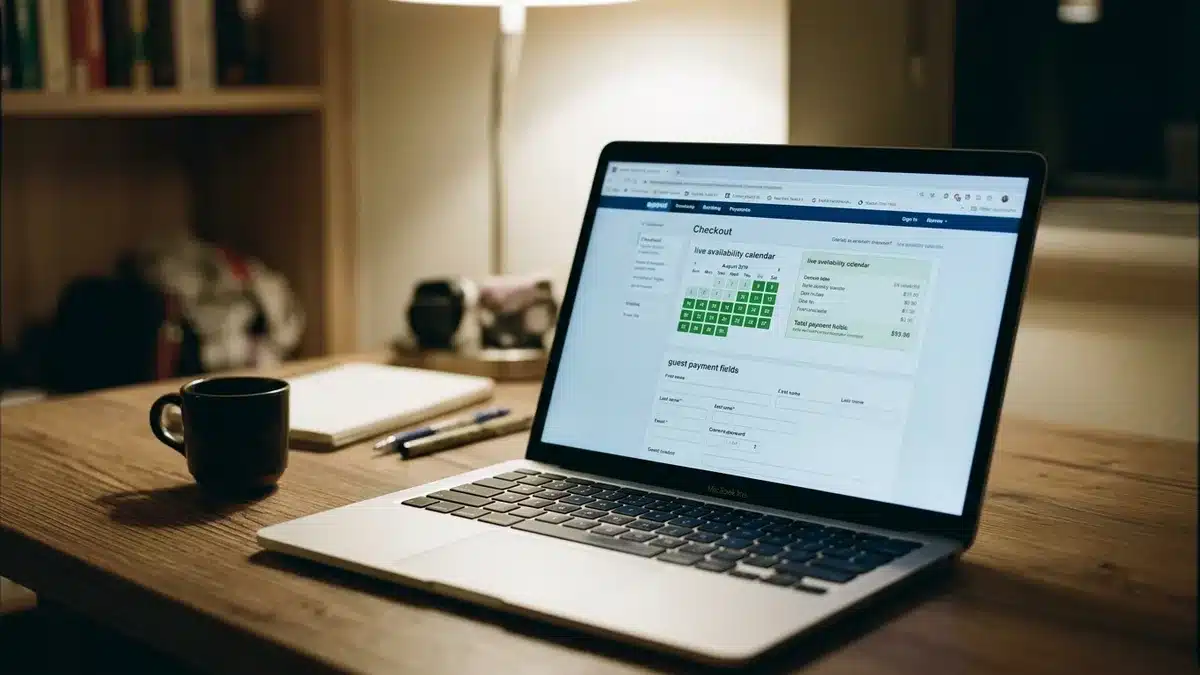
Direct booking inside Hospitable works by generating a booking website or embeddable widget that pulls live availability and pricing straight from your connected PMS calendar, then routes the guest through a payment link to confirm the reservation. The flow always creates a payment link and cannot process a $0 booking, so complimentary stays, maintenance blocks, or stays for friends and family need to be entered as manual bookings instead, not through the Direct flow.
Setup typically starts with choosing a subdomain, something like yourname.hospitable.rentals, which cannot be changed after the fact, although you can attach a custom domain later. From there you configure a booking policy: cancellation rules, payment schedule, and service fee model. Optional settings include guest verification, a rental agreement, security deposit collection, and upsells such as early check-in.
This is functional, and it works well if your only goal is having a website that exists. But a booking flow is not a marketing engine. Nothing in that setup drives a guest to the page in the first place, which is exactly the gap Boostly Connect was built to close: a website with SEO-ready property pages, live PMS sync, and CRM capture on every booking, so the traffic problem gets solved alongside the checkout problem.
Is Hospitable a Good Fit for Your Direct Booking Strategy?
Hospitable is a solid fit if you already run your PMS through their platform and want a basic direct booking presence without adding a separate tool. It is a weaker fit if your priority is generating new direct traffic, nurturing repeat guests through email, or automating guest messaging at scale, since those functions sit outside what the Direct feature was built to do.
Think about which problem you’re actually trying to solve. If you’re an independent owner with one or two properties and you just want an alternative to sending every guest to Airbnb, a basic hosted page might be enough to start. If you’re a boutique property manager juggling five to twenty units, or a portfolio operator scaling past twenty, the gap between “having a booking page” and “generating a real direct booking channel” gets expensive fast, measured in lost repeat bookings rather than lost setup time.
In our experience working with hosts making this exact transition, the pattern repeats: a host turns on a direct booking feature, gets a handful of bookings from guests who already knew them, and then plateaus because nothing is driving new traffic or reminding past guests to skip the OTA next time. That’s the exact plateau Boostly Connect‘s built-in CRM and email automation are designed to break, by automatically capturing every direct guest’s contact data and re-engaging them before their next trip.
What Is the Best Website for Direct Bookings?
The best website for direct bookings is one that combines live PMS-synced availability with conversion-focused design, built-in guest data capture, and marketing automation, not just a payment page bolted onto your property management system. A basic direct booking page answers “can a guest pay me directly,” but it doesn’t answer “how does a guest find this page in the first place.”
Most competing direct booking website builders in this space focus narrowly on the website layer alone, without a native CRM, email or SMS automation, or ongoing coaching. That leaves hosts to stitch together a separate email tool, a separate analytics dashboard, and a separate SEO strategy, which is exactly the kind of fragmented tech stack that breaks under scale.
Boostly Connect takes a different approach: a done-for-you WordPress website synced to your existing PMS in under 20 minutes, paired with an all-in-one CRM that includes live chat, AI agents, and email and SMS automation for past guest nurture. Hosts on the platform have collectively generated over one billion dollars in direct bookings across more than 2,000 hosts in 25 countries, and Boostly Connect clients reach an average of 65% direct bookings within 12 months, or the team works for free until you get there.
What Do Hospitable’s Direct Plans Actually Include?
Direct Basic, Direct Premium, and Direct Lite differ primarily in payment processing, fee structure, and protection features, not in the basic idea of having a booking website. Direct Basic uses Stripe for payment collection and carries standard processing costs. Direct Premium adds guest verification through an integrated screening provider and damage protection through a separate integrated provider, along with faster payouts, generally reaching a host’s bank account 24 hours after check-in.
Direct Lite is designed for territories where Stripe is not supported. It provides a booking website without on-platform payment processing, so the host has to collect payment off-platform, which adds manual work and removes some of the automation benefit that makes a direct channel worthwhile in the first place.
| Feature | Direct Basic | Direct Premium | Direct Lite |
|---|---|---|---|
| Payment processing | Stripe-based | Stripe-based, faster payouts | Off-platform, host collects manually |
| Guest verification | Not included | Integrated screening provider | Not included |
| Damage protection | Not included | Integrated protection provider | Not included |
| Fee model | Standard processing fees | Split-fee (4% guest / 3% host) or host-only (7%) | No platform fee, payment handled independently |
| Best for | Hosts wanting basic direct payments | Hosts wanting screening and protection built in | Hosts in territories without Stripe support |
Notice what’s missing across all three tiers: none of them include a CRM, email marketing, or guest re-engagement automation. That’s a website and payment layer, not a growth engine. If your goal is turning first-time direct bookers into repeat direct bookers, you need something layered on top, which is precisely the gap our must-have tools for short-term rental managers guide walks through in more detail.
How Do You Set Up Secure Payment Processing for Direct Bookings?
Secure payment processing for a direct booking website typically runs through a third-party processor like Stripe, which handles card verification, fraud screening, and fund transfers so the host never touches raw card data directly. Setting this up inside a PMS-based direct booking tool usually means connecting a Stripe account during onboarding and configuring your payout schedule and currency.
The risk most hosts underestimate is chargeback and fraud liability. Depending on your plan, you may be responsible for disputing chargebacks yourself, or the platform may act as merchant of record and absorb some of that risk. Direct Premium, for example, positions Hospitable as merchant of record for payment-related cancellation costs, which shifts some liability off the host. Direct Basic and Direct Lite don’t carry that same protection, so read your specific plan’s terms before assuming you’re covered.
Boostly Connect’s website builds sync payment and availability data directly from your existing PMS integration, whether that’s Hospitable, Hostfully, Lodgify, or Guesty, so pricing and payment stay accurate without you manually reconciling a separate booking calendar against your PMS.
Is It Worth Adding Direct Booking Widgets If You Mainly Rely on OTAs Today?
Yes, adding a direct booking widget is worth it even if OTAs remain your primary channel today, because direct bookings and OTA bookings are not mutually exclusive. You don’t have to choose between Airbnb and a direct channel. Most hosts run both simultaneously and simply redirect repeat guests toward their own site over time.
The financial case is straightforward. Repeat guest revenue that flows through an OTA still carries the platform’s standard commission on every single stay, indefinitely. A direct booking widget captures that same guest relationship once and keeps the revenue in-house on every future stay. Given that many vacation rentals see repeat booking rates between 10% and 25% depending on market and property type, according to Hostex’s 2026 benchmarking, that recurring commission adds up fast across a portfolio.
Where a basic widget falls short is guest recall. A payment widget alone doesn’t remember who your guest was, doesn’t email them before their next trip, and doesn’t segment repeat guests from first-timers. Our guide to re-engaging past vacation rental guests covers this gap directly, and it’s exactly why Boostly Connect pairs its booking website with a CRM that automatically captures every direct guest into your own contact database the moment they book.
How Do You Get More Direct Bookings from Instagram and Facebook?
Getting more direct bookings from Instagram and Facebook requires linking your social profiles to a conversion-ready website, not just posting property photos and hoping for link clicks. A bio link that drops a follower onto a generic OTA listing wastes the traffic; a bio link that lands on your own branded booking page with live availability converts that same follower into a direct guest.
Specifically, this means treating social content as a top-of-funnel tool that feeds your owned website, where your CRM can then capture the visitor’s contact information even if they don’t book on the first visit. As a result, a guest who saved your post six months ago but didn’t book can still be reached later through an email sequence, something no OTA search result ever allows.
Our vacation rental social media strategy guide and our guide to vacation hashtags that actually drive direct bookings both go deeper on this, but the short version is: Boostly Connect’s CRM includes social and live chat channels alongside email, so a guest inquiry from Instagram lands in the same system as a guest inquiry from your website, rather than getting lost in a separate DM inbox nobody checks daily.

How Do You Get More Direct Bookings Without Spending a Fortune on Marketing?
Getting more direct bookings without a large marketing budget means prioritizing owned channels, like SEO-optimized property pages and past guest email lists, over paid advertising. According to Hostfully’s 2026 Hospitality Report, 63% of operators identified organic traffic or SEO as a primary direct-booking driver, and 64% used repeat-booking discounts to encourage returning guests, neither of which requires an ongoing ad spend.
Practically, this looks like: publishing content that answers what your ideal guest is actually searching, keeping your booking website’s property pages structured for search visibility, and automating a post-stay email sequence that reminds past guests to rebook directly next time. None of that requires a paid media budget once the systems are in place.
This is also why we built SEO structure into every Boostly Connect website from day one instead of treating it as a separate line item. Rather than hiring a separate SEO contractor after launch, you get property pages built to be found organically, plus integration paths toward broader discovery surfaces like Google Vacation Rentals. If you want the deeper mechanics, our SEO for Airbnb listing guide and increase direct bookings with content marketing playbook both walk through the specific tactics.
What Are Common Mistakes Hosts Make with Direct Booking Setup?
The most common mistake is treating a direct booking website as a finished project the moment it goes live, rather than as the starting point of an ongoing marketing effort. A published site with zero incoming traffic and no guest data capture strategy behaves exactly like an unlisted property: technically available, practically invisible.
- Skipping guest data capture on inquiries that don’t convert. A visitor who browses but doesn’t book is a lost opportunity if you have no way to follow up later.
- Choosing a subdomain without planning for a custom domain later. Since a Hospitable subdomain cannot be changed after setup, decide your long-term branding approach before you publish.
- Ignoring the difference between guest fees and host fees. Under Direct Premium’s split model, the guest fee applies only to nightly rate and cleaning, while the host fee applies to the full payment including taxes, which changes your real margin calculation.
- Never following up with repeat guests. Without email or SMS automation, most hosts simply forget to reach out before a guest’s next likely travel window.
- Assuming direct bookings will hurt OTA visibility. This fear keeps many hosts from even trying a direct channel, but running both simultaneously doesn’t reduce your Airbnb or Vrbo search ranking.
If you’re tired of manually chasing these details across disconnected tools, this is exactly the operational mess Boostly Connect’s connected PMS, website, and CRM system was built to eliminate, since all three sync automatically once set up.
Practical Guidance: How to Choose the Right Direct Booking Setup
Choosing the right direct booking setup starts with being honest about what you’re optimizing for: a basic payment alternative, or a genuine growth channel that reduces your OTA dependency over time. A single-property owner testing the waters has different needs than a boutique manager running fifteen units across multiple owners.
- If you manage one or two properties and want a low-effort test: a basic PMS-integrated booking page can be a reasonable starting point, provided you’re realistic that it won’t generate traffic on its own.
- If you’re actively trying to reduce commission dependency: prioritize a system with built-in CRM and email automation over one with payment processing alone, since guest retention is where the compounding value lives.
- If you manage multiple properties or multiple owners: look for a platform where pricing, availability, and guest data stay unified across every listing rather than managed property by property.
- If you’re worried about losing OTA visibility: don’t be. Running a direct channel alongside Airbnb and Vrbo is standard practice, not a replacement strategy.
For a broader step-by-step framework, our website for vacation rental setup guide and no booking fee direct reservation guide both cover implementation details worth reviewing before you commit to a specific plan.
Frequently Asked Questions
Are there proven booking platforms designed for direct channel growth?
Yes. Platforms built specifically around direct booking growth combine a website synced to your PMS with guest data capture and marketing automation, rather than treating the booking page as a standalone feature. Boostly Connect, for example, connects PMS availability, a WordPress website, and a CRM into one system so the direct channel keeps growing after launch instead of plateauing.
How do I integrate secure payment processing into direct booking websites?
Secure payment processing typically connects through a third-party processor like Stripe during your platform’s onboarding flow, handling card verification and fund transfers without exposing raw card data. Check whether your specific plan positions the platform as merchant of record for cancellation-related disputes, since that affects how much chargeback liability falls on you directly.
What is a vacation rental direct booking?
A vacation rental direct booking is a reservation made through the host’s own website or booking channel rather than through an OTA like Airbnb, Vrbo, or Booking.com. It means the host keeps 100% of the guest payment minus any platform or processing fee, instead of paying a standard OTA commission on the reservation.
Is it worth adding direct booking widgets if I mainly rely on OTAs today?
Yes. A direct booking widget works alongside your existing OTA listings rather than replacing them, and it gives you a way to capture repeat guests who would otherwise rebook through the OTA and generate another commission charge. Most hosts run both channels simultaneously without any negative effect on OTA search ranking.
How do I get more direct bookings from Instagram and Facebook?
Link your social profiles to a conversion-ready website with live availability rather than a generic landing page, and make sure guest inquiries from social channels feed into the same CRM as your website inquiries. This lets you follow up with interested followers who didn’t book on their first visit.
How do I get more direct bookings without spending a fortune on marketing?
Focus on owned channels: SEO-optimized property pages, organic content, and automated email sequences to past guests. Hostfully’s 2026 Hospitality Report found 63% of operators cite organic traffic or SEO as a primary direct-booking driver, none of which requires ongoing ad spend once your website and automation are in place.
Will switching to direct bookings hurt my Airbnb search ranking?
No. Building a direct booking channel does not affect your Airbnb or Vrbo search ranking. Hosts commonly run both channels at the same time, using the direct site primarily to capture repeat guests and reduce long-term commission costs rather than to replace their OTA presence.
Conclusion
Hospitable direct booking gives you a functional way to accept guest payments outside Airbnb and Vrbo, with Direct Premium’s fee structure (4% guest / 3% host split, or a 7% host-only alternative) as the clearest example of what that costs in practice. But a payment page is not a growth strategy on its own, and the hosts who plateau at a handful of direct bookings are almost always missing the marketing and CRM layer that turns a website into a channel.
As of 2026, direct bookings still represent a minority share of total reservations industry-wide, according to Key Data’s Q2 2026 figures, which means there’s real upside left for hosts willing to build the traffic and retention systems around their booking page, not just the page itself. If you’re ready to see what that looks like with your own PMS data synced into a full website, CRM, and automation system, book a demo with Boostly Connect and see your direct booking site built out in under 20 minutes, with your existing PMS already connected.
If you’re comparing a basic PMS direct booking add-on against a full website and CRM system, it’s worth seeing the difference side by side before you commit to a subdomain you can’t change later. Get started with Boostly Connect and connect your existing PMS in minutes.